
How to Become a Daraz Seller in Bangladesh: Registration, Fees & Growth
Learn how to become a Daraz seller in Bangladesh, register an account, list products, understand fees, manage orders, and grow…
 by Sheikh Ornob

Branch office in Bangladesh explained for foreign companies, from BIDA approval and USD 50,000 remittance to RJSC, TIN, VAT, and compliance.
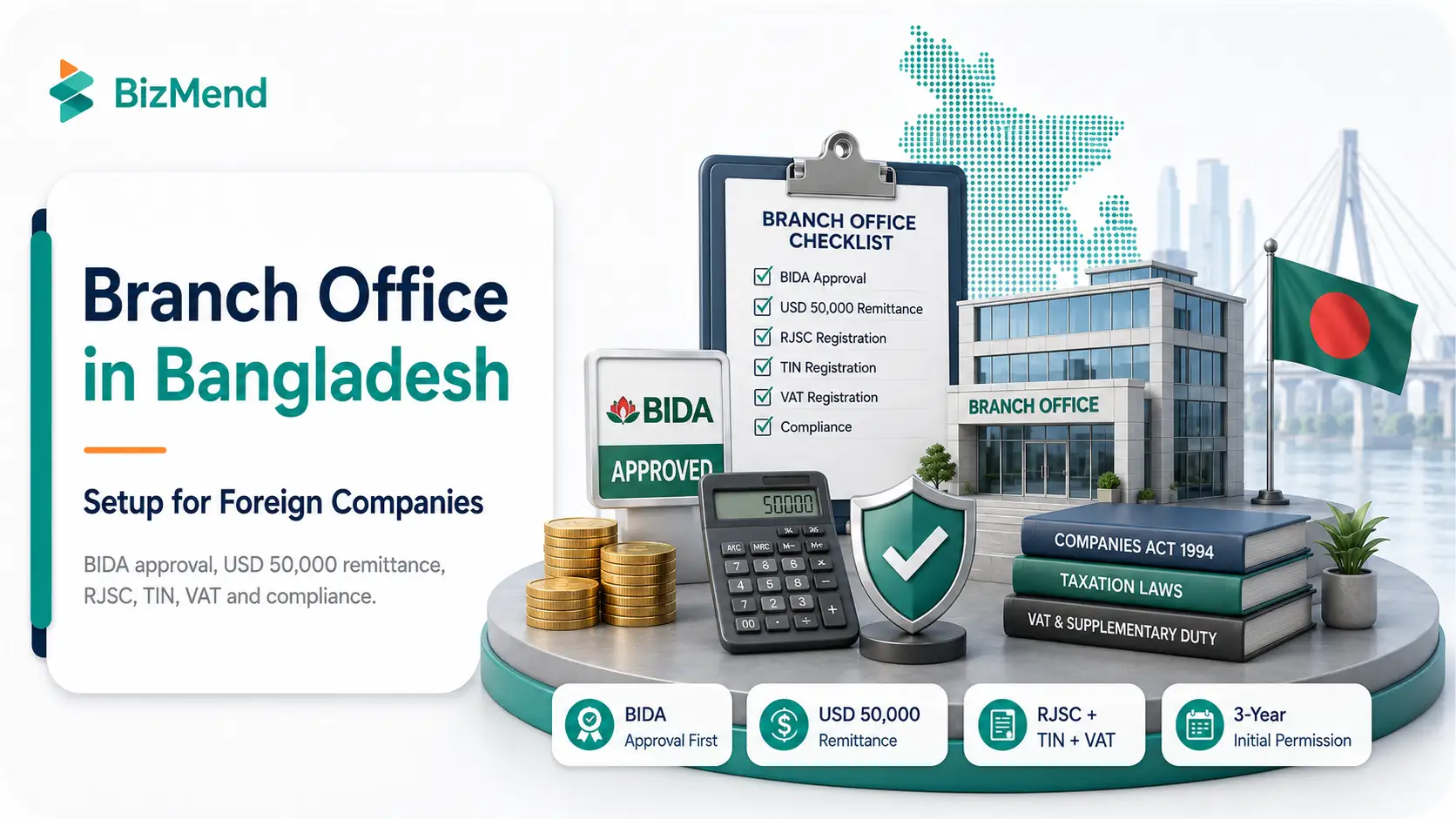
Foreign companies usually get stuck on the same question: should you open a Bangladesh branch or set up a separate local company? That choice matters early, because the paperwork, approvals, tax position, and day-to-day flexibility are not the same.
A branch office is the parent company showing up in Bangladesh, not a legal shell with its ownership story. That can work when you’re executing a contract, supporting clients, or testing a narrow operating model. It can also become a headache if you need a standalone subsidiary with broader freedom. This guide breaks down what a branch office is, who qualifies, how BIDA approval works, what happens after approval, and where this route makes more sense than incorporation.
Quick answer: A branch office in Bangladesh is a foreign company’s approved local extension, not a separate Bangladeshi company. You need BIDA permission first, then a local bank account, inward remittance of at least USD 50,000 within 2 months, Bangladesh Bank notification, RJSC filing, TIN, trade license, and VAT registration before routine operations settle down.
Bangladesh has three common foreign entry routes. A local subsidiary is a Bangladeshi company. A liaison or representative office is a presence office that cannot earn local income. A branch office sits in the middle. It is the parent company’s approved operating presence in Bangladesh, and it can do business only within the fields stated in its permission.
That makes the structure useful for project delivery, service execution, procurement support, or tightly defined commercial activity. It is less useful if you want a broad, all-purpose operating company, outside investors, or a structure that can evolve independently from the overseas parent.
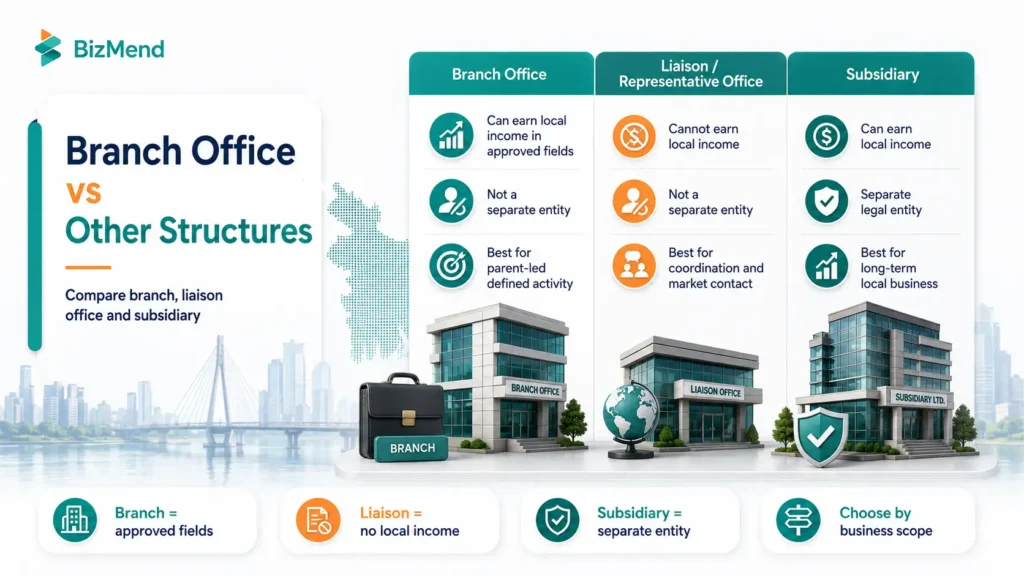
This is where most confusion shows up. Readers hear “foreign company setup” and assume every route does the same job. It does not. The choice changes how you earn income, how regulators look at you, and how much room you have to grow into adjacent activities later.
| Structure | Can Earn Local Income | Separate Entity | Best Fit |
|---|---|---|---|
| Branch office | Yes, within approved fields | No | Parent-led activity tied to a defined Bangladesh scope |
| Liaison or representative office | No | No | Relationship management, coordination, and market contact |
| Subsidiary | Yes | Yes | Long term local business with wider operating freedom |
A branch office can be a smart middle ground, but only if your Bangladesh activity is narrow enough to describe clearly to BIDA. If you expect wider trading rights, local shareholders, or a business that should look and behave like a stand alone company, a subsidiary is usually cleaner.
The branch office route is built for established foreign companies, not thinly documented startups trying to improvise their first overseas filing. The 2023 BIDA guideline says a branch office applicant should show continuous profit for the previous 3 financial years with minimum net assets of USD 100,000 or, if it is currently loss-making, accumulated profits with minimum net assets of USD 1 million. If the applicant itself cannot meet the financial test, a supporting sister, subsidiary, or holding company may step in with a solvency commitment of at least USD 10 million.
BIDA also says overseas documents should be attested by the Bangladesh mission, the mission of the relevant country in Bangladesh, or the country’s apex business chamber. In plain English, this means the branch route rewards established companies with audited records, not rushed filings with light paperwork.
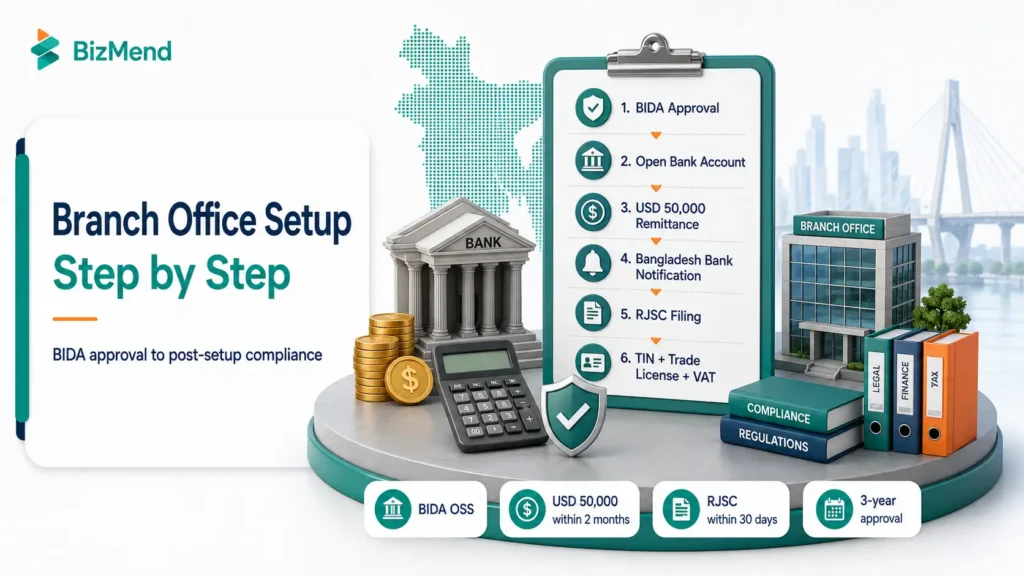
The setup path is more sequence driven than it first appears. Miss the order, and later steps start asking for documents you do not yet have. The clean workflow looks like this.
Most delays do not come from the application form itself. They come from document quality, attestation gaps, or activity descriptions that are too vague. BIDA wants to know who the parent company is, whether it is financially credible, what the Bangladesh office will do, and who will run it.
You should also prepare for downstream documents that are not strictly part of the first BIDA file, such as lease documents, tax registration details, bank papers, and later work permit files for expatriates. That is why the branch route works best when legal, finance, and local admin teams talk to each other from the start.
This is the point where many foreign companies relax too early. They get the permission letter and assume the hard part is over. It is not. The permission letter is the gate in. It is not the full compliance stack.
You still need the inward remittance, Bangladesh Bank notification, RJSC filing, tax registration, trade license, and VAT registration. If the branch will import or export, you may also need trade body membership and import or export registration before the operating model works smoothly in practice. If expatriates are to work through the office, you also need visa and work permit handling through BIDA OSS.
There is also a renewal story. Branch office permission is initially valid for 3 years, and later extensions can be granted for up to 2 years at a time if prior activity is satisfactory. The current commercial offices page says renewal applications should be filed at least 2 months before expiry. That is not a small footnote. It affects document retention, local audits, and tax clearance planning.
Once the branch is live, the real discipline is staying inside the parameters and keeping your records ready for renewal, tax work, and banking queries. A few points matter more than people expect.
A branch office usually makes sense when the parent company wants direct control, the Bangladesh scope is commercially real but clearly bounded, and the activity can be described without hand-waving. Think contract execution, defined service delivery, project support, procurement support, or a focused client-facing presence.
It is usually the wrong structure when you want a broad local growth vehicle, future local investors, wider lines of business, or a company that should develop its own governance and capital structure in Bangladesh. In those cases, a subsidiary is often more work upfront but less awkward later.
A branch office in Bangladesh works best when you want controlled, parent-led activity in a defined business lane. It works poorly when you really need a local company that can grow on its own. If you treat BIDA approval as the start of a regulated operating process, not the finish line, the route becomes much easier to manage.
Yes, but only within the fields allowed in its BIDA permission. That is the key difference from a liaison or representative office, which cannot generate local income and must cover expenses through inward remittance. If your Bangladesh plan needs broader sales rights, wider product lines, or investor participation, a subsidiary is usually the cleaner fit.
BIDA says branch office permission is initially granted for 3 years. Later extensions can be granted for up to 2 years at a time if the office’s previous activity is satisfactory. BIDA’s commercial offices page also says renewal applications should be filed at least 2 months before the current permission expires.
Not in the same way it works for a locally incorporated company. For branch, liaison, and representative offices, BIDA’s setup guidance treats the inward remittance as initial establishment cost that must come through banking channels, with an encashment certificate used as proof.
No. BIDA permission gets the branch office approved to enter, but you still need Bangladesh Bank notification, RJSC certificate of filing under section 379, TIN, trade license, and VAT or E-BIN before the local compliance stack is complete. Import or export activity can add IRC and ERC on top.
A subsidiary is usually the better choice when you want a stand alone Bangladeshi company, wider business objects, local equity participation, or a structure built for long term growth. A branch office is better when the parent company wants tight control and the Bangladesh activity is narrower, contract driven, or directly tied to the overseas business.

Learn how to become a Daraz seller in Bangladesh, register an account, list products, understand fees, manage orders, and grow…
by Sheikh Ornob

Compare the cost of living in Bangladesh in 2026, including Dhaka and Chittagong rent, food, transport, utilities, inflation, and monthly…
by Sheikh Ornob

Learn MoA and AoA requirements in Bangladesh, key clauses, drafting basics, RJSC filing steps, amendments, and common company-registration mistakes. Suggested…
by Sheikh Ornob