
 by Sheikh Ornob
If you run a company, file a personal return, import goods, or even hear someone mention e-TIN or eBIN, you are already in NBR territory. NBR stands for the National Board of Revenue, the main tax authority in Bangladesh, and its decisions shape how income tax, VAT, customs, and related systems work day to day.
This article is a plain language explainer, not legal or tax advice. The goal is simpler than that. You will see what NBR actually does, which services sit under it, and why both businesses and individuals keep running into its rules, portals, forms, and field offices.
Quick answer: NBR Bangladesh is the National Board of Revenue, the country’s central tax authority since 1972. It oversees three main wings, Income Tax, VAT, and Customs, and taxpayers commonly meet it through services like e-TIN, e-Return, eBIN, ASYCUDA WORLD, and a-Chalan.
Key Takeaways
- NBR Bangladesh is the central authority that manages tax administration across income tax, VAT, customs, and related revenue systems.
- Official NBR information says the board was established under President’s Order No. 76 of 1972 and sits under the Internal Resources Division of the Ministry of Finance.
- For most businesses, the most visible NBR touchpoints are tax identification, return filing, VAT registration, withholding-related processes, customs clearance, and government payment systems.
- For most individuals, the board becomes relevant when they need a TIN, file an income tax return, verify a return, pay certain taxes, or deal with certificates and notices.
- NBR is not just a filing portal owner. It also issues tax laws, publishes rules and forms, works on tax treaties, and supervises field-level tax administration.
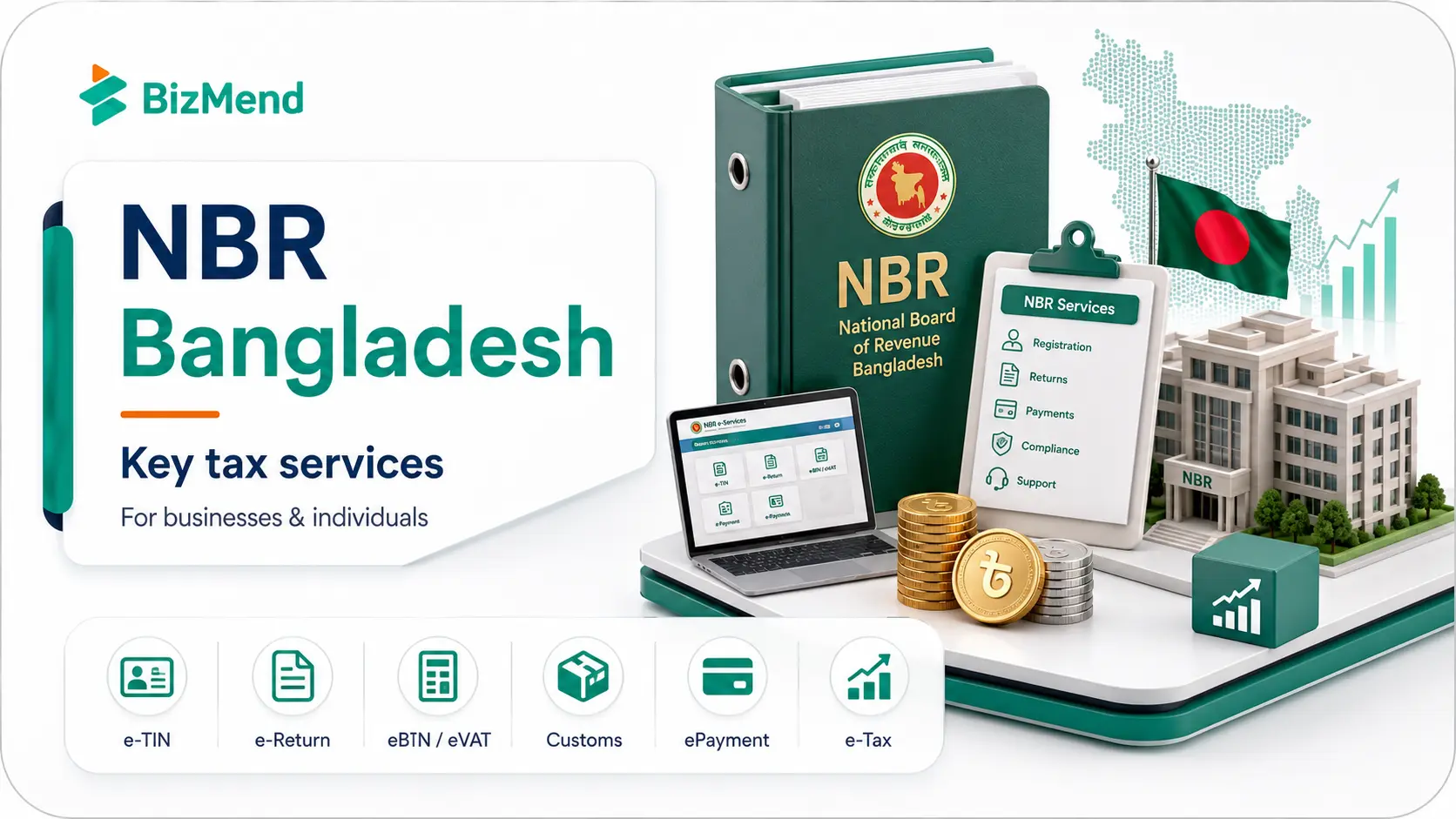
- The board’s all eServices page is useful because it puts major tools in one place, including e-TIN, e-Return, e-Tax Service, eBIN or eVAT, Bangladesh Customs, ePayment, and a-Chalan.
- Understanding the institution first helps you pick the right next step later, whether you need a tax zone, a VAT commissionerate, a customs system, or a specific online service.
- If a threshold, filing rule, or portal step matters to your case, check the latest NBR guidance because those details can change faster than the basic structure of the authority itself.
What NBR Bangladesh Actually Is
NBR is the apex tax administration authority in Bangladesh. On its official site, the board says it was created under President’s Order No. 76 of 1972. It also says the board sits under the Internal Resources Division, or IRD, within the Ministry of Finance. That matters because NBR is not a random office that only processes forms. It is the institution that connects tax policy, tax law, and tax administration in one place.
The same NBR overview says the secretary of IRD serves as the ex officio chairman of NBR. In practice, that puts the board close to both policymaking and field enforcement. So when people say, ‘NBR changed a rule’ or ‘NBR issued a notice,’ they usually mean the national authority behind the country’s tax system, not just a local tax circle or a single online portal.
NBR also works through three main tax wings: income tax, VAT, and customs. That three-part structure explains why the same authority shows up whether you are filing a personal return in Dhaka, registering for VAT as a local business, or clearing imported goods through Bangladesh Customs.
The Taxes And Services NBR Oversees
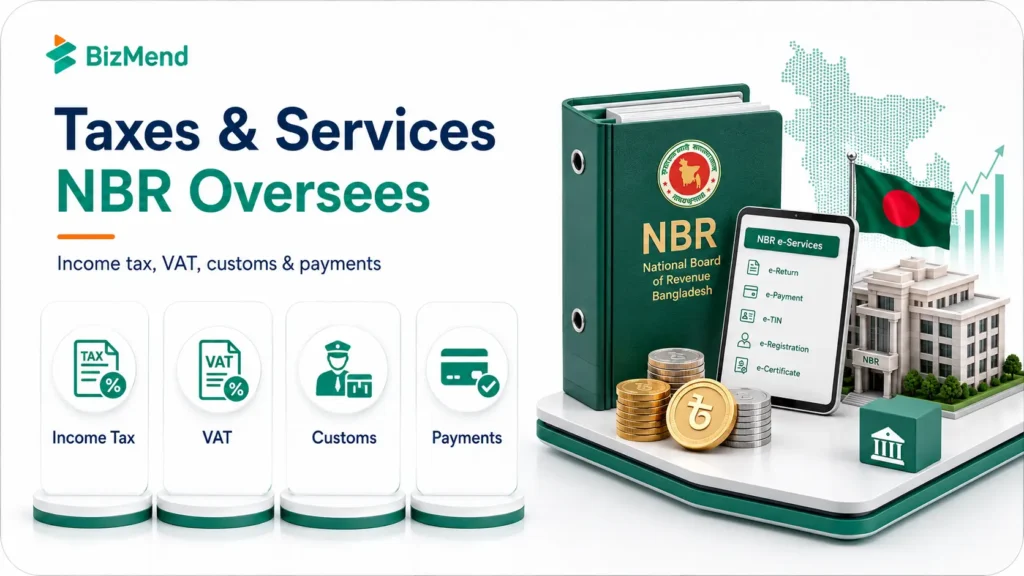
NBR’s own description says its main revenue role covers income tax, value added tax, customs duty, and excise duty. The legal base around those jobs also shows up clearly on the regulations pages. NBR currently lists the Income Tax Act, 2023; the Customs Act, 2023; and the Value Added Tax and Supplementary Duty Act, 2012, among its core laws. So if you are trying to understand what NBR handles, start there instead of treating every tax question as one big category.
| Area | What it usually means in practice | Common NBR touchpoints |
|---|---|---|
| Income Tax | TIN, return filing, withholding related matters, notices, return verification, tax zones, and appeal processes | e-TIN, e-Return, Return Verify/PSR, e-Tax Service, income tax forms |
| VAT | Registration, invoicing, return and compliance tasks for many businesses supplying goods or services in Bangladesh | eBIN or eVAT, VAT calculator, VAT learning tools, VAT agent or advisor applications |
| Customs | Import and export documentation, assessment, bonded warehouse processes, and border-related tax collection | Bangladesh Customs, CBMS, ASYCUDA WORLD, BSW, detained goods systems |
| Payments | Depositing taxes, duties, and challans through approved digital channels | ePayment and a-Chalan |
Where Businesses Usually Deal With NBR
A company can meet NBR long before the first tax return is due. If the business needs a tax identity, deals with VAT, pays tax deducted at source, imports goods, or submits a government challan, NBR is already part of the workflow. Even a small local seller may brush up against NBR through eBIN or VAT-related compliance, while a larger importer may spend more time inside customs systems like ASYCUDA WORLD or CBMS.
A practical way to think about it is this: NBR sets the lane, and the business has to choose the right entrance. A local consultancy might mostly care about income tax returns and withholding records. A retailer might care about VAT registration and return discipline. A manufacturer that imports inputs may also need customs systems, bonded procedures, and duty-related records. Same authority, different door.
- Businesses often start with tax identification and registration, then move into recurring duties such as returns, withholding, recordkeeping, and payment proof.
- VAT-registered businesses commonly deal with eBIN or eVAT and related compliance tools under the VAT wing.
- Import-driven businesses usually touch the customs side through Bangladesh Customs, BSW, ASYCUDA WORLD, or bonded warehouse-related systems.
- Large taxpayers may also deal with specialized units, including the Large Taxpayers Unit listed under NBR field offices.
The name stays the same, but the NBR doorway changes with the kind of tax problem you are trying to solve.
Where Individuals Usually Deal With NBR
For individual taxpayers, the most familiar NBR moment is usually the TIN and return cycle. That may apply to salaried employees, landlords, professionals, freelancers, or anyone who needs to show tax status for a financial or legal purpose. NBR’s current income tax pages and e-Return system make that side of the relationship more visible than before, but the underlying point is old-fashioned: the board manages the rules, forms, and verification path around personal tax compliance.
Individuals may also run into NBR indirectly. A bank, government office, licensing authority, or visa-related process may ask for tax proof, a return acknowledgement, or a certificate. Foreign nationals can also see NBR through the Tax Clearance Certificate for Foreigners service listed on the official eServices page. So even if you do not think of yourself as ‘dealing with the tax office,’ NBR can still show up as the authority behind the document you need.
- A taxpayer may need a TIN before using parts of the online income tax system.
- A filed return can matter for loans, visas, procurement, and other paperwork that asks for tax evidence.
- NBR also publishes return forms, acknowledgement formats, and notices that shape what individuals submit and keep on file.
- If your case turns technical, the next stop may be a tax zone or appeal office rather than the NBR homepage itself.
The Main NBR Online Services Worth Knowing
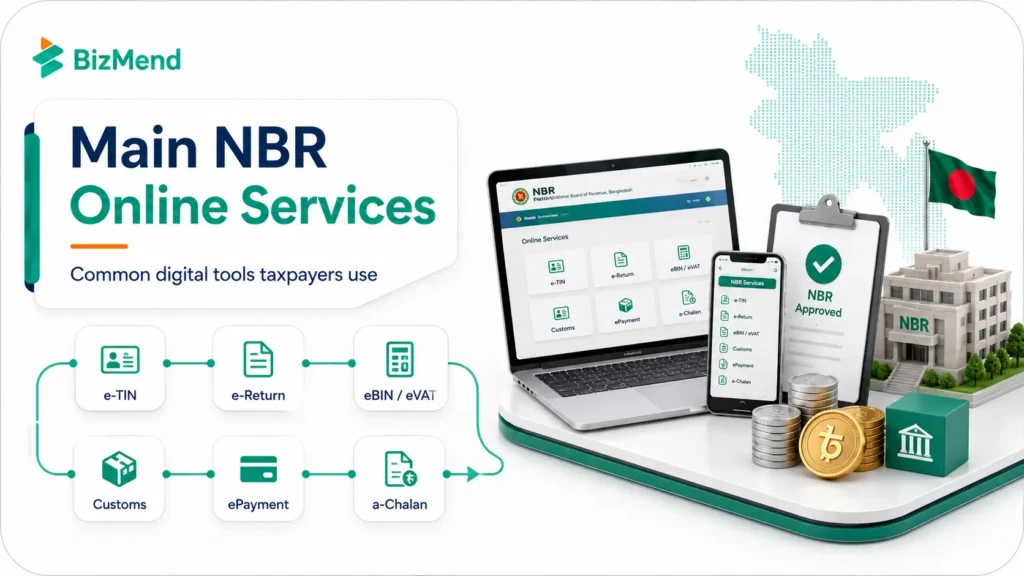
NBR’s all eServices page is useful because it shows the board as a working system, not just a logo. On the income tax side, it currently lists e-TIN, e-Return, Return Verify or PSR, e-Tax Service, e-TDS, and the Tax Clearance Certificate for Foreigners portal. On the VAT side, it lists eBIN or eVAT plus the VAT calculator and learning tools. On the customs side, it links to Bangladesh Customs, CBMS, ASYCUDA WORLD, BSW, and detained goods management.
Some details are practical enough to remember. NBR’s current e-Return guide says a new user needs a TIN and a biometrically verified SIM to register. The same guide points users to support through the hotline and the ticket system, and the main eServices page shows the hotline number as 09643 71 71 71. That kind of detail matters because many taxpayers get stuck not on tax law first, but on account access and process handoffs.
A tax system feels simpler once you stop treating every NBR task as the same website with a different button.
For income tax users
Look at e-TIN, e-Return, Return Verify or PSR, and e-Tax Service first. Those are the services most individual taxpayers and many businesses will notice earliest. The income tax forms page also shows current return form families such as IT 11GA 2023 and the one-page IT GHA 2023 form, which tells you NBR is not only hosting a portal. It is also publishing the filing instruments behind the portal.
For VAT-registered businesses
eBIN or eVAT is the obvious starting point, but the bigger point is institutional. VAT in Bangladesh sits under the same board that also handles income tax and customs, even though the workflows feel very different. NBR also still lists the Value Added Tax and Supplementary Duty Act, 2012, on its regulations page, which helps ground the VAT side in a specific legal framework instead of vague office talk.
For customs and payment workflows
If your work touches imports, exports, or bonded procedures, pay attention to Bangladesh Customs, CBMS, ASYCUDA WORLD, and BSW. For money movement itself, the NBR eServices page also links to ePayment and a-Chalan. That is a good reminder that tax compliance is not only about calculating liability. It is also about proving payment through the right route.
How To Tell Which NBR Channel You Actually Need
A lot of taxpayer frustration comes from going to the wrong NBR doorway first. If the issue starts with salary income, rent, return acknowledgement, TIN, a tax notice, or return verification, that usually points to the income tax side. If the issue starts with VAT registration, invoices, output tax, or recurring supply-related compliance, the VAT side is usually the better fit. If goods are crossing a border or sitting in a port, customs is almost always the real issue, even if the payment part looks like a tax problem.
You can also sort the problem by task type instead of taxpayer type. Identity and filing usually point to e-TIN or e-Return. Payment proof often points to e-payment or a-Chalan. Help desk issues can move through e-Tax Service or the ticketing channel. That sounds simple, but it saves real time because NBR is a network of systems and offices, not one universal inbox.
- Start with income tax if your question is about TIN, returns, notices, or personal or company income tax records.
- Start with VAT if the issue is registration, VAT compliance, or supply-related records for goods or services in Bangladesh.
- Start with customs if the problem involves import documents, bonded procedures, port clearance, or border duties.
- Start with payment tools if the core question is how to deposit money or verify a challan rather than how to calculate the tax itself.
What NBR Does Beyond Collection
It is easy to reduce NBR to a collector of taxes, but the official overview is broader than that. NBR says it helps formulate and review tax policy and tax laws, negotiates tax treaties with foreign governments, and joins interministerial discussions on economic issues linked to fiscal policy. That means the board is part of rule design, not just rule enforcement.
The field office structure also shows how wide that role is. NBR lists multiple tax zones across Dhaka, Chittagong, Gazipur, Narayanganj, Sylhet, Khulna, Rajshahi, Barisal, Bogra, and Rangpur, along with the Large Taxpayers Unit, Central Intelligence Cell, appeal tribunals, and customs-related systems. So when a taxpayer says ‘NBR,’ they may mean the national board, a wing, a field office, or a portal that sits under the same umbrella. Keeping that distinction clear saves time.
Final Thoughts
NBR Bangladesh matters because it is the center of the country’s tax machinery, not just a website you visit once a year. If you know which wing, service, or field office fits your situation, the next tax step usually becomes much less confusing.
Frequently Asked Questions
What does NBR stand for in Bangladesh?
NBR stands for the National Board of Revenue. It is Bangladesh’s central tax administration authority and officially describes itself as the apex tax body of the country.
Is NBR the same as a local tax office?
No. NBR is the national authority. A local tax zone, VAT commissionerate, customs house, or appeal office works under that broader structure. So a notice may come from a field office even though the governing authority is still NBR.
Which taxes are mainly handled by NBR, Bangladesh?
According to NBR’s official overview, the board mainly collects income tax, value added tax, customs duty, and excise duty. Different wings and systems handle the day-to-day work for each area.
Where should a taxpayer start on the NBR website?
For orientation, start with the all e-Services page because it groups the major tools in one place. From there, most people branch into e-TIN, e-Return, eBIN or eVAT, Bangladesh Customs, ePayment, or a-Chalan depending on the issue.
Does NBR only deal with businesses?
No. Businesses deal with NBR often, but individuals do too. Personal return filing, TIN-related tasks, return verification, certificates, and some travel or foreign worker-related processes can all bring an individual into NBR’s orbit.
What does the current e-Return system require for a new registration?
NBR’s current guide says a new e-Return user needs a TIN and a biometrically verified SIM to register. Because portal steps can change, it is smart to confirm the latest instructions on the official e-Return pages before starting.