
 by Sheikh Ornob
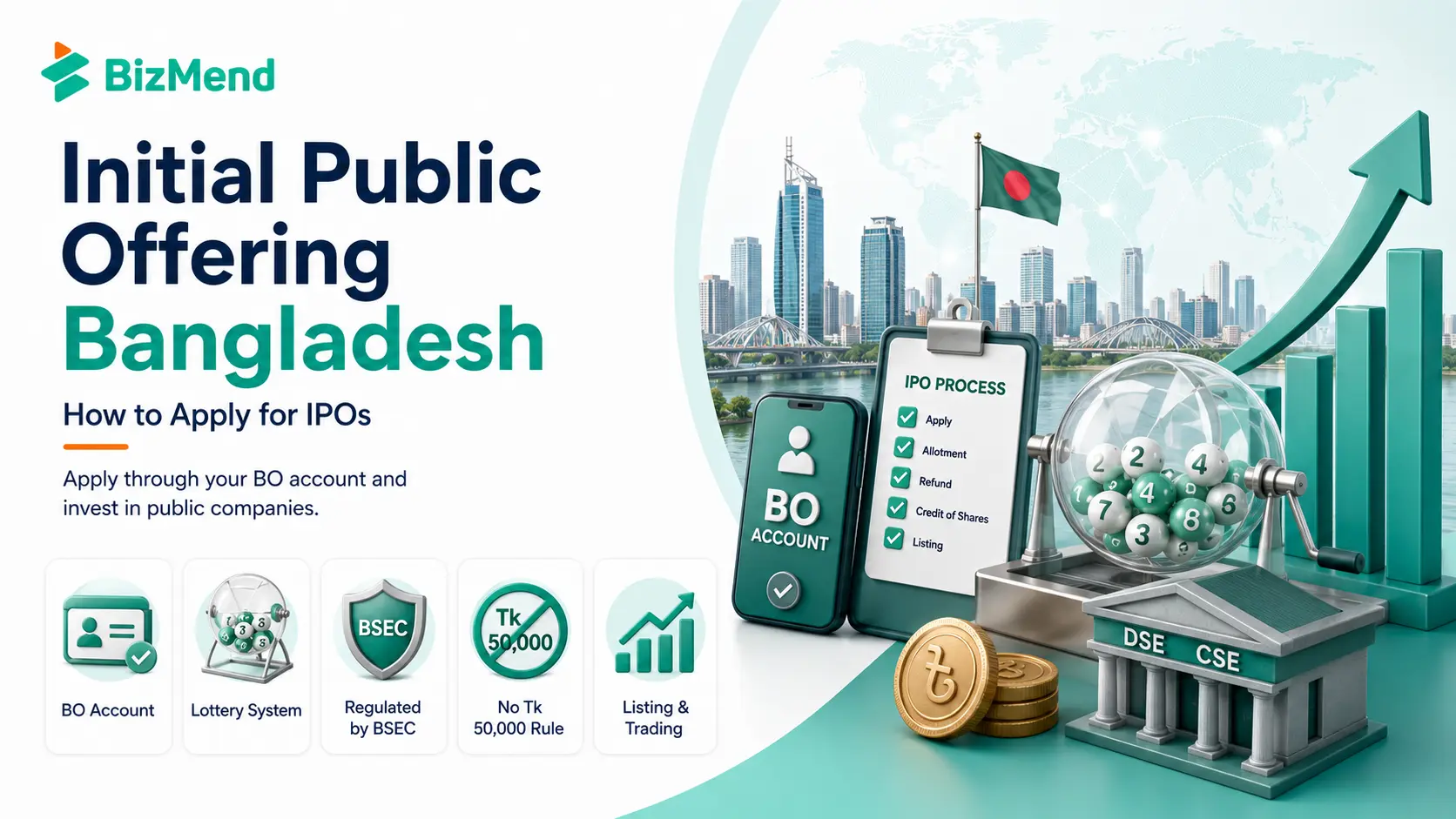
Bangladesh had no new IPOs approved through all of 2025. Zero. That stat surprised even experienced investors. But on December 30, 2025, the government gazette published the new Public Offer of Equity Securities Rules, 2025, overhauling how initial public offerings (IPO) Bangladesh work from the ground up. This guide covers what changed, how to apply as a retail investor, and what you need to do before the next IPO opens.
Quick answer: An initial public offering in Bangladesh is when a private company first sells shares to the public via the DSE or CSE. Under the Public Offer of Equity Securities Rules, 2025 (gazetted December 30, 2025), retail investors apply through a BO account, and shares are allocated by lottery when the IPO is oversubscribed.
What Is an Initial Public Offering (IPO) in Bangladesh?
An IPO, or initial public offering, is how a private company raises money from the public by selling shares for the first time. The company lists on the Dhaka Stock Exchange (DSE) or the Chittagong Stock Exchange (CSE), or both. From that point, its shares trade publicly and you, as an investor, can buy and sell them.
In Bangladesh, BSEC (Bangladesh Securities and Exchange Commission) regulates the entire IPO process. Every company going public must receive BSEC consent, while the relevant stock exchange reviews the application and gives a recommendation for listing or rejection. The new rules gazetted December 30, 2025 made the stock exchange’s role much stronger in that screening process.
To understand the regulatory structure that governs all of this, understanding how BSEC regulates Bangladesh’s capital market is a useful starting point.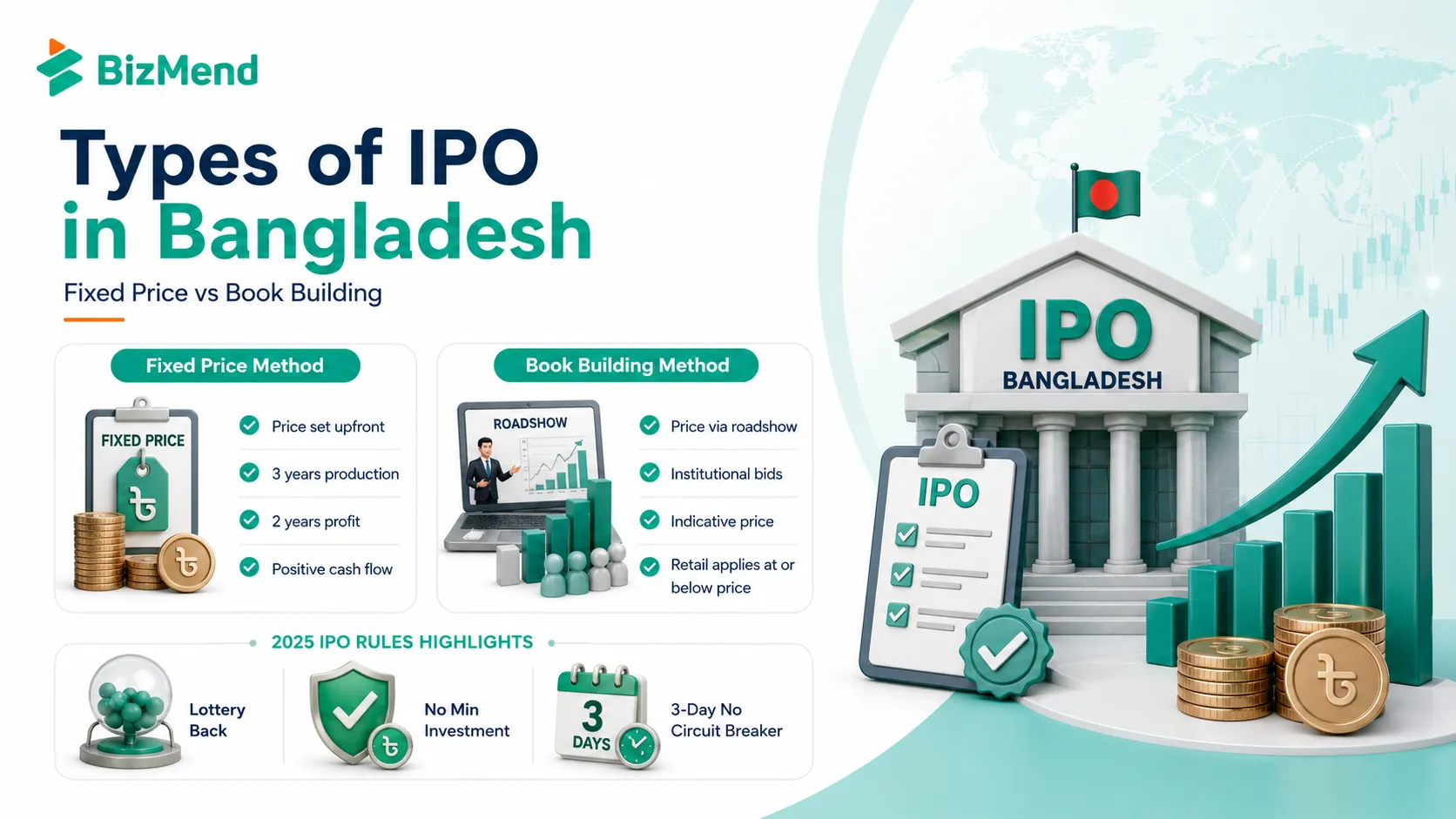
The Two Types of IPO: Fixed Price and Book Building
There are two methods companies use to offer shares in an IPO Bangladesh.
Fixed price method: The company sets a price upfront. Under the Public Offer of Equity Securities Rules, 2025, to use this method at a premium, a company must have at least three years of commercial production, two consecutive years of net profit, and positive cash flow.
Book building method: The price is determined through a roadshow. Eligible institutional investors submit price bids. An indicative price is set from those submissions. Retail investors then apply at or below that price.
Both methods now require the stock exchange to review the application and provide a positive recommendation before BSEC issues final consent. This is a new requirement under the 2025 rules.
What Changed Under the New IPO Rules 2025
The Public Offer of Equity Securities Rules, 2025 immediately replaced the Bangladesh Securities and Exchange Commission (Public Issue) Rules, 2015 upon gazetting on December 30, 2025. Some of the most significant changes in Bangladesh’s IPO framework in a decade.
The Lottery System Is Back
This is the biggest change for retail investors. Under the old pro-rata system (in place since 2021), shares were allocated proportionally based on how much money you applied with. That system heavily favored high-net-worth investors who applied with larger sums.
The new rules restored the lottery system. If an IPO is oversubscribed, shares among general investors are allocated by lottery. Everyone with a valid application has an equal chance. Don’t win? Your money comes back to your account.
And the minimum secondary market investment requirement has been scrapped. You previously needed Tk 50,000 invested in the stock market to be eligible for IPO applications. That requirement is gone under the new rules.
Key Changes That Affect You as an Investor
The 2025 rules made several other important changes:
- The 10% circuit breaker doesn’t apply for the first three trading days after a company lists. Prices can move more freely in those early days.
- Companies can use a maximum of 30% of IPO proceeds to repay loans or invest in assets. IPO funds cannot be used for rescheduled defaulted loans.
- IPO funds must be used within 5 years of the completion of the offering.
- Issuers are no longer allowed to offer discounts from the cut-off price. What you see is what you get.
- Direct listing is now permitted for multinational companies and large corporations with annual turnovers exceeding Tk 1,000 crore, with a 10% share offload requirement.
- Companies with outstanding loans above Tk 1,000 crore must now list on the stock exchange.
For anyone thinking about what the Dhaka Stock Exchange is and how share trading works, the new IPO framework connects directly to those basics.
Who Can Apply for an IPO in Bangladesh?
Under the new rules, any person with a valid BO (Beneficiary Owner) account can apply for an IPO as a general investor. There is no longer a minimum secondary market investment requirement.
You do still need a BO account. Without one, you cannot apply. Full stop.
IPO shares are divided among several investor categories: general investors (retail and local individuals), Non-Resident Bangladeshis (NRBs) and Non-Residents (NRs), mutual funds, and eligible institutional investors. The general investor pool receives the largest allocation under the new rules. For exact quota percentages for any specific offering, check the official prospectus or the BSEC website before applying.
For companies, main board listing requires a minimum paid-up capital of Tk 30 crore (Tk 300 million). After the IPO, at least 10% of total shares must be floated in the market. Post-IPO paid-up capital must reach at least Tk 50 crore (Tk 500 million).
What About NRBs and Foreign Investors?
Non-Resident Bangladeshis apply for IPO shares through a dedicated NRB BO account. Foreign nationals (non-residents) who are not Bangladeshi citizens apply through a NITA (Non-Resident Investor’s Taka Account), a specific bank account that converts foreign currency into taka for stock market investment and allows profits to be repatriated abroad.
For NRBs exploring investment options in Bangladesh from abroad, the IPO route is one of the most structured entry points into the capital market.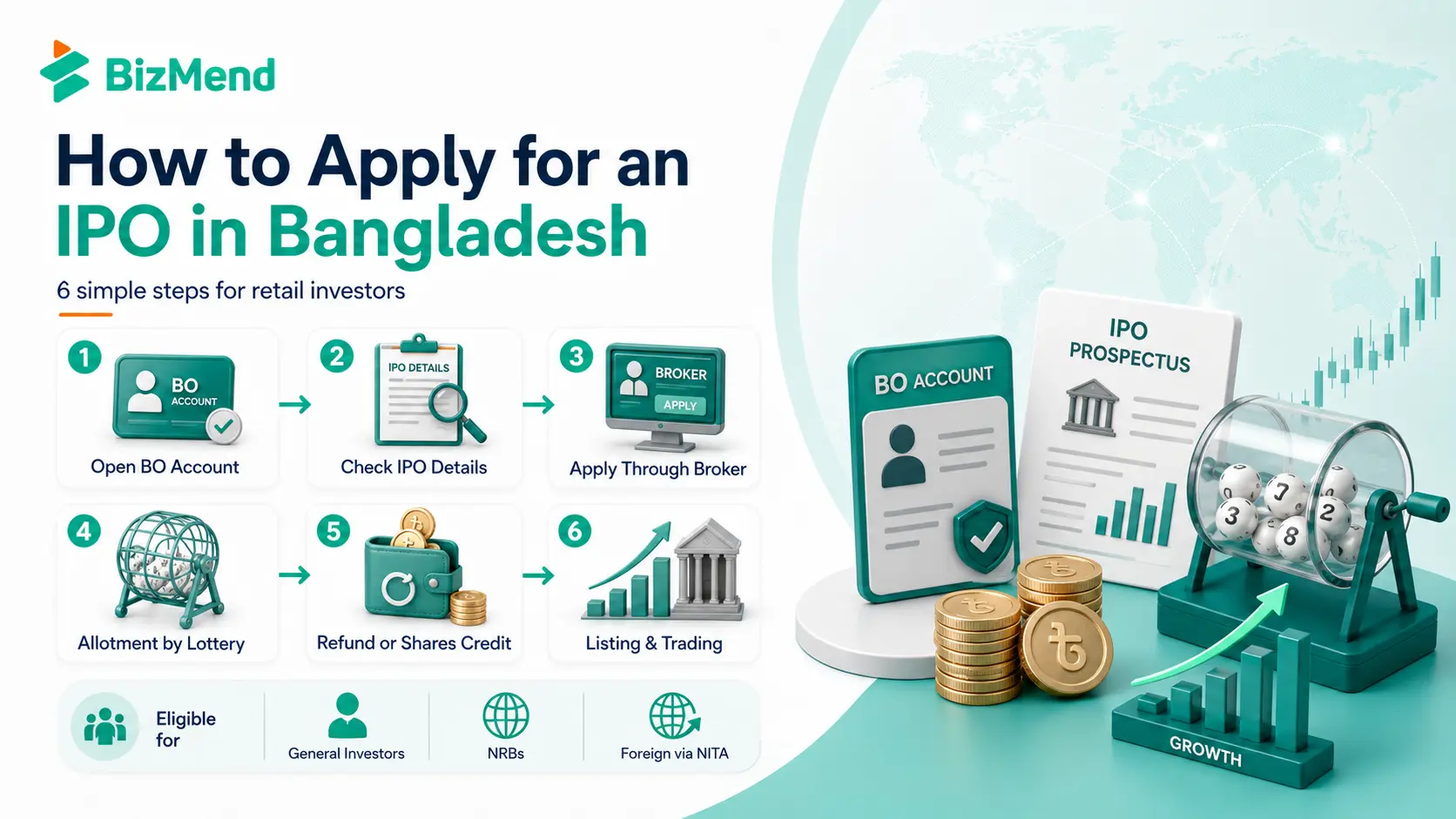
How to Apply for an IPO in Bangladesh: Step-by-Step
Step 1: Open a BO Account
A Beneficiary Owner (BO) account is your identity in the stock market. It holds your shares electronically, the way a bank account holds your money. You open it through a BSEC-licensed broker (TREC holder).
For a full guide on how to open a BO account in Bangladesh, that’s the prerequisite for everything else. No BO account, no IPO application. It’s that simple.
Step 2: Watch for New IPO Announcements
BSEC, DSE, and CSE publish IPO announcements on their official websites. Your broker should notify you too. When a new IPO is announced, the issuer must publish the prospectus online and publish a notice in at least four national daily newspapers, including two Bangla and two English newspapers. Read it. It tells you what the company does, how it plans to use the IPO funds, and its audited financials.
Don’t skip the prospectus. It’s the most important document in the whole process.
Step 3: Check the Subscription Period and Deposit Funds
Each IPO has a fixed subscription window, typically a few days long. You must have funds in your BO account or linked bank account to cover your application before the deadline. Transfer money before the window closes.
No funds in the account before the subscription period ends? You can’t apply.
Step 4: Submit Your IPO Application
Apply through your broker. Most brokers now offer online IPO application systems. You select the IPO, confirm the amount you’re applying for, and submit. Your broker handles the actual submission to the stock exchange system.
For NRBs and non-residents, applications go through the NITA account and must be submitted through a BSEC-registered custodian.
Step 5: Wait for the Lottery Result
If the IPO is oversubscribed, shares for general investors and NRBs are allotted on a lottery basis under the applicable BSEC consent-letter and stock exchange subscription procedures. Results are published on the DSE and BSEC websites. Your broker should notify you as well. If you win, shares are credited to your BO account. If you don’t, your full application amount is refunded.
Step 6: Shares Are Credited and Trading Begins
On listing day, your IPO shares appear in your BO account and start trading on the DSE or CSE. Remember: the 10% circuit breaker doesn’t apply for the first three trading days. Prices can swing more than usual during that period.
For anyone who wants to understand how to invest in Bangladesh’s share market more broadly, IPOs are just one part of a larger picture.
How IPO Shares Are Allocated: The Lottery Explained
Under the 2025 rules, share allocation among general investors is by lottery when an IPO is oversubscribed.
All valid general investor applications go into a pool. Shares for general investors and NRBs are allotted on a lottery basis when the IPO is oversubscribed, following the applicable procedure set by BSEC and the stock exchange system. Winners receive shares at the IPO price, credited to their BO account. Non-winners receive their full application amount back, usually within a few days.
One application per BO account. You can’t multiply your chances by applying from the same account twice.
This is a real improvement for small investors compared to the pro-rata system. Under pro-rata, someone applying with Tk 5 lakh got far more shares than someone applying with Tk 20,000. The lottery makes it a more level playing field.
IPO Risks You Should Understand Before Applying
IPO investing in Bangladesh is not a guaranteed profit. Let me be direct about that.
The reputation of some past IPOs hasn’t been great. BSEC Director Abul Kalam said in early 2026: “Most of the IPOs approved by the previous commission were of poor-quality companies, which destabilised the market and increased manipulation.” The new rules aim to fix that by having stock exchanges screen companies first. But no screening system is perfect.
Some risks specific to Bangladesh IPO investing:
- No guarantee of listing gains. Historically, many popular IPOs traded at a premium on listing day. But this isn’t always the case. Market conditions, sector dynamics, and company quality all affect post-listing performance.
- No guarantee of winning the lottery. Popular IPOs are heavily oversubscribed. You may apply and get nothing.
- Overvaluation risk. If the IPO price doesn’t reflect real company value, shares can drop after listing.
- Higher early-day volatility. The 10% circuit breaker doesn’t apply for the first three trading days. Prices can move sharply both up and down.
Compared to other investment options in Bangladesh like mutual funds or Sanchaypatra, IPOs carry higher short-term price volatility, especially in those early listing days.
Disclaimer: IPO investing carries risk. Always read the prospectus and verify current rules and eligibility with official DSE, CSE, BSEC, and CDBL sources before applying. Past IPO performance does not guarantee future results.
If you’re a business owner thinking about setting up or registering a business in Bangladesh with eventual public listing in mind, the new 2025 IPO framework is worth understanding from the issuer side as well.
Key Insights
- The Public Offer of Equity Securities Rules, 2025 was gazetted on December 30, 2025, immediately replacing the 2015 rules. It’s the most significant IPO framework overhaul in Bangladesh in a decade.
- Lottery system is back. Share allocation for general investors is now by lottery (not pro-rata), giving retail investors an equal chance regardless of application size.
- No minimum secondary market investment. The previous Tk 50,000 requirement to be eligible for IPO applications has been removed. Any valid BO account holder can now apply.
- Stock exchanges now gate IPOs. DSE and CSE give preliminary approval before BSEC issues final consent, strengthening the screening of companies before they list.
- No new IPOs were launched in 2025. BSEC prioritized regulatory reform over new approvals that year. The new rules are designed to bring quality companies to market in 2026.
- 10% circuit breaker doesn’t apply for first 3 trading days. This means prices can move freely post-listing, increasing short-term volatility risk for new investors.
- Always read the prospectus. It’s published by law in national newspapers and on BSEC/DSE/CSE websites. It’s the only document that tells you what you’re actually investing in.
Frequently Asked Questions
What is an IPO in Bangladesh?
An initial public offering (IPO) in Bangladesh is when a private company sells shares to the public for the first time, listing on the Dhaka Stock Exchange (DSE) or Chittagong Stock Exchange (CSE). The process is regulated by BSEC under the Public Offer of Equity Securities Rules, 2025, which was gazetted on December 30, 2025.
How do I apply for an IPO in Bangladesh?
You apply through a BSEC-licensed broker. You need a BO (Beneficiary Owner) account with CDBL, sufficient funds in your account during the subscription window, and a submitted application within the IPO’s subscription period. The broker handles submission to the stock exchange. Shares are allocated by lottery if the IPO is oversubscribed.
Do I need a BO account to apply for an IPO in Bangladesh?
Yes. A BO (Beneficiary Owner) account is mandatory to apply for any IPO in Bangladesh. It holds your shares electronically. You open it through a BSEC-licensed broker (TREC holder). NRBs open a separate NRB BO account. Foreign non-residents use a NITA (Non-Resident Investor’s Taka Account).
Is there a minimum investment required for IPO applications in Bangladesh?
Under the Public Offer of Equity Securities Rules, 2025 (gazetted December 30, 2025), the previous minimum secondary market investment requirement of Tk 50,000 has been removed. Any valid BO account holder can now apply for IPO shares regardless of their secondary market portfolio value.
How does the IPO lottery work in Bangladesh?
If an IPO receives more applications than shares available, BSEC conducts a public lottery among all valid general investor applications. Winners receive shares at the IPO price, credited to their BO account. Non-winners get their full application amount refunded, typically within a few days of the result.
What is the difference between fixed price and book building IPOs in Bangladesh?
In a fixed price IPO, the company sets the share price before subscription opens. For a premium fixed price offering, it must have at least three years of commercial production, two consecutive profitable years, and positive cash flow. In book building, the price is set through a roadshow where eligible institutional investors submit bids. Both methods require stock exchange preliminary approval and BSEC final approval under the 2025 rules.
Can NRBs apply for IPOs in Bangladesh?
Yes. Non-Resident Bangladeshis (NRBs) can apply through a dedicated NRB BO account. Foreign nationals (non-residents) apply through a NITA (Non-Resident Investor’s Taka Account), which converts foreign currency into taka for stock investment and allows profits to be repatriated. Both categories have a dedicated quota allocation in every IPO under the 2025 rules.
How soon can I sell my IPO shares after listing in Bangladesh?
Once IPO shares are credited to your BO account on listing day, you can sell them on the stock exchange immediately. Note that the 10% daily circuit breaker does not apply for the first three trading days after an IPO listing under the 2025 rules, meaning early-day price movements can be more extreme in either direction.
What makes an IPO application invalid in Bangladesh?
Common reasons include: applying without a valid BO account, submitting duplicate applications from the same BO account, entering details that don’t match your BO account registration, insufficient funds at the time of application, and applying outside the subscription window. Your broker should check these before submitting.
Where can I check IPO results and announcements in Bangladesh?
IPO results and announcements are published on BSEC (sec.gov.bd), DSE (dsebd.org), and CSE official websites. Your broker should notify you directly as well. The lottery result, share allocation, and refund timelines are all made public through these channels.
Final Thoughts
Honestly, the Bangladesh IPO market feels like it’s at a turning point after years of stagnation. The Public Offer of Equity Securities Rules, 2025 are the most investor-friendly framework in years. No minimum secondary market balance to clear. A lottery that gives every retail investor an equal shot. Stock exchanges screening companies before listing. None of that existed two years ago.
Before the next IPO opens, get your BO account ready and check BSEC and DSE for the prospectus. What kind of company would make you want to actually subscribe?