
 by Sheikh Ornob
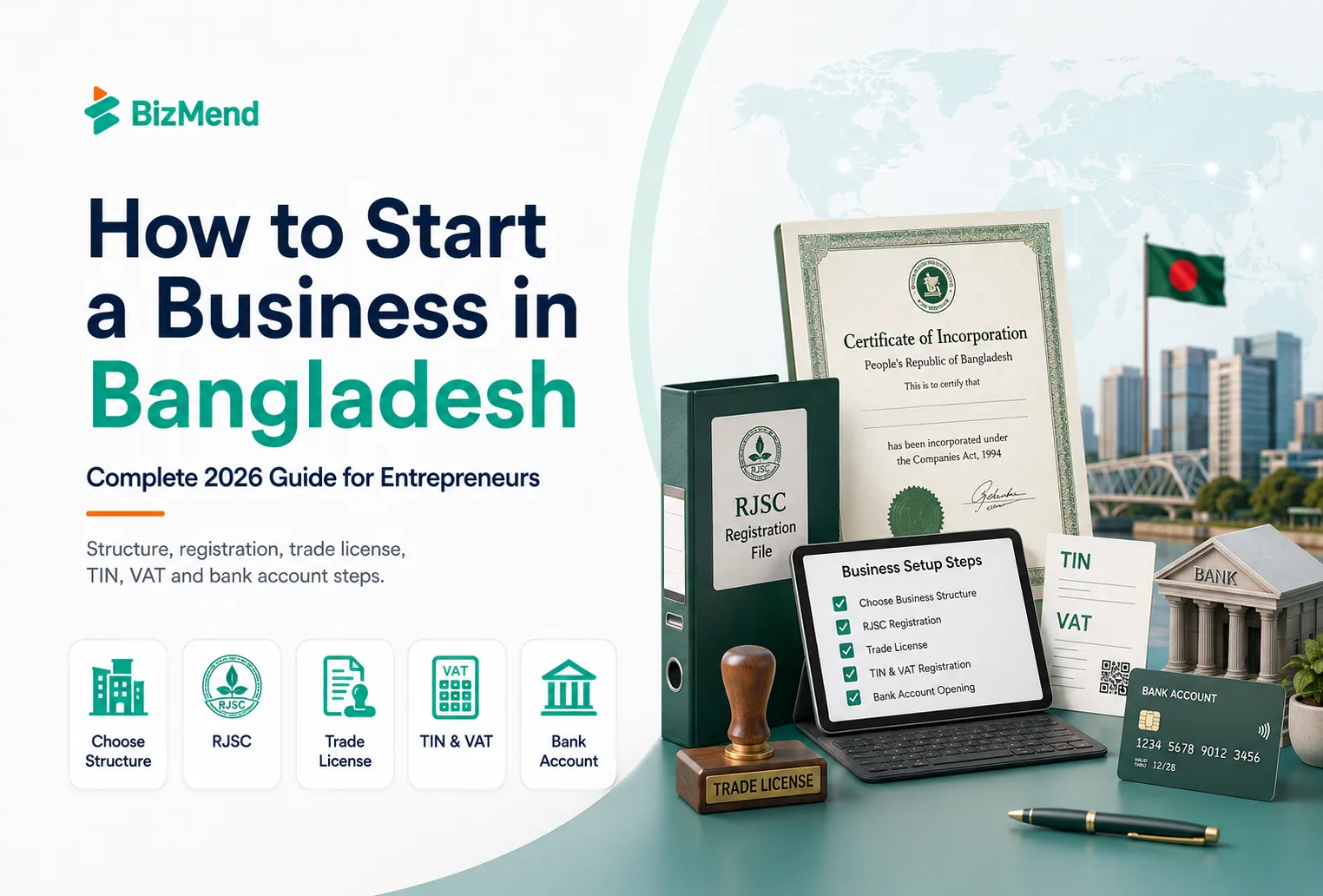
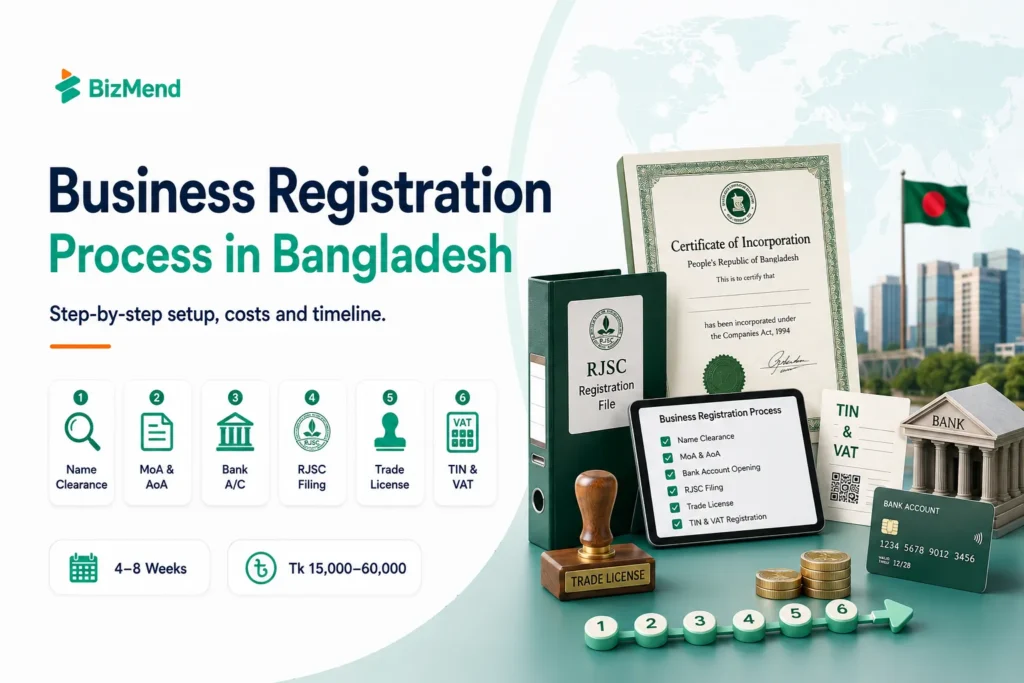
Quick Answer: To start a business in Bangladesh, pick a structure (sole proprietorship, partnership, or private limited company), register the name with RJSC, file your MoA and AoA, get a trade license, obtain a TIN, and register for VAT if turnover crosses Tk 50 lakh. Cost runs Tk 15,000 to Tk 60,000. Timeline: 4 to 8 weeks.
Starting a business in Bangladesh isn’t some tightly guarded secret. It’s a paperwork puzzle with a lot of pieces, and most founders trip on the same three: wrong structure, wrong filing order, and a stalled bank account.
If you’ve been Googling this for an hour, you’ve probably seen the same vague checklist five times. Let’s skip the fluff. Below is what you actually do, in what order, with the real fees and timelines for 2026, plus the bits that ambush first-timers.
Key Takeaways
- Bangladesh recognizes five main business structures: sole proprietorship, partnership, private limited, public limited, and One Person Company (OPC).
- Private limited is the default for most founders past Tk 30 lakh in turnover or with serious B2B contracts.
- Name clearance with RJSC is online, takes 1 working day, and stays valid for 30 days.
- TIN registration is free and instant via incometax.gov.bd.
- VAT registration kicks in at Tk 50 lakh turnover (lowered from Tk 3 crore in January 2025).
- Companies between Tk 30 lakh and Tk 50 lakh in turnover pay 4% turnover tax instead of full VAT.
- Trade license fees range from Tk 100 to Tk 40,000 depending on business category.
- Total registration cost for a small private limited runs Tk 15,000 to Tk 60,000.
- Foreign investors get a fast track through BIDA’s BanglaBiz 2.0 portal.
Why Start a Business in Bangladesh in 2026?
Bangladesh has the eighth-largest population in the world and one of the fastest growing middle classes in South Asia. GDP growth bounced back to 5.8% in 2024 after the political reset. Internet penetration crossed 75%. Mobile money usage (bKash, Nagad, Rocket) reshaped spending in ways that favor digital-first founders.
For local entrepreneurs, the timing is clean. Government push toward “Smart Bangladesh” cut a lot of in-person red tape. Most filings now happen online. Bank KYC moved to digital onboarding at the bigger private banks.
For foreign investors, the new BanglaBiz 2.0 portal (a joint BIDA and JICA project) bundles registration, tax, and licensing under one login. That’s a real shift from the agency-by-agency slog people remember from 2018.
But here’s the catch. Opportunity doesn’t equal ease. Knowing the steps in order is the difference between a business that opens in six weeks and one that gets stuck for six months.
Pick Your Structure First
Before you fill out a single form, pick your structure. This decision shapes everything: tax, liability, paperwork, banking, and how investors see you.
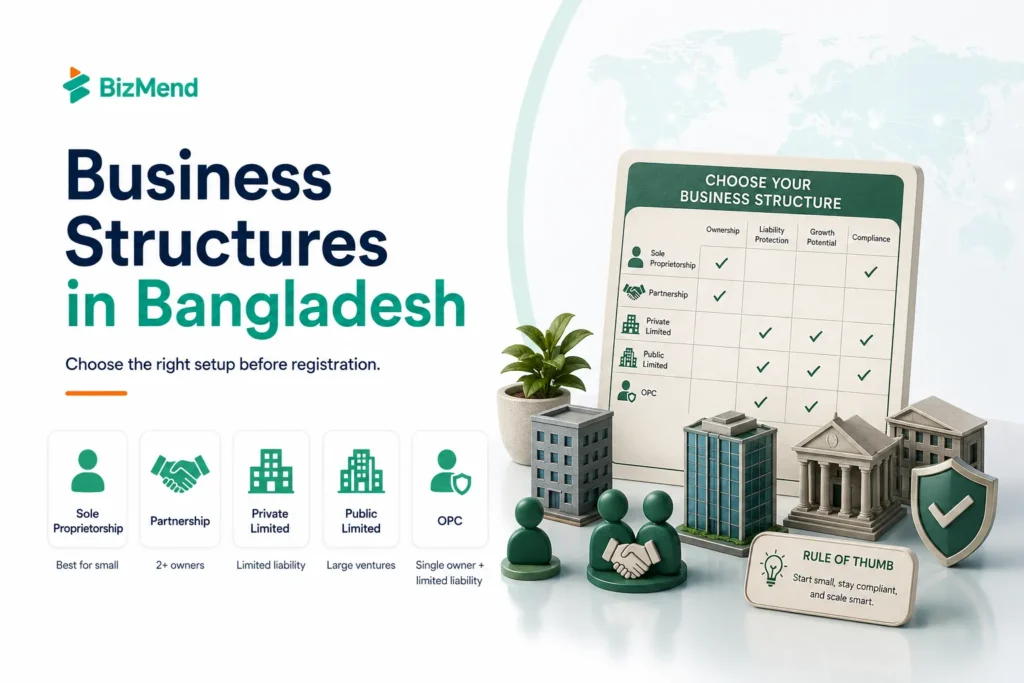
Bangladesh recognizes five main forms:
- Sole proprietorship. One owner, no separate legal entity. You are the business. Cheapest to start (just a trade license), but personal assets are exposed if things go sideways.
- Partnership. Two or more people share ownership. Registered with RJSC under the Partnership Act 1932. Partners share unlimited liability.
- Private Limited Company (Pvt Ltd). The default for serious founders. Separate legal entity, limited liability, 2 to 50 shareholders, minimum 2 directors. Required for most VC funding, B2B contracts, and platform onboarding.
- Public Limited Company (Plc). For larger ventures planning to raise from the public via the stock exchange. Minimum 7 shareholders, 3 directors.
- One Person Company (OPC). A 2020 addition that lets a single individual run a limited liability company. Good middle ground between sole prop and Pvt Ltd.
Quick rule of thumb. If your turnover will stay under Tk 30 lakh and you have no team, sole prop is fine. Past that, switch to Pvt Ltd or OPC.
For a deeper breakdown, see Sole Proprietorship in Bangladesh.
Step 1: Get Your Name Clearance from RJSC
This is where most people start, and where most people stall.
Go to roc.gov.bd and create an RJSC user account. Submit a proposed company name. The system checks each against the existing register. Names that clash, sound too similar to an existing brand, or use restricted words (Bangladesh, national, royal, or government) get rejected.
Approved name clearance is valid for 30 days. You can extend it once, but if you let it lapse, you start over.
Cost: about Tk 600 per name submission, paid online. Time: 1 working day in most cases.
Pro tip. Submit at least three name variations on the first try. RJSC reviewers can be strict on similarity, and re-applying eats days.
Step 2: Draft Your Memorandum and Articles of Association
The Memorandum of Association (MoA) lays out what your company does, where it operates, and what it’s allowed to do. The Articles of Association (AoA) covers the internal rules: how directors are appointed, how shares move, how meetings work.
These two documents form the legal spine of your company. Copy-paste templates exist, but don’t just lift one wholesale. Your business objectives clause needs to be wide enough to cover what you’ll do in three years, not just on day one.
Most founders work with a lawyer or a corporate filing service for this stage. Costs run Tk 5,000 to Tk 25,000 depending on complexity.
You’ll also need to file:
- Form IX (Consent of Directors)
- Form XII (Particulars of Directors)
- Photocopies of NID for all directors and shareholders
- Passport-size photos
- Proof of registered office address
Step 3: Open a Temporary Bank Account and Get the Encashment Certificate
Yes, you need a bank account before your company is officially registered. Yeah, it’s confusing.
Here’s why. RJSC requires proof that shareholders have actually deposited the paid-up capital. The bank issues an “Encashment Certificate” confirming the deposit. You attach this certificate to your registration filing.
Process:
- Walk into a bank with your draft MoA, AoA, name clearance certificate, and director NIDs.
- Open a temporary account in the proposed company name.
- Deposit the paid-up capital (most founders start with Tk 1 lakh).
- Request the encashment certificate. Banks usually issue it in 2 to 3 working days.
Most private banks are familiar with this routine. BRAC Bank, City Bank, and EBL handle it cleanly. State-owned banks work too but expect more counter time.
For more on picking a bank, check Best Banks for Business Accounts in Bangladesh.
Step 4: File with RJSC and Pay Government Fees
Now upload everything to the RJSC portal: name clearance, MoA, AoA, Form IX, Form XII, encashment certificate, NIDs, and photos.
Pay the government fees online. The exact amount depends on your authorized capital. Here’s a snapshot for common tiers:
| Authorized Capital | Stamp Duty (AoA) | Filing Fee | Approx. Total |
| Up to Tk 40 lakh | Tk 10,000 | Tk 1,200 | Tk 15,000 to Tk 18,000 |
| Tk 40 lakh to Tk 12 crore | Tk 30,000 | Tk 1,600 | Tk 35,000 to Tk 45,000 |
| Above Tk 12 crore | Tk 50,000 | Tk 1,800 | Tk 55,000 to Tk 70,000 |
Stamp duty on the MoA is a flat Tk 2,000 across all tiers.
RJSC reviews the filing in 3 to 7 working days. Once approved, you’ll receive your Certificate of Incorporation as a digital PDF, plus a unique registration number. That number is your company’s birth certificate.
Step 5: Apply for a Trade License from Your City Corporation
The Certificate of Incorporation says your company exists. The trade license says it’s allowed to operate in your area.
Every business in Bangladesh needs one. Even a sole proprietor running a one-person freelance shop from a Dhanmondi flat needs one.
Where to apply: The city corporation (DNCC, DSCC, CCC, KCC, or your local Pourashava) that covers your registered office.
Documents needed:
- Certificate of Incorporation (or partnership deed for partnerships)
- TIN
- Recent rent agreement or holding tax receipt
- Director NIDs and photos
- Tk 150 declaration on non-judicial stamp paper
Fee: depends on your business category. A small consultancy might pay Tk 2,000. A garments wholesaler could pay Tk 30,000 or more. The DCC fee schedule is published online. Sylhet, Chittagong, and other corporations have their own.
Most city corporations issue the license in 3 to 4 working days. Renewal is required every year by the 30th of June. Miss it, and penalties stack.
For a topic-specific deep look, see The Trade License Process in Bangladesh: A Step-by-Step Guide.
Step 6: Get Your TIN from NBR
The Tax Identification Number (TIN) is the National Board of Revenue’s way of tagging every taxpayer. Companies, individuals, and partnerships, all of them need one.
The good news? It’s free and instant.
How to do it:
- Go to incometax.gov.bd.
- Create an account using your mobile number and NID.
- Fill in the company details (name, registration number, address, directors).
- Submit. The portal generates the e-TIN certificate within 15 to 20 minutes.
- Download and save. You’ll need it for the trade license, bank accounts, VAT registration, and every annual return.
There’s no government fee. If a service is asking you for Tk 5,000 to “process” your TIN, you’re being upsold on something the system gives away free.
Step 7: Register for VAT (BIN) If You Cross Tk 50 Lakh
This is the rule that changed in January 2025, and it caught a lot of small business owners off guard.
Old rule: VAT registration kicked in at Tk 3 crore turnover. New rule (since Jan 2025): VAT kicks in at Tk 50 lakh.
Here’s how the tiers work in 2026:
- Turnover under Tk 30 lakh per year: no VAT, no turnover tax. Just income tax via your TIN.
- Turnover of Tk 30 lakh to Tk 50 lakh: pay 4% turnover tax. Get a BIN.
- Turnover above Tk 50 lakh: register for full VAT. Get a BIN.
A BIN (Business Identification Number) is what you get after VAT registration. It’s a 13-digit number tied to your company. Anyone doing import, export, or government tenders needs one regardless of turnover.
Apply at vat.gov.bd. The application is free. Approval usually takes 7 to 15 working days, sometimes faster.
You’re required to register within 15 days of crossing the threshold. Miss that window and the penalties pile up fast.
For more on tax setup, see How the Bangladesh Tax System Works for New Businesses.
Step 8: Open Your Corporate Bank Account
Once registration is fully done, swap your temporary bank account for a proper corporate current account. Some banks let you upgrade the temp account in place. Others want you to open a fresh one.
Documents the bank wants:
- Certificate of Incorporation
- TIN certificate
- Trade license
- MoA and AoA (certified copies)
- Board resolution naming the account signatories
- Director NIDs and recent photos
- Two introducer signatures from existing account holders
Most banks open the account within 5 to 10 working days. Larger private banks (BRAC, EBL, City, MTB) tend to be smoother for tech-forward founders. State-owned banks (Sonali and Janata) are reliable but slower.
Pro tip. Pick a bank with a strong online portal and API access if you plan to integrate payments, payroll, or accounting tools later. Switching banks down the road is a pain.
For a side-by-side, see How to Open a Business Bank Account in Bangladesh.
Foreign Investors: The BIDA Fast Track
If you’re not a Bangladeshi national, you have an extra layer to go through. The Bangladesh Investment Development Authority (BIDA) handles foreign investment registration, work permits, branch office approvals, and remittance clearance.
The 2026 update is worth knowing: BanglaBiz 2.0, the unified investor portal launched by BIDA in partnership with JICA. It bundles BIDA registration, RJSC, NBR, and BIN under one login. Foreign investors can now register a 100% foreign-owned company without a single in-person trip.
Costs and timelines for foreign-owned setups run higher (think Tk 80,000 to Tk 2 lakh in total fees, 6 to 10 weeks end to end), but the friction is way down compared to even three years ago.
Common Mistakes That Slow People Down
A few patterns trip up first-time founders again and again:
- Choosing the wrong structure too early. Switching from sole prop to Pvt. Ltd. later means re-doing everything. Pick once, pick right.
- Submitting one weak name and waiting. If RJSC rejects it, you wait again. Submit three names from the start.
- Forgetting the encashment certificate. Filings get rejected without it. The bank doesn’t always remind you.
- Skipping the trade license renewal in June. Penalties stack. Some banks freeze accounts attached to expired licenses.
- Ignoring VAT until it’s too late. With the new Tk 50 lakh threshold, businesses that hit a growth quarter can suddenly be three months overdue.
- Treating the TIN as optional. Without it, you can’t open a bank account, sign a lease, or receive most B2B payments.
If you want hands-on help with the paperwork (especially for foreign founders or anyone setting up a US company alongside their Bangladesh entity), Business Globalizer handles cross-border formation, banking access, and compliance.
Final Thoughts
Starting a business in Bangladesh isn’t easy. It isn’t impossibly hard either. It’s a sequence of well-defined steps that most people only stall on because nobody handed them the order.
Now you have the order. Get your name. File your papers. Pay your stamp duty. Pull the trade license. The framework is yours.
The thinking part is over. Pick your structure this week. Submit your name clearance next.
FAQs
1. What’s the difference between authorised and paid-up capital?
Authorized capital is the ceiling for what your company can raise from shareholders, while paid-up capital is what’s actually been put in. You can register with Tk 1 lakh authorized and only Tk 10,000 paid up, which is how most early-stage founders set it up.
2. How do I get name clearance from RJSC?
Sign up at roc.gov.bd, file your name, and pay around Tk 230, and the verdict usually lands in 1 to 2 working days. Walk in with three name options ready, because RJSC will reject anything that sounds too close to an existing one.
3. Is TIN registration free in Bangladesh?
Yes, free through the NBR e-TIN portal. Upload your incorporation certificate and director NID, and the TIN usually shows up in your email within 24 to 48 hours.
4. When do I need to register for VAT in Bangladesh?
The moment your annual turnover crosses Tk 30 lakh, or right away if you’re doing import/export work. Below that line, a turnover tax registration is enough, and the rate is friendlier.
5. What is Form IX in Bangladesh company registration?
Form IX is the consent letter where each director officially agrees to take the role. RJSC won’t move your file forward without a signed Form IX from every single director.
6. Which is the best bank for a startup business account in Bangladesh?
BRAC Bank, EBL, and City Bank are the SME crowd-pleasers thanks to digital banking that actually works. If your business runs on remittance, Islami Bank’s branch network across the country is hard to beat.
7. Do I need a chartered accountant for my new company in Bangladesh?
Yes, most Pvt. Ltd. companies must appoint one within 30 days of incorporation. Getting it done early also keeps your books tidy, which saves you from overpaying tax when filing season rolls around.
8. What is profit repatriation in Bangladesh?
It’s the legal route for sending company profits or dividends back to a foreign shareholder’s home country. BIDA registration plus a clean banking trail is what makes this go through without months of back-and-forth.