

A state bank answers to a state banking department instead of a federal agency, and that fact shapes its charter, its regulator, and often its focus on the community it serves. Truist, one of the largest banks in the country, holds a North Carolina state charter, proving state banks range from small lenders to household names with thousands of branches.
This guide covers what a state bank is, the types that exist, how the dual banking system works, the requirements to open one, and how to compare a state bank against a national bank.
Quick Answer: A state bank is a commercial bank chartered by a state banking department rather than the federal Office of the Comptroller of the Currency. It carries FDIC deposit insurance up to $250,000 per depositor and answers to either the Federal Reserve or the FDIC as its primary federal regulator, alongside its home state’s banking authority.
What Is a State Bank?
A state bank is a commercial bank that receives its operating charter from a state government rather than the federal Office of the Comptroller of the Currency. The charter comes from a state banking department, such as the New York Department of Financial Services or the North Carolina Office of the Commissioner of Banks, which then examines the bank for safety and soundness alongside a federal regulator.
The word state describes the charter, not the size or reach of the bank. Truist Bank, chartered in North Carolina, operates nearly 2,000 branches across 18 states and ranks among the largest banks in the country by branch count, while thousands of small community banks also hold state charters and serve a single town or county.
Reviewing the bank account types available at a state bank is a useful next step once the charter question is settled, since checking, savings, and CD products work much the same regardless of which regulator supervises the institution.
How the Dual Banking System Works
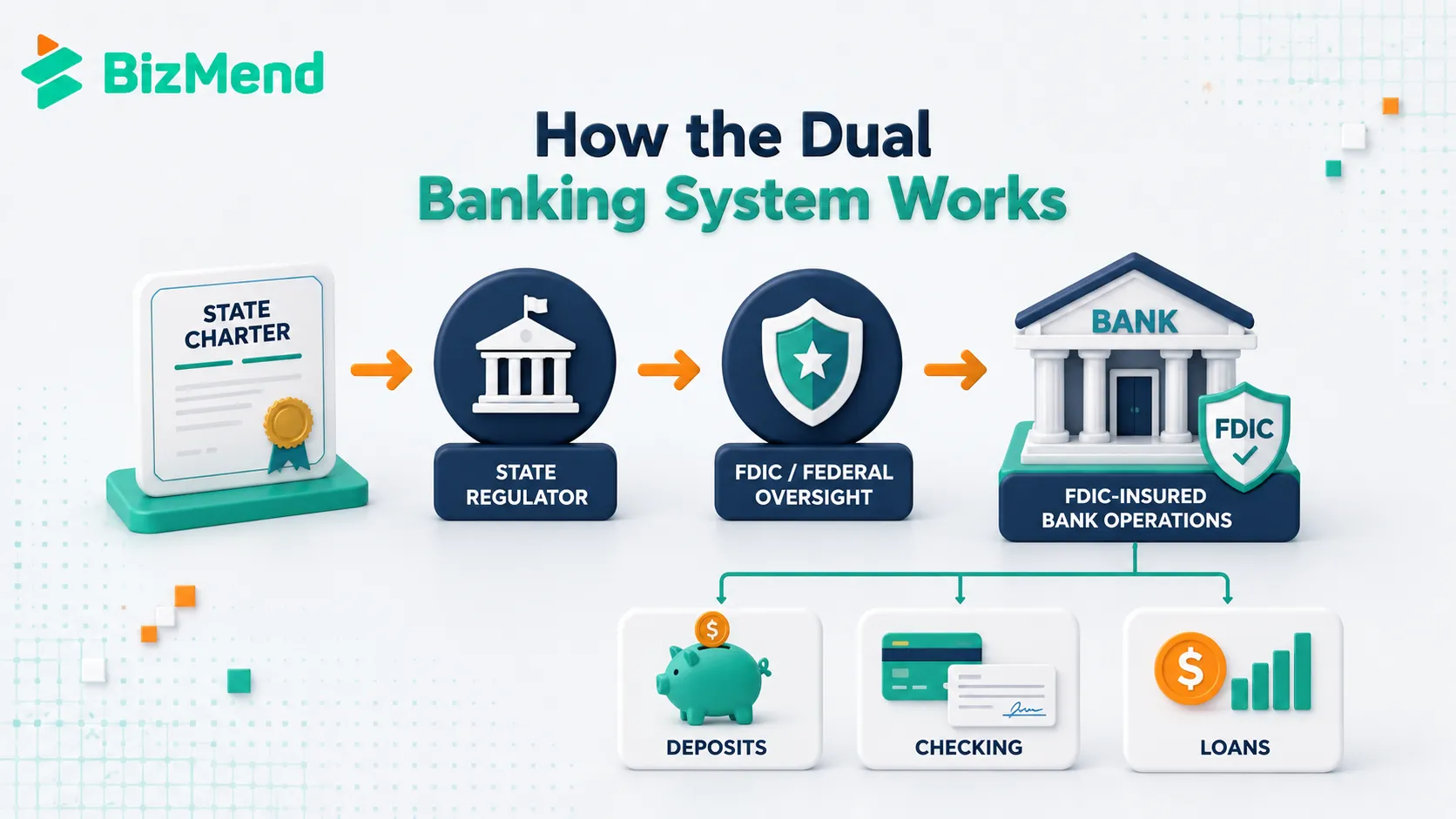
The United States runs on a dual banking system: a bank can choose a federal charter from the OCC or a state charter from one of the fifty state banking departments. This choice dates back to the Civil War era National Bank Acts of 1863 and 1864, which created national banks and a uniform currency while leaving the older state-chartered system in place alongside it.
A state-chartered bank answers to two regulators at once. Its state banking department handles day-to-day supervision, licensing, and enforcement within that state. A federal regulator adds a second layer: the Federal Reserve if the bank has chosen to join the Federal Reserve System, or the FDIC if it has not. Both federal regulators coordinate closely with state examiners and frequently conduct joint examinations.
This dual structure gives bank management a genuine choice. State law can move faster than federal rulemaking and often gives state banks more flexibility to tailor products, lending limits, and internal structure to local conditions. A bank can also convert between state and national charters later if its business needs change.
How Common Are State Banks in the US?
State banks are far more common than national banks by number, even though national banks often hold more total assets combined. Federal Reserve Bank of Kansas City data shows 83 percent of community banking organizations held a state charter as of 2025, up from 73 percent twenty five years earlier, and those state-chartered community banks now hold 79 percent of total community banking assets.
The FDIC insures thousands of banks nationwide, and the large majority carry a state charter rather than a federal one. That imbalance reflects history as much as strategy: most banks in the country started as state-chartered institutions before the OCC existed, and many new community banks still choose a state charter today for its flexibility and lower startup cost.
Types of State Banks in the US
Not every state bank looks the same on paper. The FDIC and state regulators classify state-chartered institutions into several distinct types based on Federal Reserve membership and business focus, and knowing the difference helps explain why one state bank might behave very differently from another down the street.
State Member Banks
A state member bank has joined the Federal Reserve System voluntarily, making the Federal Reserve its primary federal regulator alongside its state banking department. Membership gives the bank direct access to Federal Reserve services such as check clearing and the discount window, along with a seat in the regional Federal Reserve Bank’s governance structure.
State Nonmember Banks
A state nonmember bank has not joined the Federal Reserve System, so the FDIC serves as its primary federal regulator instead. This is the most common state charter type; Federal Reserve Bank of Kansas City data shows the large majority of community banking organizations with state charters fall into this nonmember category rather than the member category.
State Savings Banks
A state savings bank, sometimes called a state-chartered thrift, historically focused on consumer deposits and home mortgages rather than commercial lending. Many now offer a full range of products similar to a commercial bank, but the savings bank charter can carry different capital and lending rules depending on the state.
Industrial Banks
An industrial bank, or industrial loan company, is a specialized state charter that allows certain companies to own a bank without becoming a full bank holding company. Industrial banks are FDIC-insured and state-supervised like other state banks, but they operate under a narrower set of federal holding company rules.
State Trust Companies
A state trust company holds a charter focused on fiduciary services, such as managing trusts, estates, and investment accounts, rather than everyday consumer checking and savings. Some trust companies do not accept public deposits at all and instead specialize entirely in wealth management and fiduciary work for individual and institutional clients.
How a State Bank Works: Key Features and Structure
Day to day, a state bank functions like any deposit-taking institution: it accepts checking, savings, and CD deposits, then lends that money out through mortgages, auto loans, credit cards, and business financing. The margin between what it pays depositors and what it earns on loans funds its operations, a structure identical to national banks.
What sets the structure apart is oversight. Examiners from the state banking department and the federal regulator review the bank’s capital levels, loan quality, and compliance on a recurring cycle, often alternating or coordinating exams to reduce duplication. State consumer protection laws also apply on top of federal rules, which can add requirements a national bank would not face in the same state.
Many state banks lean into a community-focused structure, with local loan officers who have discretion to evaluate a small business or a first-time homebuyer using judgment rather than a rigid formula. Larger state-chartered institutions like Truist operate at a different scale but keep the same underlying charter and dual oversight structure.
Requirements and Eligibility to Open or Use a State Bank
Opening a personal account at a state bank requires the same basic documents as any US bank: a government-issued photo ID, a US mailing address, and a taxpayer identification number. US citizens use a Social Security number; non-citizens can typically use an Individual Taxpayer Identification Number instead, though many state banks still require a branch visit to complete identity verification for applicants without an SSN.
Business accounts add another layer. Newcomers who register a US company as a non-resident typically need the business formation documents before a state bank will open a business checking account. Most banks also require the company’s EIN before approving the application.
Working through a US formation checklist before the appointment helps confirm which paperwork a specific bank will expect, since requirements can vary slightly between institutions and states. Founders without a US address sometimes need a registered agent service to satisfy that requirement before a bank will proceed.
Founders setting up a US company from abroad, including US formation for Bangladeshis, generally face the same document checklist regardless of whether the bank they choose holds a state or a national charter. A US bank account guide covers the remote application process for founders who cannot visit a branch in person.
Minimum opening deposits vary widely, from zero at many online-focused state banks to several hundred dollars at some community institutions, so confirming the current requirement directly with the bank avoids a wasted trip.
Benefits and Drawbacks of a State Bank
Weighing the practical tradeoffs matters more than the charter label itself once safety is confirmed through FDIC insurance.
Benefits
- State laws often let these banks tailor products, loan terms, and underwriting to local economic conditions.
- Community-focused state banks frequently offer more personal service and faster decisions on small business and consumer loans.
- FDIC deposit insurance applies the same way as at any national bank, up to $250,000 per depositor.
- State charters range from tiny community banks to institutions with thousands of branches, so options exist at every scale.
Drawbacks
- Smaller state banks may have limited branch and ATM networks outside their home region.
- Rules, fees, and consumer protections can vary from state to state, making comparison shopping less uniform.
- Some smaller state banks offer thinner digital banking features than the largest national banks.
- Dual regulation adds compliance complexity for the bank, which can occasionally slow product rollouts or policy changes.
State Bank vs National Bank: Key Differences
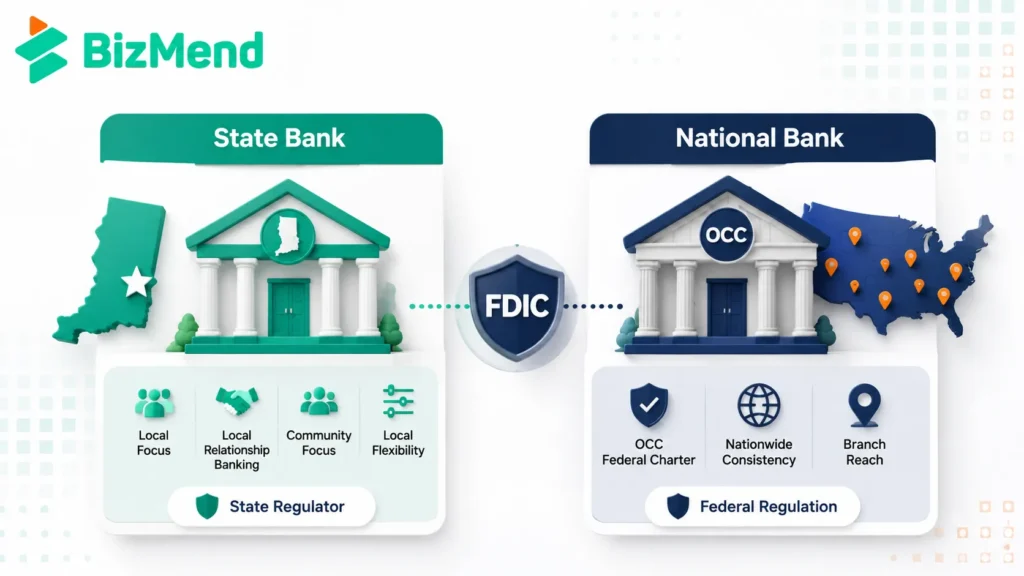
The charter source drives every other difference between a state bank and a national bank. A national bank answers only to the OCC as its primary federal regulator; a state bank answers to its state banking department plus either the Federal Reserve or the FDIC. For a full breakdown of how the national charter works, see this national bank overview, which covers OCC oversight, requirements, and how to choose among the largest banks in more depth.
| Feature | State Bank | National Bank |
| Charter issued by | State banking department | OCC (federal) |
| Primary federal regulator | Federal Reserve (if a member) or FDIC | OCC |
| Also supervised by | State banking department | Not applicable |
| FDIC insurance | Required for nearly all state banks | Required |
| Name identifier | No federal naming requirement | Often “National,” “N.A.,” or “NT&SA” |
| Typical strength | Local flexibility and relationship banking | Nationwide consistency and branch reach |
| Example | Truist Bank (North Carolina charter) | JPMorgan Chase Bank, N.A. |
For most depositors, the practical differences show up in branch footprint, local flexibility, and sometimes fee structure rather than in safety, since FDIC insurance covers both charter types identically up to the standard limit. Neither charter type is inherently the better choice; the right fit depends on whether nationwide consistency or local relationship banking matters more for a given situation.
How to Choose the Right State Bank in the US
Matching the bank to the actual need works better than choosing by reputation alone.
1. Identify what you actually need. Decide whether the priority is a nearby branch, a specific loan product, high-yield savings, or dedicated business banking before comparing options.
2. Confirm the charter and insured status. Search the state banking department’s licensee list and the FDIC’s BankFind tool to confirm the bank is currently chartered and FDIC-insured.
3. Compare fees and minimum balances. Pull the current fee schedule directly from the bank, since state banks vary widely on monthly fees, overdraft charges, and minimum balance requirements.
4. Check the branch and digital footprint. A community-focused state bank may cover only one region, so confirm branch, ATM, and mobile banking coverage matches where you actually live and travel.
5. Ask about relationship banking. Community and regional state banks often reward account holders who bring multiple products together with better rates or waived fees, so ask directly what is available.
Key Insights
- A state bank is defined by its state charter, not by its size, product range, or branch count.
- Every state bank has dual oversight: its state banking department plus either the Federal Reserve or the FDIC.
- FDIC deposit insurance works identically at state and national banks, up to $250,000 per depositor.
- State member banks answer to the Federal Reserve; state nonmember banks answer to the FDIC.
- Some of the largest US banks, including Truist, operate under state rather than national charters.
- Compare fees, APY, and access using the same factors regardless of charter type before opening an account.
Final Thoughts
A state bank is defined by its charter, not by its size or reach, and that single fact explains why the category includes both small community lenders and institutions with thousands of branches. Deposit insurance works the same way regardless of charter type, so the practical decision usually comes down to local relationships, product range, fees, and digital tools rather than which regulator signs off on the license.
Before opening an account, confirm the specific bank’s FDIC-insured status and current charter type through the FDIC’s BankFind tool rather than assuming from the name alone. Compare fees, minimum balances, and branch access against a national bank using the same factors, since neither charter type guarantees the better deal on its own.
Frequently Asked Questions
What is a state bank?
A state bank is a commercial bank chartered by a state banking department instead of a federal agency. It carries FDIC deposit insurance and answers to either the Federal Reserve or the FDIC as its primary federal regulator, plus its home state’s banking authority. Truist and thousands of community banks operate under state charters.
How does a state bank work?
A state bank accepts deposits, pays limited interest, and lends that money through mortgages, credit cards, and business loans, much like any other bank. Its state banking department conducts regular examinations alongside a federal regulator, either the Federal Reserve for state member banks or the FDIC for state nonmember banks, creating dual oversight.
Can I open a state bank account as a non-citizen?
Yes. Non-citizens can generally open a state bank account with a valid passport and an Individual Taxpayer Identification Number in place of a Social Security number. Most state banks still require an in-person visit for applicants without an SSN, and specific document requirements vary by institution, so confirm current rules before applying.
Is a state bank FDIC insured and safe?
Yes, within FDIC limits. Nearly all state banks carry FDIC deposit insurance covering up to $250,000 per depositor, per bank, per ownership category, the same protection national banks carry. Confirm any specific bank’s insured status through the FDIC’s BankFind tool, since a small number of state-chartered institutions are not FDIC members.
What is the difference between a state bank and a national bank?
The charter source is the main difference: a state bank answers to a state banking department plus the Federal Reserve or FDIC, while a national bank answers only to the OCC. Both carry the same FDIC insurance and offer similar products, so the practical differences usually show up in fees, local flexibility, and branch reach rather than safety.
How do I choose the right state bank?
Compare fees, minimum balance requirements, branch and ATM access, savings APY, digital banking tools, and how the bank has handled customer complaints. Confirm the bank’s current FDIC-insured status and charter type before applying, and weigh local relationship banking against the broader branch network a larger institution might offer.
Can a state bank operate in more than one state?
Yes, though the rules depend on the charter and each state’s laws. Many state banks operate branches in multiple states today, either through interstate branching laws passed after 1994 or by holding a charter in a state with favorable branching rules, similar to how Truist operates across 18 states from its North Carolina charter.
