

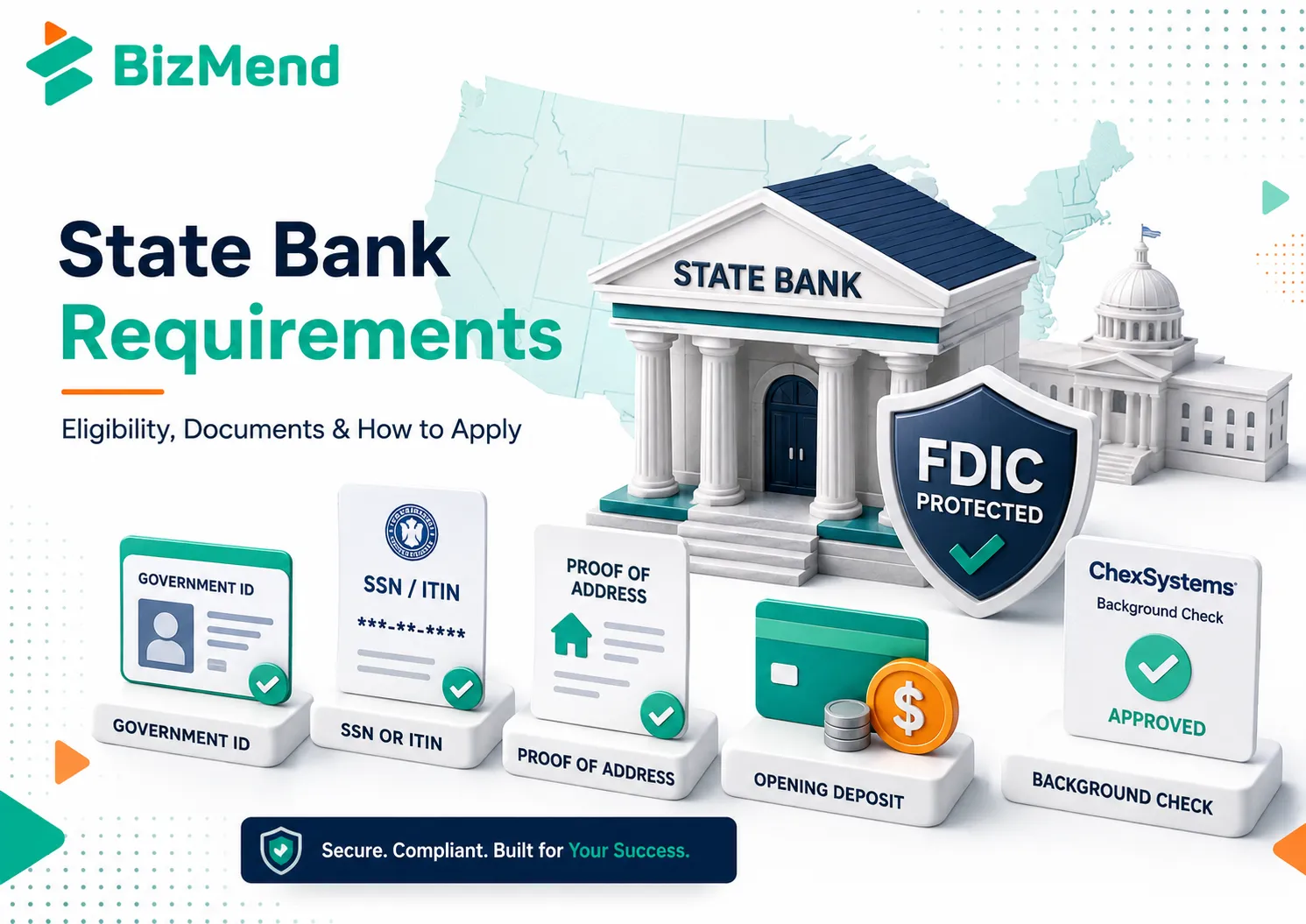
State bank requirements start with the same federal basics as any US bank: your age, a valid ID, a taxpayer number, and a banking history check. What changes is who charters and backs up the bank behind the scenes, and that distinction rarely trips up an account opening, but it does matter for what protections apply later.
Here’s exactly what a state-chartered bank asks for, why a state regulator sits alongside federal rules, and what happens once you submit an application. The steps below work whether you are opening your first account or switching from a national bank.
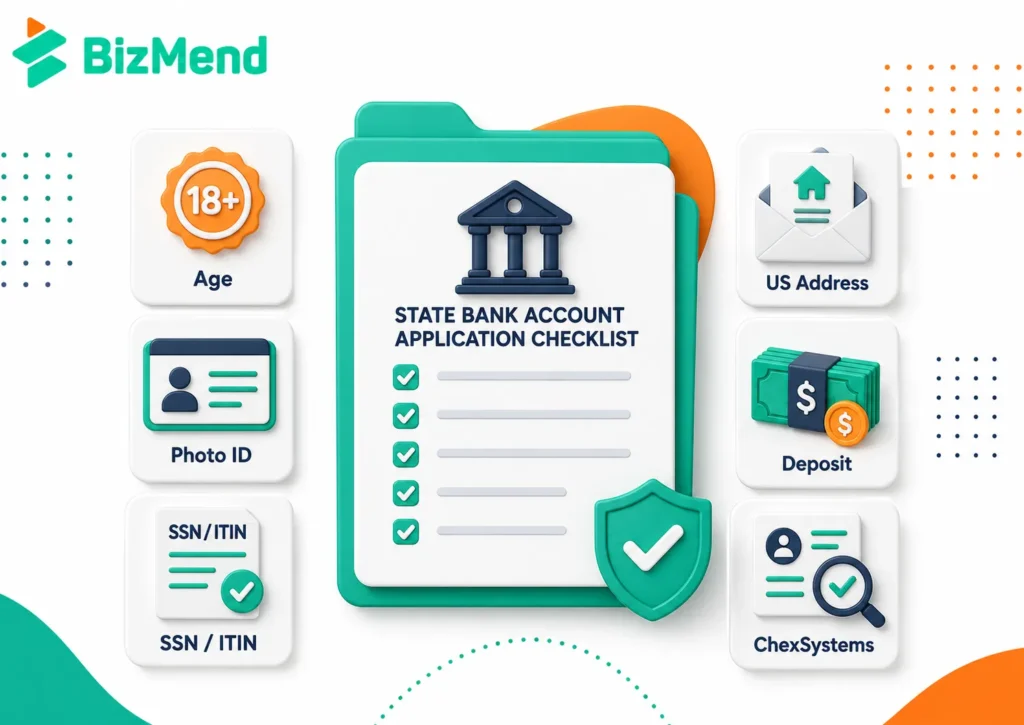
Quick Answer: State bank requirements typically include being at least 18 (or having a joint owner if younger), a government-issued photo ID, a Social Security number or ITIN, a US address, and sometimes an opening deposit. State-chartered banks follow the same federal identity checks as national banks, plus state-specific rules.
State Bank Requirements Checklist for New Accounts
A state bank gets its charter from a state banking department rather than the OCC, and its primary federal backstop is either the FDIC or the Federal Reserve, depending on whether it joined the Federal Reserve System. That regulatory split has almost no effect on what you hand over at account opening, because the same federal Customer Identification Program applies to every FDIC-insured bank regardless of charter type.
Age. Most state banks set 18 as the standalone minimum, with a small number at 19 in states that set the age of majority there. Minors can open an account earlier only with a parent or guardian as joint owner.
Identification. A government-issued photo ID, such as a driver’s license, state ID, US passport, or military ID, is required from every applicant. Non-citizens can often substitute a foreign passport or a Matricula Consular card.
Taxpayer number. US citizens and green card holders provide a Social Security number. Anyone without one, including many nonresident aliens, can use an Individual Taxpayer Identification Number instead.
Deposit and address. A current US mailing address is standard. Opening deposit amounts vary by state bank and account type, and many checking accounts waive the requirement entirely.
Banking history. Most state banks check ChexSystems or a similar consumer reporting agency before approval, the same practice used at national banks.
| Important: The one meaningful state-specific factor is consumer protection: some states layer additional disclosure or notice rules on top of federal requirements, so the exact paperwork can read slightly differently from one state bank to the next even though the underlying documents needed are the same. |
The national bank guide includes a full comparison of how state and national charters differ; the checklist above covers what actually happens at the account-opening desk.
Documents Needed for State Bank Accounts
Every document a state bank requests ties back to the same federal identification standard used industry-wide, plus any state notice the bank must give you at signing.
| Document | Why the Bank Asks For It |
| Government-issued photo ID | Confirms your identity matches your application |
| Second ID or proof of address | Backs up the primary ID with a Social Security card, utility bill, or birth certificate |
| SSN or ITIN | Lets the bank report interest income to the IRS |
| Proof of US address | Satisfies the address element of federal identification rules |
| Opening deposit, if required | Funds the account before a debit card or checks are issued |
Applicants without an SSN typically need a branch visit, since most state bank online systems are built around SSN verification. A passport plus a second ID, confirmed with the branch beforehand, avoids a wasted trip.
How to Open a State Bank Account: Step-by-Step
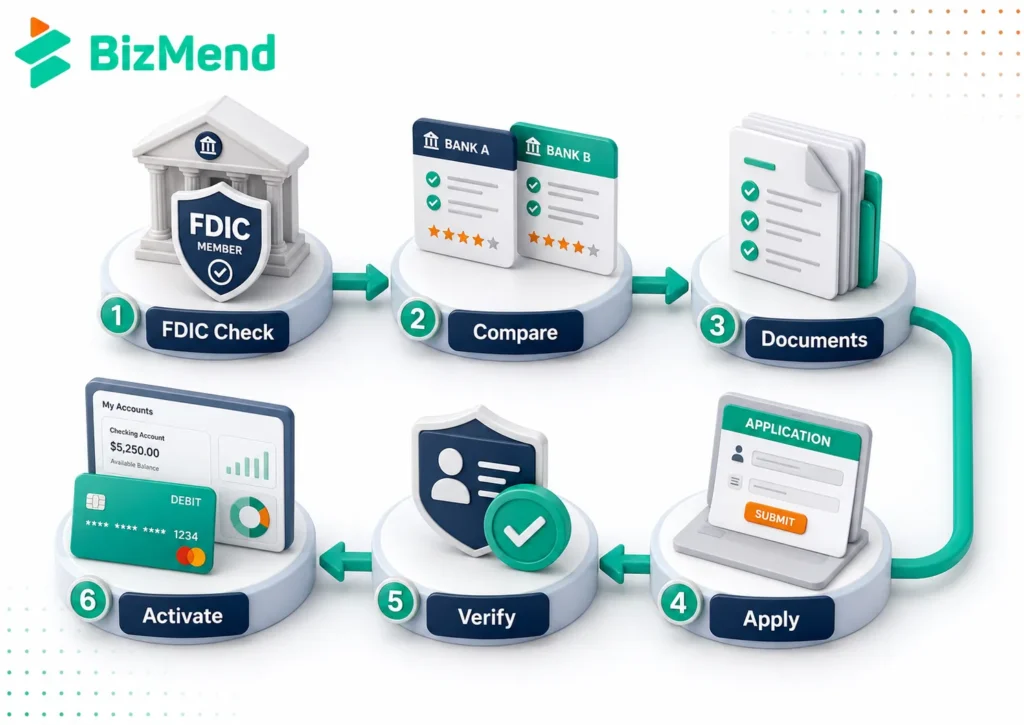
1. Confirm the charter and coverage. Check that the bank is FDIC-insured through the FDIC’s BankFind tool before applying anywhere.
2. Compare two or three state banks on fees, minimum deposit, and branch or ATM access.
3. Gather your documents: photo ID, SSN or ITIN, and proof of a US address.
4. Apply online or in-branch. Online applications suit US citizens with an SSN; non-citizens without one usually need a branch visit.
5. Complete the application with your legal name, date of birth, address, and identification number exactly as shown on your documents.
6. Fund the account, if a deposit is required, by transfer, card, check, or cash.
7. Verify your identity and activate access, either automatically online or by presenting documents in person, then set up direct deposit.
Restart this sequence separately for each account type, since a savings account and a checking account at the same state bank can carry different verification steps.
Why State Bank Applications Get Rejected
- Most denials at a state bank trace back to the same handful of causes seen industry-wide:
- A negative ChexSystems record, such as unpaid overdraft fees or an involuntary account closure at a previous bank
- A mismatch between the application details and the identification documents provided
- A missing SSN or ITIN when the bank cannot verify tax status another way
- Too many recent account applications in a short window, which risk systems can flag automatically
- An expired ID or a document type that the a specific bank does not accept
Federal law requires the bank to disclose why an application was declined when a consumer report contributed to the decision, including which reporting agency was used.
What Happens After You Apply
Online applications with a valid SSN often resolve within minutes once identity verification clears. In-branch applications with complete documents are typically approved during the same visit.
Manual review, common for non-citizen applicants, joint accounts, or unverifiable SSNs, generally takes one to five business days. The bank may contact you during this window for an additional document, so accurate contact information on the application matters.
Once approved, the account is usually active immediately. A physical debit card typically arrives by mail within five to ten business days, while a digital card or account number is often available right away for online banking.
Special Cases: Minors, Non-Citizens, and Joint Owners
Minors below the standalone account age need a parent or legal guardian as joint owner, who stays legally responsible for the account until the child reaches the bank’s independent-ownership age.
Non-citizens see the widest variation among state banks, since each institution sets its own documentation policy within federal minimums. Applicants who need an ITIN before applying can review a step-by-step ITIN guide covering the IRS Form W-7 process and typical processing time.
Joint owners share full legal rights to the account, so both parties complete identity verification and both sign the account agreement.
Key Insights
- State banks follow the same federal identity-verification rules as national banks; the charter type does not change the required documents.
- The standalone age minimum is 18 at most banks; younger applicants need a joint owner.
- An SSN or ITIN is required; non-citizens without an SSN usually need a branch visit.
- ChexSystems, not a credit score, is the most common reason for account denial.
- Some states add disclosure or notice rules on top of federal requirements.
- Manual review typically resolves within one to five business days.
Final Thoughts
Meeting state bank requirements takes the same preparation as any US bank: a valid photo ID, a Social Security number or ITIN, a US mailing address, and a clean ChexSystems file. The charter type behind the bank rarely changes what you hand over at the counter, since federal identification rules apply uniformly to every FDIC-insured bank regardless of who granted its charter.
Before applying, confirm the bank’s FDIC insurance through BankFind, pull a free ChexSystems disclosure if a past closure is a concern, and check the specific bank’s current deposit and ID rules. State-level disclosure requirements, fee schedules, and minimum deposits vary by institution and change over time, so always verify current terms directly with the bank before you apply.
Frequently Asked Questions
What do I need to open a state bank account?
A government-issued photo ID, a Social Security number or ITIN, a US mailing address, and sometimes an opening deposit. State banks verify identity under the same federal program used industry-wide before activating the account.
Can I open a state bank account without an SSN?
Yes, using an Individual Taxpayer Identification Number from the IRS instead. Most state banks require a branch visit for SSN-less applications, since online systems are typically built around SSN verification.
What is the minimum deposit for a state bank account?
It varies by bank and account type. Many checking accounts waive the opening deposit entirely, while savings accounts and certificates of deposit more commonly require one, often a modest fixed amount.
How long does it take to open a state bank account?
Online applications with an SSN often complete in minutes. Applications needing manual review, common for non-citizens or joint accounts, typically take one to five business days before the bank confirms approval.
What is ChexSystems?
A consumer reporting agency that tracks banking history, including unpaid overdrafts and involuntary account closures, separate from the three major credit bureaus. Most state and national banks check it before approving a new account.
