

Knowing how to choose a state bank in the US starts with the charter, but the charter rarely decides whether the account actually fits your life. A state bank answers to a state regulator plus the Federal Reserve or the FDIC, yet two state banks can differ completely on fees, access, and service.
What follows compares the practical factors, fees, minimum balances, savings rates, branch and digital access, then walks through a step-by-step process for narrowing the field to a bank that matches how you actually bank day to day.
Quick Answer: To choose a state bank in the US, compare monthly fees, minimum balance rules, savings APY, ATM and branch access, FDIC insurance status, digital banking tools, and customer service before applying. Verify the bank’s current charter and FDIC coverage through the FDIC’s BankFind tool, since fees and rates change often.
Factors That Actually Matter When You Choose a State Bank
A state charter tells you which regulator supervises the bank, the Federal Reserve for state member banks or the FDIC for state nonmember banks, alongside the state banking department. That detail matters less for day-to-day banking than most people assume, since FDIC deposit insurance covers state and national banks identically, up to $250,000 per depositor, per ownership category. Readers who want the full mechanics behind that charter can review our state bank charter breakdown; here, the focus stays on what actually separates one state bank from another once safety is already confirmed.
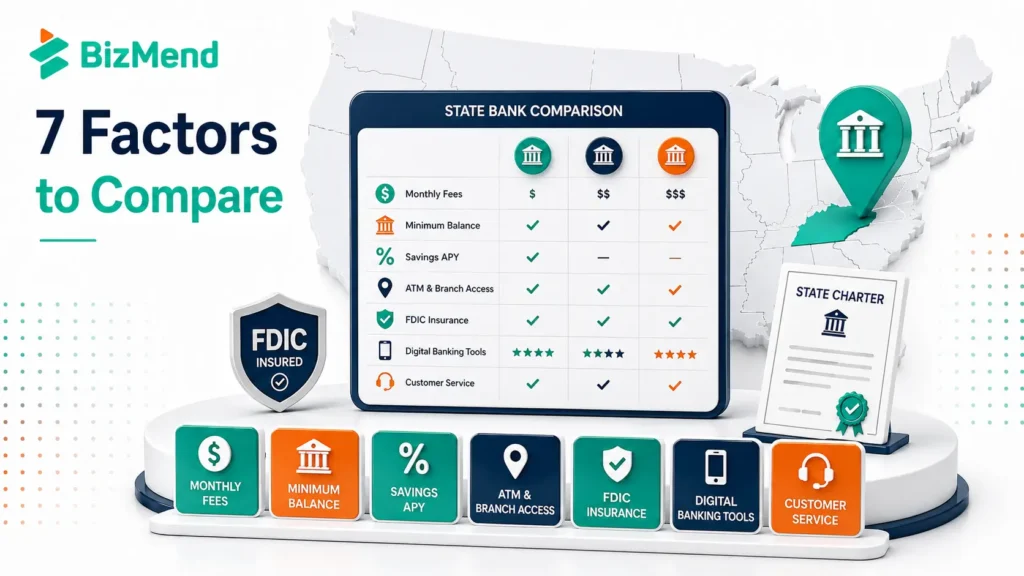
Seven factors do most of the real work in a side-by-side comparison:
- Monthly fees and minimum balance. Some state banks waive fees with direct deposit or a minimum daily balance; others charge a flat monthly fee regardless of activity, and a few tie the fee to combined balances across checking and savings. Pull the current fee schedule directly from the bank rather than relying on an older review or a comparison table that may already be outdated.
- Savings and CD yield (APY). Online-focused state banks often pay a meaningfully higher annual percentage yield than branch-heavy institutions, since they carry lower overhead and pass some of that savings back to depositors. Rates move with the broader interest rate environment, so check each bank’s published rate page on the same day you compare them.
- ATM and branch access. A community or regional state bank may only serve one metro area or state, while a larger state-chartered institution can offer branches across many states plus a wide surcharge-free ATM network. Confirm coverage against where you actually live, work, and travel, not just where the nearest branch happens to be today.
- Digital banking tools. Mobile check deposit, budgeting features, card-lock controls, and instant peer-to-peer transfer options vary widely even among banks of similar size and reputation. Newcomers who want to compare a nationally chartered alternative before deciding can see the tradeoffs in our guide on choosing a national bank.
- FDIC insurance and charter status. Confirm current insured status through the FDIC’s BankFind tool rather than assuming from the bank’s name or marketing materials, since a small number of state-chartered financial companies are not FDIC members.
- Customer service and complaint history. Live chat availability, phone hold times, fraud-response speed, and dispute resolution differ sharply between banks marketing nearly identical products on paper.
- Relationship and multi-product discounts. Community and regional state banks frequently reduce or waive fees for account holders who bring multiple products, checking, savings, and a loan, together under one relationship, so ask directly what is available before assuming the advertised rate is final.
Compare Top State Banks Side-by-Side
State charters cover everything from single-branch community lenders to institutions with thousands of locations, so the same charter label can describe very different banking experiences. The table below profiles five FDIC-insured state banks that illustrate that range, from fully online savings specialists to a large regional branch network; fees, APY, and specific product terms change often, so confirm current numbers directly with each bank before applying rather than treating this table as a live rate sheet.
| Bank | State Charter (Regulator) | Branch Network | Best Fit For |
| Ally Bank | Utah (Federal Reserve member) | Online only, no branches | High-yield savings and fee-light checking |
| Discover Bank | Delaware (FDIC nonmember) | Online only, no branches | Cashback checking paired with savings and CDs |
| Marcus by Goldman Sachs (Goldman Sachs Bank USA) | New York (Federal Reserve member) | Online only, no branches | High-yield savings and CDs without checking accounts |
| M&T Bank | New York (Federal Reserve member) | Branches across the Northeast and Mid-Atlantic | In-person relationship and business banking |
| Truist Bank | North Carolina (FDIC nonmember) | Branches across 18 states | Full-service branch banking with a large regional footprint |
Notice that charter state has little to do with where a bank actually operates. Truist, chartered in North Carolina, runs branches across eighteen states, while Ally and Marcus hold charters in Utah and New York but serve customers nationwide entirely online. Charter location signals which state regulator supervises the bank, not where its customers or branches are.
How to Choose a State Bank in the US in 5 Steps
Matching the bank to an actual need, rather than a name recognized from advertising or a one-time bonus offer, produces a better outcome than comparison shopping by reputation alone.
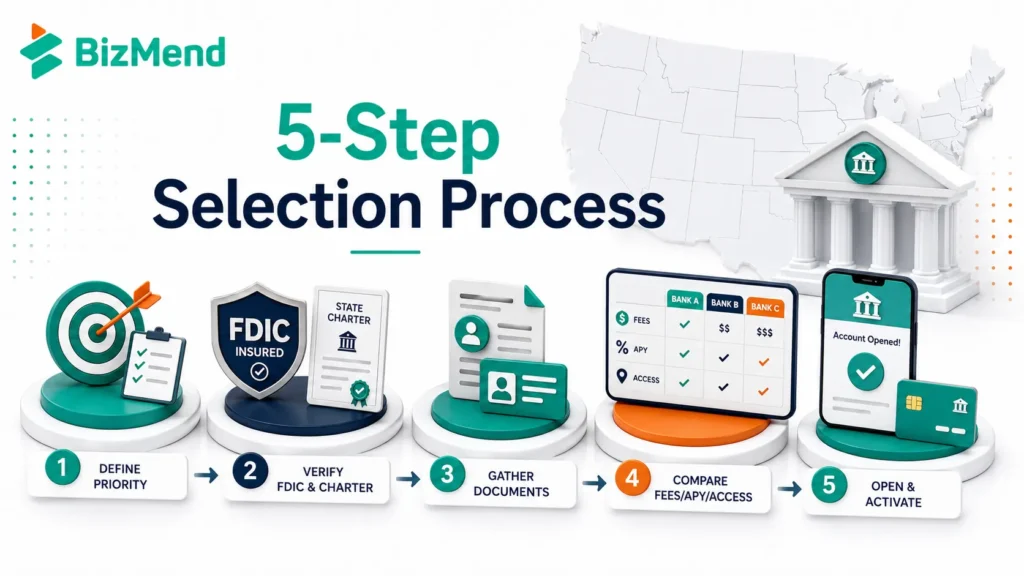
1. Define the priority first. Decide whether a nearby branch, a high savings yield, dedicated business banking, or strong mobile tools matters most before comparing options, since no single bank wins on every factor at once and tradeoffs are normal.
2. Confirm the charter and FDIC status. Search the FDIC’s BankFind tool and, where relevant, the state banking department’s licensee list to confirm the bank is currently chartered and insured before sharing any personal information.
3. Gather the documents a new account will need. Most personal accounts need a government-issued photo ID, a US mailing address, and a Social Security number or Individual Taxpayer Identification Number. Readers moving from a national bank shortlist can cross-check the paperwork against our state bank account requirements guide or the parallel national bank requirements checklist, since the documents overlap heavily either way.
4. Compare fees, APY, and access using each bank’s current numbers. Pull the fee schedule and rate sheet straight from each bank’s website rather than a comparison site, since promotional rates and fee waivers change on short notice and older articles rarely catch up in time.
5. Open the account and confirm the timeline. Online-focused state banks often approve and fund an account the same day, while opening a bank account at a branch-based institution can take a few business days once identity verification and an initial deposit are complete.
Important Considerations Before You Commit
A few practical limits apply no matter which state bank ends up on the shortlist. FDIC insurance caps coverage at $250,000 per depositor, per bank, per ownership category, so larger balances may need to be split across ownership categories or institutions to stay fully covered. Joint accounts, retirement accounts, and trust accounts are insured separately from an individual account at the same bank, which changes the math for households holding significant savings.
Important: Interest rates on savings and CD products are variable at most banks and can change without much notice, so a rate that looks competitive today may not stay that way through a full CD term unless the rate is fixed for that term. Overdraft and non-sufficient-funds fees also vary widely between the banks in this guide and are worth reviewing separately from the base monthly fee.
Red Flags to Avoid When Choosing a State Bank
- No verifiable FDIC certificate. A legitimate state bank appears in the FDIC’s BankFind database with an active certificate number; treat any bank that cannot be verified there as a serious warning sign rather than a minor gap.
- Vague fee disclosures. A bank that will not provide a written, current fee schedule before account opening makes it hard to compare the real cost against competitors and often hides the true price of the account.
- Confusing a fintech app with a bank. Many banking apps are technology companies that route deposits to a partner bank rather than holding a charter themselves; confirm which chartered institution actually holds the FDIC insurance before assuming full protection applies automatically.
- Credit unions marketed like banks. Credit unions carry NCUA share insurance rather than FDIC deposit insurance, a similar but separate protection administered by a different federal agency, so confirm which coverage actually applies to a specific account.
- Bonus offers with hidden strings. Sign-up bonuses tied to direct deposit minimums, balance requirements, or early closure fees can cost more than they pay out if the fine print goes unread before signing up.
Key Insights
- FDIC insurance protects deposits at state and national banks identically, up to $250,000 per depositor.
- Pull current fees, APY, and minimum balance directly from the bank rather than an older review.
- Confirm charter and insured status through the FDIC’s BankFind tool before applying.
- Online-focused state banks tend to pay higher APY; branch-heavy state banks tend to offer more in-person service.
- Relationship discounts at community and regional banks are rarely advertised, so ask directly.
- Fintech apps and credit unions carry different protections than a chartered, FDIC-insured state bank.
Final Thoughts
Choosing a state bank in the US works best as a matching exercise, not a search for one best answer. Branch access, digital tools, fees, and savings yield pull in different directions depending on how someone actually banks. FDIC insurance protects deposits at state and national banks the same way, so the real decision lives in fees, products, and service rather than the regulator’s name.
Before opening an account, pull the current fee schedule and rate sheet from the bank’s website and confirm FDIC insurance through the FDIC’s BankFind tool rather than assuming coverage from the name alone. Anyone considering a business account, a larger deposit, or a complex banking relationship should confirm exact requirements with the bank directly first.
Frequently Asked Questions
How do I choose a state bank in the US?
Compare monthly fees, minimum balance rules, savings APY, branch and ATM access, digital banking tools, and customer service using each bank’s current published terms. Confirm the bank’s FDIC-insured status through the FDIC’s BankFind tool before opening an account, since charter type alone does not indicate service quality.
What should I look for in a state bank?
Look for a fee structure and minimum balance that match your typical account activity, a savings or CD yield that is competitive for the current rate environment, and branch or digital coverage that matches how you actually bank. Confirmed FDIC insurance should be a baseline requirement, not a differentiator.
What is the best state bank for someone who rarely visits a branch?
Online-focused state banks such as Ally Bank, Discover Bank, and Marcus by Goldman Sachs typically pay a higher APY and charge fewer monthly fees than branch-heavy institutions, since they carry lower overhead. Someone who needs cash deposits or in-person service regularly may still prefer a branch network instead.
Is a state bank FDIC insured?
Nearly all state banks carry FDIC deposit insurance, covering up to $250,000 per depositor, per bank, per ownership category, the same protection national banks carry. A small number of state-chartered institutions are not FDIC members, so confirm any specific bank’s status through the FDIC’s BankFind tool before opening an account.
Can I switch state banks later without losing my account history?
Yes. Closing one account and opening another does not erase banking history that matters for credit or lending, such as a credit report or income documentation, though it does end that bank’s specific transaction and relationship record. Confirm any pending direct deposits, automatic payments, and checks have cleared before closing the old account.
What is the difference between a state bank and a national bank?
A state bank answers to a state banking department plus the Federal Reserve or the FDIC, while a national bank answers only to the OCC; see our national bank definition for the full regulatory picture. Both carry the same FDIC insurance and offer similar products, and a broader national bank overview covers how the national charter compares in more depth.
