

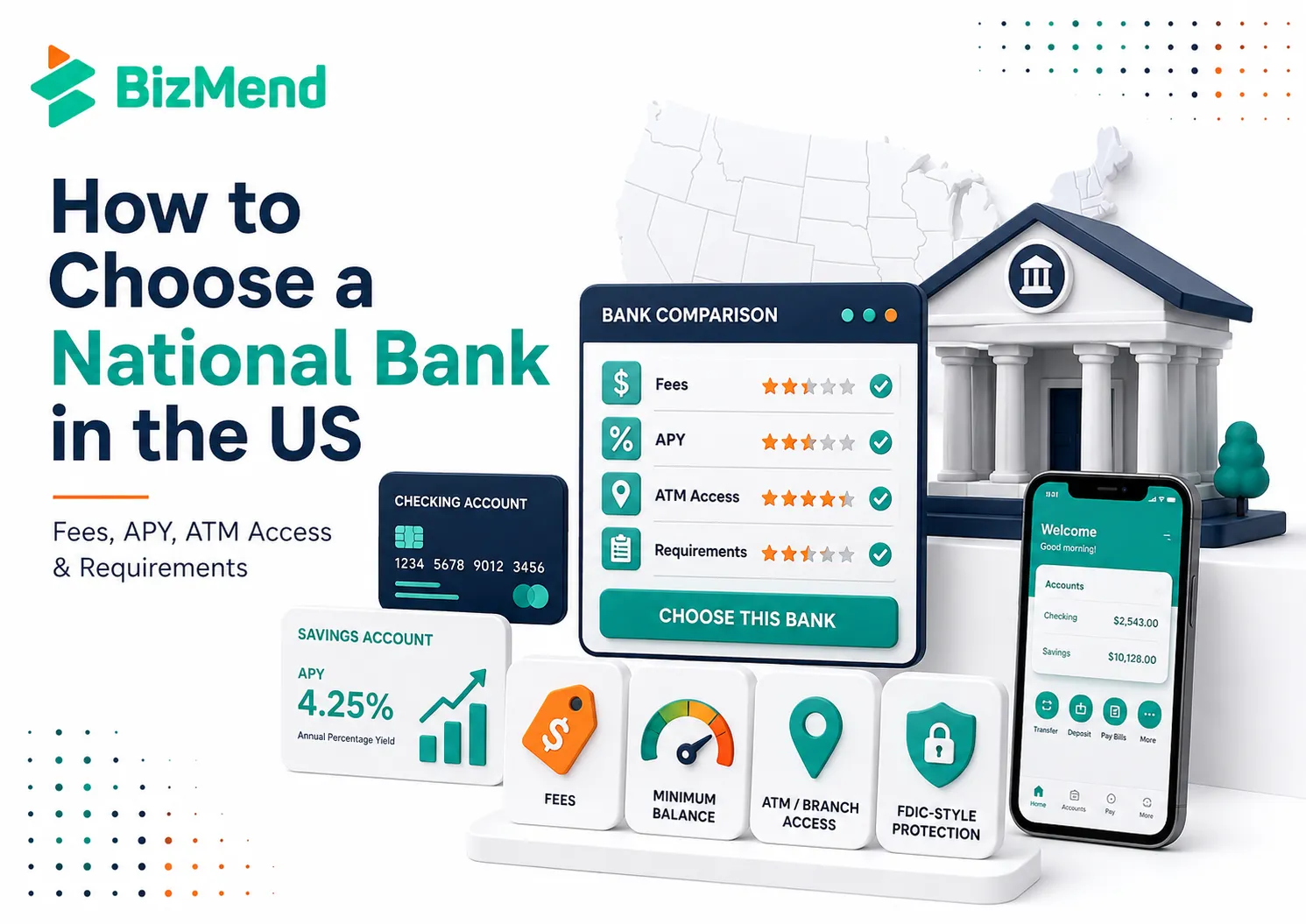
Learning how to choose a national bank in the US comes down to a handful of concrete factors, not the familiar name on a branch window. Chase, Bank of America, Wells Fargo, and other federally chartered banks promise similar safety, yet their fees, yields, and rules differ sharply. A checking account free at one bank can carry a fee at another.
The right pick means weighing what actually matters: fees, minimum balances, interest, ATM access, insurance, digital tools, and service quality. A five-step process and comparison table follow, plus the mistakes that cost new account holders money in year one.
Quick Answer: Choose a national bank in the US by comparing monthly fees and waiver rules, minimum balance requirements, savings APY, ATM access, FDIC insurance limits, and digital features against your own habits. Capital One and other no-fee digital banks suit low-balance users; Chase, Bank of America, and Wells Fargo suit branch-dependent customers willing to meet fee waivers
What Makes a Bank “National” in the US
A national bank holds a charter from the Office of the Comptroller of the Currency (OCC), an independent bureau of the US Department of Treasury, rather than from a state banking regulator. That charter requires the bank to join the Federal Reserve System and carry FDIC deposit insurance. Banks with “National,” “N.A.,” or “NT&SA” in their legal name usually signal this federal charter. OCC-supervised institutions account for roughly 68 percent of all US commercial banking assets, which is why most household names fall into this category.
The distinction between a national charter and a state charter rarely changes day-to-day banking for most customers. Both carry FDIC insurance and offer similar core products. For a full explanation of how national banks work, including account types and federal oversight, see this national bank overview and how it differs from a state-chartered institution. This guide focuses specifically on comparing options and picking one.
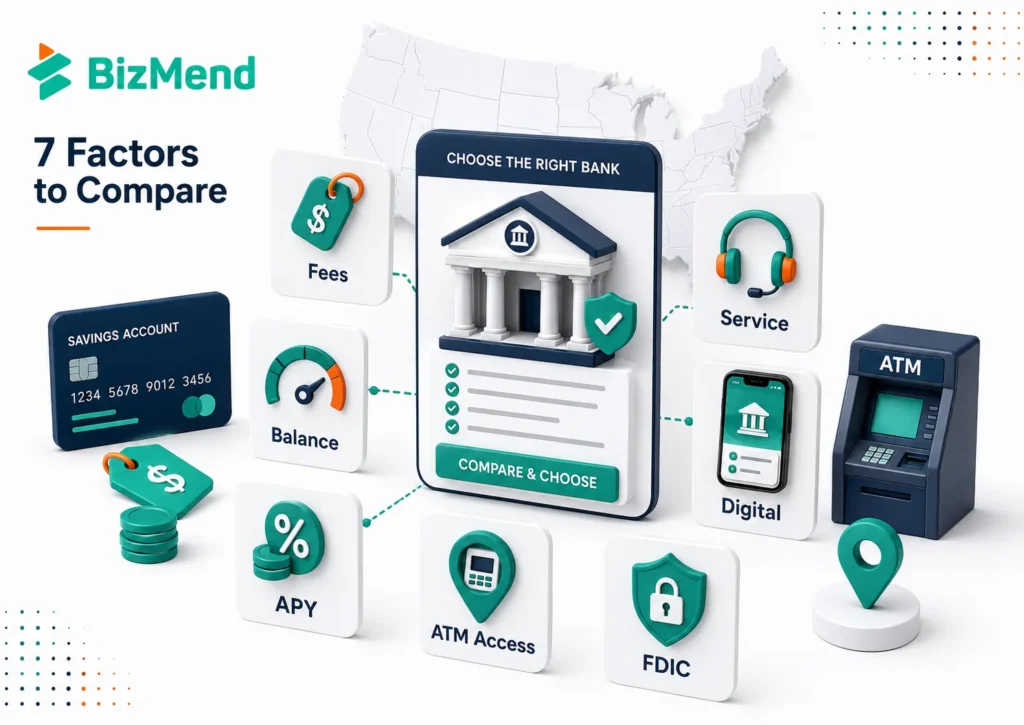
How to Choose a National Bank in the US: 7 Factors to Compare
Four or five factors usually decide the outcome once you line them up side by side. Ignore the marketing and check each one directly against the bank’s current disclosures.
Monthly Fees and Waiver Requirements
Checking account fees at major national banks currently range from $0 at Capital One to $15 at Wells Fargo. Most large banks waive the fee with a qualifying direct deposit or a minimum daily balance, but the thresholds differ. Chase Total Checking charges $12 monthly, waived with $500 in electronic deposits, a $1,500 daily balance, or $5,000 in combined linked balances. Nationally, the average monthly maintenance fee reached $13.95 in the most recent MoneyRates survey, though nearly a third of checking accounts carry no fee at all, according to Bankrate’s most recent checking account study.
Minimum Balance Requirements
Some accounts require no minimum to open or maintain; others charge a fee unless a daily balance stays above a set threshold. Bank of America’s Advantage Plus account waives its $12 fee with a $250 direct deposit or a $1,500 daily balance. A low or no-minimum account matters most for anyone building an emergency fund from scratch or managing irregular income.
APY and Interest Earned
Large branch-heavy national banks pay very little on standard savings and checking balances. The national average savings account rate stood at roughly 0.38 percent APY as of mid-2026, according to FDIC National Rate data, while several online-focused banks and credit unions paid well above 4 percent during the same period. On $10,000, that gap is worth hundreds of dollars a year. Anyone prioritizing yield should compare a bank’s savings account against the broader market before assuming a familiar name pays a fair rate.
ATM and Branch Access
Branch and ATM networks vary by a wide margin. Chase operates roughly 4,700 branches and close to 16,000 ATMs. Wells Fargo runs about 4,100 branches across 39 states. Capital One has no traditional branch network but reimburses withdrawals across more than 70,000 fee-free ATMs through the Allpoint and MoneyPass networks. Someone who deposits cash regularly needs branch access; someone who banks entirely by phone may not.
FDIC Insurance Coverage
Every national bank carries FDIC insurance automatically, covering up to $250,000 per depositor, per bank, per ownership category. A joint account and an individual account at the same bank are insured separately, which can push total coverage well above the standard limit for households with multiple account types. Depositors approaching that ceiling should use the FDIC’s Electronic Deposit Insurance Estimator (EDIE) to confirm exact coverage rather than estimating it.
Digital Banking Features
Mobile check deposit, person-to-person transfers, real-time alerts, and budgeting tools now separate banks more than branch count does for many customers. Before applying, check the bank’s current app store rating and look up its complaint record. Consumer complaint data has historically come through the Consumer Financial Protection Bureau, though the bureau’s supervisory and enforcement capacity has been significantly reduced since a February 2025 reorganization, according to a Government Accountability Office report published in February 2026. Comparing app reviews directly is now a more reliable near-term check than assuming uniform federal oversight.
Customer Service Quality
Standardized underwriting and call-center support at large national banks can mean less flexibility on individual account issues than a community bank or credit union offers. If in-person relationship banking matters, ask a branch banker directly how exceptions and disputes get handled before opening an account, rather than relying on a bank’s general marketing claims.
National Bank Comparison at a Glance
The figures below reflect published fee schedules and Federal Reserve asset data as of the stated dates. Fees, rates, and waiver rules change; verify current terms on each bank’s website before applying.
| Bank | Monthly Checking Fee | Fee Waiver | Domestic Assets | ATM Network |
| JPMorgan Chase Bank | $12 | $500 deposit, $1,500 balance, or $5,000 combined | $3.81 trillion | ~16,000 fee-free |
| Bank of America | $12 | $250 deposit or $1,500 balance | $2.65 trillion | ~15,000 fee-free |
| Wells Fargo Bank | $15 | $500 deposit, $1,500 balance, or $5,000 combined | $1.77 trillion | ~13,000 fee-free |
| U.S. Bank | $12 | $1,500 combined deposits or balance | $679 billion | ~2,000 branch-area |
| Capital One | $0 | Not applicable | $652 billion | 70,000+ fee-free |
Asset figures are drawn from the Federal Reserve’s Large Commercial Banks release as of September 30, 2025. Fee figures reflect each bank’s published disclosures as checked in July 2026.
Matching the Factors to Your Situation
The seven factors above carry different weight depending on who is banking. Someone with a steady paycheck and a smartphone rarely needs a branch and should weigh fees and APY heavily. A small business owner accepting cash payments needs branch deposit access and should weigh ATM and branch presence higher than yield. A retiree managing Social Security deposits and paper statements may prioritize in-person service over a slightly better rate elsewhere.
Reviewing the available bank account types before comparing specific banks helps clarify whether checking, savings, or a combination fits the actual goal, since chasing the wrong product type wastes time regardless of which bank offers it.
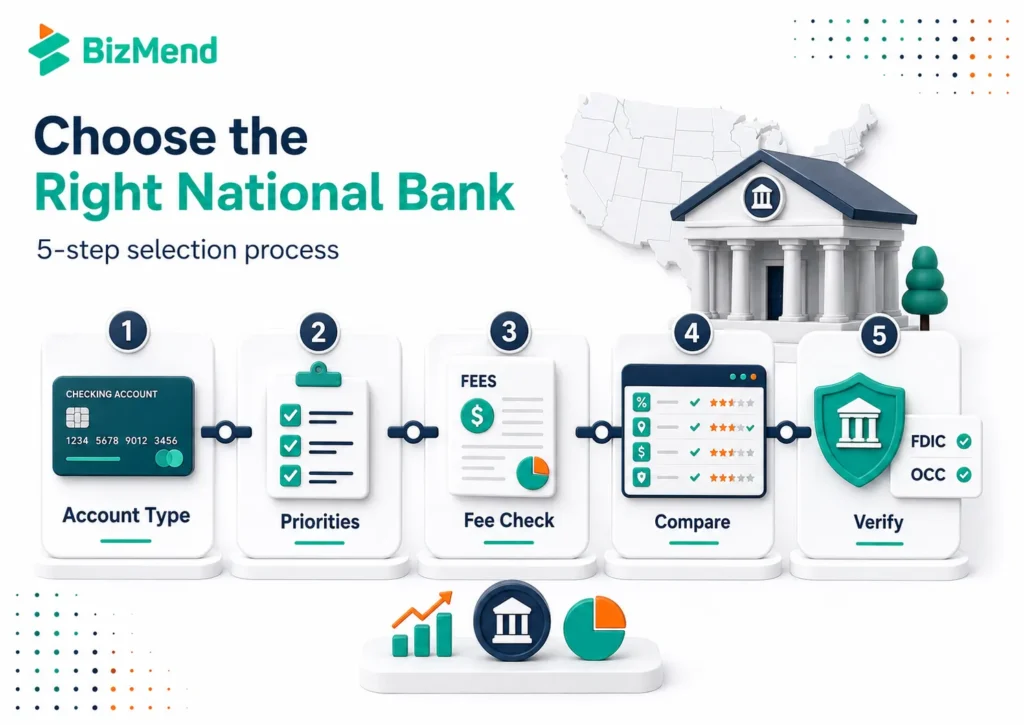
5 Steps to Choose the Right National Bank
1. Identify the primary account type you need. Decide whether the goal is everyday spending, an emergency fund, or a dedicated business account before comparing banks.
2. List two or three non-negotiables. Common ones include zero monthly fees, a large fee-free ATM network, or a specific APY floor.
3. Pull the current fee schedule from each bank’s own website. Third-party comparison sites can lag behind actual published disclosures by months.
4. Score each bank against the seven factors. Weight the factors that matter for the actual use case rather than treating them equally.
5. Confirm the bank’s charter and insurance status before funding the account. Search the OCC’s Financial Institution List or the FDIC’s BankFind tool to confirm the charter type and insured status.
Red Flags to Avoid When Choosing a National Bank
Watch for account terms that make comparison difficult or hide the real cost of the relationship.
- A promotional APY that resets to a far lower standard rate after a short introductory period without a clear disclosure of the new rate.
- Pressure to link several products together before the bank will disclose the actual fee schedule for the account being opened.
- Vague or missing overdraft fee disclosures, since overdraft charges at national banks have averaged roughly $27 to $33 per occurrence in recent surveys.
- No visible FDIC signage or an inability to confirm the charter status through the OCC or FDIC BankFind tool.
- A minimum balance requirement that is not clearly stated before account opening, discovered only after the first monthly statement.
National Bank vs. Online Bank or Credit Union
A national bank is a charter type, not a delivery channel, and several online-only brands are themselves divisions of nationally chartered banks operating without branches. The real comparison usually sits between a branch-heavy national bank, a branchless national or state-chartered bank, and a credit union. Credit unions are member-owned and insured by the National Credit Union Administration rather than the FDIC, though coverage limits are functionally similar. A savings account, checking account, or CD is simply a product type available at any of these institution categories; the account itself does not determine which type of charter holds the deposit.
Special Cases: Newcomers, Non-Residents, and Business Owners
Newcomers and non-citizens can open a personal account at most major national banks with an Individual Taxpayer Identification Number and a valid passport, though most large banks still require a branch visit for applicants without a Social Security number. Business owners face an additional requirement: banks ask for the company’s Employer Identification Number before opening a business account, so anyone unsure how to obtain one should review the steps to get an EIN first.
Founders who have not yet formed their company should work through a US formation checklist before applying, since most banks require formation documents alongside identification. Non-resident founders specifically should review the steps to register a US company. Many also need a registered agent service to satisfy a bank’s US address requirement. A detailed US bank account guide covers the remote application process in more depth for founders who cannot visit a branch in person.
Founders who have already set up their US entity, including US formation for Bangladeshis from abroad, generally follow the same seven-factor comparison for the business account, with branch access and wire transfer costs weighted higher than personal-account priorities.
Key Insights
- No single national bank fits everyone; match the account to your habits, not the brand name.
- Nearly every monthly fee can be waived with direct deposit or a minimum balance.
- Large branch-heavy banks pay minimal savings APY; Online-focused banks consistently pay more.
- FDIC coverage caps at $250,000 per depositor, per bank, per ownership category.
- Non-citizens can open accounts with an ITIN, though most require a branch visit.
- Confirm current fees and rates on the bank’s own website, not a summary article.
Final Thoughts
Choosing a national bank in the US rarely comes down to brand size. It comes down to whether the fee structure, balance rules, and digital tools match how you bank. A frequent traveler who values branch access weighs the decision differently than someone parking a six-figure emergency fund and chasing yield. Run the comparison carefully, and the answer usually becomes clear within minutes.
Fee schedules and APYs change without much warning, so confirm current terms directly on the bank’s website before applying, not from an older summary article. Non-citizens, business owners, and anyone holding deposits above 250,000 dollars at one institution should always confirm the specific rules with the bank or a financial adviser rather than relying on general guidance.
Frequently Asked Questions
What is the best national bank in the USA?
There is no single best national bank; the right choice depends on fee tolerance, balance size, branch needs, and digital habits. Capital One suits low-balance, no-fee preferences, while Chase, Bank of America, and Wells Fargo suit customers who want a large branch and ATM network and can meet fee waivers.
How is a national bank different from a state bank or online bank?
A national bank holds a federal charter from the OCC; a state bank answers to a state banking department instead. Both carry FDIC insurance and offer similar products. Online banks are often divisions of nationally or state-chartered banks operating without branches, so the charter type and the delivery channel are separate questions.
Can I open a national bank account without a Social Security number?
Yes, using an Individual Taxpayer Identification Number along with a valid passport or other government-issued photo identification. Most major national banks still require a branch visit for applicants without a Social Security number, since online applications typically cannot process an ITIN alone.
How much does a national bank checking account typically cost per month?
Monthly fees at major national banks range from $0 at Capital One to $15 at Wells Fargo, with Chase, Bank of America, and U.S. Bank charging $12. Nearly every fee can be waived through a qualifying direct deposit or minimum balance, and the national average maintenance fee was $13.95 in the most recent MoneyRates survey.
Is my money safe at a national bank?
Yes, up to FDIC limits. Coverage applies up to $250,000 per depositor, per insured bank, per ownership category, and no depositor has lost FDIC-insured funds since the agency’s founding in 1933. Balances above that limit at one bank in one ownership category are not automatically covered.
Should I choose a national bank or a credit union?
It depends on priorities. National banks generally offer wider branch networks, more products, and nationwide consistency. Credit unions are member-owned, often charge fewer fees, and can offer better rates, but membership eligibility and branch networks are usually smaller. Compare the same seven factors against both.
How do I confirm a bank is federally chartered before opening an account?
Search the OCC’s Financial Institution List at occ.gov or the FDIC’s BankFind Suite at fdic.gov. Both tools confirm charter type and current insured status for any US depository institution before you submit an application or deposit funds.
