

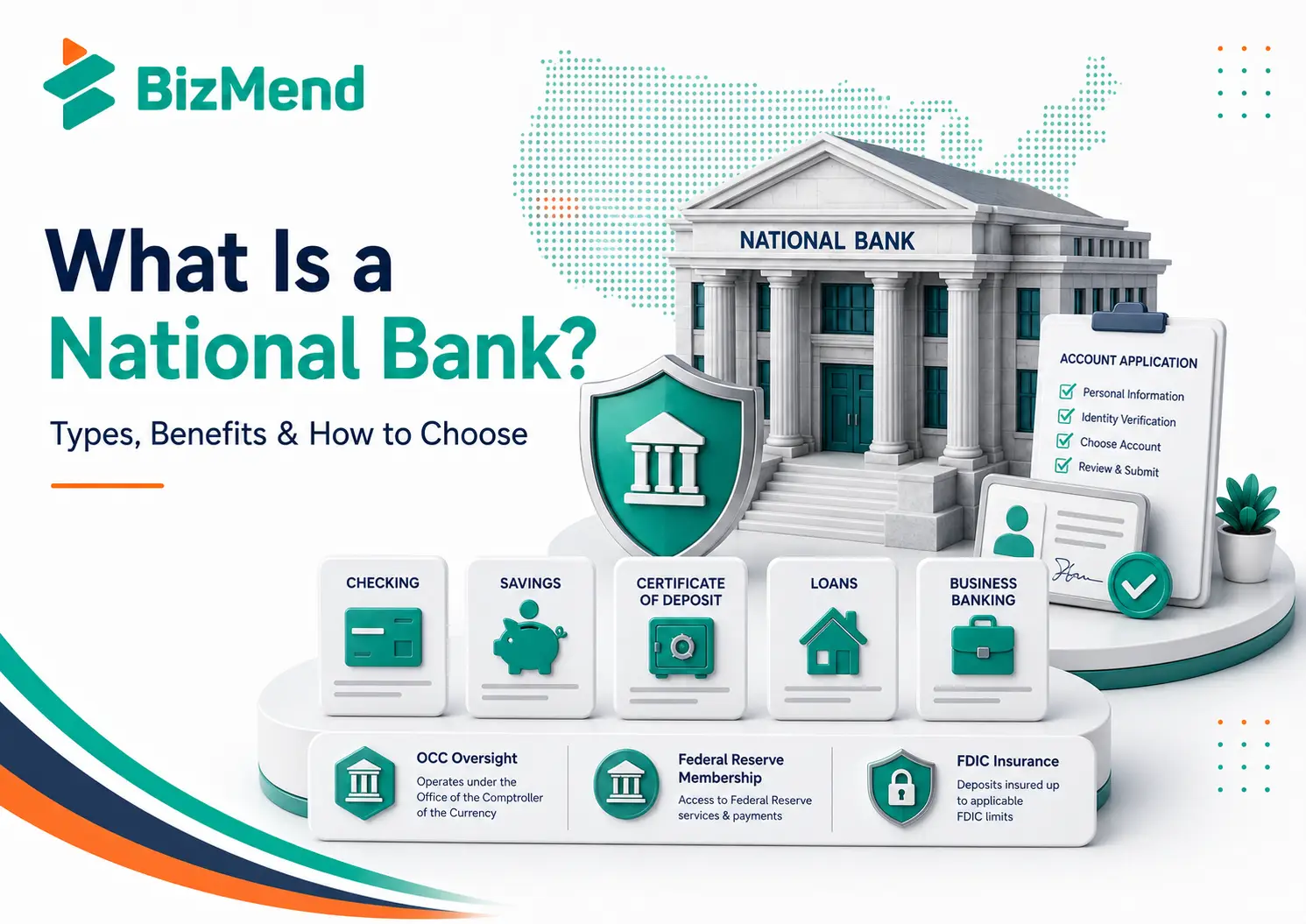
All national banks must join the Federal Reserve System and carry FDIC deposit insurance. Federal oversight, uniform consumer protections, and broad product access explain why national banks hold the majority of US household deposits, according to FDIC banking statistics.
Quick Answer: A national bank is a federally chartered commercial bank regulated by the OCC. It must belong to the Federal Reserve System, carry FDIC deposit insurance up to $250,000 per depositor per ownership category, and operate under federal law. JPMorgan Chase, Bank of America, Wells Fargo, and Citibank are well-known examples.
What Is a National Bank in the United States?
The OCC defines a national bank as a financial institution chartered and regulated by that agency. You can usually spot one by the words “National,” “National Association,” or the abbreviations “N.A.” or “NT&SA” in its legal name. JPMorgan Chase Bank, N.A. carries this designation because it holds a federal charter, not a state one.
That federal charter carries real consequences. National banks operate under federal banking law, which means they can sometimes override certain state consumer protection or lending rules that would otherwise apply to state-chartered institutions. OCC examiners conduct regular safety and soundness reviews, giving each national bank a single primary federal regulator. The FDIC covers deposits, and the Federal Reserve oversees monetary policy and acts as lender of last resort.
The OCC maintains an updated list of all active national banks and federal branches at occ.gov, refreshed monthly. That list is the authoritative check for confirming whether any institution holds a federal charter.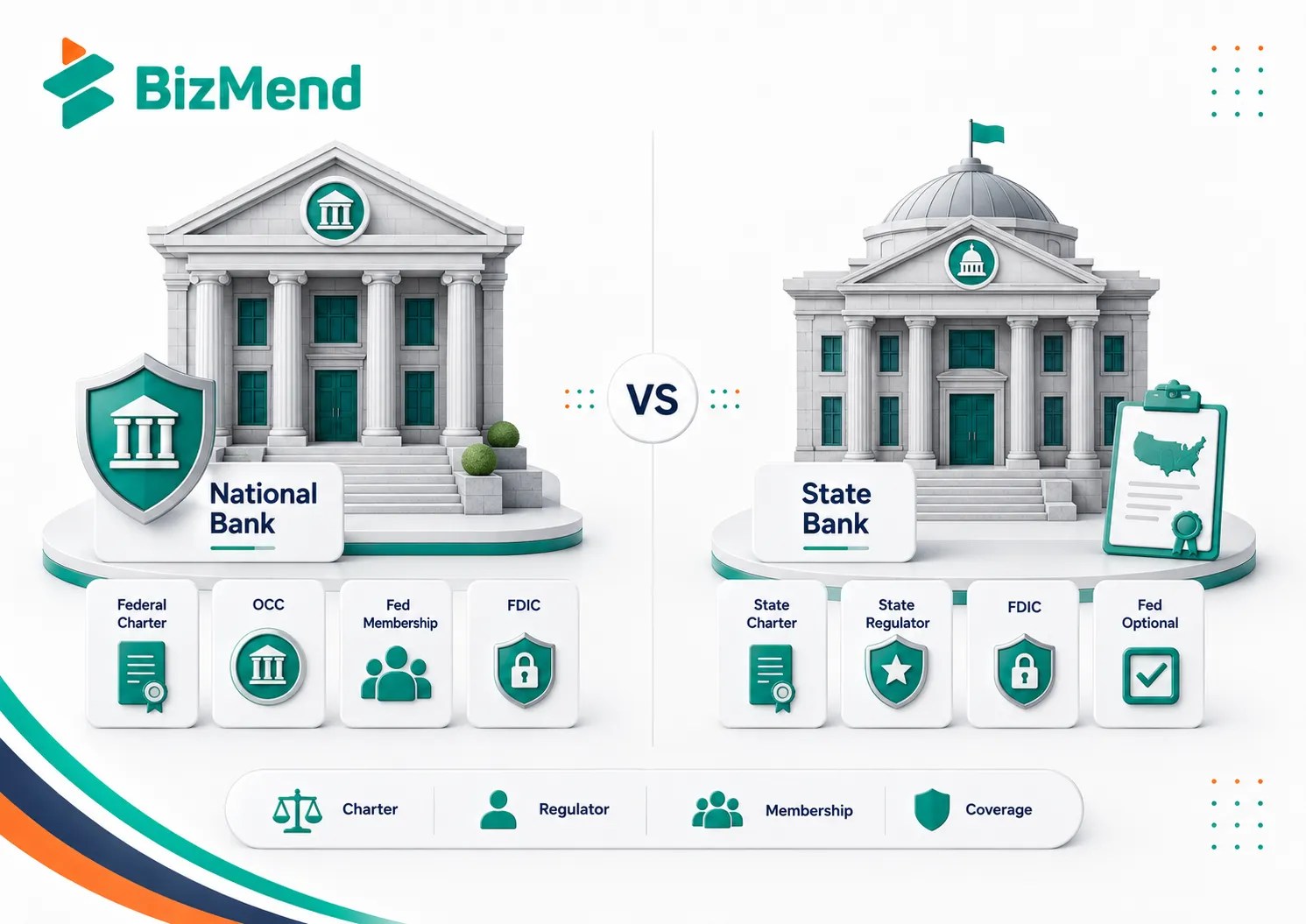
National Bank vs. State Bank: What the Difference Means for You
The US runs a dual banking system: banks can receive their operating authority from either the federal government or an individual state. A national bank’s charter comes from the OCC; a state bank’s comes from the relevant state banking department, such as the New York Department of Financial Services or the California Department of Financial Protection and Innovation.
For most depositors, day-to-day differences are small. Both types carry FDIC deposit insurance, and both offer checking accounts, savings accounts, loans, and payment services. The regulatory distinction matters more in lending: national banks can follow federal standards in situations where those standards differ from state rules, giving them more flexibility to offer consistent products across all fifty states. That is one reason the country’s largest institutions are almost all nationally chartered.
| Feature | National Bank | State Bank |
|---|---|---|
| Charter issued by | OCC (federal) | State banking department |
| Primary regulator | OCC | State regulator plus FDIC or Federal Reserve |
| Federal Reserve membership | Required | Optional |
| FDIC insurance | Required | Required if federally insured |
| Can operate across all states | Yes, under federal charter | Subject to state branching rules |
| Name identifier | Usually includes “National,” “N.A.,” or “NT&SA” | No federal naming requirement |
How a National Bank Works: Structure and Operations
An OCC-granted charter authorizes the bank to accept deposits, make loans, issue credit cards, and offer a wide range of financial services. After chartering, the bank joins the Federal Reserve System and registers with the FDIC, putting it under a three-agency oversight structure from day one. OCC examiners then conduct periodic safety and soundness reviews to verify capital adequacy, risk management, and consumer compliance.
Deposit insurance is automatic. FDIC coverage applies up to $250,000 per depositor, per insured bank, per account ownership category, with no application or fee required from the depositor. A joint account and a single-owner account at the same national bank count as separate ownership categories, which can push effective insured coverage above the headline limit.
On the lending side, national banks fund mortgages, auto loans, personal loans, small business lines, and commercial real estate by deploying the deposits they collect. The Federal Reserve’s benchmark federal funds rate shapes this relationship: when the Fed moves rates, borrowing costs and savings yields at national banks generally follow.
National Bank Account Types and Services
Checking, savings, certificates of deposit, loans, and business services are the core product categories at any full-service national bank.
Checking Accounts
Checking accounts handle everyday spending: debit card purchases, bill pay, direct deposit, and check writing. Most national banks tier their checking options from basic to premium. Basic accounts carry a monthly maintenance fee that is waived when a minimum direct deposit or balance threshold is met. Some banks, Capital One among them, charge no monthly fee at all. According to Bankrate’s 2025-2026 fee survey, the average monthly fee for an interest-bearing checking account reached $15.65 in 2026, with an average balance of $10,705 required to waive it.
Savings Accounts
Standard savings accounts at the largest national banks pay low annual percentage yields, often near 0.01 percent. The convenience of in-person branch access comes at a cost in yield. Online-focused national banks and high-yield accounts at mid-size institutions consistently pay more, and the spread between the two has been several percentage points in recent years. Anyone prioritizing yield should compare rates before committing to a branch-heavy institution.
Certificates of Deposit
CDs trade liquidity for a guaranteed fixed rate. Terms run from 30 days to five years or longer at most national banks. Early withdrawal triggers a penalty of several months’ interest. All CDs at FDIC-insured national banks carry deposit insurance within the standard limits.
Loans and Credit Products
National banks originate mortgages, home equity lines, auto loans, personal loans, student loan refinancing, and small business credit. By Q4 2024 (Federal Reserve data), the four largest were JPMorgan Chase Bank at $3.46 trillion in assets, Bank of America at $2.59 trillion, Wells Fargo Bank at $1.71 trillion, and Citibank at roughly $1.76 trillion. Their scale allows consistent underwriting across all states, though community banks often match or beat their terms for relationship borrowers.
Business Banking
Entrepreneurs who have completed US company registration need a business bank account to receive payments, pay vendors, and separate personal and business finances. National banks offer dedicated business checking, merchant services, payroll products, commercial lending, and business credit cards. The bank will ask for the company’s EIN; business owners unsure how to obtain one can follow the US LLC EIN guide on Bizmend for step-by-step instructions.
Requirements to Open a National Bank Account
Section 326 of the USA PATRIOT Act requires every national bank to run a Customer Identification Program (CIP) before opening any account. That means collecting and verifying identity information from every applicant, regardless of citizenship status.
Documents You Will Need
- Government-issued photo ID: A US driver’s license, state ID, or US passport. Non-citizens may use a foreign passport, alien identification card, or another government-issued document showing nationality or residence.
- Taxpayer identification number: US citizens and permanent residents use a Social Security Number. Non-citizens without an SSN can use an Individual Taxpayer Identification Number (ITIN). A June 2025 joint order from the OCC, FDIC, and NCUA created an exemption that lets participating banks obtain tax ID information from third parties under certain conditions, easing account opening for some non-citizen applicants.
- US mailing address: Most national banks require a current US address for CIP compliance and account correspondence.
- Initial deposit: Opening deposit requirements vary. Many checking accounts at large national banks have no minimum, though savings accounts and CDs typically do.
Non-citizens without an SSN almost always need to apply in person, since online systems at most major national banks cannot process applications without one. Bring a passport plus a second form of ID and call ahead to confirm what the specific branch accepts. Those who have already registered a US company as a non-resident will also need the EIN, articles of organization, and operating agreement for business accounts.
Important: Account-opening policies for non-citizens vary by institution and sometimes by branch. Major national banks including JPMorgan Chase, Bank of America, Wells Fargo, and Citibank do accept international students and foreign nationals in many circumstances, but requirements differ. Always confirm with the specific bank before the visit.
Benefits of Choosing a National Bank
National banks hold the largest share of US household deposits because four practical advantages set them apart.
Geographic Access
JPMorgan Chase operates more than 5,000 branches and roughly 15,000 ATMs nationwide. Bank of America runs about 3,600 domestic branches, and Wells Fargo maintains more than 4,100 locations across 39 states. For someone who travels regularly or may relocate, this reach is hard to match. Many national banks also participate in large fee-free ATM networks, extending access well beyond their own branded machines.
Product Breadth
A full-service national bank handles checking, savings, mortgages, auto loans, investment accounts, credit cards, and business services in one place. Customers who consolidate their finances at one institution may qualify for relationship pricing benefits, such as waived fees or reduced loan rates tied to holding multiple accounts or maintaining higher balances.
Federal Consumer Protections
National bank customers fall under federal consumer protection laws enforced by the Consumer Financial Protection Bureau (CFPB), covering mortgage disclosures, credit card billing, overdraft practices, and fair lending. The OCC enforces these rules through its examination process. The protections apply uniformly across every state, so moving does not change what you are owed as a customer.
FDIC Insurance Stability
Every national bank carries FDIC insurance as a condition of its charter. Since 1933, no depositor has lost a single dollar of FDIC-insured funds in a bank failure. Structuring accounts across ownership categories, such as individual and joint, can extend total insured coverage beyond $250,000 at a single institution.
Trade-offs Worth Knowing Before You Commit
Scale cuts both ways. The same size that gives national banks their reach also explains the areas where they fall short.
Savings yields at large branch-heavy national banks are consistently low. These institutions attract deposits through convenience and brand recognition, so they do not need to compete on rate. Online banks and credit unions routinely pay APYs several percentage points higher. An online bank paying 4 percent on a savings account versus a major national bank paying 0.01 percent is roughly a $400 annual difference on $10,000, compounding over time.
Monthly maintenance fees are a real ongoing cost. The average fee for a checking account reached $13.51 per month in 2026, according to a MoneyRates survey, though most banks waive it when direct deposit or balance minimums are met. Overdraft fees averaged $32.75 per occurrence in 2026 at banks that still charge them, though many large national banks have restructured or eliminated them under competitive pressure.
Customer service quality also differs from what a community bank or credit union offers. Large national banks apply standardized underwriting models that leave less room for individual judgment, particularly on small business loans and complex personal situations.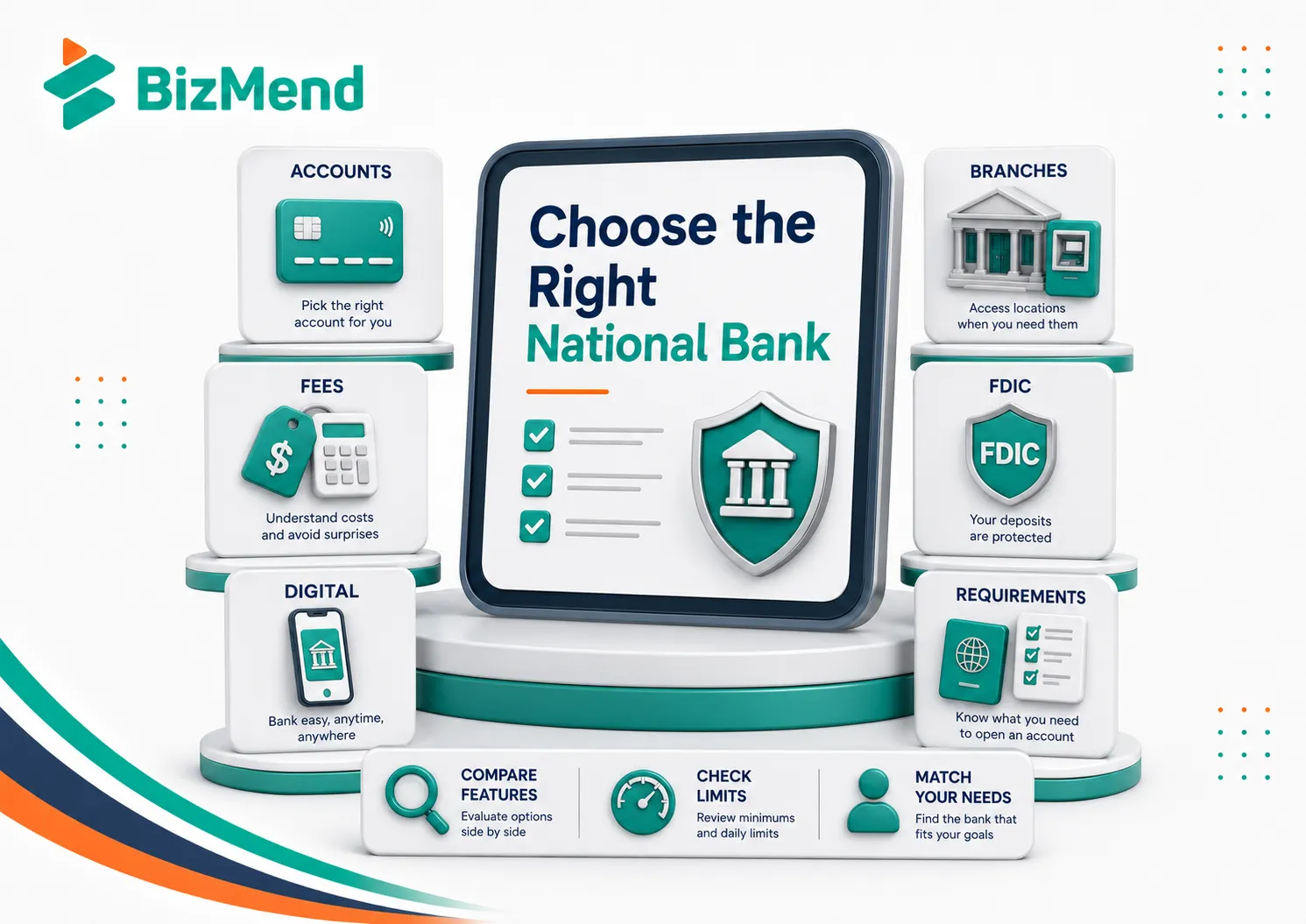
How to Choose the Right National Bank
Matching a bank to your situation beats choosing by name recognition alone. Four factors drive most of the decision.
Start With What You Actually Need
Identify the product you need first, whether that is a checking account, a mortgage, or a business banking relationship. Someone opening their first account can review the available bank account types before deciding; an entrepreneur working through a US formation checklist and preparing to launch a business has different priorities entirely. If high-yield savings is the primary goal, a mid-size or online-focused national bank will outperform the four largest institutions every time.
Compare Fees Before Signing Up
Monthly maintenance fees, overdraft policies, ATM fee structures, and wire transfer charges all vary significantly across national banks. Capital One 360 Checking carries no monthly fee at all; Chase Total Checking requires qualifying direct deposit or a minimum daily balance to avoid $15 per month as of August 2025. Checking the fee schedule on the bank’s website, not a third-party summary, gives the accurate current number.
Match Digital Capabilities to Your Habits
J.D. Power’s 2025 US National Banking Satisfaction Study ranked Capital One first among national banks for overall customer satisfaction, a result that largely reflects its digital platform. Before committing, look at current app store ratings, CFPB complaint data, and whether the bank offers real-time alerts, mobile check deposit, and person-to-person transfers without added fees.
Account for Your Deposit Size
Depositors holding more than $250,000 at one institution need a plan. The FDIC’s free Electronic Deposit Insurance Estimator (EDIE) at fdic.gov shows exactly how much is covered based on account type and ownership category. Those still deciding where to bank can also compare options through a US bank account guide that addresses non-resident-specific requirements and CIP procedures in detail.
Notable National Banks at a Glance
The table below uses Federal Reserve large commercial bank data as of Q4 2024. Asset figures change quarterly; verify current numbers through the Federal Reserve’s published releases or the FDIC Statistics on Depository Institutions tool before publication.
| Bank | Assets (Q4 2024) | Notable Features |
|---|---|---|
| JPMorgan Chase Bank, N.A. | $3.46 trillion | Largest US bank; 5,000+ branches; 15,000 ATMs |
| Bank of America, N.A. | $2.59 trillion | ~3,600 branches; Merrill wealth management; Preferred Rewards tiers |
| Wells Fargo Bank, N.A. | $1.71 trillion | 4,100+ branches across 39 states |
| Citibank, N.A. | ~$1.76 trillion | 660 US branches; 60,000+ fee-free ATMs; relationship perks from $30,000 |
| U.S. Bank National Association | ~$671 billion | 2,100 branches in 26 states; interest-bearing checking available |
| Capital One, N.A. | ~$490-649 billion | No monthly fees on 360 products; top 2025 J.D. Power satisfaction ranking |
How Federal Oversight Protects National Bank Customers
Three agencies share responsibility for the national bank safety net. The OCC examines each bank for safety, soundness, and consumer compliance. The FDIC insures deposits and, when a bank fails, typically resolves the situation within days by transferring accounts to a healthy institution or paying depositors directly. The CFPB sets and enforces consumer protection rules on mortgages, credit cards, overdraft practices, and fair lending that apply uniformly to all national banks regardless of state.
Founders or operators who have already formed a US company should note that the same federal consumer protection framework that covers personal accounts also applies to business deposit accounts at national banks. Business owners still comparing entity structures can review the trade-offs in the LLC vs C corporation article before choosing the structure that fits their banking and tax needs.
Key Insights
- National banks hold OCC federal charters and must join the Federal Reserve System and carry FDIC insurance.
- FDIC coverage applies up to $250,000 per depositor, per bank, per ownership category.
- Large branch-heavy national banks consistently pay lower savings APYs than online banks and credit unions.
- Non-citizens without an SSN can use an ITIN but typically must apply in person at a branch.
- Monthly maintenance fees averaged $13.51 in 2026; most banks waive them when deposit conditions are met.
- The right national bank depends on product needs, fee tolerance, digital habits, and deposit size.
Final Thoughts
Federal supervision, FDIC insurance, and a full product range make a national bank a practical first choice for US residents and newcomers. The structural protections are consistent across institutions, so the real work is comparing fees, yields, branch access, and digital quality among banks that all clear the same regulatory floor. That comparison, not brand size, separates a good fit from an expensive mistake.
Before opening an account, verify the current fee schedule on the bank’s website, use the FDIC’s BankFind tool to confirm insured status, and check the FDIC’s EDIE calculator if your balance may exceed $250,000. Fee structures and coverage rules change, and no article substitutes for verifying current terms directly with the institution or a financial adviser.
Frequently Asked Questions
What is a national bank in simple terms?
A national bank is a private commercial bank that received its operating charter from the OCC rather than a state agency. It must join the Federal Reserve System and carry FDIC deposit insurance. The words “National,” “N.A.,” or “NT&SA” in a bank’s legal name usually signal a federal charter.
How does a national bank differ from a state bank?
The charter source is the key difference. A state bank answers to its state banking department plus either the FDIC or the Federal Reserve as its federal backstop. A national bank answers to the OCC. Both types carry FDIC insurance and offer the same core products; the difference is regulatory, not operational, for most depositors.
Is my money safe in a national bank?
Yes, within FDIC limits. Coverage applies up to $250,000 per depositor, per insured bank, per ownership category. Since 1933, no depositor has lost insured funds in a bank failure. Balances above the limit per category at one institution are not automatically covered, so large depositors should use FDIC’s EDIE tool to map their exposure.
Can a non-citizen open an account at a national bank?
Yes, with an ITIN and a valid government-issued photo ID. Most major national banks require a branch visit for non-SSN applicants. A June 2025 regulatory change lets participating banks source taxpayer identification from third parties under certain conditions, which may simplify account opening at those institutions.
What fees should I expect at a national bank?
Monthly maintenance fees averaged $13.51 in 2026, waivable at most banks by meeting direct deposit or balance minimums. Overdraft fees averaged $32.75 per occurrence in 2026 at banks that still charge them. Wire transfers, out-of-network ATMs, and paper statements carry additional charges that vary by institution. Review the bank’s current fee schedule directly before opening.
Do national banks pay competitive interest rates on savings?
Not typically. The largest national banks pay low APYs on savings accounts because they attract deposits through convenience rather than yield. Online-focused national banks and credit unions consistently pay more. For loan products, national bank rates are broadly competitive, though community banks sometimes offer better pricing for relationship borrowers.
How do I confirm a bank holds a national charter?
Search the OCC’s monthly-updated Financial Institution List at occ.gov, or use the FDIC’s BankFind Suite at fdic.gov. Both tools confirm charter type and insurance status for any US depository institution.
