
 by Sheikh Ornob
Foreign companies often want a Bangladesh presence before they commit to a full subsidiary. That’s where a liaison office comes in. It gives you a local desk, local staff, and a formal approval route without pretending you’re already built for sales.
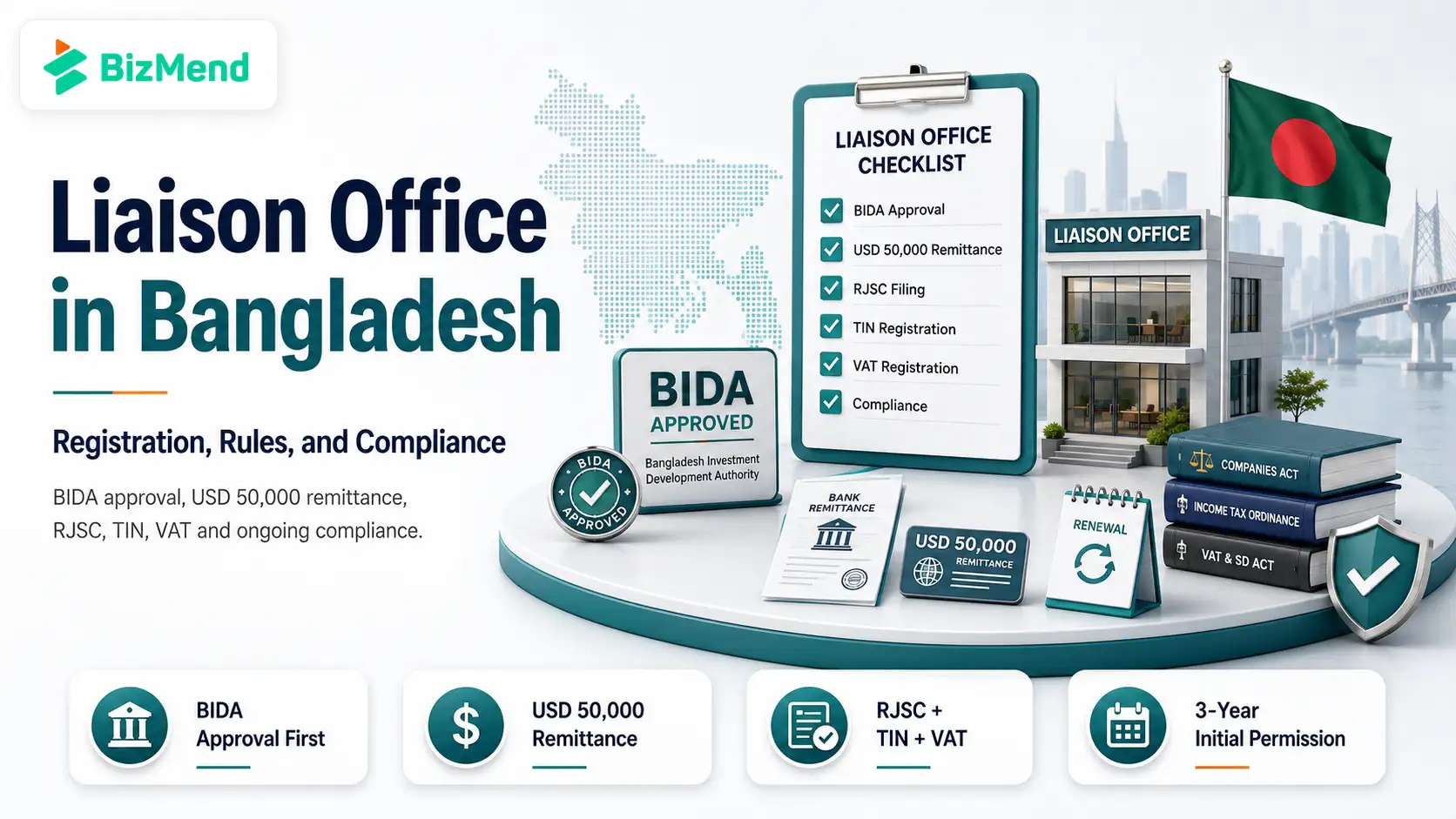
In Bangladesh, this setup runs through BIDA’s commercial office process, and the paperwork matters more than most first-time entrants expect. You need approval, a bank account, inward remittance, Bangladesh Bank notification, RJSC filing, tax registrations, and then ongoing renewals if you keep the office open. This guide explains what a liaison office usually means, how it compares with a representative office, what it can realistically do, and where compliance pressure shows up first.
What Is a Liaison Office in Bangladesh
At a practical level, a liaison office is the lightest formal market entry option for a foreign company that wants a presence in Bangladesh without forming a full local subsidiary. BIDA treats branch, liaison, and representative offices as one commercial office approval stream, and its FAQ says these offices of a foreign company must obtain registration from BIDA. That tells you two things fast: this is a recognized route, and it sits inside a supervised approval process rather than informal market testing.
Most foreign companies use this format when they want to study the market, build relationships, supervise vendors, support a parent company contract, or keep a local coordination desk open before larger investment decisions. The office can have premises, staff, visas, work permits, tax registrations, and bank reporting obligations, but it is still not the same thing as a locally incorporated company.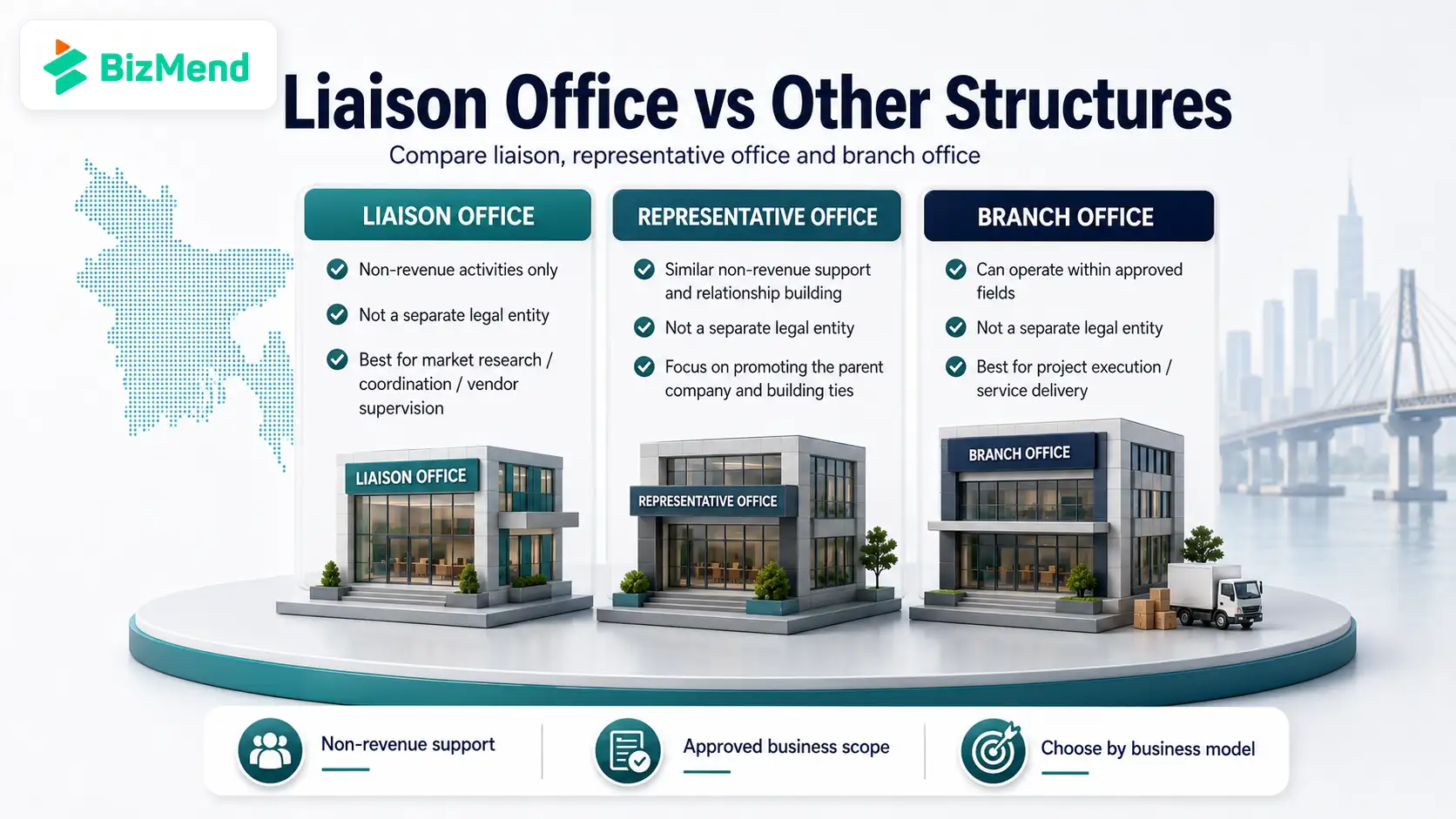
Liaison Office vs Representative Office in Bangladesh
BIDA’s public materials usually say branch, liaison, and representative office together, and the Bangladesh commercial office checklist does not separate liaison and representative office into two different application routes. So in Bangladesh practice, readers often use liaison office and representative office almost interchangeably. That said, you should still match the wording in your approval letter, board resolution, and bank filings to the exact label BIDA approves.
If your Bangladesh team needs to carry on revenue work, sign local sales contracts, or handle import and export activity as an operating arm of the parent, you should stop and compare a branch office or a subsidiary instead. BIDA’s FAQ expressly notes that a branch office engaged in export and import needs export and import registration certificates, which is a useful signal that operating activity belongs in a different structure than a pure liaison presence.
What a Liaison Office Can and Cannot Do
As a working model, a liaison office is usually best for non revenue activity: market research, parent company representation, supplier coordination, quality monitoring, feasibility work, and communication with regulators, banks, or potential partners. It is the right fit when the Bangladesh office supports the parent company rather than becoming the commercial center of the business. This is why foreign groups often use it as a first step, not the final structure.
Where founders get into trouble is treating the office like a quiet subsidiary. If the local team starts invoicing customers, booking local income, or carrying on trading activity beyond the approved scope, the legal and banking position gets harder very quickly. The safe way to think about it is simple: read the activity description in the BIDA application as a limit, not as a suggestion, and line up the real business model with that description before you launch.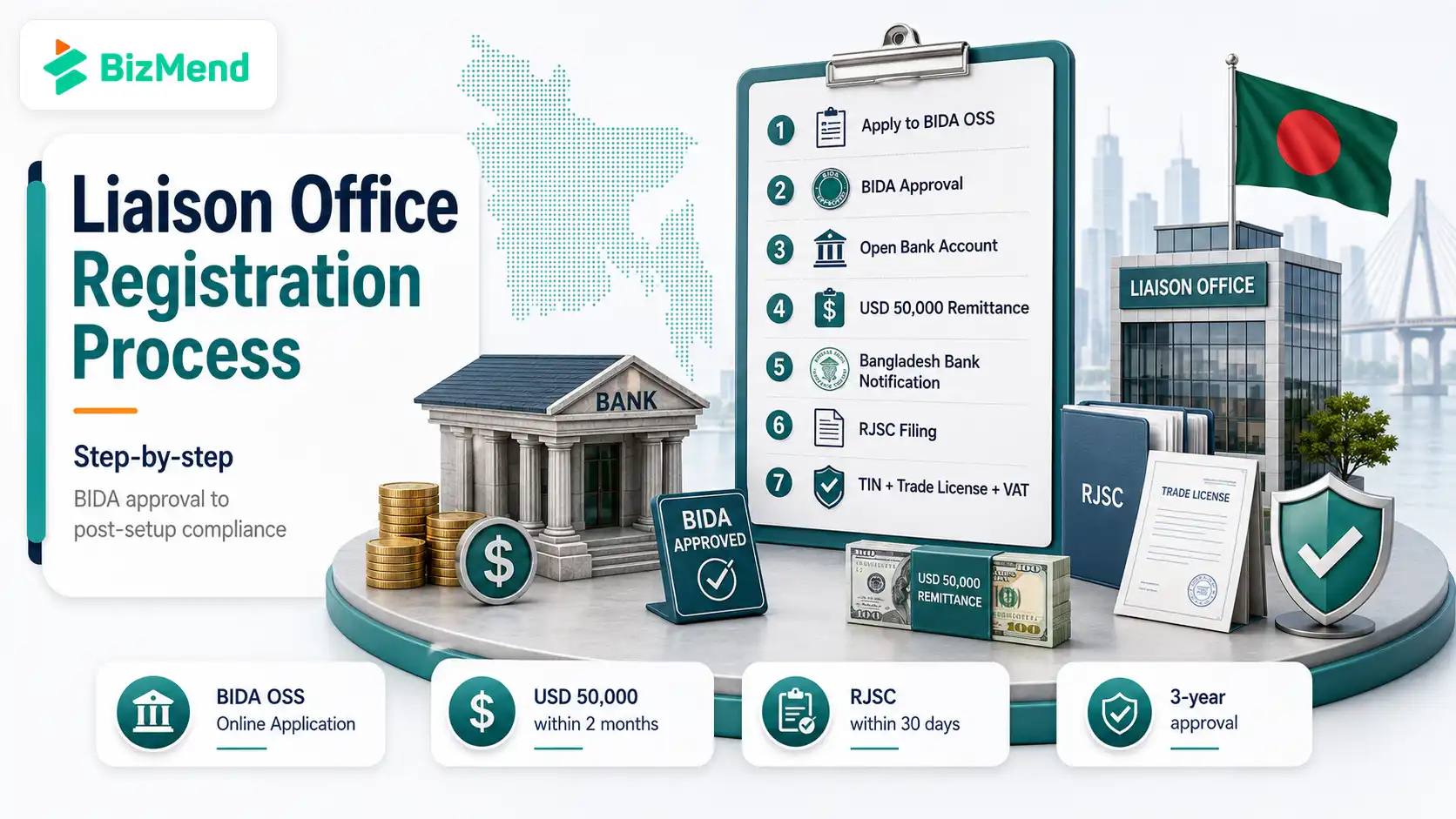
How Registration Works, Step by Step
Step 1 is the BIDA OSS application. BIDA’s FAQ says the route runs through OSS, and the official service page lists a 16 working day service timeline for opening a branch, liaison, or representative office, subject to inter ministerial committee approval. A separate BIDA FAQ also says that committee sits twice a month, which is useful for planning because the practical calendar is not just the portal clock.
Step 2 is the document pack. BIDA lists the core set as the board resolution for opening the office, audited accounts for the previous financial year, proposed organogram, details of the parent company’s activities, names and nationalities of directors or owners, the parent company’s memorandum and articles, certificate of incorporation, an authorization letter, and a clear description of what the Bangladesh office will do.
Step 3 is attestation and hard copy follow through. BIDA says the documents must be attested by the relevant Bangladesh mission, the mission of the respective country in Bangladesh, or the respective country’s apex business chamber, and after online submission the hard copies still go to BIDA’s Commercial Wing. That catches a lot of first time applicants because the process is digital, but it is not digital only.
Step 4 is fees and approval horizon. The current service page lists a BDT 25,000 fee for opening the office, and BIDA’s FAQ notes that commercial office registration also attracts 15 percent VAT. The same FAQ states that the initial approval is for 3 years.
What Happens After BIDA Approval
Approval is only the midpoint. BIDA’s FAQ says that after approval you rent the office, open a Bangladesh bank account, and bring in foreign exchange equivalent to at least USD 50,000 within 2 months from the approval date. The same checklist then requires notification to Bangladesh Bank under section 18B within 30 days, RJSC filing within 30 days under section 379 of the Companies Act, a TIN, a trade license, and VAT registration with NBR.
If you plan to staff the office with expatriates, timing matters. BIDA’s FAQ says the employer must apply for the work permit within 15 days of the expatriate’s arrival, while the commercial office service page lists the new work permit fee at BDT 5,000 per person per year with a 16 working day processing time. In other words, immigration and office setup should be planned together, not one after the other.
Ongoing Compliance Obligations You Should Expect
Ongoing compliance is where a liaison office starts to feel more real than its low profile image suggests. BIDA’s renewal checklist asks for the Bangladesh Bank notification letter, latest income tax clearance, parent company audited accounts, the Bangladesh office audit report, local and foreign manpower statement, up to date encashment certificate of inward remittance, and a copy of the last permission letter. It also says the renewal application should be filed at least 2 months before the current permission expires.
The renewal fee is currently BDT 10,000 and the listed processing time is 16 working days, again subject to inter ministerial approval. BIDA also has separate processes for address change, name change, waiver of conditions in the permission letter, work permit amendment, and work permit cancellation. So the real compliance posture is not just annual tax housekeeping. It is ongoing file maintenance across the office’s approvals, staffing, and reporting trail.
One more practical point: keep your remittance records, tax filings, office lease, manpower list, and parent company resolutions in a form you can produce quickly. The commercial office framework repeatedly asks for updated evidence, not just the original approval pack. If your internal records are scattered across head office, the Bangladesh office, and the bank, renewals get slower and riskier than they need to be.
When a Liaison Office Makes Sense, and When It Does Not
A liaison office makes sense when your Bangladesh plan is still about presence, coordination, and learning. It works well for market entry teams that need a local address, relationship building, feasibility research, vendor supervision, or a platform to support the parent company’s regional strategy. It also suits groups that want formal visibility with regulators and banks before they take on the heavier work of company incorporation.
It is a weak fit when the Bangladesh plan already includes local revenue, active service delivery, inventory movement, or broad commercial contracting. In that situation, a branch office or a locally incorporated company is usually the better comparison set. For readers already at that stage, the most natural internal follow ups are a company types guide, a BIDA approval guide, and a private limited company registration piece, because the choice is no longer about first presence. It is about operating structure.
Final Thoughts
A liaison office in Bangladesh is useful precisely because it is limited. If you want a formal local presence without jumping straight into a full operating company, it can be the right first move. Just do not mistake a lighter structure for light compliance. BIDA approval is only the front door. The real work is matching your scope, paperwork, bank trail, and renewal calendar from day one.
Key Takeaways
- A liaison office gives a foreign company a formal Bangladesh presence without forcing an immediate move into full company incorporation.
- BIDA is the main approval gate for branch, liaison, and representative offices outside the special zone regimes, and the office cannot be treated as an informal market test once approval is granted.
- The initial BIDA approval is generally for 3 years, and the setup checklist continues after approval with remittance, Bangladesh Bank notification, RJSC filing, tax registration, trade license, and VAT steps.
- The opening fee is currently BDT 25,000, renewal is BDT 10,000, and both are listed with a 16 working day service timeline that still depends on inter ministerial approval.
- If you are bringing in expatriates, work permit planning should start early because the employer is expected to apply within 15 days of arrival and the permit itself is a separate commercial office process.
- The safest way to use a liaison office is to keep the approved activity description narrow, support focused, and well documented from the first day of operation.
- If your Bangladesh plan already includes local revenue generation, broad service delivery, or import and export operations, you should compare a branch office or a locally incorporated company before filing.
- Renewal is not a formality, because BIDA asks for updated audit, tax, remittance, manpower, and approval records and wants the extension filing at least 2 months before expiry.
FAQ
Is a liaison office the same as a representative office in Bangladesh?
In Bangladesh practice, the two labels often overlap because BIDA groups liaison and representative offices within the same commercial office approval framework. Still, you should use the exact wording that appears in your BIDA permission letter and supporting filings so your bank, tax, and compliance records stay consistent.
How long does the initial approval usually last?
BIDA’s FAQ says the initial approval for a branch, liaison, representative, or project office is for 3 years. That does not mean you wait until the last minute, because the same public materials say renewal applications should be lodged at least 2 months before the current permission expires.
Is there a minimum inward remittance amount after approval?
Yes. BIDA’s published setup checklist says the office should bring in foreign exchange equivalent to at least USD 50,000 within 2 months of getting approval. That remittance trail matters later as well, because up to date encashment evidence appears again in the renewal checklist.
Does a liaison office still need RJSC, TIN, trade license, and VAT registration?
According to BIDA’s FAQ, yes. After approval, the checklist includes Bangladesh Bank notification, RJSC filing for certificate of filing, TIN, trade license, and VAT registration with NBR. A liaison office may be lighter than a subsidiary, but it is not free from local registrations.
When should you start the renewal process?
Start earlier than you think. BIDA’s extension checklist says the application should be submitted at least 2 months before the existing permission expires, and the filing package includes tax clearance, audit reports, remittance records, and updated manpower statements.
Can expatriates work in a liaison office?
Yes, but through the proper visa and work permit process. BIDA’s FAQ says the employer should submit the work permit application within 15 days of the expatriate’s arrival, and the commercial office service page lists a current fee of BDT 5,000 per person per year for a new work permit.