
 by Sheikh Ornob
Figuring out income tax in Bangladesh can feel harder than it should. You hear about slabs, TIN, return proof, and tax day, and suddenly a simple question turns into a full blown puzzle.
For ordinary individuals, the real question is simple. Do you need to file, how much of your income is taxable, and what does the return process look like in practice? This guide focuses on personal income tax, not company tax. It walks through the current Bangladesh rates, who may still need a return, what papers to keep ready, and how to submit a return without guessing through NBR language. Plenty of people do not know where salary tax ends and return filing begins.
Quick answer: As of May 2026, Bangladesh’s announced individual slabs for assessment year 2026 to 2027 start with a tax free threshold of Tk 375,000 for general taxpayers, then 10%, 15%, 20%, 25%, and 30% bands. You file through NBR with a TIN, supporting records, and your payable tax or credits worked out first.
Key Takeaways
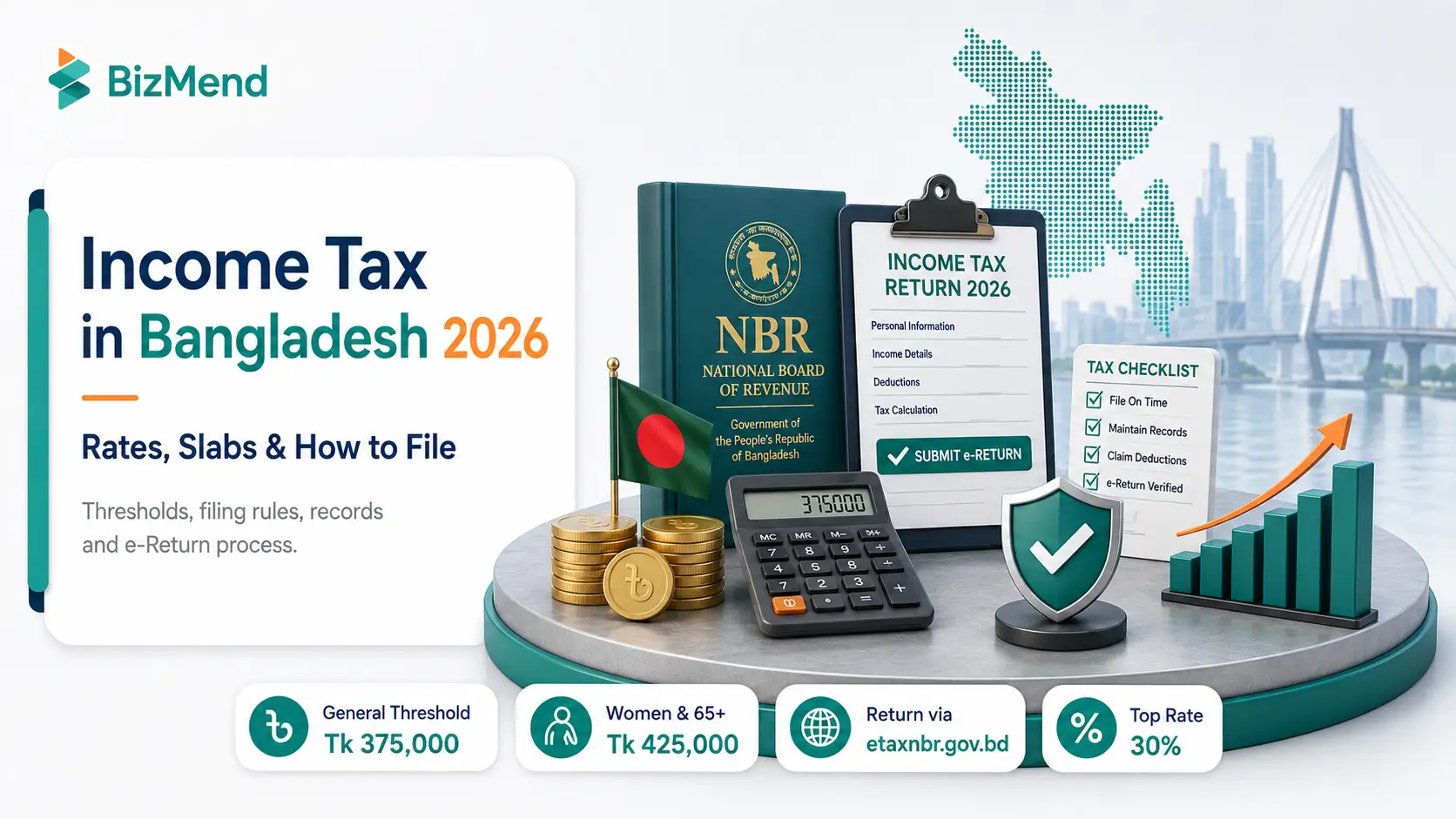
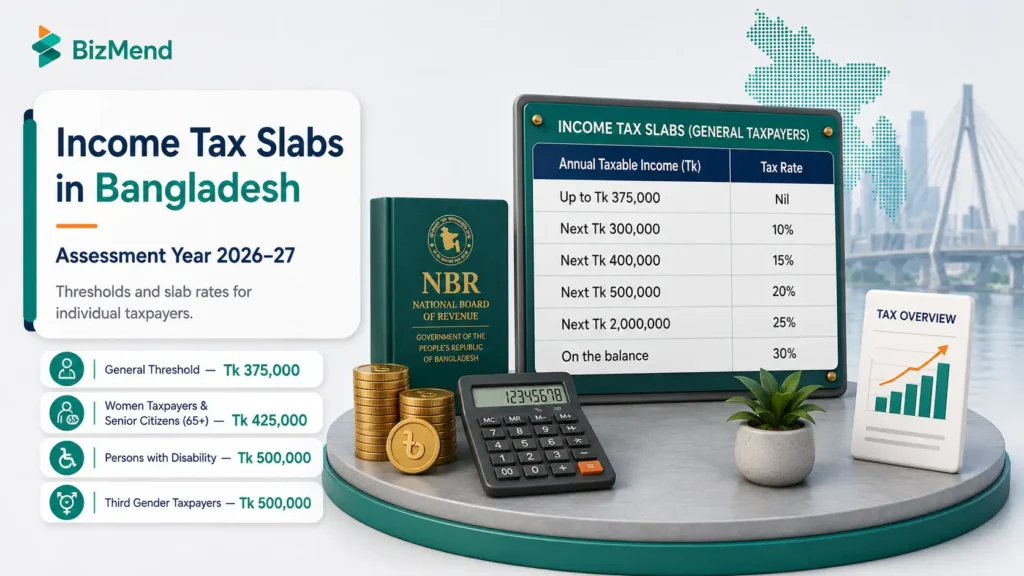
- For the announced assessment year 2026 to 2027 rates, a general individual taxpayer gets a tax free threshold of Tk 375,000.
- Women taxpayers and senior citizens aged 65 or more have a higher threshold of Tk 425,000, while persons with disability and third gender taxpayers get Tk 500,000.
- A slab does not tax your whole income at one rate. Each part of taxable income is taxed in layers.
- Many people still need to file a return even when the final tax is low or zero, especially if they need proof of return submission for banking, licensing, property, or professional matters.
- Under the current law, return filing can be mandatory if you were assessed in any of the last three years, hold a registered TIN, are a public servant, or hold certain company or management roles.
- The NBR e Return system uses `etaxnbr.gov.bd`, and registration requires a TIN plus a biometric verified mobile number.
- If your total assets exceed Tk 50 lakh, or you own a motor vehicle or certain property, you may also need to file an assets and liabilities statement with the return.
- Leaving the process for the deadline week is risky because profile mismatches, missing source tax details, and unpaid balances are what slow people down most.
What Income Tax in Bangladesh Means for Individuals
When most people search for income tax in Bangladesh, they are not asking about company tax. They want to know what happens to salary income, freelance income, rent, professional fees, and the return they personally have to file. That is the lane this article stays in. If you’re trying to set up a business in Bangladesh instead, How to Start a Business in Bangladesh as a Foreigner walks through the full setup path
For individuals, NBR looks at your total taxable income, the threshold that applies to your category, any source tax or advance tax already paid, possible rebates, and whether you still have a filing duty under the law. Your slab tells you how rates are layered. It does not mean every taka you earned gets hit with the highest rate you touched. That confusion causes a lot of unnecessary panic.
Which 2026 Income Tax Slabs Apply
As of May 14, 2026, the latest official rate table already published for individuals is the one announced for assessment years 2026 to 2027 and 2027 to 2028. Bangladesh also uses two time labels that people mix up constantly: the income year, when you earn the money, and the assessment year, when that income is assessed and the return is filed. If you want the current 2026 picture, this announced table is the one to watch.
Tax free thresholds by taxpayer category
The announced tax free threshold is not the same for everyone. Here is the current published threshold table for individual taxpayers and Hindu Undivided Families.
| Taxpayer category | Threshold |
|---|---|
| General taxpayer | Tk 375,000 |
| Women taxpayers and senior citizens aged 65 or more | Tk 425,000 |
| Persons with disability | Tk 500,000 |
| Gazetted war-wounded freedom fighters | Tk 525,000 |
| Gazetted “July Warriors” injured in the July Mass Uprising 2024 | Tk 525,000 |
| Third gender taxpayers | Tk 500,000 |
There is also an extra Tk 50,000 threshold increase for each child or adopted child with disability claimed by a parent or legal guardian. If both parents are taxpayers, only one parent can use that facility.
Personal tax slabs for general taxpayers
| Taxable income band | Rate |
|---|---|
| Up to Tk 375,000 | Nil |
| Next Tk 300,000 | 10% |
| Next Tk 400,000 | 15% |
| Next Tk 500,000 | 20% |
| Next Tk 2,000,000 | 25% |
| On the balance | 30% |
The same announced package says that if total income crosses the tax free limit, the flat minimum tax is Tk 5,000 regardless of location, while new taxpayers get a reduced minimum tax of Tk 1,000. That matters because even a low computed liability may not be the last number you pay.
A simple example so the slabs feel real
Say you are a general taxpayer with taxable income of Tk 900,000. The first Tk 375,000 is tax free. The next Tk 300,000 is taxed at 10%, which is Tk 30,000. The remaining Tk 225,000 falls into the 15% layer, which is Tk 33,750. Your tax from slabs is Tk 63,750 before any rebate, source tax credit, or other adjustment. That is why saying, “I am in the 15% slab,” never tells the whole story by itself.
Who Needs to File a Return Even If Tax Is Low
Crossing the tax free threshold is the obvious trigger, but it is not the only one. Under section 166 of the Income Tax Act, 2023, return filing can still be mandatory for several categories of people even when the final payable tax is small. Section 264 then adds a long list of situations where you must show proof that a return was filed.
- You generally must file if your total income is above the tax free threshold that applies to your category.
- You may also need to file if you were assessed to tax in any one of the previous three income years.
- Return filing can be mandatory if you are a shareholder director, a shareholder employee of a company, a partner of a firm, a public servant, or an employee in an executive or management position in a business.
- If you already hold a registered TIN as an assessee, section 166 can still pull you into the filing requirement.
- Proof of submission of return is currently required in many everyday situations, including some loans above Tk 20 lakh, trade license issue or renewal in city corporation or paurashava areas, becoming a director or sponsor shareholder, maintaining a credit card, and some land or apartment registrations above Tk 10 lakh.
- The law also lists examples such as English medium school admission for a child or dependent, registration or fitness renewal of many motor vehicles except two and three wheelers, certain electricity or gas connections, some professional memberships, and selling goods or services through digital platforms to consumers in Bangladesh.
So if you keep asking, “Do I owe tax?” you may be asking the second question first. The first question is, “Do I need a return for legal proof, compliance history, or status?” For many people, that is the real answer.
What You Need Before You Start Filing
A clean filing starts before you log in. The online process is much less stressful when you have the core records in one place, especially if your income comes from more than one source.
- Your 12 digit TIN and your NID or passport details.
- A mobile number that is biometric verified and can be used for e Return registration.
- Salary certificate, pay summary, or source tax records if you are employed.
- Bank interest details, savings instrument information, and any proof of tax already deducted.
- Rent or property income details if you earn from house property.
- Business or professional income records if you are self employed or freelance.
- Investment and rebate proof, such as eligible savings, insurance, or approved investment records where applicable.
- Your previous return acknowledgment if this is not your first filing.
You should also check whether you need the extra statements that many first time filers overlook. Under section 167, an individual must file a statement of assets and liabilities if total assets exceed Tk 50 lakh, if the person owns a motor vehicle, invests in a house or apartment inside a city corporation area, owns any asset abroad, or is a shareholder director of a company. All public servants must file that statement too. Under section 168, a lifestyle expense statement becomes mandatory in cases including income above Tk 500,000, business income, vehicle ownership, shareholder directorship, or certain city corporation property investments.
How to File Income Tax in Bangladesh Step by Step
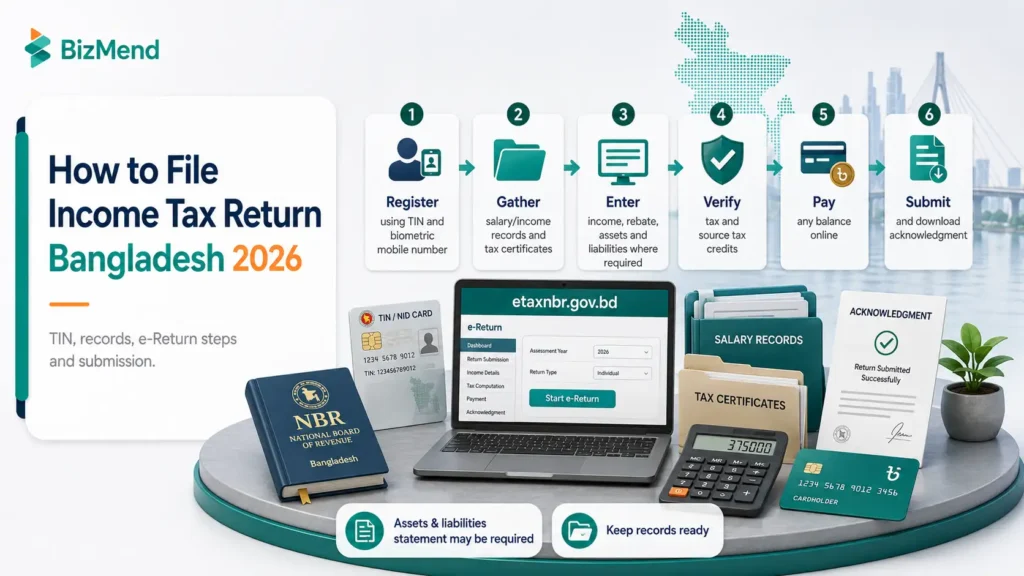
For most individual taxpayers, the practical route is the NBR e Return system. The public user manual for the current portal points people to etaxnbr.gov.bd, where e TIN, e Return, return verification, and tax services sit under one roof.
- Make sure your TIN profile is correct first. If your name, gender, or mobile number is wrong in the TIN system, fix that before you try to file.
- Register on the e Return portal using your TIN and biometric verified mobile number, then create your password.
- Open a regular e Return and enter the assessment information and the heads of income that apply to you, such as salary, property, agriculture, business, capital gains, financial assets, or other sources.
- Fill the income details carefully, then move through the rebate, expenditure, and assets and liabilities tabs where required.
- Review your source tax and advance tax claims. The system can pull or verify some items, but not every claim is auto verified, so your records still matter.
- If a balance remains payable, use the payment step. The NBR manual says online banking, cards, and mobile banking options are available through the payment gateway.
- From the tax and payment page, proceed to the online return preview, check the full draft, then submit the return and download the acknowledgment and return related certificates from the tax record area.
One useful practical note: in the published e Return manual for assessment year 2025 to 2026, NBR said taxpayers generally do not need to upload supporting documents at the time of online submission. That does not mean the papers do not matter. It only means you should keep them ready for correct data entry and possible later verification.
Common Mistakes First Time Filers Make
Most filing problems are not dramatic. They are small, preventable mistakes that pile up. Here are the ones that waste the most time.
- Treating the slab rate as if it applies to your whole income.
- Ignoring source tax, advance tax, or salary deduction records that should be credited in the return.
- Skipping the assets and liabilities statement or lifestyle expense statement when the law clearly makes them mandatory.
- Waiting until the deadline to discover that your mobile number, TIN profile, or login details do not match.
- Assuming zero payable tax means zero filing duty.
- Using rough estimates for bank interest, rent income, or professional receipts instead of checking the real numbers.
And yes, deadlines matter. Late filing can bring penalties under the law, so filing early is not just good behavior. It is usually the easiest way to avoid silly damage.
Should You File It Yourself or Get Help
If your case is straightforward salary income with clean source tax records, doing it yourself is realistic. Once business income, property income, foreign assets, or multiple tax credits enter the picture, the form gets less forgiving and the review burden grows fast.
If the paperwork is what keeps delaying you, outside help is a real option. Third-party service providers handle filing and compliance related work in this broader space. Use help if your facts are messy, not because the form looks intimidating.
Final Thoughts
Income tax in Bangladesh gets much easier once you separate three things: who must file, how slabs work, and what proof NBR may ask for later. Get your TIN, records, and return done early, and the process feels administrative, not mysterious.
Frequently Asked Questions
Do I need to file if my salary tax is already deducted at source?
Often, yes. Source tax on salary does not automatically remove your return duty. If your income crosses the threshold, you were assessed in one of the last three years, you hold a registered TIN, or you fall under any proof of return rule, you may still need to file.
Is my whole income taxed at the highest slab I reach?
No. Bangladesh personal income tax works in layers. You first get the tax free threshold that applies to your category, then each next slice is taxed at its own rate. Reaching a higher slab only changes the rate on the portion inside that slab.
What is the difference between a TIN and proof of submission of return?
A TIN is your taxpayer identification number. Proof of submission of return is the acknowledgment or system generated certificate showing that you actually filed a return for a specific assessment year. You can have a TIN and still need to file to get valid proof.
Can I file online without going to the tax office?
For many individual cases, yes. NBR’s e-Return system lets you register, prepare the return, pay any balance, submit it online, and download the acknowledgment from the tax record area. Some complex cases can still need clarification or follow up with your tax circle.
What if I have little or no taxable income but I need a trade license or credit card?
That is exactly where people get caught off guard. The current law requires proof of return submission for many activities that are not just about paying tax. So even with low payable tax, filing may still be necessary because the document itself is required.