
How to Become a Daraz Seller in Bangladesh: Registration, Fees & Growth
Learn how to become a Daraz seller in Bangladesh, register an account, list products, understand fees, manage orders, and grow…
 by Sheikh Ornob

Learn how a joint venture in Bangladesh is structured, what the law covers, and which ownership, governance, and exit terms matter before you sign.
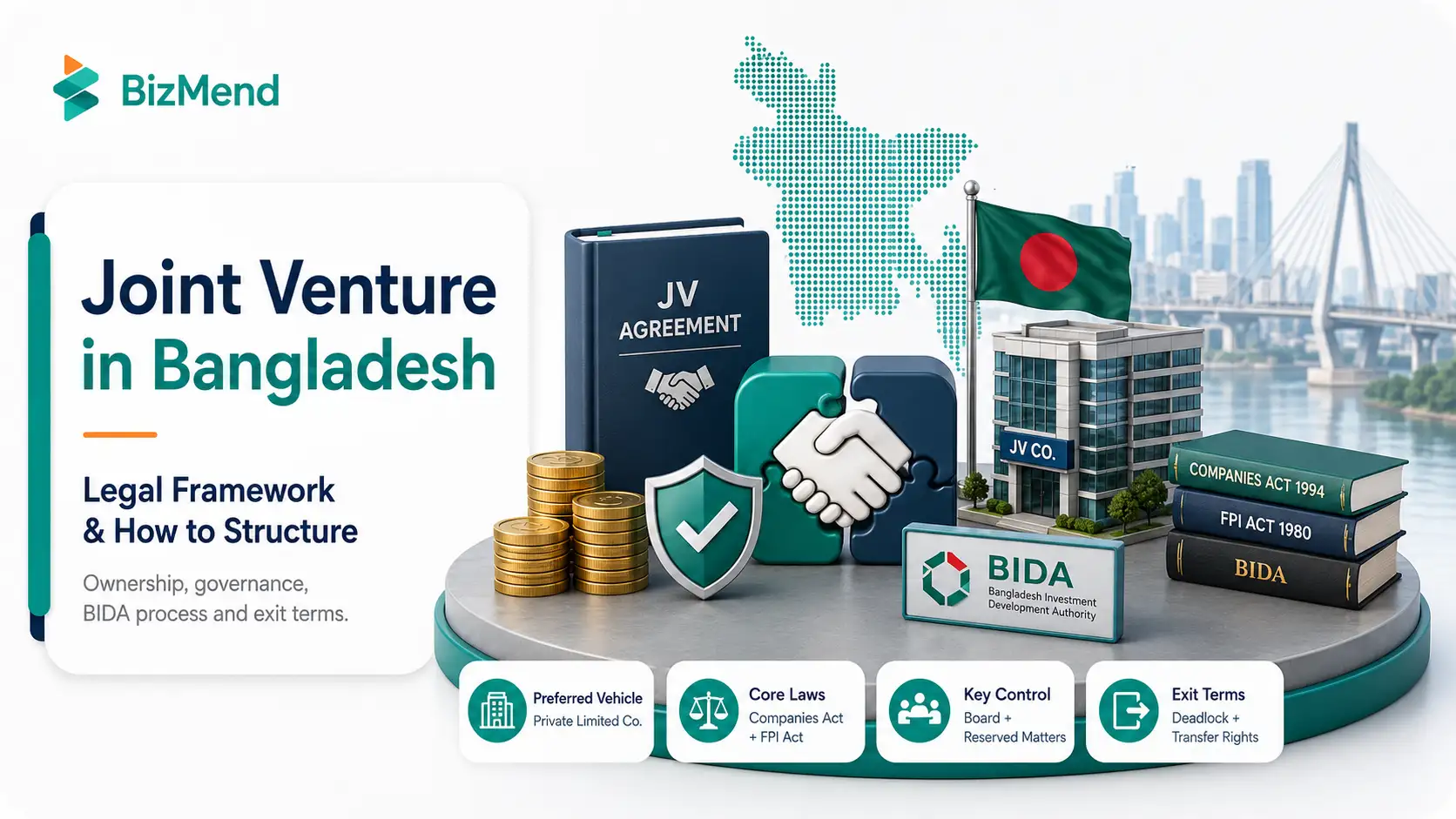
A joint venture looks attractive when Bangladesh feels promising but still a little opaque. You want local reach, but you do not want to give away control by accident.
That tension is why joint ventures show up so often in Bangladesh market entry planning. In practice, a real JV usually means a locally incorporated company owned by at least two parties, with rights split through the shareholding documents and a separate joint venture agreement. Get that architecture right, and a JV can open doors. Get it wrong, and you inherit a partner problem with statutory filings attached.
Quick answer: A joint venture in Bangladesh usually works best as a private limited company registered with RJSC, with foreign or local investment handled through BIDA where applicable. The hard part is not incorporation. It is locking down ownership, board control, reserved matters, cash contribution rules, and exit rights before operations begin.

Let us clear up the first confusion. Not every partnership, channel arrangement, or profit share deal is a joint venture. In Bangladesh, investors often use the term loosely. Lawyers and regulators do not.
A real JV usually means a Bangladesh entity, most often a private limited company, where a foreign investor and a local or foreign partner hold shares in the same vehicle. That company has its own constitutional documents, its own filings, and its own tax life. The commercial deal between the parties sits on top of that through a shareholders or joint venture agreement.
A looser collaboration can still matter commercially. A distributor agreement, project collaboration, manufacturing arrangement, or technology license may be useful. It just is not the same thing as shared equity. If you need control over assets, staff, licenses, and long term profit rights, a real jointly owned company is usually the cleaner tool.
Think in two layers. Layer one is the company itself: incorporation, directors, share capital, statutory books, tax filings, and sector approvals. Layer two is the deal between the owners: who appoints the managing director, who signs off on budgets, who can raise debt, and what happens if one side stops funding.
Bangladesh regulators will mostly see layer one first. Your future dispute will almost always live in layer two.
A JV makes sense when the local partner is bringing something real and hard to replicate. That could be distribution into Dhaka and Chattogram, land access, supply relationships, regulatory know how in a controlled industry, or a customer network that would take you years to build alone.
It also makes sense when market knowledge is part of the asset. Bangladesh is not a plug and play jurisdiction. Approvals, hiring, tax handling, and even landlord negotiations tend to move faster when one side already understands the local operating rhythm.
But let us not romanticize it. A JV is not automatically safer or simpler than a wholly owned subsidiary. You are trading autonomy for local access and local execution capacity. If the other side is mainly offering introductions and optimism, you may be better off with a service contract, a distributor, or your own subsidiary.
Use a JV when the partner brings one of these: regulated access, execution infrastructure, sector credibility, or meaningful capital alongside yours.
Avoid a JV when the real goal is only speed, market testing, or low cost setup. Those goals sound reasonable, but shared ownership is a heavy legal response to a light commercial problem.
| Situation | A JV Often Fits | A JV Often Misfires |
|---|---|---|
| Regulated or access heavy sector | Local partner brings permits, land, distribution, or sector credibility | Local partner mainly offers vague introductions |
| Capital burden | Both sides are funding a real operating plan | One side expects the other to keep rescuing the cash flow |
| Control objective | You can live with shared governance because access is worth it | You need fast unilateral decision making |
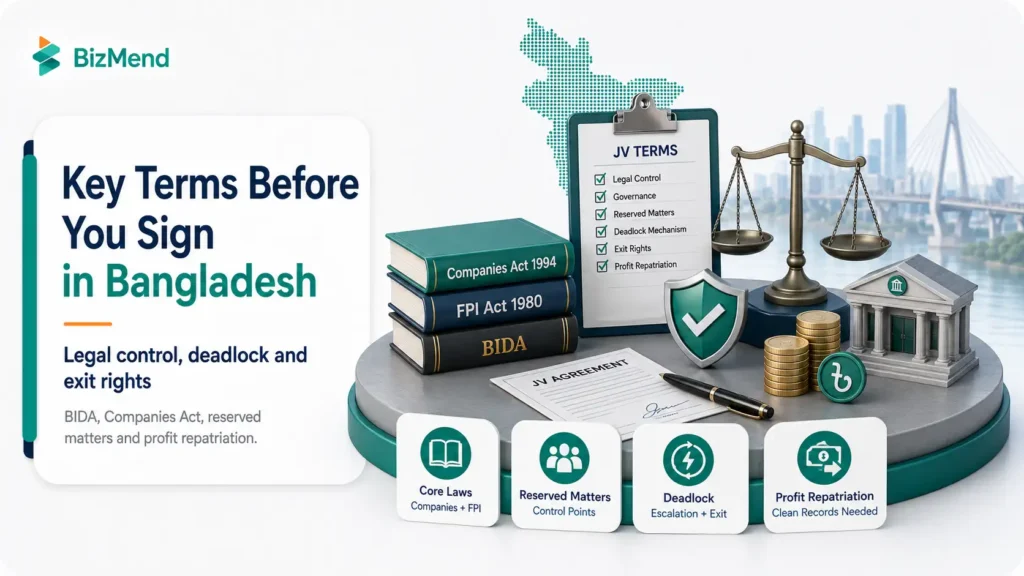
The backbone is straightforward. The Companies Act 1994 governs the company form, director rules, and core shareholder mechanics. Bangladesh also has the Foreign Private Investment (Promotion and Protection) Act 1980, which is one of the key statutes behind foreign investment protection and repatriation rights. For foreign and joint venture industrial projects outside special zones, BIDA is the main facilitation body you will deal with.
BIDA’s current foreign and JV service page is useful because it shows the process in practical terms. For a new industrial project registration, BIDA lists incorporation records, MoA and AoA, trade license, TIN, land or lease documents, encashment certificate, and RJSC forms as core documents. It also lists project based fees that currently run from Tk 5,000 to Tk 100,000 plus VAT, depending on investment size.
The same page matters for structuring because BIDA treats changes in the nature of investment, investor name and address, investment amount, and equity as amendment events. That is a reminder many founders miss. A JV is not static. If shares move later, your regulatory paperwork may need to move with them.
BIDA’s own FAQ says it handles domestic, 100 percent foreign, joint venture, and commercial office registrations outside BEZA, BEPZA, BHTPA, and BSCIC. The same FAQ also notes that BIDA registration is not itself required for pure commercial and trading activities. That distinction matters because some founders assume every foreign connected business must start with the exact same BIDA path.
Sector filters matter too. BIDA’s investment guidance still points to a controlled sector concept under the National Industrial Policy, and its checklist requires a no objection certificate from the relevant ministry or department where the industry is controlled. If your venture touches banking, insurance, telecom, power, natural resources, aviation, or other restricted areas, do not paper the deal first and ask questions later.
In most cases, the vehicle is a Bangladesh private limited company. The Companies Act framework, as summarized in current Companies Act references, still points to a standard private company having at least two directors and capping members at fifty, excluding certain employee members in the count. That format is usually flexible enough for foreign investors while keeping governance manageable.
The bigger question is not the shell. It is the split. A 50 50 structure sounds fair until you hit a budget dispute, dividend holdback, or change in strategy. Many workable JVs in Bangladesh are built around one of three models: majority control with minority protections, equal economics with uneven governance, or staged ownership where one party earns further equity after hitting milestones.
Do not reduce the deal to cash versus cash. In Bangladesh, one side often contributes money while the other contributes land use rights, licenses, distribution channels, technical know how, management depth, or factory access. That can work, but only if the contribution is defined with painful clarity.
Spell out timing, valuation, evidence, and default consequences. If cash is due in tranches, say when. If machinery or technology is part of the subscription logic, say how it is valued and what happens if import timing slips. If a local partner is contributing relationships or market access, translate that into operational obligations you can actually test.
This is also where banking becomes practical rather than theoretical. Your capital path, dividend path, and foreign currency path will all depend on the banks you use, and the documents you can produce. If you are comparing banking options, Commercial Banks in Bangladesh: List, Types & Functions 2025 helps frame the current landscape.
If the memorandum and articles tell the outside world how the company exists, the JV agreement tells the owners how it behaves when money and pressure arrive. This is the real control document.
At minimum, the agreement should deal with shareholding split, board composition, quorum rules, reserved matters, funding obligations, business plan approval, related party transactions, transfer restrictions, dividend policy, information rights, confidentiality, non compete terms where appropriate, and dispute resolution.
Reserved matters are decisions that cannot be pushed through by ordinary board or shareholder majority. In Bangladesh JVs, common items include changes to share capital, new debt, annual budget approval, appointment or removal of the managing director, related party contracts, large asset sales, changes to business scope, dividends, and new branches or factories.
If you skip this section, the stronger side will default to control through the board, local execution, or document custody. That may be survivable in month one. It becomes ugly in year two.
Every JV starts with optimism. Deadlock clauses exist for the day optimism runs out. Build a real escalation path: management negotiation, board escalation, shareholder meeting, cooling off period, then a defined buy sell or exit route.
Exit rights deserve the same discipline. Think about right of first refusal, tag rights, drag rights, put and call mechanics, valuation formula, bad leaver rules, and forced sale triggers after prolonged deadlock. If one side can leave only through litigation, you have not built an exit plan. You have built a hostage situation with a company seal.
Once the company exists, the romance is over and the compliance calendar begins. You are dealing with RJSC maintenance, tax filings, VAT where relevant, trade license renewals, employment records, and sector specific permissions. If you plan to employ expatriates, BIDA’s foreign and JV process still lists work permit filing through OSS, with a current fee of BDT 5,000 plus VAT per person per year.
Profit repatriation is one of the biggest reasons foreign investors care about structure. BIDA’s current FAQ states that dividend and profit income can be remitted through an authorized dealer for non resident shareholders, and its remittance guidance points to Bangladesh Bank foreign exchange rules, including FE Circular No. 29 of July 2020 for dividend credits to foreign currency accounts. That is good news, but it is not a blank cheque. Repatriation works best when the investment trail, tax position, and corporate records have been kept clean from day one.
Ask this blunt question: if the relationship gets tense, who still controls the company day to day? The chop on the seal, the bank mandate, the ERP access, the factory gate, the tax password, the import papers, the HR files, the customer contracts. In Bangladesh, practical control can drift away from paper control faster than many foreign founders expect.
Structure the deal like you expect friction, not like you expect permanent harmony. Good documents do not create trust. They keep distrust from blowing up the enterprise when business pressure gets real.
A joint venture in Bangladesh can be a smart entry vehicle, but only when the partner adds something you cannot cheaply build yourself. The structure works best when you separate access from control, document both with discipline, and negotiate the unpleasant scenarios before incorporation. That is the difference between a strategic alliance and an expensive misunderstanding.
Yes, in many sectors a foreign investor can hold a majority stake, or even full ownership in a different structure, but the answer depends on the sector and any policy restrictions. If the business falls into a controlled area, you may need extra approvals or a no objection certificate before the structure is accepted in practice.
Usually, yes. The memorandum and articles create the company and set its public internal rules. The joint venture or shareholders agreement sits beside them and deals with commercial control, funding, deadlock, transfers, information rights, and exit mechanics in more detail.
Not always in the same way. BIDA is central for foreign and joint venture industrial projects outside special zones, and it also handles important post setup services such as work permits and visa recommendations. But BIDA’s own FAQ says registration is not required for pure commercial and trading activities, so the route depends on what the business actually does.
Treating the deal like a friendship instead of a controlled investment. The most common failure is leaving reserved matters, funding defaults, deadlock, and exit rights vague because the parties expect to sort them out later. Later is when bargaining power gets expensive.
Yes, post tax dividends and profits can generally be remitted through an authorized dealer for non resident shareholders, provided the investment and tax records line up properly with Bangladesh’s foreign exchange rules. The right answer is less about theory and more about whether your paperwork has been kept clean from the beginning.

Learn how to become a Daraz seller in Bangladesh, register an account, list products, understand fees, manage orders, and grow…
by Sheikh Ornob

Compare the cost of living in Bangladesh in 2026, including Dhaka and Chittagong rent, food, transport, utilities, inflation, and monthly…
by Sheikh Ornob

Learn MoA and AoA requirements in Bangladesh, key clauses, drafting basics, RJSC filing steps, amendments, and common company-registration mistakes. Suggested…
by Sheikh Ornob