How to Become a Daraz Seller in Bangladesh: Registration, Fees & Growth
Learn how to become a Daraz seller in Bangladesh, register an account, list products, understand fees, manage orders, and grow…
 by Sheikh Ornob

Compare the cost of living in Bangladesh in 2026, including Dhaka and Chittagong rent, food, transport, utilities, inflation, and monthly budgets.
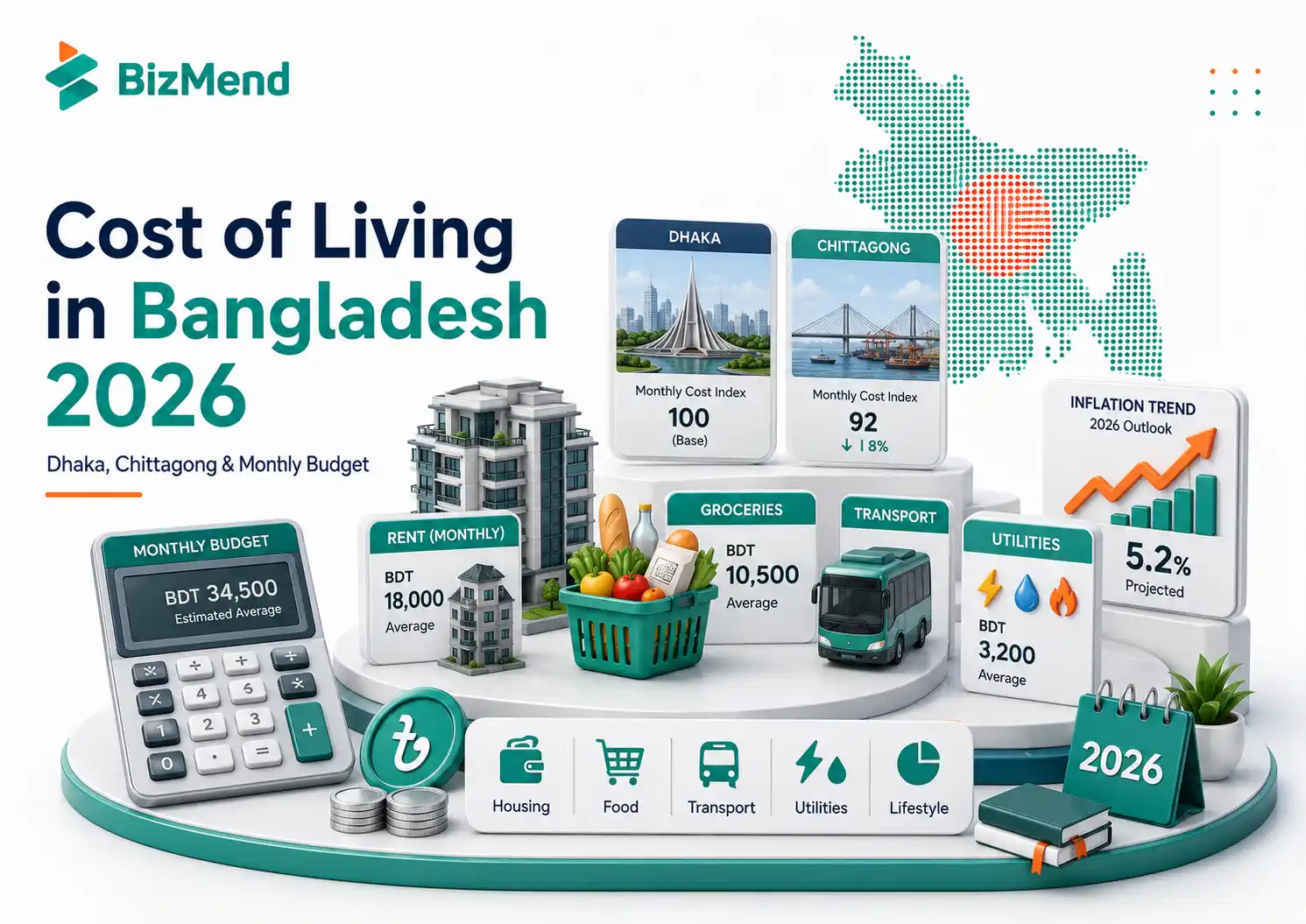
The cost of living in Bangladesh in 2026 depends heavily on city, housing choice, family size, transport habits, and education or healthcare needs. Dhaka is usually the most expensive major city because rent, commuting, childcare, and convenience spending rise quickly. Chittagong can be more affordable, especially for housing, although prices still vary sharply by neighbourhood and lifestyle.
This guide uses June 2026 crowdsourced Numbeo city-price data plus editorial planning ranges; these figures are useful for budgeting but are not official government living-cost tables. The figures are planning estimates, not guaranteed monthly bills. A student sharing a flat, a single professional living alone, and a family with private-school expenses can have completely different budgets even in the same area.
Quick Answer: The cost of living in Bangladesh is lowest for people who share housing and use local food and transport. A careful single-person monthly budget may start around Tk 25,500 – 49,000 in Dhaka and Tk 22,500 – 42,500 in Chittagong, while family budgets vary far more because of rent, education, healthcare, and lifestyle.
There is no single reliable national living-cost number. Bangladesh includes high-cost neighborhoods in Dhaka, industrial and port areas in Chittagong, university towns, district cities, and rural locations with very different housing and transport markets.
For most households, the largest monthly categories are housing, food, transport, utilities, education, and healthcare. Rent creates the biggest city-to-city gap. Lifestyle choices then widen it: frequent ride-sharing, imported groceries, air-conditioning, private hospitals, and English-medium education can push expenses far above a basic local budget.
Bangladesh’s inflation rate also matters. According to Bangladesh Bank’s current inflation data, sourced from BBS, point-to-point inflation was 9.16% in June 2026, and the 12-month average was 8.68%, so household budgets should include a price-change buffer.
Dhaka offers the widest job market and the largest range of housing, schools, hospitals, restaurants, and services. It also carries the highest pressure from rent, congestion, and commuting. A short distance on the map may still create a high monthly transport bill if the route is slow or requires multiple rides.
Numbeo’s crowdsourced Dhaka page, last updated 16 June 2026, reports a one-bedroom apartment average of about Tk 18,342 in the city center and Tk 9,167 outside the center. A three-bedroom average is about Tk 53,105 in central areas and Tk 28,450 outside. These are crowdsourced averages, and actual listings can be much lower or higher depending on neighborhood, building age, security, lift, generator, parking, and service charges.
The same data reports basic monthly utilities for an 85-square-meter apartment at roughly Tk 5,566, broadband around Tk 1,397, and a mobile plan around Tk 593. A one-way local transport ticket is shown at around Tk 50, but real commuting costs depend on whether someone uses buses, the metro, rickshaws, CNGs, ride-sharing, or a private vehicle.
Chittagong, officially Chattogram, is generally cheaper than Dhaka for housing, though premium areas and large apartments can still be expensive. The city’s port, industrial zones, hills, and spread-out neighborhoods also make location important for commuting.
Numbeo’s crowdsourced Chittagong page, last updated 6 June 2026, reports a one-bedroom average of about Tk 15,538 in the city center and Tk 7,518 outside. A three-bedroom average is around Tk 33,700 in central areas and Tk 20,030 outside. Basic utilities for an 85-square-meter apartment are shown near Tk 3,696, broadband around Tk 1,525, and a mobile plan around Tk 674.
Chittagong may therefore offer a lower housing burden, but families should compare the total route between home, work, school, and healthcare. A cheaper apartment can lose its advantage when daily travel becomes slow or costly.
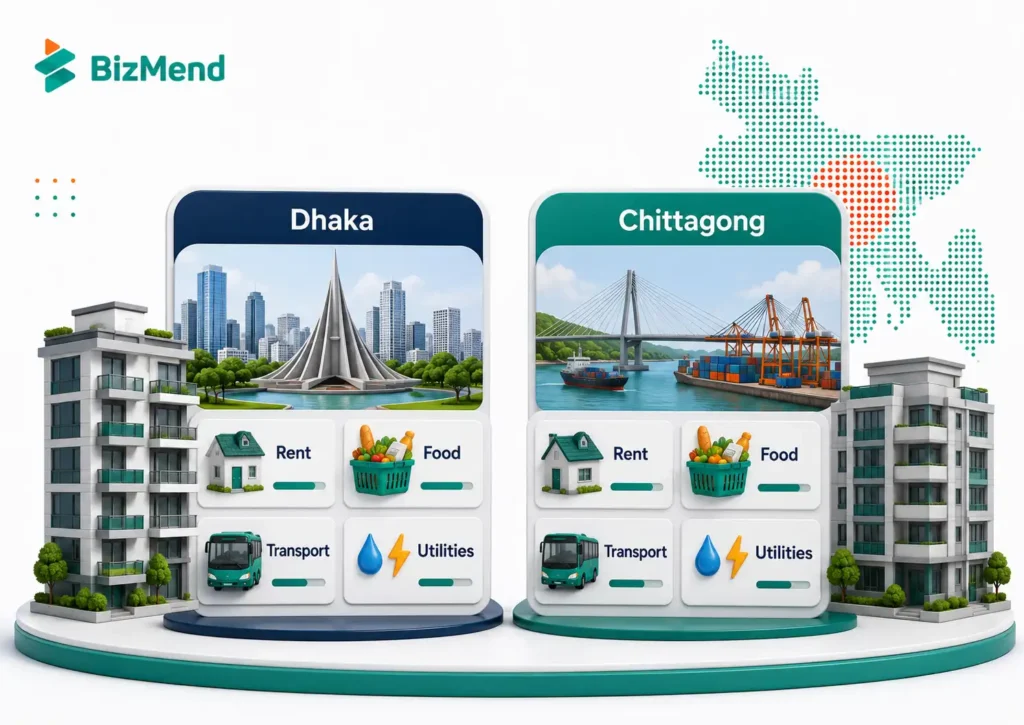
| Expense | Dhaka reference | Chittagong reference | Practical takeaway |
| 1-bedroom, city centre | About Tk 18,342 | About Tk 15,538 | Chittagong is usually lower, but area quality matters. |
| 1-bedroom, outside centre | About Tk 9,167 | About Tk 7,518 | Shared or outer-area housing reduces the budget most. |
| 3-bedroom, city centre | About Tk 53,105 | About Tk 33,700 | Family housing shows the largest city gap. |
| Basic utilities, 85 m² | About Tk 5,566 | About Tk 3,696 | Air-conditioning and household size can change bills sharply. |
| Broadband, 60 Mbps+ | About Tk 1,397 | About Tk 1,525 | Plan speed, ISP, and location affect the final price. |
| Average net salary reported | About Tk 34,631 | About Tk 34,458 | Crowdsourced salary estimates are context, not official averages. |
Source note: The figures above are rounded from Numbeo’s June 2026 city pages and should be treated as planning references; readers should compare them with official CPI and household statistics from the Bangladesh Bureau of Statistics.
Rent is usually the most important decision in a Bangladesh living-cost plan, although households comparing long-term renting with ownership should also consider the rates, down payment, and repayment burden of home loans in Bangladesh. A lower rent often creates more savings than cutting small food or mobile expenses. However, tenants should budget beyond the advertised rent.
Students and single workers can reduce housing costs by sharing a flat or room. Families may prefer lower-cost outer neighbourhoods, but should calculate school transport, office travel, safety, drainage, and access to hospitals before signing a lease.
Food budgets vary more by shopping style than by city. Local rice, lentils, vegetables, fish, chicken, eggs, and seasonal fruit can support a moderate budget. Imported food, premium meat, delivery apps, restaurant meals, and frequent coffee or snacks increase costs quickly.
June 2026 Numbeo data places selected Dhaka grocery items around Tk 84/kg for rice, Tk 145 for 12 eggs, Tk 422/kg for chicken fillets, and Tk 798/kg for beef, but local market prices can change by area, season, quality, and shop type. Chittagong values are similar for rice and eggs, but individual product prices vary widely by market, cut, brand, season, and neighborhood.
A practical food budget may be around Tk 9,000–16,000 for one person who mostly cooks, and Tk 30,000–55,000 for a family of four. These ranges can fall with bulk local shopping or rise substantially with dining out, special diets, baby food, and imported products.
Transport is one of the hardest expenses to estimate because distance alone does not explain the cost. Dhaka congestion, route changes, ride-sharing surcharges, and multiple short trips can make commuting expensive. Chittagong can be cheaper for some routes, but hills, distance, and limited direct connections may raise costs for others.
A public-transport-focused commuter may spend roughly Tk 1,500–4,000 per month. A mixed bus, rickshaw, metro, CNG, or ride-sharing routine may cost Tk 4,000–10,000 or more. Private vehicle owners must add fuel, parking, maintenance, insurance, and depreciation.
Electricity is the largest variable utility cost. Household size, air-conditioner use, water pumps, refrigerators, cooking method, and backup-power arrangements can change the bill. Many apartments also charge a fixed service fee that is separate from electricity and internet.
For a small household, a combined monthly budget of Tk 2,500–6,000 for electricity, water, gas or LPG, internet, and mobile may be realistic. Larger air-conditioned homes can exceed this range. Always ask whether rent includes water, gas, security, lift, and generator charges.
Education is the category with the widest possible range. Government institutions, Bangla-medium private schools, English-version schools, English-medium schools, universities, coaching, transport, books, and admission fees create very different monthly costs. Families should build an annual education budget and divide it by 12 rather than counting tuition alone, and compare education loans in Bangladesh only when fees cannot reasonably be covered through income, savings, or scholarships.
Healthcare also needs a buffer. Routine consultations and generic medicine may be manageable, but diagnostics, dental care, maternity, surgery, chronic disease, and private hospitals can create large one-time bills. A household emergency fund and suitable health insurance in Bangladesh can provide better protection than assuming the same medical expense every month.
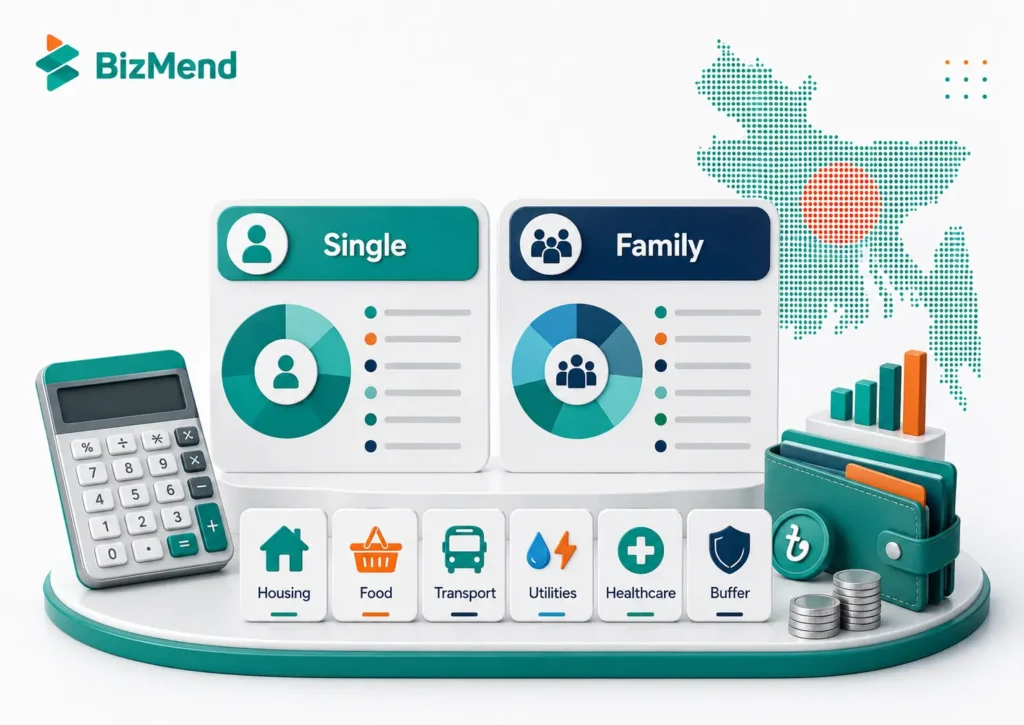
| Category | Dhaka modest range | Chittagong modest range |
| Shared room or modest rent | Tk 8,000–15,000 | Tk 7,000–12,000 |
| Food and groceries | Tk 10,000–16,000 | Tk 9,000–15,000 |
| Transport | Tk 2,000–6,000 | Tk 1,500–5,000 |
| Utilities, internet, mobile | Tk 2,500–5,000 | Tk 2,000–4,500 |
| Healthcare, personal, leisure | Tk 3,000–7,000 | Tk 3,000–6,000 |
| Estimated total | Tk 25,500–49,000 | Tk 22,500–42,500 |
These are planning ranges for a relatively careful lifestyle, not official averages. Living alone in a central apartment, using ride-sharing daily, or eating out regularly can raise the total well above Tk 50,000.
| Category | Dhaka family range | Chittagong family range |
| Rent and service charges | Tk 25,000–55,000 | Tk 18,000–38,000 |
| Food and household supplies | Tk 30,000–55,000 | Tk 28,000–50,000 |
| Transport | Tk 6,000–18,000 | Tk 5,000–14,000 |
| Utilities and connectivity | Tk 6,000–12,000 | Tk 5,000–10,000 |
| Education and healthcare | Tk 10,000–40,000+ | Tk 8,000–30,000+ |
| Personal, clothing, emergencies | Tk 8,000–18,000 | Tk 7,000–15,000 |
| Estimated total | Tk 85,000–198,000+ | Tk 71,000–157,000+ |
Education is the biggest reason family budgets cannot be reduced to one clean number. Numbeo’s statistical model estimates monthly costs excluding rent at about Tk 178,272 for a family of four in Dhaka and Tk 155,953 in Chittagong; because these estimates exclude rent and use Numbeo’s own model, keep them separate from this article’s editorial family-budget ranges. Frugal local households may spend less, while families using private education, private healthcare, domestic help, and frequent transport may spend more.
Numbeo’s crowdsourced salary figures should be treated as user-submitted context and should not be confused with the legally applicable minimum wage in Bangladesh, which can differ by industry and worker category. Because this is crowdsourced, it should not be treated as an official labor-market average. It still shows an important budgeting problem: a single worker earning around that level may need shared housing, family support, employer transport, or strict spending control to save consistently in Dhaka.
Job seekers should compare take-home pay after applicable income tax in Bangladesh with the office location, commuting cost, lunch support, allowances, health benefits, bonus, provident fund, and remote-work policy. A slightly lower salary near home can sometimes produce a better disposable income than a higher salary requiring expensive daily travel.
1. Choose housing by total commute cost, not rent alone.
2. Track food delivery and small digital payments; they are easy to overlook.
3. Buy seasonal produce and compare local markets with supermarkets.
4. Share internet, transport, or housing where practical and safe.
5. Use a monthly sinking fund for education, healthcare, travel, and repairs.
6. Negotiate salary using total benefits, not only the basic amount.
7. Keep an emergency fund in an accessible account instead of depending on credit for medical or moving costs, and compare the available types of bank accounts in Bangladesh before choosing where to hold it.
The cost of living in Bangladesh cannot be summarized by one national average. Dhaka offers more jobs and services but usually demands a higher housing and transport budget. Chittagong is often more affordable, particularly for rent, although neighborhood and commuting choices still matter. Build a personal budget from your actual housing, work location, education, healthcare, and lifestyle needs. Use current city data as a starting point, confirm local prices before moving, and keep a buffer for inflation and irregular expenses. NRB entrepreneurs managing overseas income should also budget for currency conversion, international transfers, and fees connected with a US bank account for non-residents.
A careful single-person budget may be around Tk 25,500–49,000 in Dhaka and Tk 22,500–42,500 in Chittagong. Central rent, frequent ride-sharing, dining out, or living alone can increase the total.
Usually yes, especially for larger apartments and commuting. June 2026 crowdsourced data shows a larger gap for three-bedroom rent than for groceries or internet.
A practical planning range may start around Tk 85,000 per month and can exceed Tk 198,000 when rent, private education, healthcare, transport, and lifestyle spending are higher.
Yes, mainly by using shared housing, campus or local food, and public transport. Tuition, coaching, devices, and travel should be budgeted separately.
For urban households, housing is commonly the biggest fixed expense. For families, education and healthcare can sometimes become equally important.
They are useful estimates, not guaranteed bills. Crowdsourced data should be compared with current rent listings, local market prices, utility arrangements, and the household’s actual lifestyle.
Recheck major costs at least quarterly and before relocation, salary negotiation, school admission, or signing a new lease.

Learn how to become a Daraz seller in Bangladesh, register an account, list products, understand fees, manage orders, and grow…
by Sheikh Ornob

Learn MoA and AoA requirements in Bangladesh, key clauses, drafting basics, RJSC filing steps, amendments, and common company-registration mistakes. Suggested…
by Sheikh Ornob

Compare corporate health insurance in Bangladesh for employees, including group coverage, claims, hospital networks, pricing factors, exclusions, providers, and HR…
by Sheikh Ornob