How to Become a Daraz Seller in Bangladesh: Registration, Fees & Growth
Learn how to become a Daraz seller in Bangladesh, register an account, list products, understand fees, manage orders, and grow…
 by Sheikh Ornob

Bangladesh inflation rate was 9.16% in June 2026. See CPI meaning, food and non-food inflation, policy rate links, causes, and business impact.
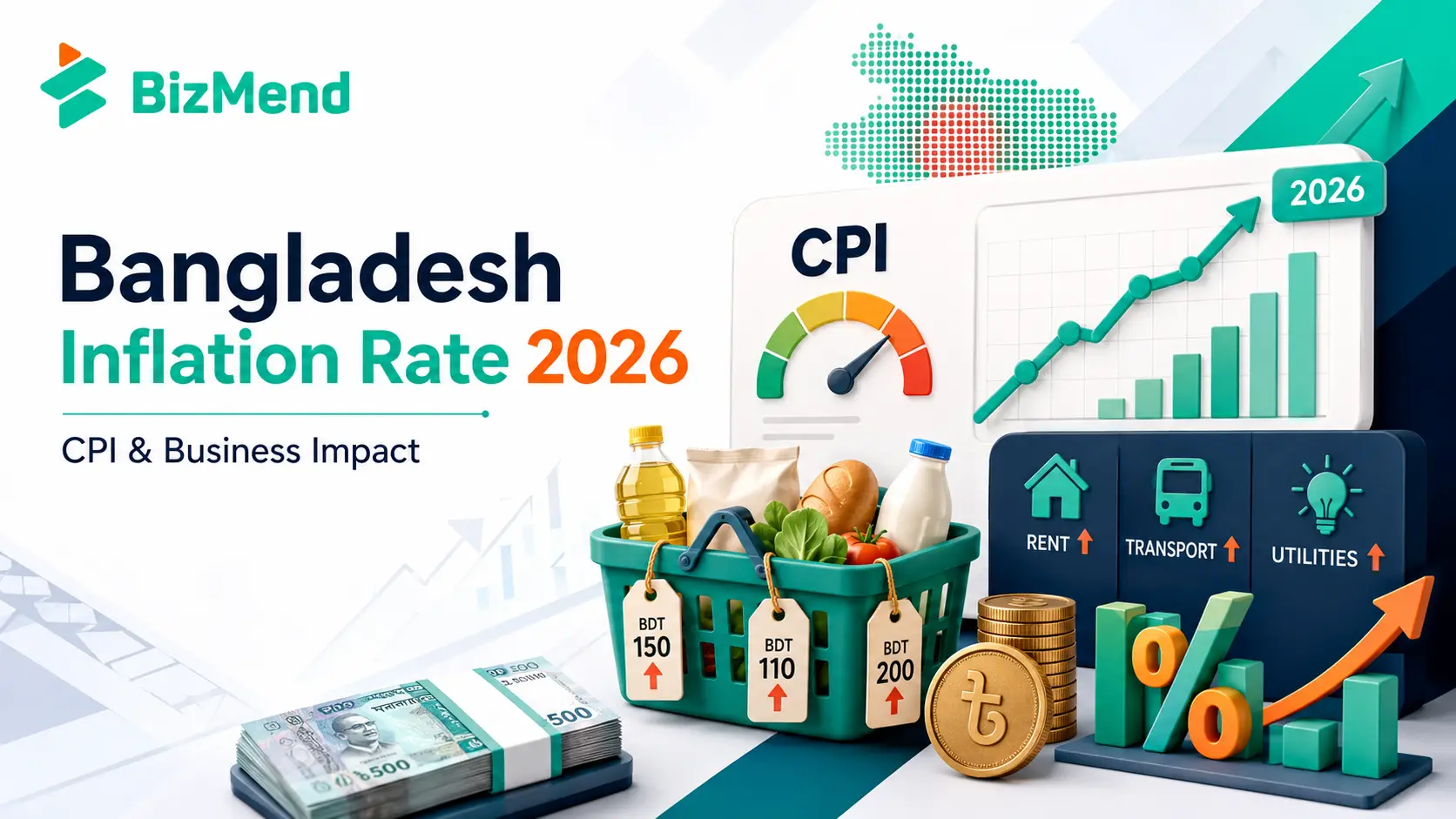
Prices still feel heavy in Bangladesh. The Bangladesh inflation rate eased in June 2026, but groceries, rent, transport, and financing still squeeze budgets. That gap matters for families and firms.
To read the numbers well, you need the CPI Bangladesh uses, the latest BBS release, and the policy moves behind higher borrowing costs. This guide explains consumer price index Bangladesh basics, the Bangladesh inflation rate 2025 vs 2026 context, food and non-food inflation, the causes of price rise Bangladesh, and what business owners should watch next. It keeps the macro talk practical, because inflation only matters when it changes cash-flow decisions.
Quick Answer: Bangladesh’s latest available point-to-point inflation rate was 9.16 percent in June 2026, down from 9.42 percent in May, according to Bangladesh Bank’s BBS-sourced update. Food inflation was 8.60 percent, and non-food inflation was 9.61 percent, so the pressure is easing but still high.
Bangladesh Bank’s current inflation page, which cites BBS, listed point-to-point inflation at 9.16 percent for June 2026, compared with 9.42 percent in May and 8.48 percent in June 2025. That is the clean headline, and it is the number most readers mean by the current inflation rate Bangladesh.
The full picture is more layered. BBS-reported CPI figures showed the national CPI rising to 146.11 in June 2026 from 145.61 in May 2026. So the yearly inflation rate slowed, but the actual price level still moved up from the previous month.
Bangladesh CPI and inflation snapshot: latest available June 2026 data
| Indicator | June 2026 | May 2026 | June 2025 or FY context |
| Headline point-to-point inflation | 9.16 percent | 9.42 percent | 8.48 percent |
| Food inflation | 8.60 percent | 9.06 percent | 7.39 percent in June 2025 |
| Non-food inflation | 9.61 percent | 9.71 percent | 9.37 percent in June 2025 |
| Rural inflation | 9.23 percent | 9.48 percent | Higher than urban in June 2026 |
| Urban inflation | 9.01 percent | 9.25 percent | Lower than rural in June 2026 |
| National CPI | 146.11 | 145.61 | Base year 2021-22 equals 100 |
| 12-month average inflation | 8.68 percent | 8.63 percent | 10.03 percent in June 2025 |
Sources: Bangladesh Bank current inflation page and BBS monthly CPI details reported by UNB on July 6, 2026.
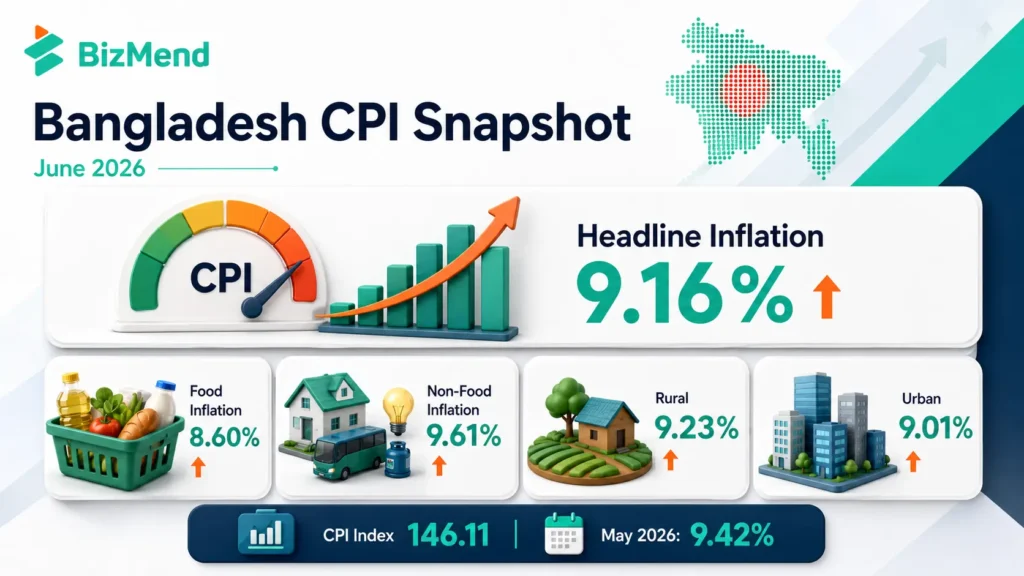
CPI means Consumer Price Index. BBS defines it as the average change over time in prices for a selected set of final goods and services. In daily life, CPI is the official price basket behind the inflation number people discuss at shops, classrooms, offices, and policy meetings.
The consumer price index Bangladesh uses currently has 2021-22 as the base year. A base index of 100 means the basket’s price level in that year. A national CPI of 146.11 means the same representative basket costs about 46.11 percent more than it did in the base period.
The basket is broad. BBS methodology describes a CPI basket covering 383 goods and services, with price collection from 154 markets across Bangladesh, so publishers should cite the latest BBS methodology note when using these details. The latest methodology describes 127 food items with 242 varieties and 256 non-food items with 507 varieties.
The Bangladesh inflation rate 2025 story was painful because average inflation reached 10.03 percent in FY2024-25. Food inflation averaged 10.70 percent that year, while non-food inflation averaged 9.47 percent. That made the pressure broad, not just a kitchen-market issue.
FY2025-26 looks better, but not easy. BBS-reported figures show annual average inflation falling to 8.68 percent, average food inflation dropping to 8.06 percent, and average non-food inflation easing to 9.20 percent. That is disinflation, not cheap prices.
Inflation in Bangladesh 2026 has several causes working at once. Bangladesh Bank’s Monetary Policy Review pointed to weak competition, distribution problems, market management issues, and supply chain disruptions. It also noted global pressure from oil prices and geopolitical tension, which can raise import costs.
Inflation falls on paper before it feels lighter at the bazar counter.
The exchange rate is a useful signal. Bangladesh Bank’s FX reference rate page showed the USDBDT reference rate at 123.3157 for 13 July 2026, while the 29 June 2026 reference rate was about 123.18. That kind of level affects import invoices first, then wholesale prices, then retail prices.
Food inflation in Bangladesh: searches spike for a simple reason: people feel food prices every day. In June 2026, food inflation fell to 8.60 percent from 9.06 percent in May. But it was still higher than 7.39 percent in June 2025, so many households were still paying more than a year earlier.
The rural and urban split also matters. Rural food inflation eased to 8.52 percent in June, while urban food inflation dropped to 8.76 percent. That difference may look small, but it can matter for wage earners, students, and small traders whose budgets leave little room.
Non-food inflation was 9.61 percent in June 2026. That includes categories such as housing, water, electricity, gas, health, transport, education, communication, restaurants, hotels, clothing, and services. For businesses, this is where overhead pressure often hides.
The rural non-food rate reached 9.98 percent, while the urban non-food rate was 9.16 percent. A shop owner may feel this through higher delivery charges, maintenance bills, rent pressure, packaging costs, financing costs, or staff expenses. A family may feel it through tuition, medical visits, transport, and utilities.
This is why CPI Bangladesh should not be read as only a food story. Food drives emotions, but non-food costs shape the base on which firms set prices and households plan monthly spending.
Bangladesh Bank kept the policy rate at 10.00%, with the SLF rate at 11.50% and the SDF rate at 7.50%, according to its policy-rate display and H1FY27 monetary policy materials. The SLF rate stayed at 11.5 percent and the SDF rate at 7.5 percent. The central bank said the stance was meant to rein in headline inflation and inflation expectations.
Interest-rate policy cannot grow rice, unload ships, or fix a broken cold chain. It can, however, cool borrowing, reduce speculative demand, and signal that the central bank does not want inflation expectations to drift upward.
There is a business tradeoff. Tighter policy can help slow inflation, but it can also raise loan costs and delay investment. The FY2026 to 2027 budget targets inflation at 7.5 percent and GDP growth at 6.5 percent, so policymakers are trying to lower prices without freezing activity.
For households, the simplest pain test is wages versus prices. BBS-reported wage data showed national wage growth at 8.18 percent in June 2026, while headline inflation was 9.16 percent. That means many workers may still feel real purchasing power pressure.
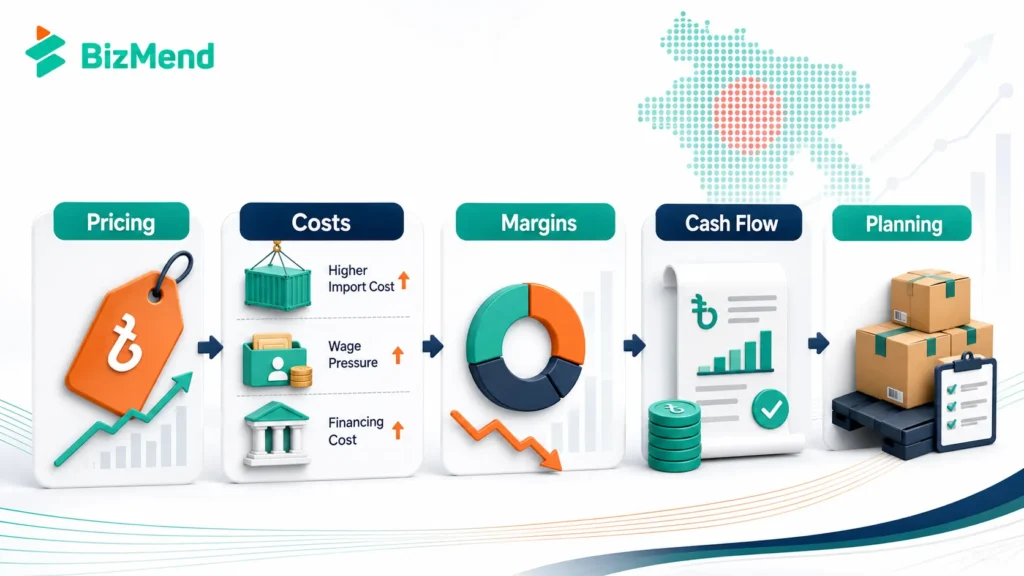
The first business hit is not always lower sales. Often, it is thinner room for mistakes.
For investors and business owners, inflation also changes valuation, cash planning, and income tax in Bangladesh 2026 decisions when profits, salaries, and expenses move together. That does not make every sector unattractive, but it raises the bar for earnings quality.
No sector feels inflation in exactly the same way. A garment exporter, a grocery store, a restaurant, and a construction supplier face different cost mixes. The shared lesson is simple: track your own inflation basket, not just the national CPI.
Sector-wise impact of inflation in Bangladesh 2026
| Sector | Likely impact | Practical move |
| Retail and FMCG | For e-commerce in Bangladesh, customers may buy smaller packs, switch brands, and compare prices more often when inflation stays high. | Protect fast-moving essentials and review price changes weekly. |
| Restaurants and cafes | Food, rent, staff, gas, and delivery costs can rise together. | Shorten menus, track plate cost, and adjust portions carefully. |
| Importers and distributors | Exchange-rate changes and freight costs can alter landed cost quickly. | Quote with shorter validity and keep a currency buffer. |
| Manufacturing | Raw materials, energy, finance, and wage costs can squeeze gross margin. | Review input contracts and build a monthly cost dashboard. |
| RMG and exporters | A weaker taka can help revenue in local currency, but imported inputs and financing still matter. | Track net exposure after imported fabric, accessories, freight, and loans. |
| Agriculture and food supply | Fuel, fertilizer, storage, weather, and road logistics shape final prices. | Plan procurement around seasonal risk and storage limits. |
| Construction and real estate | Cement, steel, transport, labor, and credit costs can slow demand. | Reprice project budgets and avoid thin-margin commitments. |
| Banks and investors | Higher rates can slow private credit demand and change asset preferences. | Watch loan quality, deposit costs, and real returns after inflation. |
This table is an editorial business interpretation based on CPI categories, monetary policy data, and Bangladesh operating conditions.
The Bangladesh inflation rate is useful, but a business needs a smaller dashboard. A grocery chain should not track the same details as a software exporter. Still, six signals belong on almost every owner’s monthly review.
The goal is not to become an economist. It is to notice cost pressure early enough to adjust purchase orders, prices, credit terms, staffing plans, and seek business consulting before margins get squeezed.
This article uses the latest available June 2026 CPI and inflation data released by BBS and cross-checked through Bangladesh Bank on 14 July 2026, Asia/Dhaka time. Recheck BBS and Bangladesh Bank before publication if July 2026 data has been released. Before publishing or updating the article, check the BBS CPI release page and Bangladesh Bank’s current inflation page for July 2026 data or any revision to June 2026.
Bangladesh’s inflation problem is easing, but it is not solved. The June 2026 rate of 9.16 percent is lower than May, yet food, non-food costs, financing, and wages still matter for daily decisions. For business owners, the smartest move is steady tracking: CPI, exchange rate, policy rate, input costs, and customer behavior.
The current inflation rate Bangladesh reported for June 2026 was 9.16 percent on a point-to-point basis. Bangladesh Bank published the figure with BBS as the source, and the same update showed May 2026 at 9.42 percent.
CPI Bangladesh means the Consumer Price Index used by BBS to track price changes across a basket of goods and services. It matters because the inflation rate comes from changes in that index, not from one product or one market.
Food inflation is closely watched because food purchases are frequent and essential. In June 2026, food inflation eased to 8.60 percent, but it still sat above the June 2025 level of 7.39 percent, so many households continued to feel pressure.
The policy rate affects borrowing costs, liquidity, and demand. Bangladesh Bank kept the rate at 10.0 percent for H1FY27 to restrain inflation pressure. It cannot fix supply shocks alone, but it can influence credit growth and expectations.
Inflation in Bangladesh 2026 was moving down in June compared with May, and annual average inflation for FY2025-26 was lower than FY2024-25. Still, the June headline rate stayed above 9 percent, so the trend is better but still uncomfortable.

Learn how to become a Daraz seller in Bangladesh, register an account, list products, understand fees, manage orders, and grow…
by Sheikh Ornob
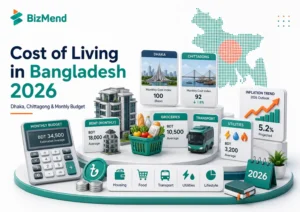
Compare the cost of living in Bangladesh in 2026, including Dhaka and Chittagong rent, food, transport, utilities, inflation, and monthly…
by Sheikh Ornob

Learn MoA and AoA requirements in Bangladesh, key clauses, drafting basics, RJSC filing steps, amendments, and common company-registration mistakes. Suggested…
by Sheikh Ornob