
How to Become a Daraz Seller in Bangladesh: Registration, Fees & Growth
Learn how to become a Daraz seller in Bangladesh, register an account, list products, understand fees, manage orders, and grow…
 by Sheikh Ornob

Learn MoA and AoA requirements in Bangladesh, key clauses, drafting basics, RJSC filing steps, amendments, and common company-registration mistakes.
Suggested URL Slug
memorandum-of-association-bangladesh-moa-aoa
A Memorandum of Association in Bangladesh defines a company’s legal foundation, including its name, registered office, objects, liability, share capital, and founding subscribers. The Articles of Association then set the internal rules for shares, directors, meetings, voting, dividends, and management. For founders registering a private limited company in Bangladesh, both documents are normally prepared before incorporation and submitted through the Registrar of Joint Stock Companies and Firms (RJSC).
These documents are not interchangeable and should not be copied from an overseas template without review. A poorly drafted object clause can restrict future activities, while unclear articles may create disputes over control or share transfers. This guide explains the Bangladesh-specific purpose, format, filing process, and amendment considerations without replacing professional legal advice.
Quick Answer: The MoA states what a Bangladesh company is formed to do and its core legal structure, while the AoA governs how the company operates internally. Both are normally drafted, signed by subscribers, and filed with RJSC during incorporation. Clauses should match the business, shareholding, capital plan, and Companies Act requirements.
The Memorandum of Association and Articles of Association together form the constitutional framework of a company incorporated under the Companies Act, 1994. The MoA establishes the company’s permitted scope and foundational details. The AoA explains how the shareholders and directors will exercise their rights and manage the company.
Entrepreneurs may casually call the AoA “company bylaws,” but the formal Bangladesh filing document is the Articles of Association, and that formal term should be used in RJSC and legal documents. That description is useful for beginners, although the formal document filed in Bangladesh is the Articles of Association. In a joint venture in Bangladesh, a shareholders’ or joint-venture agreement may sit beside the AoA, but it does not replace the company’s registered constitutional documents.
The memorandum of association in Bangladesh is the company’s external charter. It tells regulators, members, lenders, and counterparties the basic conditions on which the company was incorporated. For a company limited by shares, the document normally covers the company name, registered-office jurisdiction, objects, limited liability, authorized share capital, and subscriber commitments.
The objects clause deserves special care. It should cover the actual business and reasonably foreseeable supporting activities without becoming a random list of unrelated trades. Regulated activities, such as banking, insurance, telecommunications, securities, education, healthcare, or certain import and industrial operations, may still require separate licences or approvals even when they appear in the MoA.
The articles of association Bangladesh companies use are the internal operating rules. They govern the relationship among shareholders, directors, and the company. A private company’s articles commonly address shares, directors, meetings, voting, dividends, accounts, notices, and procedures that may become relevant if the shareholders later decide to close a company in Bangladesh.
The AoA should preserve the features required for private-company status, while a public limited company in Bangladesh follows different rules for membership, share transfers, public fundraising, and governance. The wording must fit the Companies Act and the company’s actual ownership plan. Generic articles can become troublesome when founders later disagree about control, funding, or exit rights.
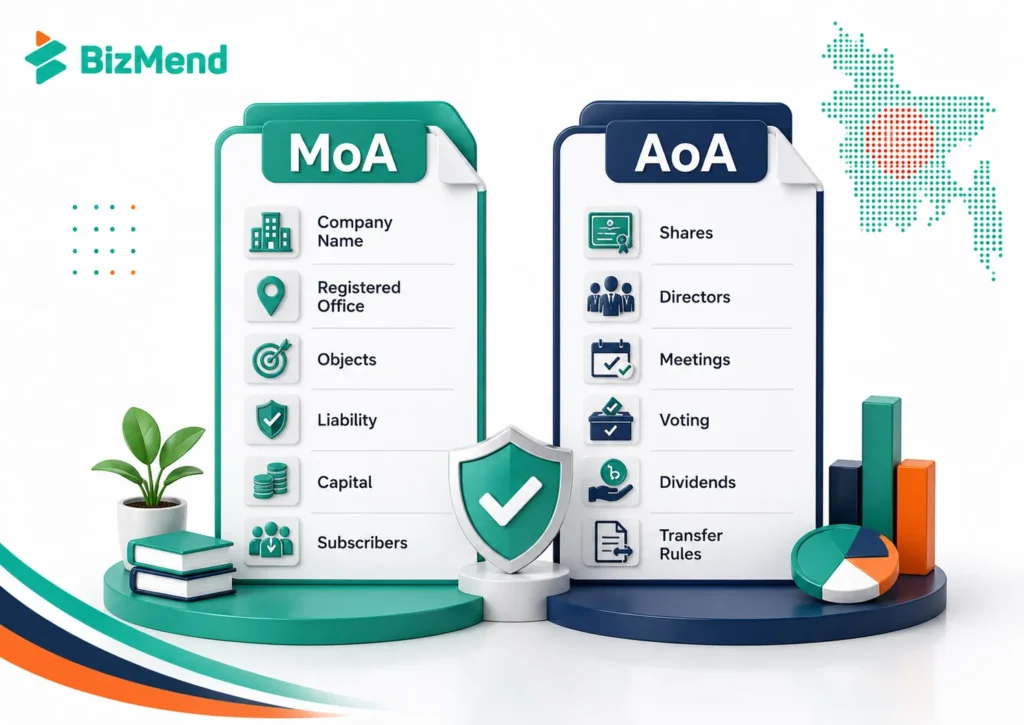
| Point | Memorandum of Association (MoA) | Articles of Association (AoA) |
| Main purpose | Defines the company’s identity, scope, liability, capital, and subscribers. | Defines internal management and shareholder/director procedures. |
| Business activities | Contains the objects for which the company is formed. | Explains how authorized activities and corporate powers are managed. |
| Share structure | States the authorized capital and its division into shares. | Sets rules for issue, transfer, calls, forfeiture, and rights attached to shares. |
| Governance | Usually contains limited governance detail. | Covers directors, meetings, voting, quorum, resolutions, and dividends. |
| Amendment | Change requirements depend on the clause and may need special approvals. | Usually amended by the prescribed shareholder resolution and RJSC filing. |
| Relationship | Sets the outer constitutional boundary. | Must operate consistently with the Act and the MoA. |
The proposed name should match the name cleared by RJSC and use the appropriate company ending. The spelling must remain consistent across the MoA, AoA, forms, signatures, and online application.
For a company limited by shares, the MoA should state the registered-office address, and the same address details must stay consistent with the applicable RJSC filing forms. The company must maintain a valid address for official notices and statutory records.
This clause describes the principal business and supporting powers. For a technology startup in Bangladesh, the objects clause might include software development, licensing, support, consulting, and other lawful technology services that match the actual business model. It should not claim regulated powers the company cannot legally exercise without approval.
For a company limited by shares, the clause states that member liability is limited. In practical terms, the member’s exposure is generally linked to any unpaid amount on the shares held, subject to applicable law and exceptional liabilities created by misconduct or separate guarantees.
The capital clause states the authorized share capital and how it is divided—for example, a stated amount divided into ordinary shares of a stated face value. Authorized capital is not the same as paid-up capital. The initial subscriptions and issued shares must be consistent with the incorporation forms and subscriber table.
The subscribers confirm that they wish to form the company and agree to take the number of shares shown beside their names. For a private company, at least two persons are required to subscribe to the MoA, and each subscriber to a share-limited company must take at least one share and mention the number of shares taken beside their name. Each subscriber’s name, address, occupation or description, share commitment, signature, and witness details should be completed consistently.
| AoA topic | Practical drafting question |
| Share transfers | Must an existing shareholder get first opportunity to buy? Who approves a transfer? |
| New shares | Who can authorize an issue, and do existing members receive pre-emption rights? |
| Directors | How are directors appointed, removed, paid, and authorized to act? |
| Board meetings | What notice, quorum, voting, and conflict-of-interest rules apply? |
| Shareholder meetings | How are meetings called, proxies accepted, and resolutions passed? |
| Banking and contracts | The Articles should identify the authorized signatory who may open accounts, sign cheques, borrow funds, or execute contracts on behalf of the company. |
| Dividends and reserves | When may dividends be recommended or declared and from what profits? |
| Death or incapacity | How are shares transmitted to legal representatives? |
| Disputes and deadlock | Is there a workable process when equal owners cannot agree? |
| Notices and records | How will formal notices be delivered and corporate records maintained? |
Some founder protections—such as vesting, detailed drag-along or tag-along rights, intellectual-property assignment, non-compete obligations, and complex investment rights—may require coordinated drafting across the AoA and a shareholders’ agreement. A private side agreement should not contradict the registered articles.
Bangladesh filings should follow the structure and execution requirements applicable under the Companies Act and the current RJSC system. The documents are generally arranged in numbered clauses and include a subscriber page. They should use the cleared company name, accurate capital figures, and consistent shareholder information.
A ‘sample MoA’ found online is only a reference. It may contain obsolete clauses, a different company type, foreign law, excessive objects, or governance provisions that do not match the founders’ agreement. The safest approach is to start from an accepted Bangladesh structure and customize it carefully.
A practical object might state that the company will develop, license, market, and support software and related digital services. Supporting language may cover hiring staff, acquiring equipment, entering contracts, protecting intellectual property, and carrying out lawful activities incidental to the main object. The final wording should reflect the real business and licensing position.
If authorized capital is BDT 1,000,000 divided into 100,000 ordinary shares of BDT 10 each, the clause and subscriber table must use those same figures. The company does not need to issue every authorized share at incorporation, but issued and paid-up amounts must be accurately disclosed.
The articles may require a selling shareholder to offer shares to existing members before transferring them to an outsider. The clause should explain notice, price determination, acceptance period, board involvement, and what happens if members do not purchase. Vague restrictions can delay a legitimate transfer or create avoidable disputes.
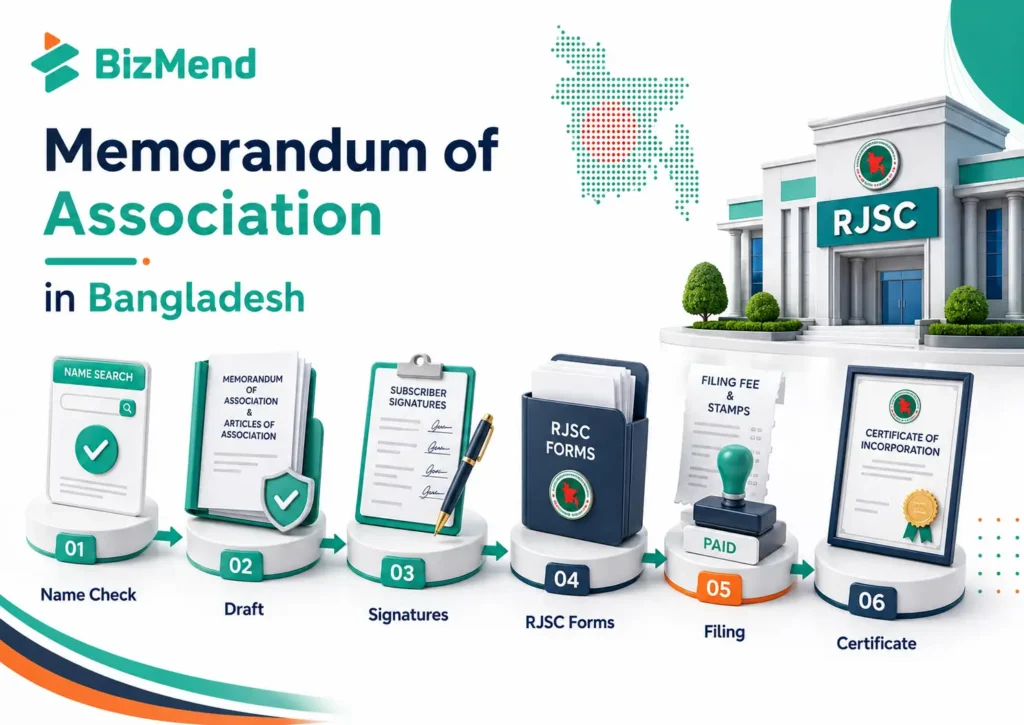
1. Obtain1. Obtain name clearance through the official Registrar of Joint Stock Companies and Firms process and confirm the proposed company type before drafting the MoA and AoA.
2. Finalize the registered office, objects, authorized capital, paid-up plan, subscribers, directors, and share allocation.
3. Draft the MoA and AoA in a Bangladesh-compliant format and review all names, identity details, addresses, and figures.
4. For a private company, RJSC’s business-process guide lists MoA and AoA, Form I, Form VI, Form IX, Form X, Form XII, evidence of name clearance, and applicable special adhesive stamps or treasury challan materials as registration-application documents.
5. Submit the constitutional documents and supporting information through the applicable RJSC online or assisted filing channel and pay the prescribed registration fees and stamp duties.
6. Respond to any RJSC query or correction request. A mismatch in name, capital, signature, object wording, or form data can delay approval.
7. After approval, collect the incorporation certificate and constitutional documents; the wider process of how to start a business in Bangladesh also includes trade licence, TIN, VAT, banking, and applicable sector registrations.
RJSC forms, portal fields, fees, and technical submission requirements can change. Before filing, verify the current checklist on the official RJSC platform or through an experienced company secretary, lawyer, or registration professional. Incorporation does not automatically grant a trade licence, tax registration, VAT registration, import permission, or sector licence.
Foreign founders seeking to register a private limited company in Bangladesh may face additional document, capital-remittance, notarization, identity, and shareholder-verification requirements. The exact route depends on the ownership structure and current government procedures, so cross-border founders should confirm the requirements before signing documents or sending capital.
A registered MoA or AoA should not be edited informally. The required process depends on what is being changed. An AoA amendment generally requires a special resolution, updated articles, and the required RJSC filing, subject to the Companies Act, the existing MoA/AoA, and any sector-specific approvals. Changes to objects, name, capital, liability, or registered-office details can follow different statutory routes; for object-clause changes, Companies Act section 12 requires special resolution and court approval before the change becomes effective beyond what the court approves.
Before an amendment, review contracts, licences, tax records, banking mandates, shareholder rights, and sector approvals. A capital increase, for example, may require both constitutional and filing changes, while an object change may affect licences and bank compliance. Obtain professional advice where the Companies Act, court confirmation, regulator consent, or foreign-investment rules may apply.
A well-drafted memorandum of association Bangladesh founders can rely on should clearly define the company’s purpose, capital, liability, and subscribers. The Articles of Association should then turn the founders’ commercial understanding into practical rules for ownership, control, meetings, share transfers, and decision-making.
Before filing, check every clause against the Companies Act, current RJSC requirements, and the actual business plan. Spending time on accurate drafting is usually easier than correcting a restrictive object clause, inconsistent capital structure, or governance dispute after incorporation.
A private limited company is normally incorporated with a Memorandum of Association and Articles of Association filed through RJSC. The current portal checklist and execution requirements should be verified before submission.
In practical conversation, yes—the AoA performs the role people often mean by company bylaws. The formal Bangladesh document is the Articles of Association, and it must comply with the Companies Act and the MoA.
Using another document as a reference is risky. Its objects, capital, ownership, voting, and transfer rules may not fit your company. It may also contain outdated or foreign-law wording. Customize and legally review the documents.
Every clause matters, but the objects clause often needs the most business planning because it defines the company’s permitted purposes. The capital and subscriber clauses must also match the incorporation data exactly.
Yes, but the procedure depends on the clause. Shareholder resolutions, revised documents, RJSC filings, fees, and sometimes additional approval may be required. Do not alter the signed document without following the statutory process.
No. The object clause does not replace regulatory licences, trade licences, tax or VAT registration, environmental clearance, import permissions, or other approvals required for the activity.
Subscriber signatures must be attested in the manner required by the Companies Act and current RJSC process. Confirm the witness information and execution format before signing, especially where a subscriber is abroad.

Learn how to become a Daraz seller in Bangladesh, register an account, list products, understand fees, manage orders, and grow…
by Sheikh Ornob

Compare the cost of living in Bangladesh in 2026, including Dhaka and Chittagong rent, food, transport, utilities, inflation, and monthly…
by Sheikh Ornob

Compare corporate health insurance in Bangladesh for employees, including group coverage, claims, hospital networks, pricing factors, exclusions, providers, and HR…
by Sheikh Ornob