
How to Become a Daraz Seller in Bangladesh: Registration, Fees & Growth
Learn how to become a Daraz seller in Bangladesh, register an account, list products, understand fees, manage orders, and grow…
 by Sheikh Ornob

Form a public limited company in Bangladesh. List on DSE or CSE. RJSC steps, BSEC IPO rules, and learn what it really costs.
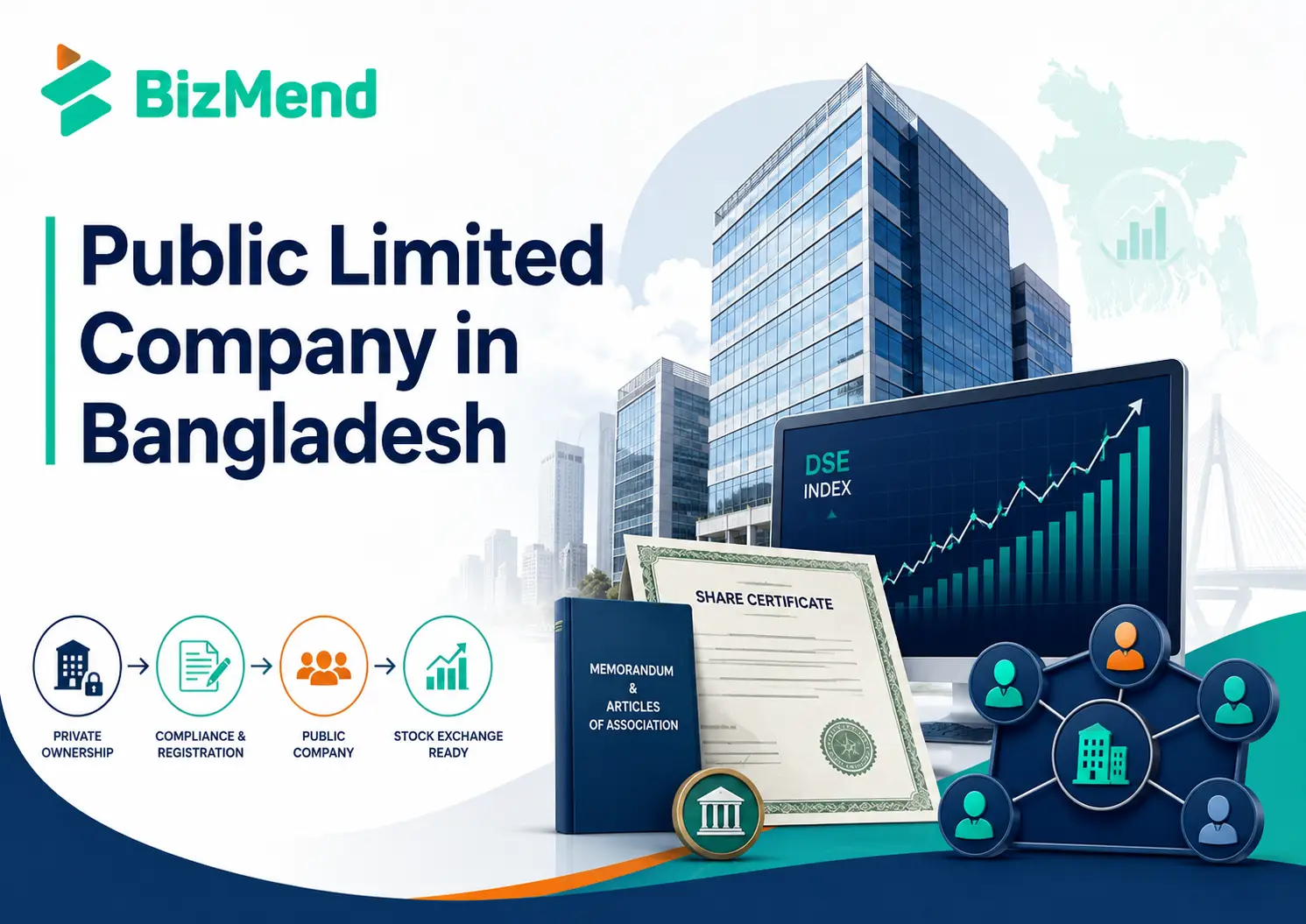
Going from a private limited company to a public limited company in Bangladesh is like moving from a family kitchen to a restaurant chain. The food is the same. The accountability isn’t. Suddenly you’ve got more cooks, more diners, a health inspector who shows up unannounced, and an audit trail that has to satisfy strangers.
That’s the PLC reality. More shareholders, stricter filings, board minutes that actually matter, and a stack of obligations that grow louder if you choose to list on DSE or CSE. This guide covers both stages: forming the PLC at RJSC, and the optional second act of going public through BSEC. The fees, the math, and the parts founders usually underestimate.
Quick answer: A public limited company in Bangladesh needs at least 7 shareholders, 3 directors, and Memorandum and Articles of Association filed with RJSC under the Companies Act 1994. Listing on DSE or CSE is optional and runs through BSEC, requiring Tk 30 crore minimum post-IPO paid-up capital, a cleared prospectus, and either a fixed-price or book-building IPO route.
A public limited company (PLC) is a company whose shares can be offered to the public, where shareholder liability is limited to the amount unpaid on those shares, and where ownership transfers freely without unanimous consent from existing members. In Bangladesh, PLCs sit under the Companies Act 1994, register with RJSC, and (if they choose to list) come under BSEC supervision while trading on DSE or CSE.
That parenthetical matters. A PLC doesn’t have to be on the stock exchange. Plenty of PLCs sit on RJSC’s books for years and never go public. Listing is a separate, optional second stage with its own rulebook.
Think of a PLC like a passport. Having one doesn’t mean you’ve flown anywhere. It just means you’re allowed to.
Both structures give shareholders limited liability. Both file with RJSC. Both need a TIN, a trade license, and a corporate bank account. Past those basics, the gap is wide.
| Feature | Private Limited | Public Limited |
|---|---|---|
| Minimum shareholders | 2 | 7 |
| Maximum shareholders | 50 | No statutory limit |
| Minimum directors | 2 | 3 |
| Share transfer | Restricted by AoA | Freely transferable |
| Public capital raise | Not allowed | Allowed (with BSEC approval) |
| Certificate of Commencement | Not required | Required before starting business |
| Annual return to RJSC | Required | Required |
| Statutory disclosure | Limited | Heavy if listed |
| Typical use case | SMEs, family business, startups | Capital-raising, IPO candidates |
If you’re not planning to raise public money, a private limited company in Bangladesh is the cleaner answer. PLC overhead only pays for itself when you actually need shareholder breadth, public capital, or both. For non-residents weighing structure choices, our breakdown of company types and restrictions for foreigners in Bangladesh is a useful next read.
Seven. That’s the minimum number of shareholders for a PLC in Bangladesh. Drop below 7 at any point and you’re technically out of compliance. RJSC has the legal right to strike the company off if the count sits below seven for more than six months.
Three. The minimum board size. Directors must be over 18, mentally fit, not undischarged bankrupts, and clear of past convictions for fraud, breach of trust, or corporate malpractice. In practice, banks expect at least one director to be a Bangladeshi resident for the corporate account opening process to go smoothly.
Paid-up capital is where reality varies. The Companies Act 1994 doesn’t fix a minimum for unlisted PLCs. The MoA states authorized capital. Paid-up capital is what subscribers actually put in. Most PLCs that aren’t planning to list start with paid-up capital between Tk 50 lakh and Tk 5 crore, sized to the business and the bank account they’re trying to open.
If you do plan to list on DSE or CSE, BSEC’s revised IPO rules require post-IPO paid-up capital of at least Tk 30 crore. Pre-IPO capital plus the issue size has to clear that bar. Below it, you can stay public on RJSC paper, but neither exchange will let you in.
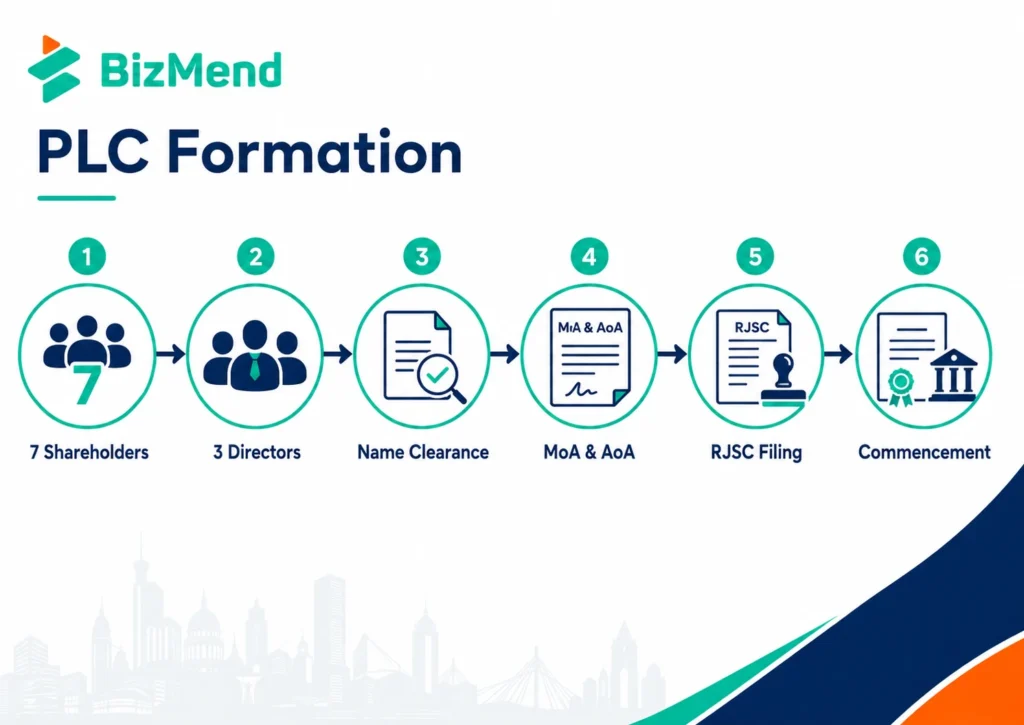
The actual formation process at RJSC follows the same rails as a private limited company, just with more subscribers and a heavier stack of constitutional documents. For a broader walkthrough of registering any business structure here, see our guide to starting a business in Bangladesh as a foreigner.
Step 1. Name clearance. File a Name Clearance application on the RJSC online portal at www.roc.gov.bd. Fee is Tk 600. Approval typically lands in 1 to 3 working days. The cleared name reserves for 30 days.
Step 2. Draft the constitutional documents. The Memorandum of Association lists subscribers, the registered office address, the company’s objects, the authorized capital, and the share split. The Articles of Association set internal rules: how directors are appointed, how AGMs are called, how shares are issued and transferred, how dividends are declared, how disputes are resolved. Because PLCs face heavier scrutiny down the line, get a corporate lawyer to draft these. Boilerplate AoAs work for private limiteds. They don’t always survive a BSEC review.
Step 3. Subscriber and director documents. Each of the seven-plus subscribers and three-plus directors needs a TIN. Foreign directors need passport copies and notarized signature samples. Local directors need NIDs, photos, and signature samples.
Step 4. File with RJSC. Submit the MoA, AoA, Form IX (consent of directors), Form XII (particulars of directors), the encumbrance form, and the registered office declaration. Pay the registration fees, which scale with authorized capital.
Step 5. Stamp duty. Stamp duty is paid on the authorized capital. For a Tk 1 crore authorized capital, expect roughly Tk 7,000 in stamp duty plus the standard MoA and AoA stamp fees. Bigger authorized capital, bigger bill.
Step 6. Receive the Certificate of Incorporation. This is the proof your PLC legally exists. RJSC also issues a Certificate of Commencement, which (for PLCs specifically, unlike private limiteds) is required before the company can begin trading or borrow money.
Step 7. Post-incorporation registrations. Trade license from the relevant City Corporation. TIN registration with NBR. BIN/VAT registration if turnover crosses Tk 30 lakh. Open the corporate bank account. Register for Customs (IRC/ERC) if importing or exporting. Our breakdown of the types of bank accounts in Bangladesh walks through which corporate account fits which kind of trading activity.
Total formation time: typically 4 to 8 weeks if documents are clean. Foreign subscriber paperwork stretches the timeline.
Total formation cost: Tk 25,000 to Tk 1,50,000 for the RJSC stage alone, depending on authorized capital and lawyer fees.
Forming a PLC and listing a PLC are two different decisions. The first is a paperwork sprint of a few weeks. The second is an 8 to 18 month regulatory marathon, and it stays expensive forever after.
Bangladesh has two stock exchanges:
Both sit under the Bangladesh Securities and Exchange Commission (BSEC), which writes the rulebook. The current core framework is the BSEC (Public Issue) Rules, 2015, with major amendments rolled in over the past decade. Another overhaul is in flight for the 2026 cycle, focused on tightening quality filters and lifting the minimum capital bar.
Two routes exist for an IPO.
The simpler route. The issuer offers shares at par (typically Tk 10 face value) or at a fixed price disclosed in the prospectus. Minimum issue size: Tk 30 crore or 10 percent of the company’s paid-up capital, whichever is higher. Best for smaller, more straightforward issuers.
Investor quota structure under fixed price: 30 percent for eligible investors, 50 percent for general investors (excluding non-resident Bangladeshis), and the balance reserved for NRBs and mutual funds. Allotment to general investors is by lottery if the issue is oversubscribed, which it usually is.
For larger issuers wanting institutional price discovery. Eligible investors (typically large mutual funds, banks, merchant banks, and insurers) submit bids during a bidding period. The cut-off price discovered there becomes the floor for the public issue. Minimum issue size: Tk 75 crore.
Investor quota under book building: 50 percent for eligible investors, 40 percent for general investors (excluding NRBs), and the balance for mutual funds and NRBs. The cap on cut-off price multiples is set by BSEC and adjusts periodically.
Roughly the sequence:
The total timeline from “we’re going public” to “first day of trading” is rarely under 12 months. Eighteen to twenty-four months is more honest if the company hasn’t been audit-ready from day one.
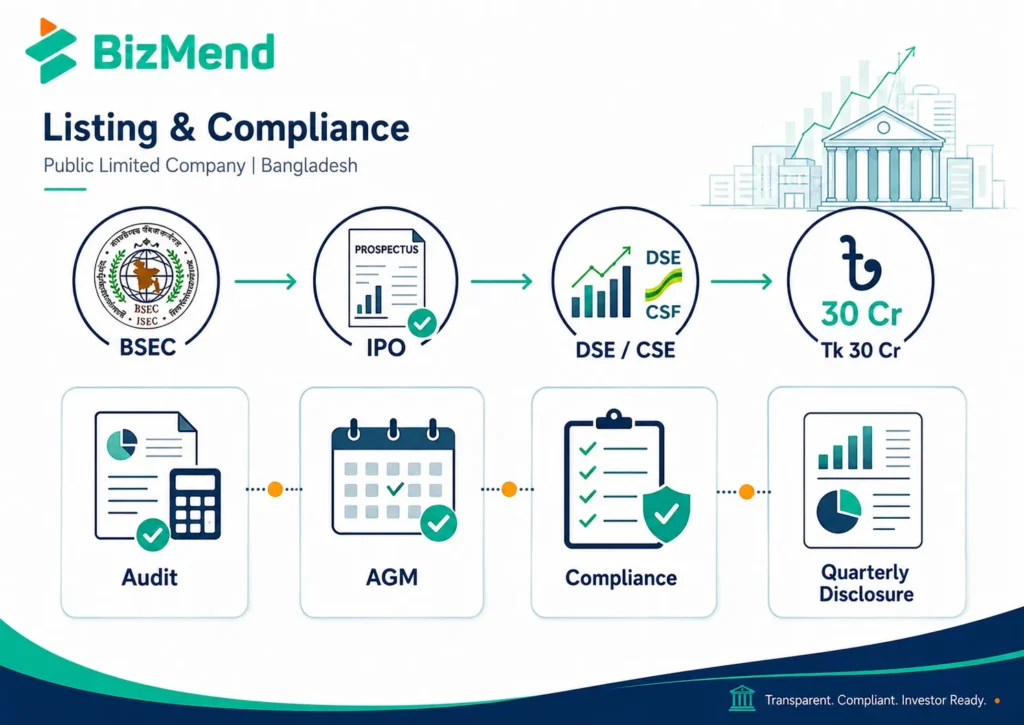
Forming a PLC is the cheap part. Running one is where the bill keeps adding up.
Annual obligations for every PLC, listed or not:
Additional obligations if listed:
Skipping any of these isn’t a soft fail. BSEC has the power to suspend trading, levy fines, and de-list. RJSC can strike off non-filing companies.
The PLC structure costs more, files more, and discloses more. None of that pays for itself unless one of these is true:
If none of those apply, a private limited company does almost everything a PLC does, with half the paperwork. Many founders incorporate as private limited first, then convert to PLC just before the IPO push. That’s a normal path and often the cheaper one.
PLC formation isn’t where founders trip. The compliance treadmill is. The audits, AGMs, disclosures, and BSEC filings start the day you incorporate and never let up. If you’re sure the business needs that machinery, build it on day one. If you’re not, start as a private limited and graduate later. For end-to-end help on filings and compliance setup, Business Globalizer handles the paperwork side of things.
There’s no statutory minimum for unlisted PLCs under the Companies Act 1994. Practical paid-up capital ranges from Tk 50 lakh to Tk 5 crore depending on the business. To list on DSE or CSE, BSEC requires post-IPO paid-up capital of at least Tk 30 crore.
Roughly 4 to 8 weeks if subscriber documents are clean. Name clearance arrives in 1 to 3 working days. Drafting the MoA and AoA, then paying stamp duty, takes most of the time. Foreign director documents push the timeline longer.
Yes. Members pass a special resolution, amend the Articles of Association, file the change with RJSC, and meet the seven-shareholder and three-director thresholds. Many founders use this route right before an IPO push, after running as private limited for years.
Fixed price sets the share price in advance and works for issue sizes from Tk 30 crore up. Book building uses institutional bidding to discover price and is required when issue size hits Tk 75 crore or more. Larger issuers usually go book building because it surfaces a more defensible price.
Yes. Unlike private limited companies, PLCs in Bangladesh must obtain a Certificate of Commencement from RJSC before starting business operations or borrowing money. This is a separate step that comes after the Certificate of Incorporation.
Yes. A PLC is a structure, not a listing requirement. Many Bangladeshi PLCs sit on RJSC’s books unlisted for years or permanently. Listing on DSE or CSE is an optional decision regulated by BSEC, with its own thresholds and ongoing obligations.

Learn how to become a Daraz seller in Bangladesh, register an account, list products, understand fees, manage orders, and grow…
by Sheikh Ornob

Compare the cost of living in Bangladesh in 2026, including Dhaka and Chittagong rent, food, transport, utilities, inflation, and monthly…
by Sheikh Ornob
Learn MoA and AoA requirements in Bangladesh, key clauses, drafting basics, RJSC filing steps, amendments, and common company-registration mistakes. Suggested…
by Sheikh Ornob