How to Become a Daraz Seller in Bangladesh: Registration, Fees & Growth
Learn how to become a Daraz seller in Bangladesh, register an account, list products, understand fees, manage orders, and grow…
 by Sheikh Ornob

Cost, process, and requirements to set up a private limited company in Bangladesh in 2026. Real numbers, what RJSC wants, and when Pvt Ltd actually fits.
Search “private limited company in Bangladesh” and you’ll get a wall of guides written for non-resident founders flying in from Dubai or London. If you’re a Bangladeshi sitting in Dhaka, Chattogram, or Sylhet trying to make sense of your options, most of that content doesn’t speak to you. Visa workarounds are irrelevant. Repatriation rules don’t apply. The hand-holding fees consultants quote are inflated for foreign budgets.
The local founder version is a different conversation. Smaller bills, simpler paperwork, and a few rules that catch first-time founders specifically. What’s below: the actual 2026 cost breakdown, what RJSC requires, and how to know whether a Pvt. Ltd. is even the right move for where you are.
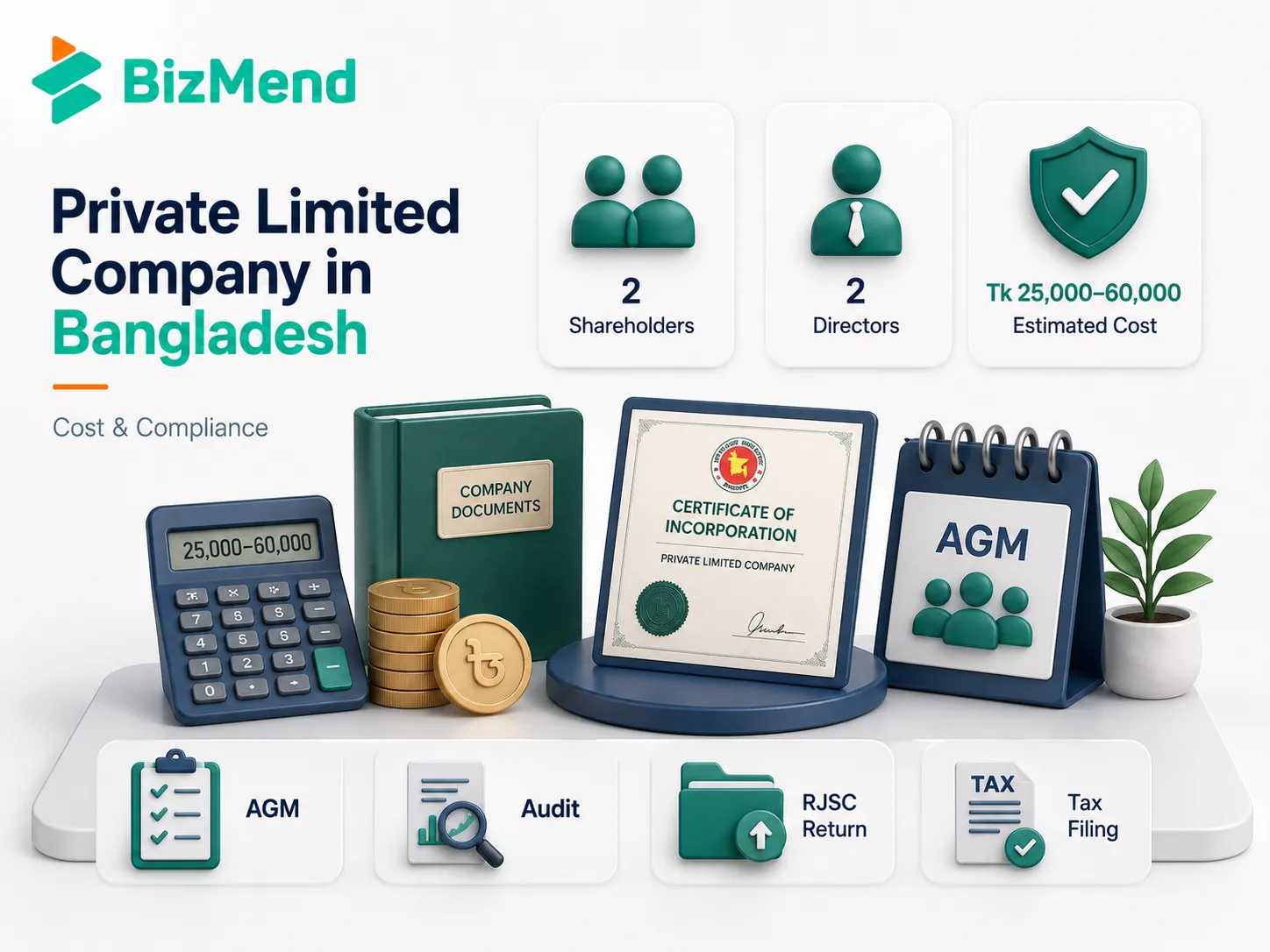
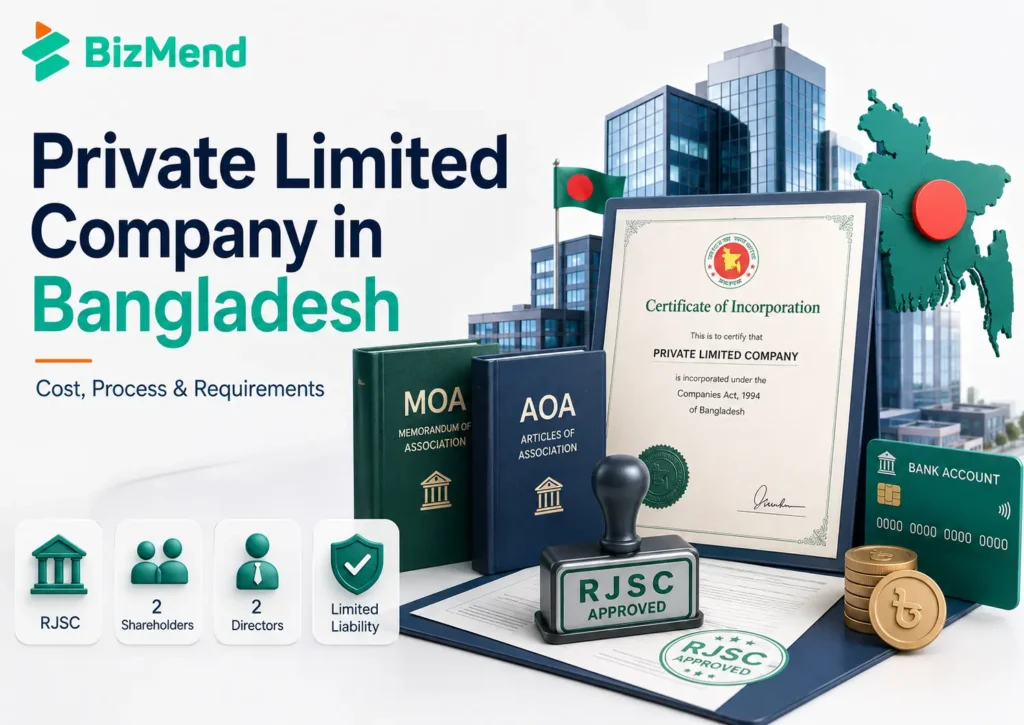
| Quick answer: A private limited company in Bangladesh requires 2 shareholders, 2 directors, a registered office, and an MOA and AOA filed with RJSC under the Companies Act 1994. There’s no statutory minimum paid-up capital, though Tk 1 lakh is standard practice. Total 2026 setup cost runs Tk 25,000 to Tk 60,000 plus paid-up deposit. |
A private limited company in Bangladesh is your business as a separate legal person, registered under the Companies Act 1994. Once RJSC stamps your file, your company has its own bank account, its own TIN, its own contracts, and (the part most founders care about) its own losses if things go sideways.
That last bit is the headline benefit: limited liability. Your house, your car, and your personal savings stay outside the firing line if the business takes on debt it can’t repay. For a sole proprietor, there’s no such wall. Personal and business assets are the same pool.
The “private” part means shares stay among a small group. Maximum 50 shareholders. No public stock issue, no DSE listing path without converting to a public limited company first.
For most Bangladeshi founders past the freelance or hobby stage, this is the structure your CA will eventually push you toward. The reasons (liability, tax, banking, credibility) come up below.
Not every business needs a Pvt Ltd on day one. Most don’t.
If you’re a freelance content writer, a tutor, a small-batch home baker, or a part-time reseller, sole proprietorship handles your needs. One trade license in your name, your personal TIN, and you’re trading legally. Setup cost: under Tk 10,000 in most cases.
The switch to Pvt Ltd starts making sense when one of these things is true:
A small example. A Mirpur-based importer ran a sole prop for two years selling LED lighting through Daraz and Facebook. Turnover hit Tk 1.2 crore. He brought in a friend as a partner and tried to open a joint current account at City Bank. Got rejected twice. Registered a Pvt Ltd in five weeks, opened the corporate account in two more, and the friction vanished.
That’s roughly the inflection point most founders hit.
The “registration fee” is a small slice of the bill. The full setup includes stamp duty, lawyer fees, notary, and the trade license layer that comes after.
Realistic 2026 breakdown for a Pvt Ltd with Tk 1 lakh authorized capital:
| Line item | Cost (Tk) | Notes |
|---|---|---|
| RJSC name clearance | 600 | One-time, applied online |
| Stamp duty on MOA / AOA | 2,000 to 3,000 | Scales with authorized capital |
| RJSC registration filing fee | 4,000 to 7,000 | Scales with authorized capital |
| Notary, attestation, photocopies | 1,500 to 2,500 | Lawyer’s office overhead |
| Lawyer or CA professional fee | 15,000 to 40,000 | Wide range; shop around |
| Bank deposit (paid-up capital) | 1,00,000 typical | Sits in your company account |
| All-in setup (excluding paid-up) | 25,000 to 60,000 | Excludes trade license, TIN, BIN |
A few things this table won’t tell you on its own.
Stamp duty and RJSC filing fees both scale with the authorized capital you declare. Push authorized capital from Tk 1 lakh to Tk 10 lakh and those line items jump by Tk 8,000 to Tk 12,000 combined. Most first-time founders inflate this number “in case we grow,” which is a needless tax. You can always increase authorized capital later.
Professional fees vary wildly. A solo lawyer in Sylhet might charge Tk 12,000 for a clean Pvt Ltd file. A boutique corporate firm in Gulshan can quote Tk 50,000 or more for the same paperwork. Mid-tier CAs running Facebook and LinkedIn ads typically land in the Tk 18,000 to Tk 25,000 band.
(Quick note: these numbers are accurate as of early 2026. Stamp Act schedules, RJSC notifications, and trade license rates change. Always confirm the current line items before you write any cheques.)
Here’s what you need ready before you start filing.
People:
For each director and shareholder:
Company-level documents:
Capital declarations:
That’s the substance of what RJSC enforces. Your lawyer or CA assembles, formats, and notarizes; you supply the raw inputs and signatures.
This is where nine out of ten first-time founders get confused. Let’s settle it.
Authorized capital is the ceiling. The maximum share capital your company can ever issue without amending the MOA. It’s a number you declare in the founding documents. You don’t have to actually own this amount.
Paid-up capital is what’s actually been issued and deposited in the company’s bank account. Real money.
So if your MOA says “authorized capital Tk 10 lakh divided into 10,000 shares of Tk 100 each,” and you and your co-founder each subscribe to 500 shares, your paid-up capital is Tk 1 lakh. The other Tk 9 lakh is theoretical headroom.
The Companies Act 1994 doesn’t set a statutory minimum paid-up capital for a private limited company. You could technically incorporate with Tk 1,000. But here’s why most lawyers floor it at Tk 1 lakh:
There’s no rule that says you need crores in the bank to be legitimate. Tk 1 lakh paid-up handles most early-stage SMBs cleanly. If you’re going after a sector-regulated business (NBFI, manufacturing, insurance, telecom), check the regulator’s prescribed minimum, which can be much higher.
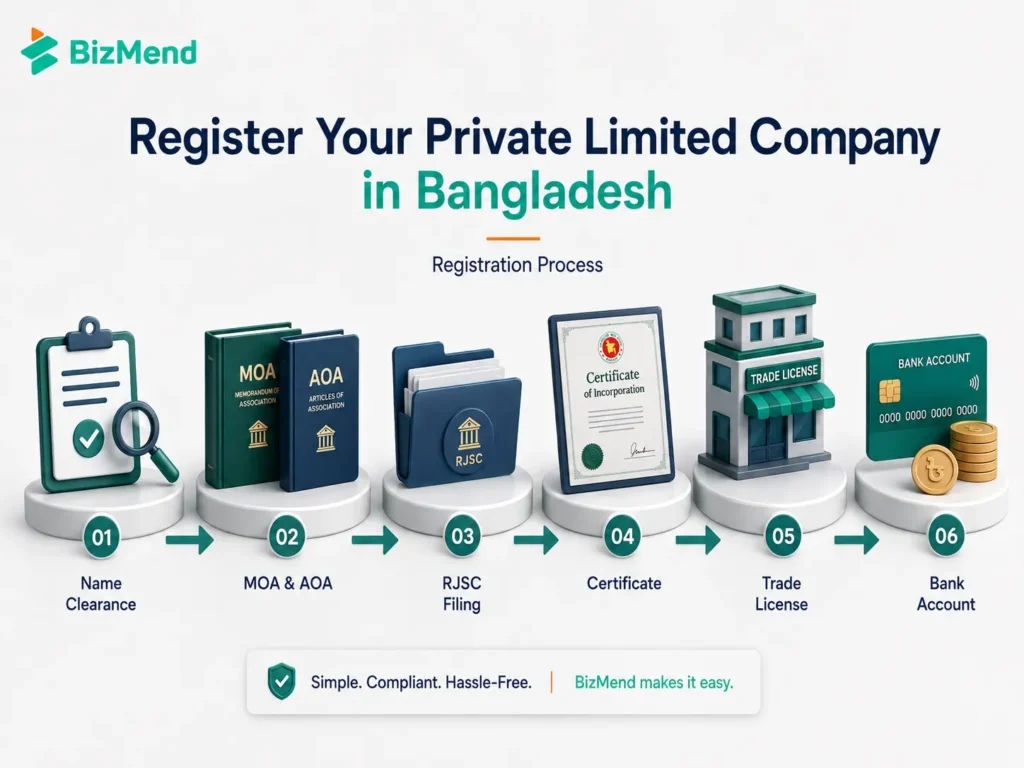
Getting your incorporation certificate isn’t the finish line. A Pvt Ltd registered with RJSC but missing the rest of the stack can’t legally trade.
You still need:
Realistic timeline from first lawyer meeting to operational Pvt Ltd with bank account: 4 to 8 weeks if your documents are clean.
Here’s the part most “how to register” guides skip, and the reason your CA quotes a higher annual fee than you expected.
A Pvt Ltd is a perpetual obligation, not a one-time event. Every year, your company must:
Compliance is the seatbelt. Boring until the day it isn’t.
Skip these for a year and the penalties stay manageable. Skip them for two years and your Pvt Ltd quietly drifts toward inactive status. Banks restrict the account. Tenders reject your bid. And if RJSC eventually strikes the company off the register, restoring it costs more than running it would have.
Honest annual compliance budget for a small Pvt Ltd in 2026: Tk 25,000 to Tk 75,000, depending on your CA’s fees and how organized your bookkeeping stays.
Counter-question worth answering before you sign anything.
Skip the Pvt Ltd, at least for now, if:
A Pvt Ltd is a tool, not a status symbol. Use it when the structure earns its annual compliance bill.
Pvt Ltd registration in Bangladesh isn’t the sealed-off boardroom story most consultants would have you believe. It’s a structured set of filings with a price tag that’s smaller than you think and a compliance load that’s bigger than you think. Match the structure to your actual stage, not to the founder image you want to project. If you’d rather hand the whole filing off, Business Globalizer handles end-to-end Pvt Ltd setup for local and non-resident founders.
What’s the minimum paid-up capital for a private limited company in Bangladesh?
There’s no statutory minimum under the Companies Act 1994. You can incorporate with Tk 1,000 paid up. Most lawyers floor it at Tk 1 lakh so banks, suppliers, and tax officers take you seriously.
How long does Pvt Ltd registration take in Bangladesh in 2026?
Name clearance is 1 to 2 working days. Document drafting takes a week or two depending on your lawyer. RJSC filing approval typically lands in 7 to 15 working days. Add 2 to 4 more weeks for trade license, TIN, BIN, and corporate bank account. Total: about 4 to 8 weeks end to end.
Can I be the only director of my Pvt Ltd?
No. Bangladesh law requires at least 2 directors and 2 shareholders. They can be the same two people, often a husband and wife or two business partners. If you genuinely want to fly solo, sole proprietorship is the right structure.
Can I register my Pvt Ltd at my home address?
Yes, your home address can be your registered office, provided you have proof (rental agreement or ownership deed plus a recent utility bill). Many small Pvt Ltds run from the founder’s apartment for years before moving to a formal office. The registered office must be a physical address inside Bangladesh.
Do I need a trade license before or after RJSC registration?
After. The trade license is issued in your registered company’s name, so you need the incorporation certificate first. Most City Corporations also want your company TIN before issuing the license. Sequence: RJSC, then company TIN, then trade license, then BIN if applicable.
What happens if I stop filing my Pvt Ltd’s annual returns?
Late fees compound monthly with RJSC. Two years of non-filing flags the company as inactive. Banks may restrict the corporate account. Eventually RJSC can strike the company off the register, at which point restoring it (a fresh application, fees, and explanation) is slower and more expensive than running it would have been.

Learn how to become a Daraz seller in Bangladesh, register an account, list products, understand fees, manage orders, and grow…
by Sheikh Ornob

Compare the cost of living in Bangladesh in 2026, including Dhaka and Chittagong rent, food, transport, utilities, inflation, and monthly…
by Sheikh Ornob
Learn MoA and AoA requirements in Bangladesh, key clauses, drafting basics, RJSC filing steps, amendments, and common company-registration mistakes. Suggested…
by Sheikh Ornob