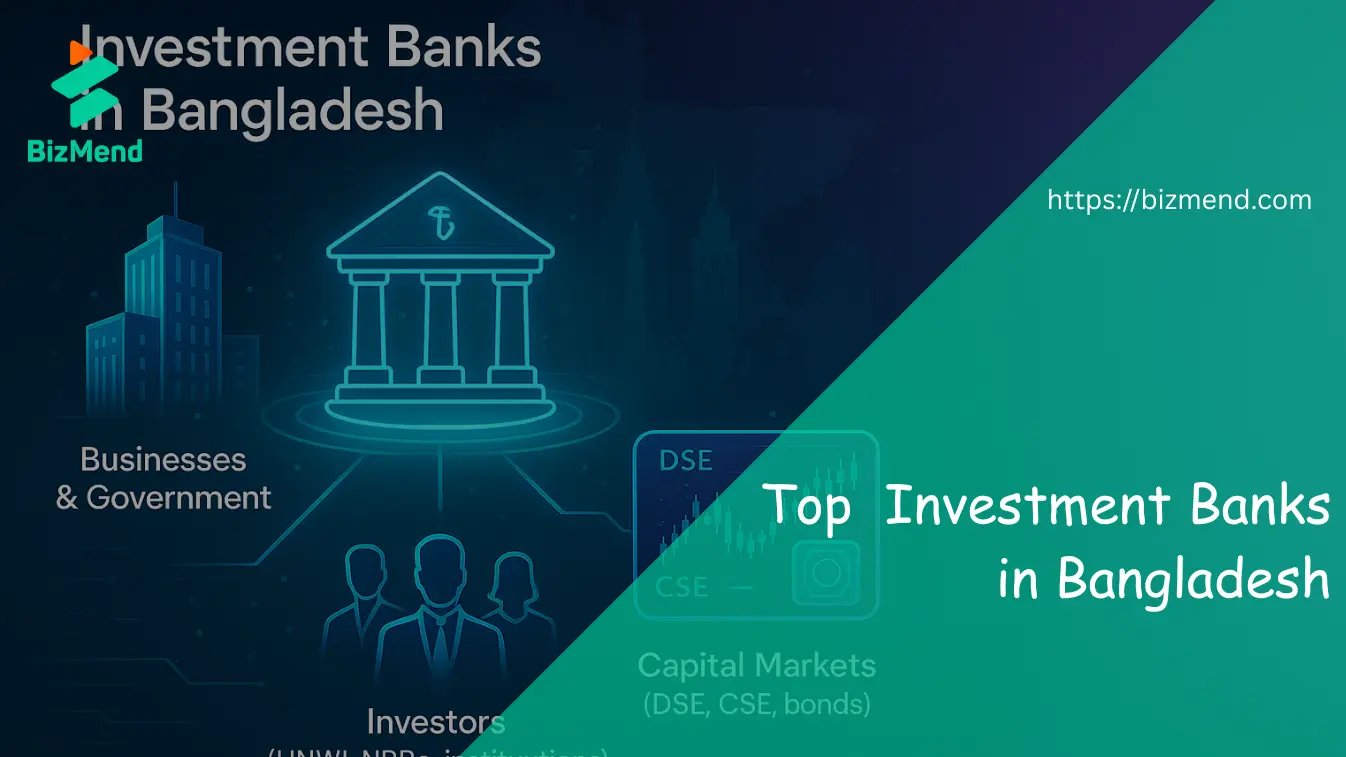
Iinvestment banks in Bangladesh means licensed institutions that help companies and governments raise capital and provide professional advisory and portfolio services, rather than taking regular deposits.
In simple terms: if commercial banks handle your day-to-day money (accounts, cards, loans), investment banks help big projects and investors move large money in a smarter, structured way.
In Bangladesh, this activity is done mainly by merchant banks and investment-banking subsidiaries of banks and insurers, licensed and supervised by the Bangladesh Securities and Exchange Commission (BSEC) and represented by the Bangladesh Merchant Bankers Association (BMBA).
They sit in the middle of three sides:
- Businesses & governments that need money for growth
- Investors (institutions, HNWI, NRBs) who want better returns
- Capital markets (DSE, CSE, bond markets) where money and ideas meet
This guide will briefly explain what investment banking does in Bangladesh, then walk through a curated top-10 list of investment banks, and finally help you understand how to choose the right one.
What Does Investment Banks Actually Do in Bangladesh?
While the label is “merchant banking” locally, the core functions are the same as global investment banking:
- Capital Raising (Equity & Debt)
- Managing IPOs, rights issues, private placements
- Structuring and placing bonds and sukuk
- Syndicating loans or arranging long-term project finance
- Corporate & Transaction Advisory
- M&A advisory (buy-side / sell-side)
- Valuation, restructuring, feasibility studies
- Strategic advice on going public or staying private
- Portfolio & Wealth Management
- Discretionary and non-discretionary portfolios for HNWI, NRBs, institutions
- Research-driven stock selection and asset allocation
- Sometimes private equity or special situation investments
In short, investment banks design and execute the financial “deals” that help the Bangladeshi economy grow – while giving serious investors a more professional way to participate in that growth.
Top 10 Investment Banks (Merchant Banks) in Bangladesh
1. IDLC Investments Limited :
- Bank Code: IDLCIL
- Website: https://investments.idlc.com/
- Started operating as a merchant bank: 1999
IDLC Investments Limited is the investment-banking arm of IDLC Finance and one of the most established merchant banks in Bangladesh. Over the years, it has built a strong name for IPO management, corporate advisory, and research-backed portfolio management for both institutions and high-net-worth individuals.
What makes IDLCIL special
- One of the earliest and most recognised merchant banks in the country
- Strong focus on discretionary portfolio management and long-term wealth building
- Solid track record in public offerings, rights issues, and private placements
2. LankaBangla Investments PLC
- Bank Code : LBI
- Website: https://lankabangla-investments.com/
- Started operating as a merchant bank: Around 2010
LankaBangla Investments PLC is a full-service merchant bank under the LankaBangla group. It’s widely known for its primary market strength, handling a wide range of IPOs, rights issues, and private placements, along with advisory and portfolio services.
What makes LBI special
- Clear positioning as a leading investment bank in Bangladesh
- Active in equity capital markets, M&A advisory, and corporate restructuring
- Offers research-driven services for both issuers and investors
3. City Bank Capital Resources Limited
- Bank Code : CBCRL
- Website: https://www.cbcrl.com/
- Started operating as a merchant bank: 2010
City Bank Capital is the investment-banking subsidiary of City Bank. It mainly focuses on equity and debt capital raising, including bonds and sukuk, and high-end corporate advisory for large local and multinational clients.
What makes CBCRL special
- Strong backing from a major commercial bank (City Bank)
- Proven experience in bond, sukuk and structured finance transactions
- Good fit for large corporates looking at complex funding solutions
4. Green Delta Capital Limited
- Bank Code : GDCL
- Website: https://greendeltacapital.com/
- Started operating as a merchant bank: 2010–2011
Green Delta Capital is a full-fledged merchant bank under the Green Delta group. It’s often recognised for its work in innovative capital-market products, including debt instruments and structured solutions, alongside traditional IPO and portfolio services.
What makes GDCL special
- Frequently highlighted as an award-winning merchant bank
- Strong footprint in corporate investment banking and wealth management
- Good partner for infrastructure, insurance and institutional clients
5. EBL Investments Limited
- Bank Code : EBLIL
- Website: https://eblinvestments.com/
- Started operating as a merchant bank: 2013
EBL Investments Limited is the merchant-banking arm of Eastern Bank PLC. It focuses on public offerings, debt financing, M&A advisory, private equity deals, and portfolio management for both corporate and individual clients.
What makes EBLIL special
- Part of a strong, tech-forward bank (EBL) with good corporate relationships
- Provides an integrated solution: commercial banking + investment banking under the same group
- Attractive for businesses already banking with EBL and looking to tap the capital markets
6. MTB Capital Limited
- Bank Code : MTBCL
- Website: https://mtbcap.com/
- Started operating as a merchant bank: Around 2011
MTB Capital is a merchant bank fully owned by Mutual Trust Bank. It mainly offers issue management, underwriting and portfolio management, helping companies move from traditional bank financing into the capital market.
What makes MTBCL special
- Strong link to Mutual Trust Bank’s SME and corporate franchise
- Good entry point for mid-sized companies planning their first public or private issue
- Provides portfolio solutions to individual and institutional investors
7. AB Investment Limited
- Bank Code : ABIL
- Website: https://abbl.com/subsidiaries/local-subsidiaries/ab-investment-limited/
- Started operating as a merchant bank: 2010
AB Investment Limited is the merchant-banking subsidiary of AB Bank. It offers a wide range of merchant-banking services, including IPO/Rights issue management, underwriting, and portfolio management for investors.
What makes ABIL special
- Backed by one of Bangladesh’s oldest private banks (AB Bank)
- Experience with early capital-market development and fundraising deals
- Suitable for clients who prefer the AB Bank ecosystem for both banking and investment needs
8. AAA Finance & Investment Limited
- Bank Code : AAA
- Website: https://aaafinancebd.com/
- Started operating as a merchant bank: 1991
AAA Finance & Investment Limited is considered a pioneer of merchant banking in Bangladesh. With decades of experience, it has handled a wide range of IPOs, rights issues, bonds, foreign financing structures, and portfolio services.
What makes AAA special
- One of the oldest merchant banks in the country with deep market roots
- Long-term experience in both equity and debt capital markets
- A solid choice for issuers and investors who value legacy and continuity
9. BMSL Investment Limited (Code:)
- Bank Code : BMSL
- Website: https://www.bmslinvestment.com/
- Started operating as a merchant bank: 1997
BMSL Investment Limited is a full-fledged merchant bank that focuses on issue management, underwriting, portfolio management, and pre-IPO/private placements. It has been active across multiple market cycles.
What makes BMSL special
- Long-standing presence in the primary and secondary markets
- Strong at handling mid-market fundraising and advisory assignments
- Good partner for companies planning pre-IPO placements before going public
10. Agrani Equity & Investment Limited (Code: )
- Bank Code : AEIL
- Website : https://www.agranibank.org/index.php/home/merchant_banking/agrani-equity—investment-limited
- Started operating as a merchant bank: 2010
Agrani Equity & Investment Limited is the investment-banking subsidiary of state-owned Agrani Bank PLC. It provides issue management, underwriting and portfolio services, with the added comfort of a large government-backed bank behind it.
What makes AEIL special
- Backed by a major state-owned commercial bank
- Attractive for government-linked entities and businesses that already rely on Agrani Bank
- Provides a mix of public-sector strength and capital-market capabilities
Remember, there are more than these 10 on the BSEC/BMBA lists; this is simply a practical shortlist of highly visible players if you’re starting research.
How to Choose the Right Investment Bank in Bangladesh
Choosing an investment bank is a relationship decision, not just a logo decision. Here’s a simple framework you can follow.
Match Services to Your Need
Start with your primary objective, then work backward:
- IPO / rights issue / IQIO – You want a bank with a strong primary market and regulatory track record (e.g., IDLCIL, LBI, GDCL, EBLIL).
- Bond or sukuk – Look for proven debt and sukuk structuring credentials and experience with institutional investors.
- M&A / restructuring – Focus on firms that actively promote M&A and corporate advisory capabilities, not just IPOs.
- Portfolio management – Prioritize banks with dedicated portfolio teams, robust research and clear performance reporting.
If a bank’s website barely talks about the service you care about, that’s a red flag.
Look at Track Record & Sector Experience
In Bangladesh, sector familiarity really matters:
- Has the bank done deals in your industry (RMG, pharma, FMCG, fintech, infrastructure, etc.)?
- Are there case studies, tombstones or deal lists on their website?
- Do they mention specific landmark IPOs or bonds they arranged?
An investment bank that has already navigated regulators, investors and business realities in your sector will usually move faster and make fewer mistakes.
Fees, Transparency & Communication
Investment banking mandates involve significant fees, but the real issue is clarity:
- Ask for a written mandate that explains retainer fees, success fees, out-of-pocket expenses and what happens if the deal is postponed or fails.
- Notice how they explain complex topics (book-building, pricing, lock-ups, covenants). If they can’t explain it in simple Bangla/English, they may not be a great partner for your board and shareholders.
Transparent banks won’t hesitate to talk about risks, not only upside.
Relationship & Long-Term Support
You’re not just buying a one-time service; you’re (ideally) building a multi-year relationship:
- Does the team ask about your 5–10 year plan, or only about this one deal?
- Will they still pick up your call after the IPO or bond issuance is over?
- Do they have the capacity to support follow-on offerings, acquisitions or restructurings later?
A good rule of thumb: if you feel pressured to “sign now” without full clarity, pause.
How We Selected 10 Investment Banks in Bangladesh
Because the term “top investment bank” can be vague, this list follows a clear, transparent approach:
- BSEC / BMBA Merchant-Banker Lists
We started from the official BSEC list of licensed merchant bankers and cross-checked with the Bangladesh Merchant Bankers Association (BMBA) member information. - Official Websites & Public Profiles
For each institution, we reviewed their own websites and profiles to confirm:
- Merchant-banking license and year of commencement
- Scope of services (IPO, bonds, M&A, portfolio, etc.)
- How strongly they position themselves as investment banks
- Merchant-banking license and year of commencement
- Recent News & Awards
We also noted market recognition, for example:
- Green Delta Capital being recognized as a top merchant bank by BSEC and other awards
- Firms like IDLC, LankaBangla, City Bank Capital frequently branded as leading investment banks in Bangladesh.
- Green Delta Capital being recognized as a top merchant bank by BSEC and other awards
Important: This is an editorial, alphabetical-style shortlist, not a formal ranking by size, revenue or regulatory rating. Always do your own due diligence before appointing any advisor.
FAQs Investment Banks in Bangladesh
1. What is the difference between an investment bank and a merchant bank in Bangladesh?
Globally, people say “investment bank”; in Bangladesh, the same role is usually called “merchant bank”. Practically, they both focus on capital raising, advisory and portfolio management, not on taking regular deposits like commercial banks. BSEC licenses them under merchant-banker regulations, but clients and media often call them investment banks.
2. Can individuals use investment banks, or are they only for big companies?
They are not only for big corporates. Most Bangladeshi merchant banks offer portfolio management and wealth services to individual investors—especially high-net-worth individuals (HNWI) and NRBs who want professional management of larger portfolios. Companies, on the other hand, typically use them for IPOs, bonds and M&A.
3. How do investment banks in Bangladesh make money?
Their main income comes from fees, not from interest on deposits:
- Advisory and issue-management fees on IPOs, rights issues, bonds and sukuk
- Underwriting fees for taking on placement risk
- Portfolio-management and performance fees on managed accounts
- Sometimes success-based fees for M&A or fundraising transactions
4. Which investment bank is best for IPOs and public offerings?
“Best” depends on your sector and deal size, but based on public positioning and track record, IDLC Investments, LankaBangla Investments, City Bank Capital, Green Delta Capital and EBL Investments are frequently cited as active IPO and public-issue managers in Bangladesh. Always compare 2–3 banks’ recent IPO deals in your industry before choosing.
5. Which investment banks are better for portfolio management and HNWI services?
For portfolio management, you generally want banks that highlight:
- Dedicated portfolio/wealth divisions
- Strong research and long history in the capital market
Firms like IDLC Investments, LankaBangla Investments, Green Delta Capital and EBL Investments all actively promote their portfolio services. But the right choice depends on your risk profile, minimum ticket size and how comfortable you feel with their team.
6. Are investment banks regulated differently from commercial banks?
Yes. In Bangladesh:
- Merchant-banking and portfolio activities are licensed and supervised by BSEC under merchant-banker regulations.
- Parent banks (if any) are supervised by Bangladesh Bank as commercial banks.
So an investment-banking subsidiary sits under a capital-market regulator, even if its parent is a regular bank.
7. How long does it usually take to raise capital through a merchant bank?
It depends on the type of transaction and regulatory approvals, but roughly:
- IPO / public offer: often 9–18 months from early preparation to listing, assuming documents and finances are in good shape.
- Private placement / debt deal: can be shorter, around 3–9 months, depending on structure and investor appetite.
Treat these as ballpark ranges, not promises. A good investment bank will build a realistic timeline for your specific case.