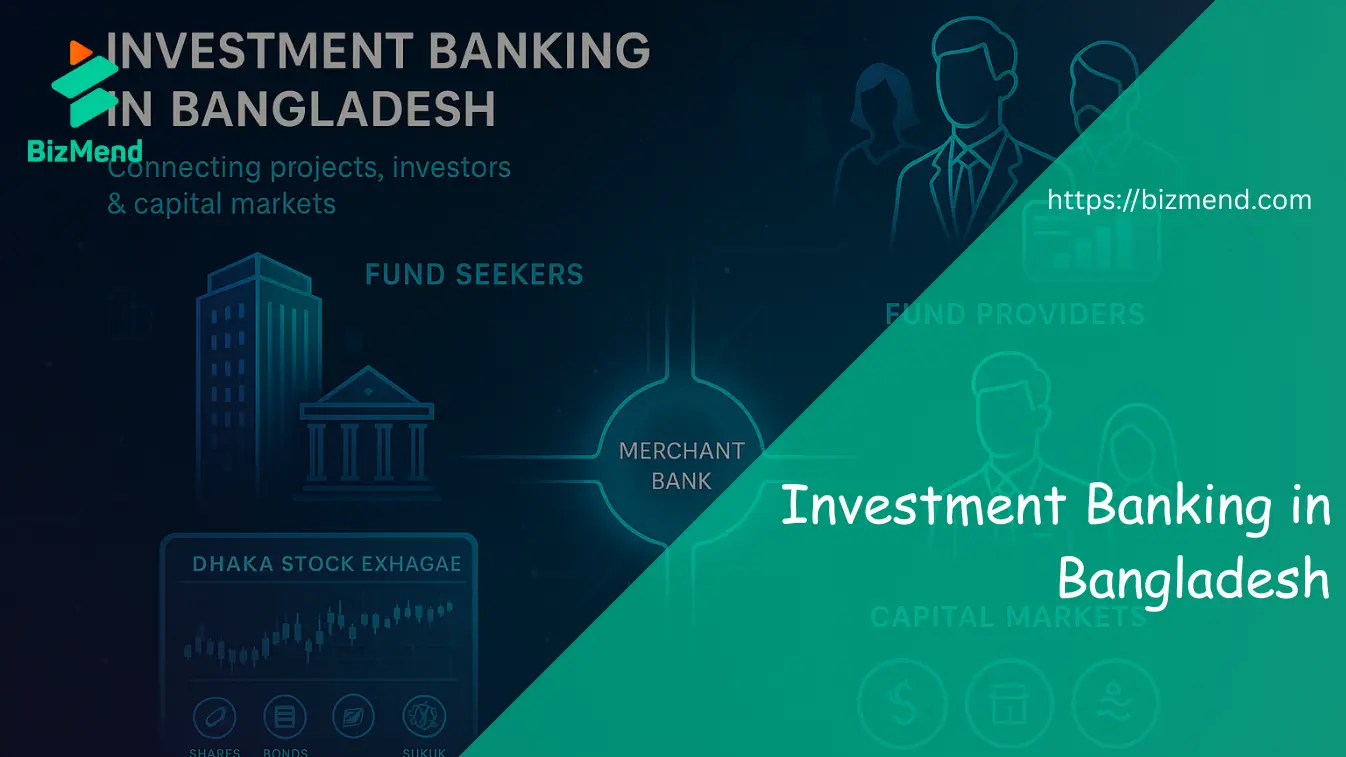
Investment banking In Bangladesh (commonly called merchant banking) is a specialized financial service that:
- Helps companies, government bodies, and institutions raise long-term capital through shares, bonds, sukuk, and other instruments instead of normal bank loans, and
- Helps investors and high-net-worth individuals invest their money professionally in the capital market through portfolio management and advisory.
In simple words:
Investment banking connects people who need big money for projects with people who have money and want to invest.
In this guide, you’ll learn:
- What investment/merchant banking really means in Bangladesh
- What problems it solves for businesses and investors
- The main services it offers (IPOs, bonds, sukuk, M&A, portfolios)
- Who uses these services
- How the process works
- How to know if your business is ready for it
- How to choose the right merchant bank
What Is Investment Banking (Merchant Banking) in Bangladesh?
Globally, the term is investment banking.
In Bangladesh, most of these activities are done by merchant banks or the investment arm of commercial banks.
These institutions are:
- Licensed and regulated (mainly by the capital market regulator)
- Focused on capital markets (shares, bonds, sukuk), not on day-to-day deposits and loans
- Working between “fund seekers” (companies, government, NGOs) and “fund providers” (investors, institutions, NRBs)
You can think of a merchant bank as:
A deal architect and capital-market guide that designs the right financial structure, navigates regulations, and finds investors for large funding needs.
Investment Bank vs Merchant Bank – Are They the Same?
In Bangladesh:
- The legal/regulatory term you’ll see is usually “merchant bank” or “merchant banking division”.
- In global finance and media, the same kind of work is called “investment banking”.
Functionally, when we talk about investment banking in Bangladesh, we are talking about:
Merchant banks and investment divisions of financial institutions that arrange capital-market deals and manage investments.
What Problems Does Investment Banking Solve in Bangladesh?
For Businesses and Institutions
Most growing businesses in Bangladesh run into these issues:
- Bank loans are not enough for very large or long-term projects.
- Expanding into new plants, power projects, telecom networks, or infrastructure needs huge capital.
- Owners want to grow faster but don’t want to rely only on collateral-backed loans.
Investment banking solves this by helping you:
- Raise equity (sell shares: IPO, rights issue, private placements)
- Raise long-term debt (corporate bonds, debentures, sukuk)
- Restructure or sell your company (M&A, strategic sale)
- Get professional advice on valuation and capital structure
In short:
Investment banking gives Bangladeshi businesses access to bigger, smarter, and more flexible money than traditional loans.
For Investors and High-Net-Worth Individuals
On the other side, many people and institutions have surplus funds, but:
- They don’t have time or skills to pick good stocks, bonds, or sukuk.
- They want better returns than FDRs, but with some professional risk management.
Investment banks help them by:
- Managing portfolios (Portfolio Management Services – PMS)
- Giving access to IPOs, bonds, sukuk, and structured products
- Providing research and advisory to support decisions
So for investors, merchant banks are like:
A professional money manager who uses the capital market to grow your wealth over time.
Core Investment Banking Services in Bangladesh (At a Glance)
Here are the main service families you’ll see in the Bangladeshi context.
Equity Capital: IPOs, Rights Issues, and Private Placements
Investment banks help companies:
- Go public via IPO (Initial Public Offering) – listing shares on DSE/CSE so anyone can invest
- Raise more capital from existing shareholders through rights issues
- Raise money from selected investors (local or foreign) via private placements
Their role includes:
- Valuation and pricing
- Preparing the prospectus and documentation
- Coordinating with regulators and stock exchanges
- Marketing the offer to investors
Debt Capital: Corporate Bonds, Debentures, and Sukuk
Not every company wants to dilute ownership. Debt capital is another path.
Investment banks help structure and place:
- Corporate bonds and debentures – interest-based instruments
- Sukuk – Shariah-compliant investment certificates (Islamic alternative to bonds)
They work on:
- Deciding coupon/profit, tenure, and security
- Getting ratings and regulatory approvals
- Selling these instruments to institutions and high-net-worth investors
Advisory: M&A, Valuation, and Restructuring
For companies that are:
- Planning to merge with or acquire another business
- Looking to sell a stake or the entire company
- Wanting to restructure debt, equity, or ownership
Investment banks provide:
- Valuation and fairness opinions
- Deal structuring and negotiation support
- Due diligence coordination
- End-to-end transaction advisory
Investment & Portfolio Services
For investors (individuals, NRBs, institutions), many merchant banks offer:
- Discretionary portfolios – they manage the investments for you
- Non-discretionary/advisory – they advise; you approve trades
- Access to new issues (IPOs, bonds, sukuk)
- Research and market insights
This is where investment banking intersects with wealth management.
Who Actually Uses Investment Banking in Bangladesh?
Large and Mid-Sized Corporates
These include:
- Telecom operators
- Power and energy companies
- Infrastructure and industrial firms
- Large manufacturing, pharma, and financial companies
They use investment banks to:
- Raise capital for expansion
- Access public markets
- Restructure balance sheets
- Execute M&A deals
Banks, NBFIs, and Institutional Clients
Banks and non-bank financial institutions may use investment-banking services for:
- Issuing subordinated bonds
- Structuring capital instruments
- Co-arranging syndicated deals
Institutions such as mutual funds, insurance companies, pension funds are often on the investor side of these deals.
Government, NGOs, and Social Enterprises
Public and social sector entities may use investment banking tools to:
- Finance infrastructure and development projects
- Issue green bonds, social bonds, or sukuk
- Attract blended finance and impact investors
Investors – HNWI, Institutions, and NRBs
High-net-worth individuals, family businesses, and NRBs use merchant banks to:
- Invest in stocks, bonds, sukuk, funds
- Get professionally managed portfolios
- Access deals and issues that are hard to reach alone
How the Investment Banking Process Works (Simple Step-by-Step)
The exact steps depend on the deal type, but a typical journey looks like this:
- Initial Discussion & Feasibility Check
- You discuss your funding or strategic need.
- The investment bank evaluates whether capital markets are suitable and what structure fits.
- You discuss your funding or strategic need.
- Mandate & Engagement Letter
- If both sides agree, they sign an engagement letter.
- It defines scope, responsibilities, timelines, and fee structure.
- If both sides agree, they sign an engagement letter.
- Due Diligence & Data Collection
- The bank reviews your financials, legal documents, operations, and projections.
- This step helps design a realistic and compliant deal.
- The bank reviews your financials, legal documents, operations, and projections.
- Deal Structuring & Documentation
- Decide the right instrument: shares, bond, sukuk, etc.
- Prepare prospectus, information memorandum, and supporting documents.
- Decide the right instrument: shares, bond, sukuk, etc.
- Regulatory Approvals
- Submit applications and documents to relevant regulators and exchanges.
- Respond to queries and make necessary adjustments.
- Submit applications and documents to relevant regulators and exchanges.
- Marketing & Investor Roadshow
- Present the opportunity to potential investors: institutions, HNWI, NRBs, etc.
- Gather feedback, build interest, and finalize allocations.
- Present the opportunity to potential investors: institutions, HNWI, NRBs, etc.
- Subscription, Allotment & Listing/Closing
- Investors subscribe and transfer funds.
- Shares/bonds/sukuk are allotted and, where applicable, listed in the market.
- Investors subscribe and transfer funds.
- Post-Deal Support & Ongoing Compliance
- Support in disclosures, reporting, and investor communication.
- Sometimes help with future rounds of capital raising.
- Support in disclosures, reporting, and investor communication.
How to Know If Your Business Is Ready for Investment Banking
Financial Readiness
Your business is more likely to be ready if:
- You have several years of audited financial statements
- Revenues are meaningful, with a clear growth story
- Your profitability is reasonably stable or improving, or you have a strong path to profit
Governance & Compliance Readiness
Signals that you’re prepared:
- Clean, documented ownership structure
- Basic board and governance framework in place
- Tax and regulatory filings are largely up to date
Strategic Readiness
You should be clear on:
- Why you want to raise capital (expansion, new projects, acquisitions, deleveraging)
- How much you need, and how you will use it
- Your willingness to accept more transparency and reporting, especially if you go public
If these points fit your situation, it may be time to:
Book a diagnostic meeting with a licensed merchant bank to explore options.
Risks, Costs, and How a Good Investment Bank Adds Value
Typical Risks
- Market risk: Poor market conditions can hurt deal success or pricing.
- Regulatory risk: Approvals can take time or require changes.
- Valuation risk: What you think your business is worth may differ from investor expectations.
- Reputation risk: A badly structured or failed deal can harm your brand.
Typical Cost Components
While exact amounts vary, common cost heads include:
- Advisory and success fees
- Legal, rating, and regulatory fees
- Marketing and roadshow expenses
The key is to understand the total cost upfront and see it as an investment in long-term growth.
How a Good Investment Bank Reduces These Risks
A strong, experienced merchant bank will:
- Tell you frankly if your business is not yet ready
- Suggest structures that fit your risk and growth profile
- Use their regulatory experience to avoid avoidable delays
- Use their investor network to improve the chances of a successful deal
How to Choose the Right Investment / Merchant Bank in Bangladesh
When evaluating options, look at:
- Licensing & reputation – Are they properly regulated and respected?
- Track record – Have they done successful deals in your sector or similar size?
- Product expertise – IPOs, bonds, sukuk, M&A, portfolios – do they know your type of transaction?
- Investor network – Can they actually reach the investors you need?
- Transparency – Are fees and processes clearly explained?
- Communication style – Do they simplify complex ideas and understand your business?
Shortlist a few, meet them, and choose the team that combines credibility, clarity, and genuine understanding of your goals.
FAQ: Investment Banking in Bangladesh
What is the difference between an investment bank and a merchant bank in Bangladesh?
In Bangladesh, the legal term is usually “merchant bank”, but the functions are very similar to what the world calls “investment banking”. Both focus on capital markets (shares, bonds, sukuk, advisory) rather than everyday deposits and loans.
Is investment banking only for very large companies?
No. Very large companies use it the most, but mid-sized and fast-growing businesses can also benefit, especially through private placements, smaller bond issues, or advisory. The key factor is whether your funding need and structure justify the cost and complexity.
Can a small or family-owned business use investment banking services?
Yes, but only when it reaches a certain level of size, formalization, and governance. Many very small businesses are better served by standard bank loans and overdrafts. Once your business is formal, audited, and growing, investment banking can become an option.
How do investment banks in Bangladesh actually make money?
They earn through fees and charges: advisory fees, underwriting fees, success fees on deals, and management fees on portfolio services. Some also earn trading or investment income from their own capital-market activities.
Who regulates investment and merchant banking activities in Bangladesh?
Merchant banking and capital-market activities are mainly regulated by the securities regulator and stock exchanges. Other regulators may be involved depending on the type of instrument, sector, or entity.
How long does it usually take to complete an IPO or bond deal in Bangladesh?
It depends on the size and complexity, but it is not quick. From preparation to closing, it can take several months to more than a year, especially when regulatory reviews and market timing are considered.
Is investing through a merchant bank safer than investing on my own?
The market risk is still there, but a professional portfolio manager can help with diversification, research, and discipline. That doesn’t guarantee profit, but it often leads to more structured and informed decisions than a purely DIY approach.