

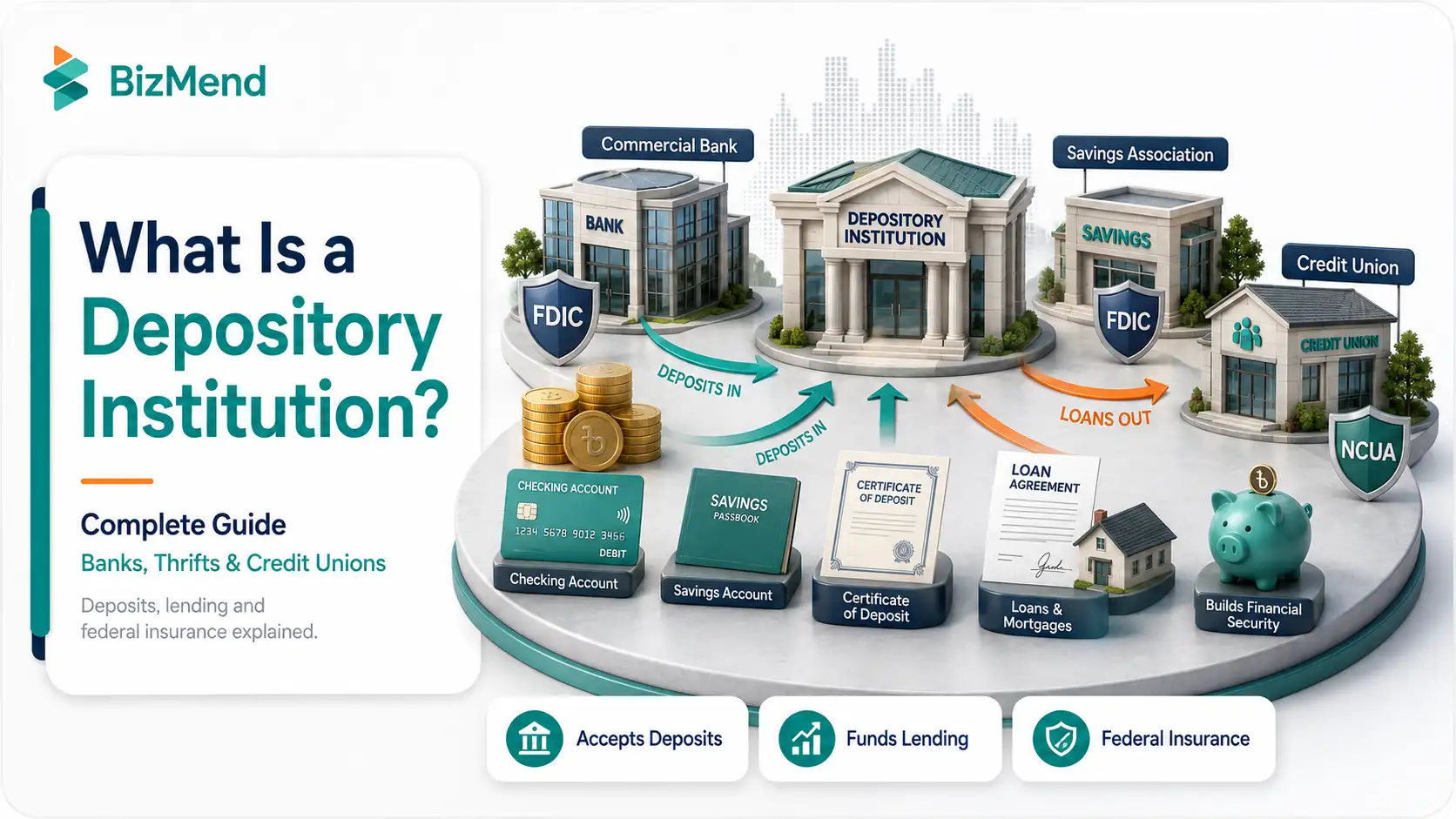
What is a depository institution, and why does the term matter more than “bank”? A depository institution is any financial company licensed to accept deposits from the public, including commercial banks, savings associations, and credit unions. Nearly everyone with a checking account, savings account, or certificate of deposit is already a customer of one.
The distinction matters because deposit insurance, reserve requirements, and consumer protections all attach to this legal category, not just to the word “bank.” This guide covers what a depository institution is, the types available in the US, how they work, and how to choose one.
Quick Answer: A depository institution is a financial company licensed to accept deposits from the public and use them to fund loans. In the US, this includes commercial banks, savings associations, and credit unions. Deposits are insured up to $250,000 per depositor by the FDIC (banks and thrifts) or NCUA (credit unions).
What Is a Depository Institution?
A depository institution is a financial company licensed to accept deposits from the public and use those funds to make loans, subject to federal or state supervision. Under federal law, the narrowest definition, found in the Federal Deposit Insurance Act, covers only banks and savings associations. The Federal Reserve’s own reserve-requirement rules use a broader definition that also includes credit unions, and that broader meaning is what most consumer guides, regulators, and this article intend when they use the term.
In practice, a depository institution works as a two-sided business. On one side, it takes in checking deposits, savings deposits, and certificates of deposit, paying depositors modest interest in return. On the other side, it lends a portion of those funds out as mortgages, auto loans, credit cards, and business loans, charging borrowers a higher rate than it pays depositors. The spread between what it pays and what it earns, minus operating costs, is how the institution stays in business.
Almost every US household uses a depository institution, whether that is a national retail bank, a local credit union, or an online-only bank. What sets these institutions apart from other financial companies is the deposit itself: money held at a depository institution is a direct claim on the institution, protected by federal deposit insurance, rather than an investment whose value can rise or fall. That protection, more than any single product feature, is why the category still matters even as fintech apps and payment platforms increasingly compete for the same customer relationships.
How It Differs From Non-Depository Products
Not every financial company that holds your money is a depository institution. Brokerages, payment apps, and investment platforms often hold client funds, but unless those funds sit in an FDIC-insured or NCUA-insured account at a partner depository institution, they are not deposits in the legal sense and do not carry the same insurance. Finance companies, mortgage lenders, and insurance companies fund their lending through bonds, commercial paper, or equity capital instead of public deposits, which is the defining line the law draws between depository and non-depository institutions.
This distinction matters most when a product looks and feels like a bank account but technically is not one. A popular payment app balance, a prepaid card, or a cryptocurrency exchange balance can all resemble a checking account in a mobile interface, yet none of them is automatically a deposit at a depository institution. Some fintech apps solve this by partnering with an actual bank behind the scenes and passing FDIC coverage through to the customer; others do not, and a customer has to read the fine print to know which situation applies. When in doubt, the safest approach is to confirm in writing which FDIC-insured or NCUA-insured institution actually holds the funds, rather than assuming a familiar-looking app automatically carries deposit insurance.
Types of Depository Institutions in the US
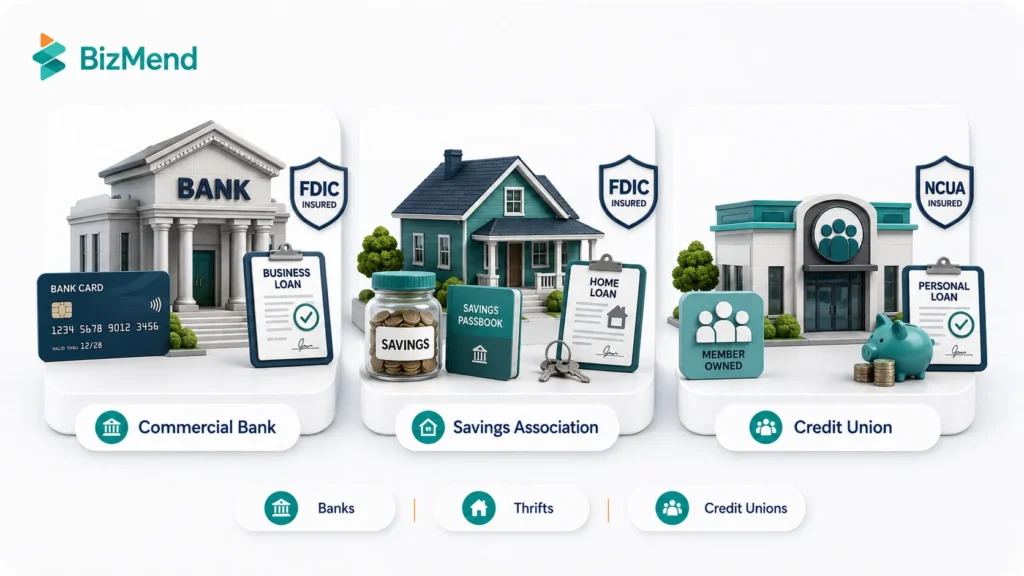
The US depository system has three broad categories, each with its own regulatory home, though the practical experience of banking with any of them looks similar to a depositor.
| Type | Ownership | Primary Regulator | Deposit Insurer |
| Commercial bank | Shareholder-owned (or privately held) | OCC (national) or state regulator plus Fed/FDIC (state) | FDIC |
| Savings association (thrift) | Shareholder-owned or mutual | OCC or state regulator | FDIC |
| Credit union | Member-owned cooperative | National Credit Union Administration | NCUA |
Commercial banks are the largest category and split further by charter. A national bank holds a federal charter and answers primarily to the Comptroller of the Currency. A state bank instead holds a state charter and answers to a state regulator alongside the Federal Reserve or FDIC. Size and footprint create further distinctions within the commercial bank category. A community bank typically serves a single city or region with a relationship-focused model. A regional bank, by contrast, operates across multiple states with a broader branch and product footprint.
Savings associations, sometimes called thrifts, historically focused on home mortgage lending and consumer savings, tracing back to a business model built around funding local homeownership rather than broad commercial lending. Many have converted to bank charters over the past few decades as the regulatory and competitive advantages of the thrift charter narrowed, so the number of standalone savings associations has shrunk considerably since the 1980s. The ones that remain are still full depository institutions, subject to their own federal oversight and carrying the same FDIC insurance as a commercial bank.
Credit unions are member-owned cooperatives rather than shareholder-owned companies, which is the single biggest structural difference in this list. Membership is typically limited to people who share a common bond, such as an employer, a geographic area, a school, or an association, and a prospective member usually has to join the underlying association or meet the field-of-membership criteria before opening an account. Profits are returned to members through better rates and lower fees rather than paid out as dividends to outside shareholders, which is part of why credit union rates are sometimes more competitive than a comparable bank account.
Digital-first institutions cut across these categories rather than forming a fourth one. An online bank is usually a bank or savings association chartered like any other, just without a branch network. Some depository institutions instead maintain a full bank branch footprint alongside complete digital access.
How a Depository Institution Works
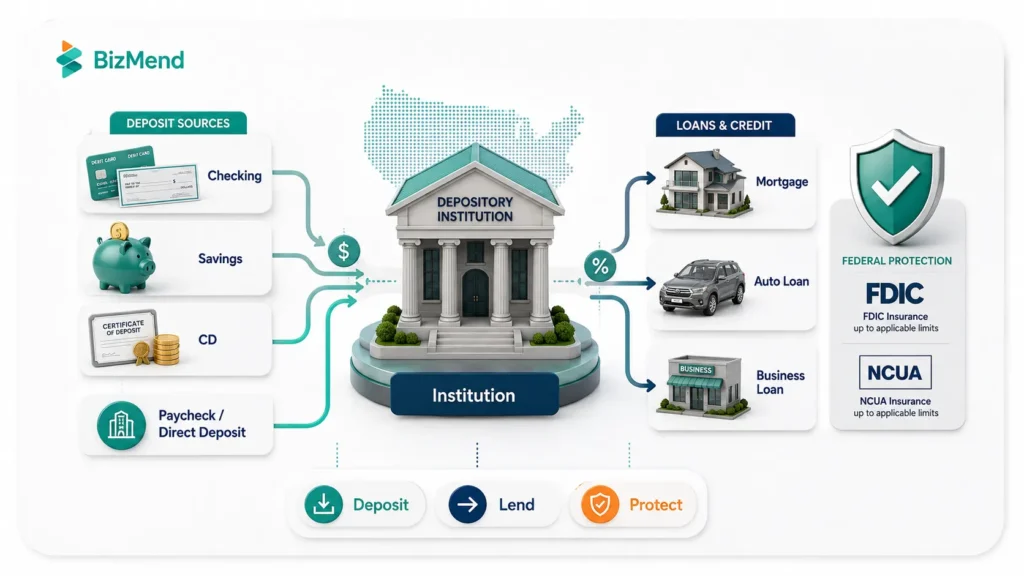
The mechanics behind every depository institution follow the same basic pattern, regardless of size or charter type.
Deposits come in first. A depositor opens an account and places funds into it, whether through a paycheck deposit, a wire transfer, or a cash deposit at a branch. Those funds legally belong to the depositor, and the institution owes them back on demand or on the account’s agreed terms.
A portion of deposits funds lending. The institution keeps some funds in reserve, historically a Federal Reserve requirement and still a practical necessity for meeting withdrawals, and lends out the rest through mortgages, personal loans, credit cards, and business credit lines.
Interest flows in both directions. The institution pays depositors a rate on interest-bearing accounts and charges borrowers a higher rate on loans. That spread, along with fees for specific services, is the core of how a depository institution generates revenue.
Deposit insurance backstops the whole system. If a depository institution fails, the FDIC or NCUA steps in to pay insured depositors, typically within a few business days, which is why a bank or credit union failure rarely turns into a direct loss for an ordinary depositor within coverage limits.
Reserve requirements tie the system together at a national level. The Depository Institutions Deregulation and Monetary Control Act of 1980 extended Federal Reserve reserve requirements to essentially every depository institution, banks, thrifts, and credit unions alike, rather than only Federal Reserve member banks as had been the case before. That law is also where the modern, broad definition of “depository institution” used throughout this guide originates, since the Federal Reserve needed a single term that covered every institution type it wanted to regulate for reserve purposes.
Requirements and Eligibility to Open an Account
Opening an account at a depository institution generally requires proof of identity, a taxpayer identification number, and enough information for the institution to run a routine account-screening check, though the exact requirements vary by institution type.
For a national bank, expect to provide government-issued photo ID, a Social Security number or ITIN, and a US address; see national bank requirements for the full checklist. A state bank generally asks for similar documentation, detailed in state bank requirements, though minimum opening deposits can vary by institution. A community bank often runs a lighter-touch process built around a local relationship; community bank requirements covers what that looks like in practice. A regional bank spanning multiple states typically follows a more standardized process instead, outlined in regional bank requirements.
Online banks usually complete identity verification digitally rather than in person; see online bank requirements for what that process involves. Anyone opening an account at a physical location should also review bank branch requirements, since in-person identification steps differ slightly from online-only onboarding. Credit unions add one more step beyond typical bank requirements: applicants must also meet the credit union’s membership eligibility, based on the common bond that defines who can join.
Newcomers to the US banking system, including recent immigrants and non-residents, face additional documentation questions that a standard requirements checklist does not fully cover; resources like this guide to opening a US bank account as a non-resident address that situation specifically.
Most institutions also run a consumer-report screening, commonly through ChexSystems for banks, to check for a history of unpaid account fees or fraud at other institutions before approving a new account. Age is another common requirement: most depository institutions require an account holder to be at least 18, though minors can typically access an account through a joint account with a parent or guardian, or through a custodial account structure that transfers full control once the minor reaches adulthood.
Benefits and Potential Drawbacks
Depository institutions offer real, well-established advantages, but they are not free of trade-offs.
Benefits center on safety and convenience:
- Federal deposit insurance up to $250,000 per depositor, per institution, per ownership category, backed by the full faith and credit of the US government
- Easy, near-instant access to funds through debit cards, checks, ATMs, and electronic transfers
- A documented transaction history that supports budgeting, tax preparation, and building a credit profile over time
- A baseline of federal consumer protection law, including rules on error resolution and account disclosures, that unregulated or uninsured alternatives do not carry
- The ability to receive direct deposit paychecks, government benefits, and tax refunds without delay
Drawbacks are mostly about opportunity cost and friction:
- Interest paid on standard deposit accounts is often modest compared to what other investments can return over a longer time horizon
- Monthly fees or minimum-balance requirements can apply at some institutions, particularly on basic checking accounts
- A poor banking history at one institution, reflected in a ChexSystems report, can make it harder to open an account elsewhere until that history clears, typically after several years
- Credit union membership requirements can exclude someone who does not qualify under the relevant common bond, even if the credit union otherwise offers better rates
How to Choose the Right Depository Institution for Your Needs
The right depository institution depends on what you actually do with your money, not on which one has the most recognizable name.
Start with insurance and safety: confirm any candidate institution is FDIC-insured or NCUA-insured before opening an account, since that single fact matters more than any feature comparison. From there, match the institution type to your habits. Readers who want nationwide branch and ATM access should see how to choose a national bank. Those who prefer working with a state-chartered institution instead can review how to choose a state bank. If a closer, more personal relationship matters most, how to choose a community bank walks through what to compare. Readers weighing a larger multi-state option instead can consult how to choose a regional bank.
Digital-first users have their own path. The guide on how to choose an online bank is worth reading first, since it covers the factors that matter when there is no branch to visit. Anyone who still wants in-person service alongside digital tools should instead read how to choose a bank branch for what to evaluate on a branch visit. Readers still deciding between a physical and digital-first relationship entirely may also find online bank vs traditional bank useful before narrowing the list further.
Whichever type fits best, compare two or three specific institutions on fees, minimum balance requirements, interest rates, digital features, and customer service before committing, rather than treating institution type alone as the deciding factor.
Key Insights
- A depository institution is any company licensed to accept public deposits, covering banks, savings associations, and credit unions.
- Deposits are insured up to $250,000 per depositor by the FDIC for banks and thrifts, or the NCUA for credit unions.
- The core mechanics are the same everywhere: deposits fund loans, and the interest spread covers the institution’s costs.
- Opening an account generally requires ID, a taxpayer number, and a consumer-report screening such as ChexSystems.
- Credit unions add a membership eligibility requirement that banks do not have.
- Institution type matters less than confirmed deposit insurance, fees, rates, and how you actually plan to bank.
Final Thoughts on Depository Institutions
A depository institution is the legal category behind nearly every checking account, savings account, and certificate of deposit in the US, whether the institution calls itself a bank, a savings association, or a credit union. Understanding the category matters because deposit insurance, reserve rules, and consumer protections attach to it directly, not to any brand name or marketing label a provider happens to use.
Choosing among depository institutions comes down to a short, practical list of factors: insurance coverage, fees, interest rates, accessibility, and the kind of service you actually want. Compare a small set of options against those factors, confirm FDIC or NCUA coverage directly with the institution, and revisit your choice again whenever your financial situation changes meaningfully.
Frequently Asked Questions
What is a depository institution?
A depository institution is a financial company licensed to accept deposits from the public and use them to fund loans. In the US, this covers commercial banks, savings associations, and, under the broader Federal Reserve definition, credit unions.
How does a depository institution work?
It accepts deposits, keeps a portion in reserve, and lends the rest to borrowers at a higher rate than it pays depositors. The difference between what it earns on loans and pays on deposits, along with account fees, funds its operations.
Can I have accounts at more than one depository institution?
Yes. There is no legal limit on how many depository institutions you can use, and spreading funds across separate FDIC-insured or NCUA-insured institutions is a common way to extend deposit insurance coverage beyond the $250,000 per-institution limit.
Is it safe to keep money at a depository institution?
For amounts within FDIC or NCUA coverage limits, yes. Since the FDIC was created in 1933, no depositor has lost a single cent of insured funds when a federally insured institution failed, and the NCUA has maintained a comparable record for credit unions. It is still worth confirming an institution’s insured status directly, through the FDIC’s BankFind tool or the NCUA’s equivalent lookup, if you are unfamiliar with it or its marketing does not clearly display an FDIC or NCUA sign.
What does “depository institution” actually mean?
It is the legal and regulatory term for a company that can lawfully accept deposits from the public, as distinct from an investment firm, insurer, or finance company that raises money in other ways. Regulators use the term specifically because “bank” alone does not capture credit unions and savings associations.
Who needs a depository institution?
Almost everyone who wants to receive a paycheck by direct deposit, pay bills electronically, or keep savings protected by federal insurance needs some form of depository institution relationship, even if they also use investment or payment accounts elsewhere.
How is a depository institution different from other kinds of accounts?
Money at a depository institution is a deposit, a direct, insured claim against the institution that is generally available on demand or on clearly stated terms. Money in a brokerage account, a payment app balance, or a cryptocurrency wallet is typically an investment or a different kind of claim entirely, without the same federal deposit insurance protection, and its value can fluctuate in ways a standard deposit account’s balance never does. Understanding which category a given account falls into is often the single most useful question to ask before moving meaningful money anywhere.
