

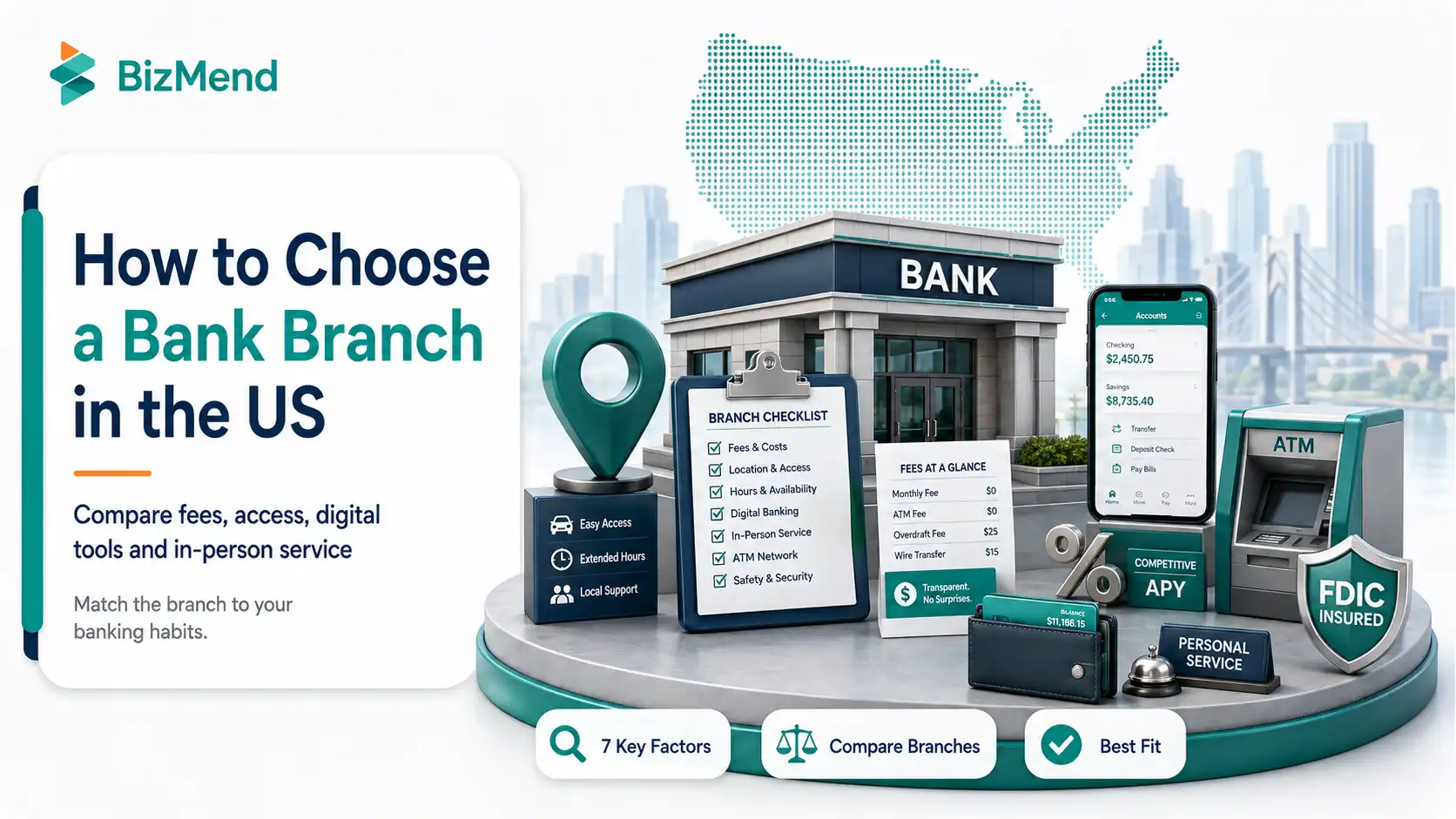
Learning how to choose a bank branch in the US comes down to matching seven factors against your own habits, not picking whichever storefront sits closest to home or looks the most polished from the parking lot. The account behind the counter and the branch itself both matter, and a great location with the wrong account terms still costs you money every single month.
This guide walks through the factors worth comparing, a side-by-side look at common bank branch profiles, a five-step selection process, and the red flags that should send you looking elsewhere before you apply.
Quick Answer: To choose a bank branch, compare monthly fees, minimum balance rules, interest rates, ATM access, FDIC insurance, digital features, and in-person customer service against your own habits, then visit two or three branches, compare their current fee schedules directly, and confirm FDIC coverage before opening an account there.
Key Factors to Compare When Choosing a Bank Branch
Monthly fees. Ask whether the fee is waived by direct deposit, a minimum balance, or account type, and compare that requirement against your actual paycheck and spending pattern rather than the advertised fee alone. A branch can only offer the terms the bank behind it sets, so the fee schedule matters more than the building itself, no matter how nice the lobby looks or how new the furniture is.
Minimum balance requirements. Some accounts charge a fee below a set balance; others simply close the account after enough low-balance notices. Match this number against your lowest typical balance during a slow month, not your average balance, since the slow month is when the requirement actually costs you money you were not expecting to lose.
Interest rate and APY. Rates on checking and savings accounts change often and vary by bank rather than by branch, so treat any specific number in an old comparison chart as a snapshot rather than a guarantee. Ask the branch staff for the bank’s current rate sheet directly, since a branch employee can usually pull this up on the spot rather than making you search online yourself, and can also explain any tier structure tied to your balance.
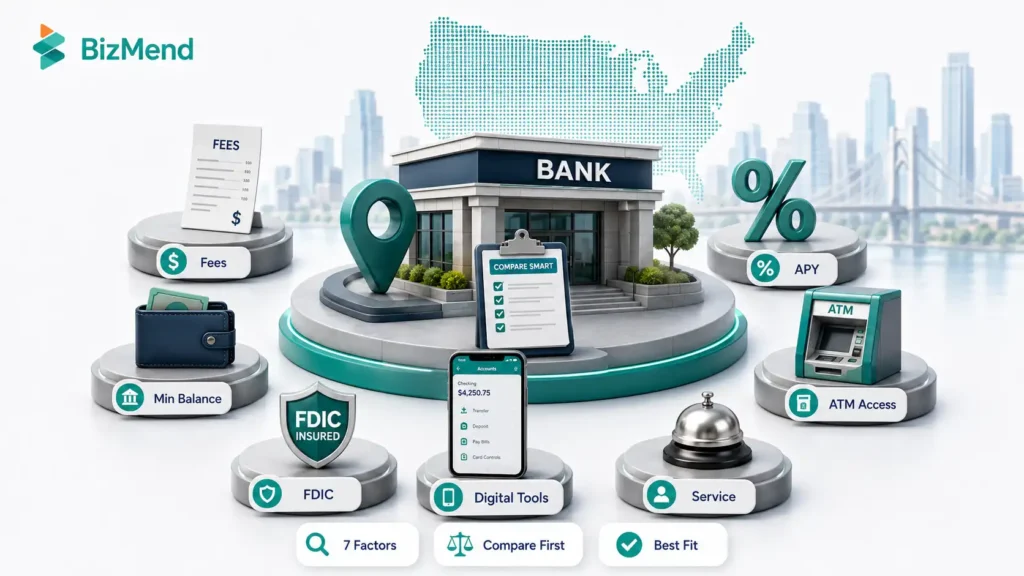
ATM access. A branch’s own ATM covers immediate withdrawals, but ask whether the bank belongs to a larger surcharge-free network and how many machines are actually near where you live, work, and travel, not just near this one location you happen to be visiting today. A wide network matters more than a single convenient machine once you factor in daily life beyond this specific branch.
FDIC insurance. Confirm coverage directly through the FDIC’s BankFind tool rather than assuming from the branch’s signage or how established it looks from the outside. Every dollar up to $250,000 per depositor, per bank, per ownership category is protected identically, so this factor rarely differentiates one branch from another once you confirm the bank itself carries current coverage on file with regulators.
Digital features. Even a branch-first relationship usually comes with a mobile app, so test its deposit, bill pay, and transfer speed before committing, and ask whether the branch can help troubleshoot the app in person if something goes wrong later on, since not every location trains staff equally on the digital side.
Customer service. Branch-level service varies more than people expect within the same bank, so ask about typical wait times, whether appointments are available, and how a dispute like a wrong charge actually gets resolved at this specific location rather than assuming every branch of the same bank performs identically. A location with a stable, long-tenured staff often resolves problems faster than one with frequent turnover.
Bank Branch Comparison at a Glance
Real bank branches vary too much by bank, location, and staffing to rank fairly in a single table, so the comparison below groups common bank branch profiles by the way they tend to operate day to day. Use it to decide which profile fits your situation, then compare actual branches in your area against that profile rather than treating any single name as universally best for every reader.
| Profile | Typical Fees | Service Style | Best Fit For |
| Full-service branch of a large national bank | Often higher, sometimes waivable | Full staff, appointment-based bankers | Complex needs, loans, and nationwide access |
| Branch of a smaller regional or local bank | Often lower or more negotiable | Personal, relationship-based service | Local relationships and flexible in-person help |
| In-store or retail branch | Often lower monthly fee | Limited staff, extended retail hours | Quick, everyday transactions on a flexible schedule |
| ITM-equipped or hybrid branch | Varies by bank | Video-assisted teller, longer hours | Tech-comfortable users who still want a human option |
Use the table as a starting filter rather than a final answer on its own. A full-service branch near you might already run efficient appointment scheduling, and an in-store branch might still offer a surprisingly knowledgeable staff member for a quick loan question, so confirm the specifics with each location once you have narrowed the list to two or three real candidates worth an actual visit.
Every profile above still needs the same core account terms confirmed directly with the bank, since the classification of the branch itself matters less than the account and the charter behind it. A state bank can run any of these branch styles just as easily as a large institution can. A national bank follows the same logic from the federal charter side, so the profile and the specific location matter more than the charter type alone. Reading up on what actually defines a national bank charter is useful background if a branch on your shortlist turns out to be organized that way.
Newcomers comparing a non-resident bank account against a standard branch visit will find the profile framework above still applies, since document requirements rarely change the underlying comparison factors. The identity and taxpayer number rules stay the same regardless of which profile a specific branch fits.
5 Steps to Choose the Right Bank Branch
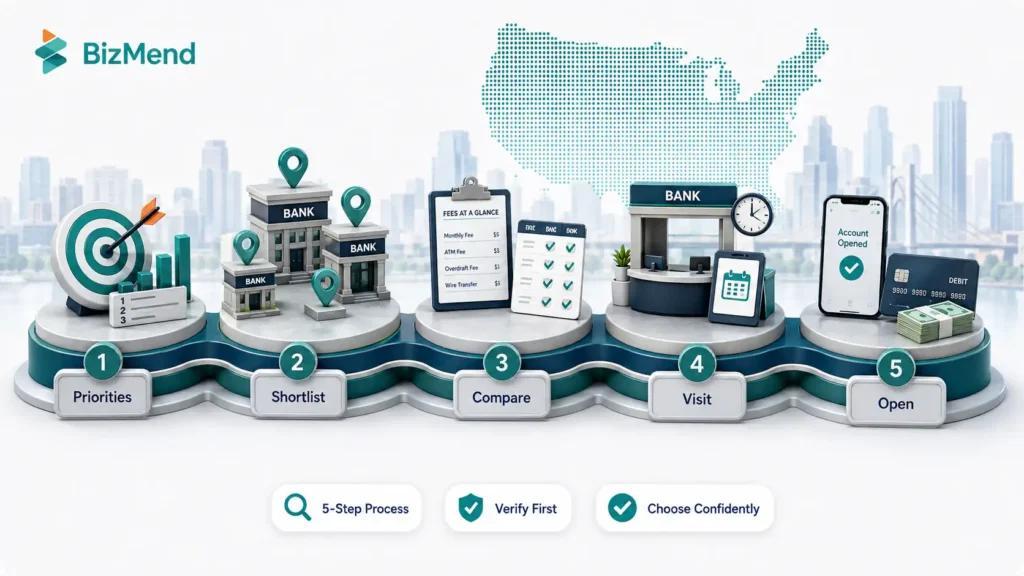
1. Rank your priorities. Decide which of the seven factors matters most for your situation, since no single branch wins on every factor at once, and ranking them first prevents a convenient location from distracting you from a real dealbreaker later. Write the ranking down before you start visiting locations.
2. Build a shortlist of two or three branches. Search the FDIC’s BankFind tool to confirm each bank is currently insured, and note whether the branch belongs to a state or national charter before going further with any of them. Ask a neighbor or coworker which branch they use, since word of mouth often surfaces service quality a website cannot show.
3. Compare current fee schedules and account terms side by side. Pull the actual fee schedule from each bank’s website or ask a branch employee directly rather than relying on a comparison site that may already be outdated by months or longer, and write the numbers down so the comparison is not just a memory of which lobby felt nicer.
4. Visit in person and ask about service. Gauge wait times, ask whether appointments are available for account opening, and ask directly how the branch handles a dispute like a wrong charge before it actually happens to you, since the answer reveals more than the decor ever will.
5. Open the account that fits, and keep a runner-up in mind. Fund the account, set up direct deposit if that waives a fee, and note a second-choice branch in case your needs change later on down the road.
Working through the same process used when choosing a state bank applies here too, since the comparison factors barely change across charter types once FDIC coverage is confirmed. The national bank selection process follows the same five steps from the federal charter side, useful if a branch on your shortlist turns out to belong to a nationally chartered bank instead.
Red Flags to Avoid When Choosing a Bank Branch
Unclear or unverifiable FDIC status is the biggest red flag of all. If a bank’s insured status does not show up on the FDIC’s BankFind tool, or branch staff cannot answer the question directly and confidently, treat that as a reason to stop and look elsewhere immediately, no matter how convenient the location seems or how friendly the staff appear to be.
A fee schedule the branch will not put in writing is a close second. A legitimate branch can print or clearly explain its current fee schedule and minimum balance rules; reluctance to share exact numbers before you apply is a sign the terms may be less favorable than the pitch suggests once you actually sign up and the honeymoon period ends. Ask for the document to take home rather than settling for a verbal summary you cannot double-check later.
Pressure to open multiple products immediately deserves suspicion too. A banker pushing a credit card, a loan, and a second account before your first deposit even clears is optimizing for cross-sell numbers, not necessarily for your actual situation or genuine needs. Reviewing the national bank requirements checklist alongside a branch’s offer can help you tell a standard onboarding step from a genuine upsell attempt dressed up as a favor.
Long or unpredictable wait times without explanation are worth noting too, especially if a branch cannot give you a rough estimate or offer an appointment alternative when the lobby is clearly busy on a given day. Consistently long lines can signal understaffing that will affect you again on a future visit, not just a one-time bad day you happened to catch during a rush.
A pattern of unresolved complaints rounds out the list. A bank with a consistent history of unresolved billing or fraud disputes tied to a specific branch, verified through consumer complaint channels rather than a single bad review, points to a service problem worth taking seriously before you commit your paycheck to that location. The general state bank requirements checklist is a useful cross-check too, since a bank cutting corners on documentation often cuts corners on service down the line.
Key Insights
- Rank your own priorities first; no single bank branch wins on every factor at once.
- FDIC insurance covers every branch of an insured bank identically, so it rarely separates options.
- Compare actual current fee schedules directly with the bank rather than trusting an old online chart.
- Branch-level service quality can vary more than people expect within the very same bank.
- Ask about appointment availability and dispute handling before you actually need either one urgently.
- An unverifiable FDIC status or a hidden fee schedule are the clearest reasons to walk away.
Final Thoughts
Choosing a bank branch works best as a matching exercise, not a search for the closest storefront or the shiniest lobby. Rank the factors that matter most in your situation, whether that is fee tolerance, in-person service, or digital tools, then compare two or three real branches against that list instead of defaulting to whichever one is easiest to drive to on a Tuesday afternoon.
Confirm FDIC insurance through the official BankFind tool before applying anywhere, pull the bank’s actual current fee schedule, and visit in person to judge service quality directly for yourself. A branch that genuinely fits your habits will usually beat a closer one that does not, and switching later remains straightforward if your needs eventually change.
Frequently Asked Questions
How do I choose a bank branch in the US?
Compare monthly fees, minimum balance rules, interest rates, ATM access, FDIC insurance, digital features, and in-person customer service against your own banking habits, then shortlist two or three branches and compare their current fee schedules directly before applying anywhere. Rank the factors that matter most to you first.
What should I look for in a bank branch?
Look for confirmed FDIC insurance, a fee schedule that matches your typical balance, reasonable wait times, and clear answers about how the branch resolves a dispute rather than just a friendly greeting at the counter. A staff member who answers questions confidently is usually a good early sign.
What is the best bank branch for my situation?
There is no single best bank branch, since the right fit depends on your balance patterns, how much in-person service matters to you, and whether you need specialty services like notary work, so compare a shortlist against your own priorities instead of a generic online ranking.
Is a bank branch FDIC insured?
Yes, as long as the bank operating it carries current FDIC insurance, which covers every branch of that bank identically, up to $250,000 per depositor, per bank, per ownership category. Confirm any specific bank’s status through the FDIC’s BankFind tool before opening an account there.
Can I switch bank branches later if I change my mind?
Yes. Switching branches, or switching banks entirely, is common and usually straightforward: open the new account, redirect direct deposits and automatic payments, confirm they are landing correctly, then close the old account once the transition is fully complete and nothing is left pending.
