

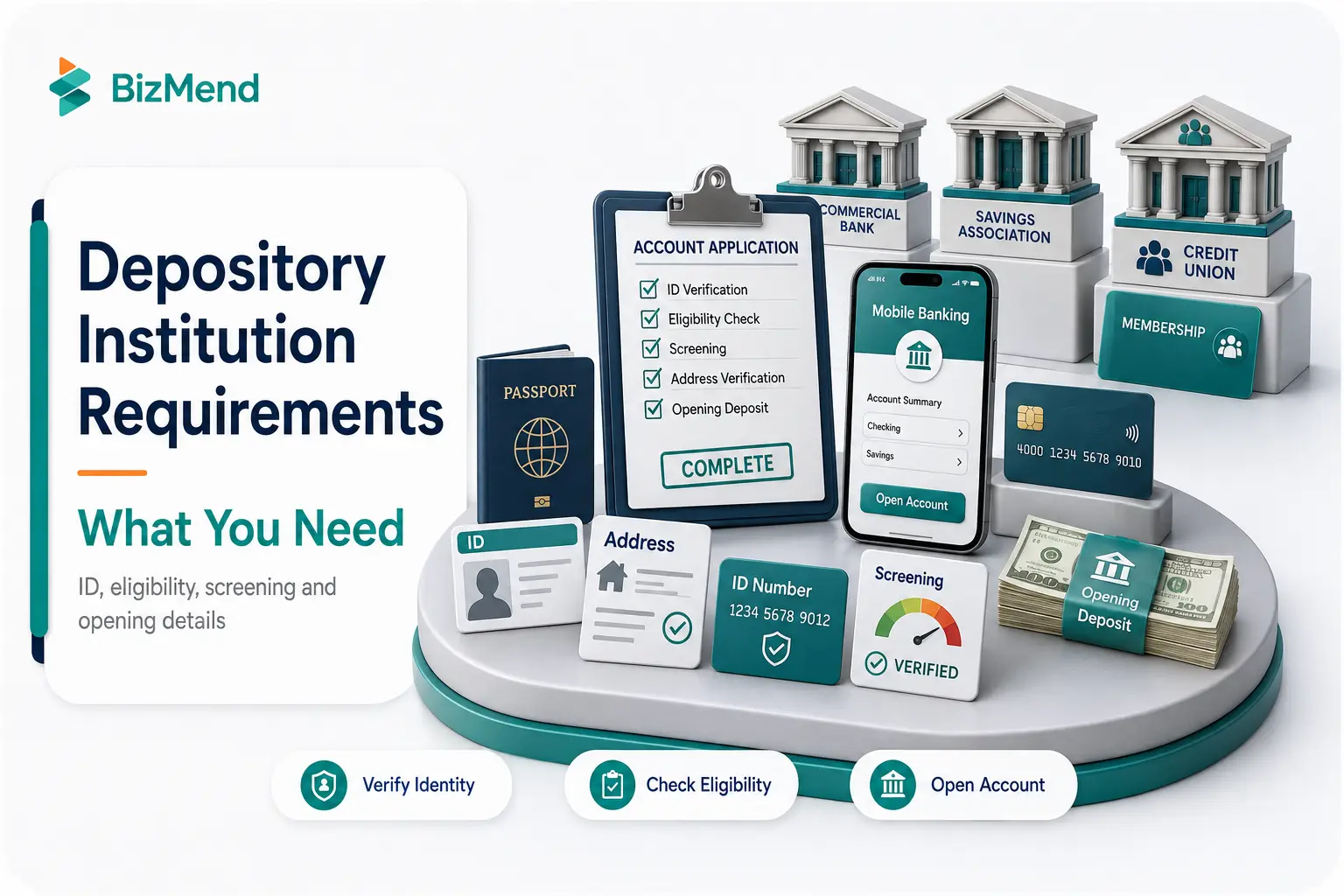
Depository institution requirements come down to the same handful of checks no matter which type of institution you pick. A depository institution is not one product you open; it is a category covering banks, savings associations, and credit unions, and you actually open an account at a specific one of them.
Federal law requires every bank, thrift, and credit union to verify your identity before opening an account, so the paperwork looks similar everywhere. Credit unions add one extra step: proving you qualify for membership. This guide covers exactly what to bring and what to expect.
Quick Answer: To open a depository institution account, you generally need to be 18 or older, provide government-issued photo ID, give a Social Security number or ITIN, and pass a ChexSystems or credit screening. Initial deposits range from $0 to around $100 depending on the institution. Credit unions also require membership eligibility.
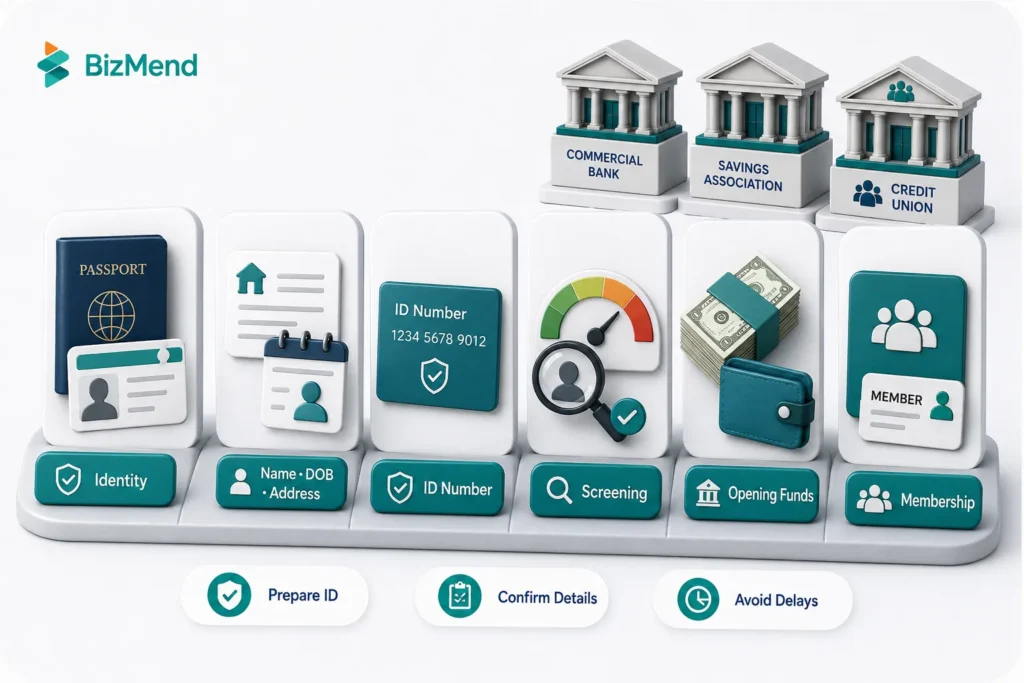
Eligibility Checklist to Open a Depository Institution Account
Age: Most institutions require applicants to be at least 18. Minors can typically access an account through a joint account with a parent or guardian, or a custodial account that transfers full control at adulthood. Some institutions also offer teen checking accounts with parental oversight built in, which is a separate product from a standard adult account.
Government-issued photo ID: A driver’s license, state-issued ID card, US passport, or military ID is generally accepted. Some institutions accept a foreign passport for non-citizens, sometimes alongside a second form of ID such as a visa or an employment authorization document.
Taxpayer identification number: A Social Security number covers most US applicants. Non-citizens who are not eligible for an SSN can generally use an Individual Taxpayer Identification Number instead, and in some cases institutions accept an alternative government-issued identification number under federal verification rules.
Initial deposit: Requirements vary widely, from $0 at many online banks to around $25 to $100 at traditional banks and credit unions. There is no single, universal minimum, and the figure often depends on the specific account product rather than the institution as a whole.
Consumer-report screening: Most banks run a ChexSystems check, and some credit unions do as well, to review your history with other deposit accounts before approving a new one. A handful of institutions market themselves specifically as not using ChexSystems, which can matter if your history includes a past denial elsewhere.
None of these five items is optional in practice, though the specific documents and thresholds shift from one institution to the next, which is why confirming details with your chosen provider before a branch visit or online application saves a wasted trip.
Documents You’ll Need, and Why Each One Matters
Every bank, savings association, and credit union operating in the US must run a Customer Identification Program under Section 326 of the USA PATRIOT Act, which is the real reason the paperwork below exists rather than an arbitrary institutional preference.
Government-issued photo ID lets the institution verify your name, date of birth, and photograph against the person standing in front of them or applying online, satisfying the core identity-verification requirement of federal law.
Social Security number or ITIN gives the institution a taxpayer identifier it is legally required to collect and later use for interest reporting on IRS Form 1099-INT if your account earns interest.
Proof of current address, such as a utility bill or lease, is sometimes requested separately when the address on your ID does not match where you currently live.
Initial funding source, whether cash, a check, or an electronic transfer, is needed simply to open the account with a balance above zero where a minimum deposit applies.
Proof of membership eligibility, required only at credit unions, demonstrates that you qualify under the credit union’s field of membership, such as an employer, location, or affiliated association.
Foreign nationals without a Social Security number are not automatically excluded. Federal identification rules explicitly allow an alternative government-issued number, such as a passport number, when a US taxpayer number is not available, though individual institutions still set their own additional documentation preferences on top of that federal floor.
Special Situations Worth Knowing About
Joint and business accounts carry extra documentation. A joint account typically requires both applicants to individually satisfy the identification and taxpayer-number requirements above, not just one primary applicant. A business account adds entity-level documents, such as an Employer Identification Number and formation paperwork, on top of the individual owner’s personal identification.
Applicants with a security freeze on their credit report should know that a ChexSystems freeze is separate from a credit bureau freeze and generally needs to be lifted directly with ChexSystems before certain institutions will complete a screening check.
Institutions occasionally waive or reduce requirements for specific programs, such as second-chance checking accounts designed for applicants with a ChexSystems history, or accounts built for younger applicants that require a co-signer instead of independent qualification.
Step-by-Step Process to Open a Depository Institution Account
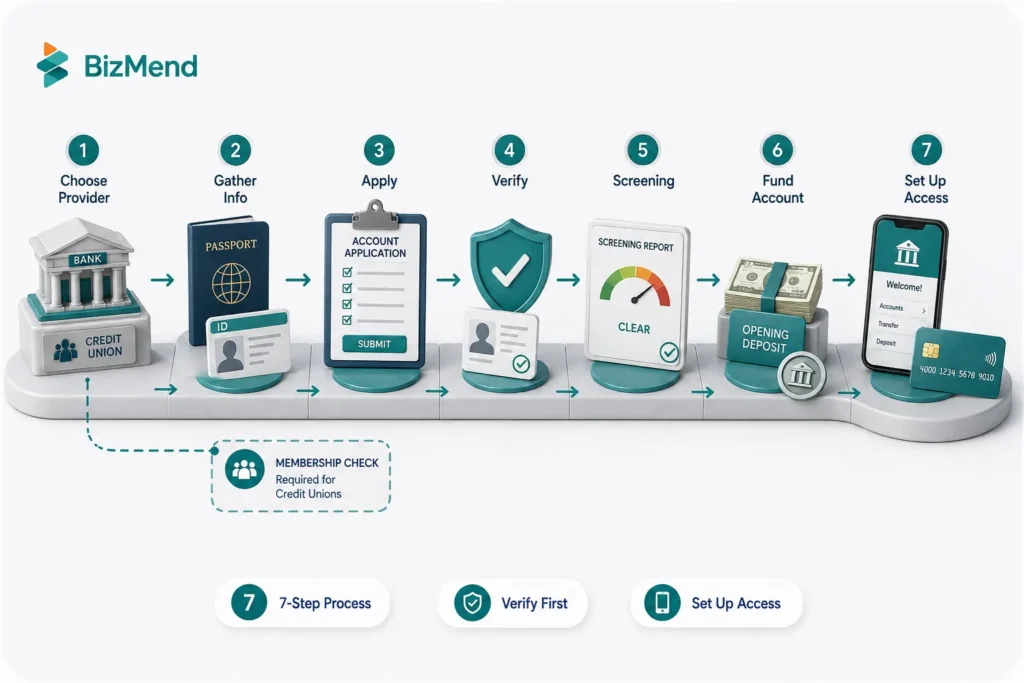
1. Choose the Type of Institution and Specific Provider
Decide whether a national bank, state bank, community bank, regional bank, online bank, or credit union fits your needs, since eligibility details differ slightly by type and provider. This decision also affects which regulator and deposit insurer stands behind your account, which is worth confirming before you commit time to an application.
2. Gather Your Documents
Pull together government-issued photo ID, your Social Security number or ITIN, proof of address if you have recently moved, and funds for any minimum opening deposit before you start the application.
3. Complete the Application
Apply online, through a mobile app, or in person at a branch, entering your personal details and selecting the specific account type you want, such as checking, savings, or both.
4. Fund the Account
Transfer, deposit, or wire the funds needed to meet any minimum balance requirement; some institutions activate the account instantly, while others hold it pending the transfer clearing.
5. Complete Identity Verification
The institution runs its Customer Identification Program checks in the background, which can include a consumer-report screening such as ChexSystems, and may ask follow-up questions if anything does not match automatically. Online applicants sometimes need to upload a photo of their ID or complete a short video verification step, while in-branch applicants typically finish this step on the spot with an employee reviewing physical documents directly.
6. Set Up Account Access
Activate your debit card, enroll in online and mobile banking, and set up direct deposit or automatic transfers once the account is confirmed open.
7. Review Your Account Disclosures
Read the fee schedule, overdraft policy, and terms of service the institution provides, since these documents govern the account going forward and are not just a formality to skip past.
Common Reasons Applications Are Denied and How to Avoid Them
- Most denials trace back to one of six patterns, and knowing them in advance lets you fix a problem before it costs you an application.
- A negative ChexSystems or consumer-report history, most often from unpaid overdraft fees or a prior account closed for cause
- Expired, mismatched, or insufficient identification, such as an ID with an old address and no secondary document to confirm the current one
- No usable taxpayer identification number, when neither an SSN nor an ITIN nor an accepted alternative is provided
- A match against a government sanctions or watch list during the mandatory screening every institution must run
- Failing to meet a credit union’s field-of-membership requirement, which is unique to that institution type
- An incomplete application, often from a missing signature or an unfunded initial deposit
If your application is denied, most institutions are required to tell you why and which consumer reporting agency supplied the information behind the decision, and you have the right to dispute inaccurate information with that agency directly, generally within 30 days.
What Happens After You Apply: Timeline and Next Steps
Approval timing depends heavily on institution type. Online applications at most banks are approved within minutes to a few hours, since identity verification runs automatically against government and consumer-reporting databases. In-branch applications often finish the same day, once the officer confirms your documents and funds the account on the spot. Credit unions can take a few additional days if your membership eligibility needs manual confirmation before the account itself can open.
Once approved, expect a debit card and any physical checks to arrive by mail within five to ten business days, though some institutions offer instant digital card access through a mobile app before the physical card arrives. Full account features, such as higher withdrawal limits or certain transfer types, sometimes phase in gradually during the first few weeks as the institution builds a transaction history on the new account, a common practice meant to limit fraud exposure on brand-new relationships. Setting up direct deposit and any automatic bill payments is usually the last practical step before the account is fully in everyday use, and many employers need a voided check or a printed account and routing number to complete that setup on their end.
Requirements by Institution Type
The core requirements above apply broadly, but each institution type has its own detailed checklist worth reviewing before you apply. See national bank requirements if you are applying at a federally chartered bank. Readers applying at a state-chartered institution instead should check state bank requirements. Readers considering a smaller, local option should check community bank requirements. Larger multi-state institutions are covered instead in regional bank requirements.
Digital-first applicants should review online bank requirements for how identity verification works without a branch visit. Anyone planning to apply in person can also check bank branch requirements for what to bring to that specific appointment.
Newcomers to the US, including recent immigrants and non-residents, often have questions a general checklist does not fully answer; this guide to opening a US bank account as a non-resident addresses that situation directly.
Key Insights
- Requirements are largely consistent across institution types because federal law, not institutional preference, sets the baseline.
- A driver’s license, state ID, passport, or military ID all typically work as government-issued photo ID.
- Foreign nationals without an SSN can generally use an ITIN or an alternative government-issued number instead.
- Initial deposits range from $0 to around $100, with no single universal minimum across institutions.
- ChexSystems history, not missing paperwork, is the most common reason applications get denied.
- Credit unions add a membership eligibility step that banks and thrifts do not have.
Final Thoughts
Meeting depository institution requirements is rarely the hard part of opening a new account; gathering the right documents before you apply is. Bring a valid photo ID, your Social Security number or ITIN, and enough money to cover any minimum opening deposit. Most applications clear within minutes at a bank, or a few days at a credit union waiting on membership approval.
The real risk sits in your banking history, not your paperwork. A ChexSystems flag from a past account, not a missing document, is by far the most common reason applications get denied outright. Pull your free annual ChexSystems report before applying if you have had banking trouble before, and confirm current deposit minimums directly with the specific institution.
Frequently Asked Questions
What do I need to open an account at a depository institution?
Generally, a government-issued photo ID, a Social Security number or ITIN, enough funds to cover any minimum opening deposit, and a clean enough ChexSystems or consumer-report history to pass the institution’s screening. Credit union applicants also need to confirm they meet that specific credit union’s membership eligibility before an account can be opened.
Can I open an account without a Social Security number?
Yes. Federal identification rules allow an Individual Taxpayer Identification Number or another accepted government-issued number as an alternative to an SSN, though the specific institution may request additional documentation to support it.
What is the minimum deposit for a depository institution account?
It varies by institution rather than following one national rule. Many online banks allow $0 to open, while traditional banks and credit unions commonly ask for somewhere between $25 and $100, sometimes more for certain account types.
How long does it take to open an account?
Online applications are often approved within minutes to a few hours. In-branch applications frequently finish the same day. Credit union applications can take a few extra days if membership eligibility needs manual review first.
What is ChexSystems?
ChexSystems is a consumer reporting agency, covered by the federal Fair Credit Reporting Act, that tracks negative deposit account history, such as unpaid overdrafts, bounced checks, suspected fraud, or accounts closed for cause, for roughly five years. Somewhere between 80 and 90 percent of US banks and many credit unions check it before approving a new account, and you can request your own report free once a year directly from ChexSystems.
Do credit unions have different requirements than banks?
Mostly the same core requirements apply, but credit unions add one extra step: you must qualify for membership under the credit union’s field of membership, such as an employer, a location, or an affiliated group, before an account can open.
What if I’m new to the US or don’t have a long banking history?
Newcomers can generally still open an account using a passport, an ITIN if they lack an SSN, and proof of a US address, though some institutions offer accounts specifically designed for applicants without an established US credit or banking history. Bringing extra documentation, such as a visa, an employment offer letter, or a foreign bank reference, can help when a single primary document does not fully satisfy an institution’s internal verification standards.
