

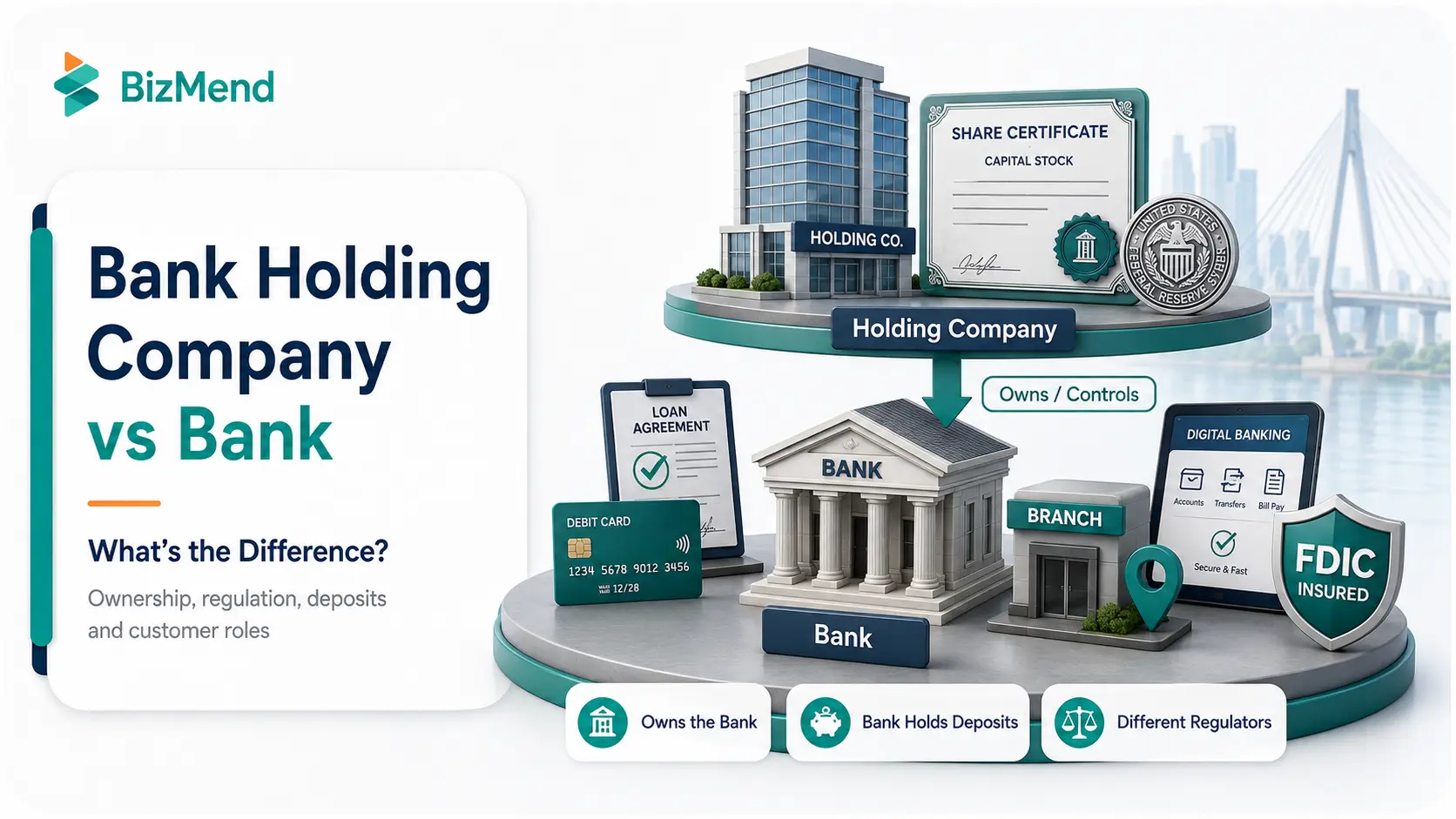
Searching for a bank holding company vs bank makes it sound like a choice between two competing products, but it is not one. A bank holding company owns or controls a bank; the bank is the entity that actually takes deposits and makes loans. If your bank has a parent company, you are already a customer of both, whether you realized it or not.
What genuinely differs is what each one does, who regulates it, and when it matters to you. This guide compares them accurately, so the framing matches how they actually relate rather than how a shopping comparison usually works.
Quick Answer: A bank holding company and a bank are not alternatives; a bank holding company owns or controls a bank. The bank accepts deposits, makes loans, and is FDIC insured; the holding company is a Federal Reserve regulated parent that does neither directly. Using a bank with a parent company means you already use both.
Bank Holding Company vs. Bank: Quick Comparison Table
| Criteria | Bank | Bank Holding Company |
| What it is | A chartered institution that accepts deposits and makes loans directly | A parent company that owns or controls one or more banks |
| Legal definition | Defined by its charter (national or state) and by accepting deposits plus commercial lending | Defined by the Bank Holding Company Act as any company that controls a bank |
| Primary regulator | OCC for national banks; state regulator plus the Fed or FDIC for state banks | The Federal Reserve, under the Bank Holding Company Act |
| Accepts deposits or makes loans directly | Yes | No |
| FDIC insurance | Insured up to $250,000 per depositor, per bank, per ownership category | Never insured itself; insurance applies only to its subsidiary bank |
| What a consumer interacts with | Accounts, cards, branches, loan officers, digital banking | Nothing directly, in almost all everyday cases |
| Typical public filings | Call reports filed with its primary regulator | FR Y-9C financial statements and FR Y-6 annual reports filed with the Federal Reserve |
This table is not ranking two competing options. It is showing how one entity, the bank, sits inside a structure that another entity, the holding company, owns and oversees. Every row describes a different layer of the same organization rather than two separate choices competing for your business.
Why These Aren’t Actually Alternatives
Under the Bank Holding Company Act, a company becomes a bank holding company the moment it controls a bank, meaning it owns 25 percent or more of the bank’s voting stock, controls its board, or is found to exercise a controlling influence over it. That same law defines what counts as a bank for this purpose: an institution that accepts deposits a depositor can withdraw by check or similar means, and that also makes commercial loans. A bank meeting that definition and controlled by a holding company must, by law, remain FDIC insured for as long as the relationship exists.
Put simply, the holding company is upstream of the bank, not beside it. This is essentially the same parent subsidiary structure used to organize ownership in other industries, just applied to banking under its own federal statute. Comparing a bank and its holding company the way you would compare two checking accounts misses what each one actually is.
How the Ownership Structure Actually Works
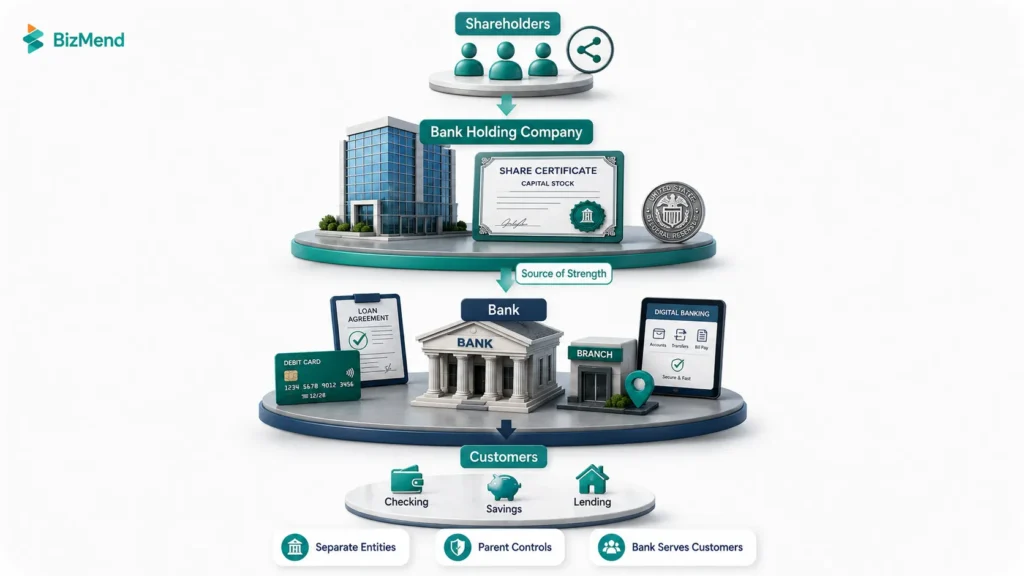
Not every bank has a separate holding company, and among those that do, the structure varies. A one-bank holding company controls a single institution, often formed specifically to give that bank easier access to capital markets or a cleaner path for future ownership changes. A multi-bank holding company controls several banks at once, sometimes operating them under different names or charter types within the same corporate family.
The holding company itself typically has few or no customer-facing employees. Its staff, where it has dedicated staff at all, generally works on capital planning, regulatory compliance, and overseeing the subsidiary bank or banks, not on teller lines or loan applications. That difference in function is a large part of why comparing the two head to head produces a confusing, apples-to-oranges result rather than a useful answer.
How to Check Your Own Bank’s Structure
You do not have to guess whether your bank has a holding company, or which one. The Federal Reserve’s National Information Center, at ffiec.gov/npw, is a free public database covering every bank operating in the US. Search your bank’s name, open its institution profile, and the page shows the top-tier holding company, if one exists, along with an RSSD ID that the Federal Reserve uses to track the organization over time.
If the search returns no holding company at all, your bank is independently owned, and the comparison in this article simplifies further: there is no separate parent entity to think about, only the bank itself and its own regulator.
What a Bank Actually Does
A bank is the entity you experience directly. It holds a charter, either as a national bank supervised by the Comptroller of the Currency, or as a state charter. State-chartered institutions answer to a state bank regulator alongside the Federal Reserve or FDIC. That charter is what allows the bank to accept deposits, issue debit cards, extend loans, and operate branches or digital platforms.
Every one of those deposits is FDIC insured up to $250,000 per depositor, per bank, per ownership category, a protection tied directly to the bank’s own charter rather than to any parent company. That protection applies the same way whether the bank is a large regional bank or a small institution. A community bank, for instance, carries identical deposit insurance mechanics to a much larger one. The bank also files its own call report with its primary regulator each quarter, separate from any financial statement its parent company might file, and it maintains the physical or digital presence, including any bank branch network, that customers actually use.
Day-to-day service quality, product features, and pricing decisions are made at the bank level, even when a holding company owns it. A change in the parent company rarely changes the products a customer sees; a change in the bank’s own management or strategy usually does.
What a Bank Holding Company Actually Does
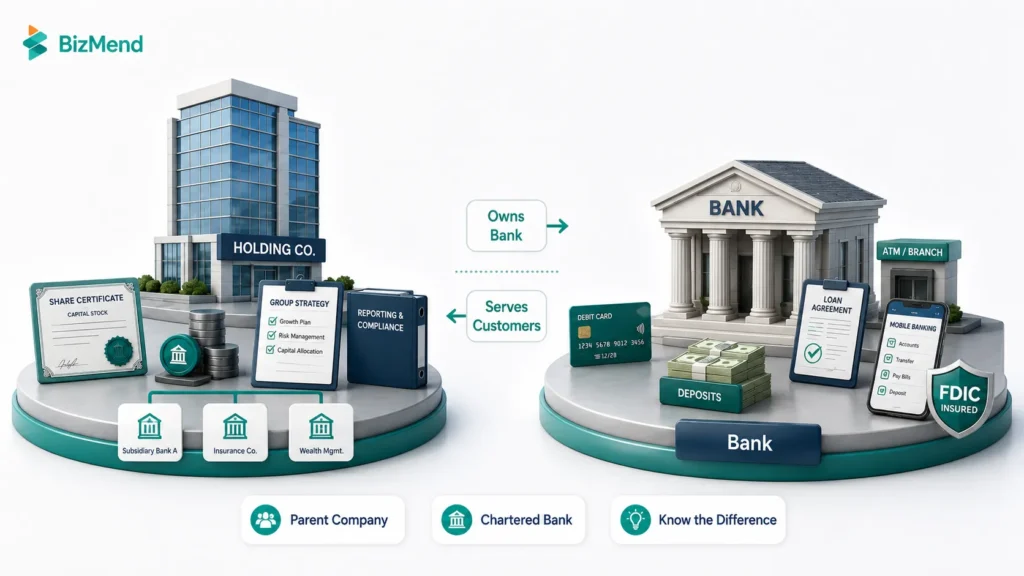
A bank holding company does not open accounts, issue cards, or staff a bank branch. Its role is ownership and oversight: holding the bank’s stock, raising capital that can support the bank, and answering to the Federal Reserve rather than to a bank chartering authority.
Federal law requires a bank holding company to serve as a source of financial and managerial strength to its subsidiary bank, and it must file periodic reports, including the FR Y-9C consolidated financial statement and the annual FR Y-6 report, with the Federal Reserve. Ownership and structure details are public too; the Federal Reserve’s National Information Center lets anyone look up which holding company controls a given bank. A holding company that wants to engage in activities beyond traditional banking, such as insurance or securities dealing, can separately elect financial holding company status under the Gramm-Leach-Bliley Act, though most smaller holding companies never need that step.
The holding company’s financial condition matters most when something goes wrong. Its legal duty to support the bank financially is one reason regulators pay close attention to the parent’s capital position, even though that position rarely shows up anywhere a retail customer would look.
Common Misconceptions in This Comparison
“A bank holding company is a bigger, different kind of bank.” It is not a bank at all in the operating sense. It cannot accept a deposit or issue a loan directly; only its chartered bank subsidiary can do that.
“If the holding company is strong, the bank must offer better rates.” Not necessarily. Deposit rates, loan pricing, and fees are competitive decisions made at the bank level, shaped by local competition and the bank’s own strategy, not dictated by the parent’s balance sheet.
“A bank without a holding company is somehow less legitimate.” Independently owned banks, without a separate holding company layer, are common, especially among smaller and older institutions, and they are regulated and insured on the same terms as banks that do have one.
“Bank holding company insurance and bank insurance are the same coverage.” They are not. FDIC insurance attaches only to the bank’s deposits. A holding company has no equivalent deposit insurance because it does not hold deposits to insure in the first place, and no amount of parent-company strength substitutes for that coverage if it is missing.
When Each One Actually Matters to You
For everyday banking, the bank is what matters. Fees, minimum balance requirements, interest rates, ATM access, and customer service are all set and delivered by the bank, not its parent. Comparing banks on those factors is exactly the right approach; the holding company has no equivalent features to compare.
The holding company matters in a narrower set of situations. A depositor carrying balances above the $250,000 FDIC limit wants to understand the financial strength of the organization standing behind the bank, since that context helps judge how the bank is likely to be run and supported over time. A business opening a large commercial relationship, applying for a significant credit line, or setting up treasury services often reviews the parent company as part of routine vendor due diligence, the same way it would vet any other counterparty. An investor considering the bank’s publicly traded stock is, by definition, evaluating the holding company rather than the bank account itself, since the holding company, not the bank, is the entity whose shares trade on an exchange.
Most people never need to think about the distinction at all. If your balances stay within FDIC limits and you are not conducting business-level due diligence or buying bank stock, your relationship begins and ends with the bank, and that is a perfectly complete way to bank.
The Bottom Line
There is no bank holding company versus bank verdict to declare, because picking one over the other is not a real decision. Every practical banking factor, from fees to service quality, lives at the bank level; the holding company adds nothing to that list and takes nothing away from it either. Choose your bank based on fees, rates, access, and service. Look at the holding company only if your balances, business relationship, or investment plans genuinely call for that extra layer of research.
Key Insights
- A bank holding company owns or controls a bank; they are not competing options you choose between.
- The bank accepts deposits and makes loans directly; the holding company does neither.
- FDIC insurance covers deposits at the bank, never the holding company itself.
- The Federal Reserve regulates holding companies; the OCC or a state regulator plus the Fed or FDIC regulates the bank.
- Everyday banking decisions should be based on the bank, not its parent company.
- The holding company mainly matters for large depositors, business due diligence, and stock investors.
Final Thoughts on Bank Holding Company vs Bank
There is no genuine bank holding company versus bank decision to make, because the two are not competitors. The bank is what you deal with day to day: deposits, loans, cards, and FDIC coverage all run through it. The holding company sits above that relationship as the regulated parent, relevant only in specific situations, not as a routine banking choice.
For everyday checking, savings, and lending, evaluate the bank itself using the usual factors: fees, rates, access, and service quality. Look into the holding company separately only if you are a large depositor, a business client doing real due diligence, or an investor. Confirm any current structure or filing directly through the Federal Reserve or FDIC before relying on it.
Frequently Asked Questions
Is a bank holding company better than a bank?
The question does not quite apply, since a bank holding company owns the bank rather than competing with it. Neither is “better” in isolation; the bank handles your day-to-day banking, while the holding company is the regulated parent standing behind it, and each one is judged by entirely different, non-competing criteria.
Can I have both a bank holding company and a bank?
You do not “have” a bank holding company the way you have a bank account. If your bank is owned by a holding company, which most banks of any size are, you are already connected to both simply by banking there.
Which is safer, a bank or a bank holding company?
FDIC insurance protects your deposits at the bank level, up to $250,000 per depositor, per bank, per ownership category, regardless of the parent’s size. A financially strong holding company, judged by its capital ratios and regulatory standing, can be a positive sign for the organization overall, and its legal duty to act as a source of strength for the bank adds a layer of protection beyond the bank’s own capital. Even so, your deposit protection itself does not depend on the holding company’s condition.
Which has better returns, a bank or a bank holding company?
These are different kinds of returns entirely. A bank pays interest, or APY, on deposit accounts, which is a fixed, predictable return set by the bank itself. A holding company’s stock, if it is publicly traded, can rise or fall in value like any other equity investment, which is a separate question from deposit rates and carries investment risk that a savings account simply does not have.
Is NCUA insurance relevant to a bank holding company?
No. The NCUA insures deposits at credit unions, not banks or bank holding companies. Bank deposits are insured by the FDIC, and that distinction does not change based on whether the bank has a holding company.
How do I know if my bank has a holding company?
Search your bank’s name on the Federal Reserve’s National Information Center at ffiec.gov/npw. The institution profile shows the top-tier holding company, if one exists, along with its RSSD ID.
Do all banks have a bank holding company?
No. Some banks, particularly smaller or older institutions, remain independently owned without a separate holding company structure. Most banks of meaningful size do have one, often because it offers capital-raising and structural flexibility that operating without one does not, such as an easier path to acquiring other banks or issuing debt at the parent level instead of through the bank itself.
