

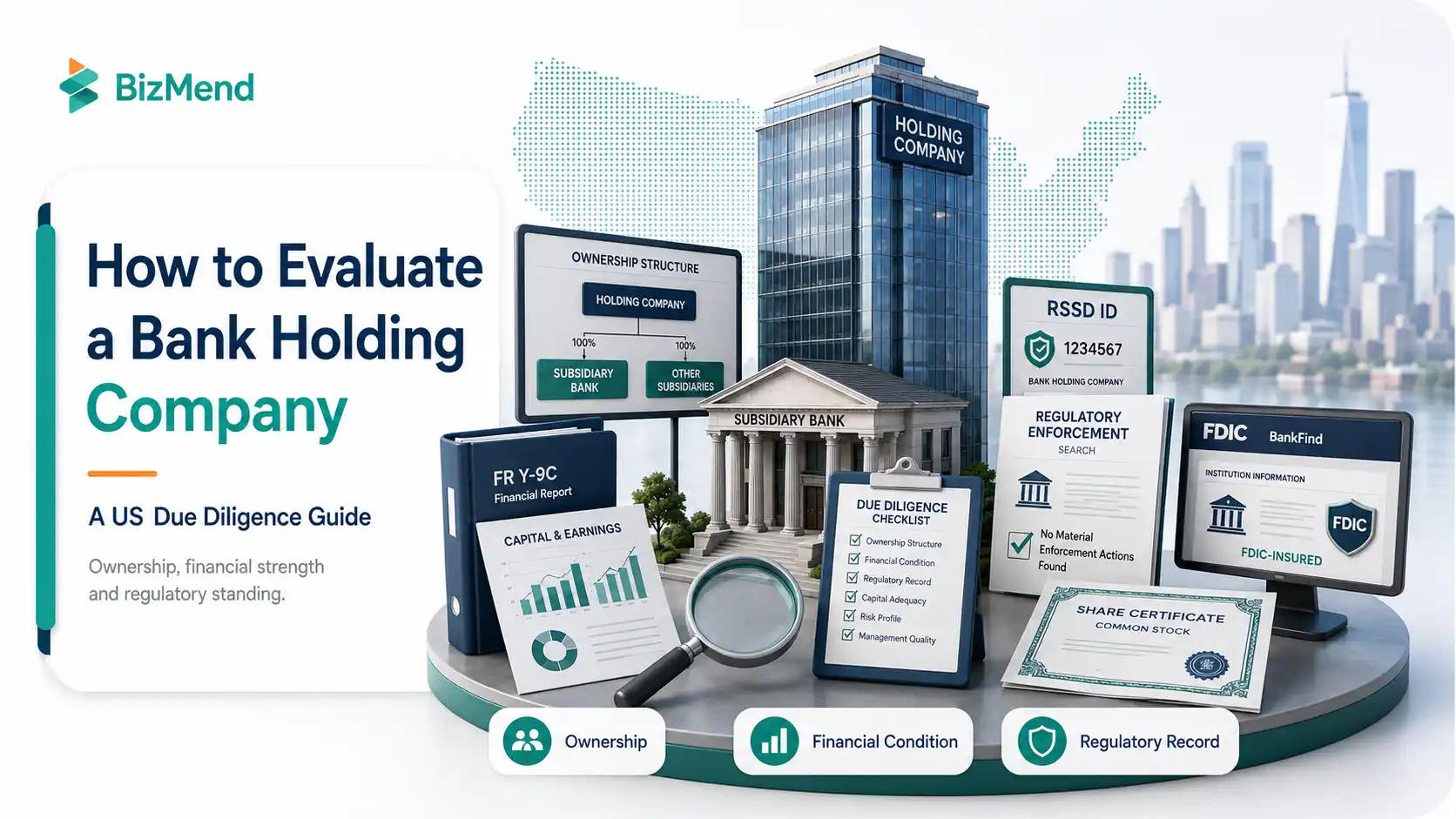
If you searched for how to choose a bank holding company in the US, here is the catch: a bank holding company does not hand out debit cards, set APYs, or staff a branch, so there is nothing to compare the way you would compare bank accounts. What you can actually evaluate is the holding company itself.
That evaluation matters once balances grow past FDIC limits, once a business opens a commercial banking relationship, or once someone considers buying the holding company’s stock. This guide walks through how to research one, using the same public tools examiners and analysts use.
Quick Answer: To evaluate a bank holding company, look up its ownership structure on the Federal Reserve’s National Information Center, review its consolidated financial condition through public FR Y-9C filings, and check for Federal Reserve or FDIC enforcement actions. The holding company itself is never FDIC insured; only deposits at its subsidiary bank are.
Why the Holding Company Behind Your Bank Sometimes Matters
Most people never need to think about their bank’s holding company. Your deposits are insured through the bank itself, and day-to-day service, fees, and features come from the bank, not its parent. For routine checking and savings decisions, the practical question is which bank to choose, not which holding company.
A handful of situations change that. Depositors carrying balances above the $250,000 FDIC insurance limit want to understand the financial strength of the organization standing behind their bank, since spreading funds across ownership categories or institutions depends on knowing the actual corporate structure involved. Businesses opening a commercial banking relationship, applying for a large credit line, or setting up treasury services often do light due diligence on the parent company as part of normal vendor risk review. Investors buying a publicly traded bank stock are, by definition, evaluating the holding company directly, since that is the entity whose shares trade on an exchange. Employees, vendors, and correspondent banks assessing a counterparty relationship fall into a similar category. In each of these cases, the research tools below apply.
Finding Out Which Holding Company Owns Your Bank
Every bank operating in the US is either independent or controlled by a holding company, and the Federal Reserve’s National Information Center publishes that structure for free. Search the bank’s name at ffiec.gov/npw, open its institution profile, and the page shows the top-tier holding company along with an RSSD ID, a unique identifier the Federal Reserve assigns to track the organization over time.
This structure is essentially a corporate parent sitting above one or more banks, similar to a parent subsidiary structure used to organize other kinds of businesses. Knowing the parent’s name is step one; what you do with that name next is where the actual evaluation happens.
Key Factors to Check When Evaluating a Bank Holding Company
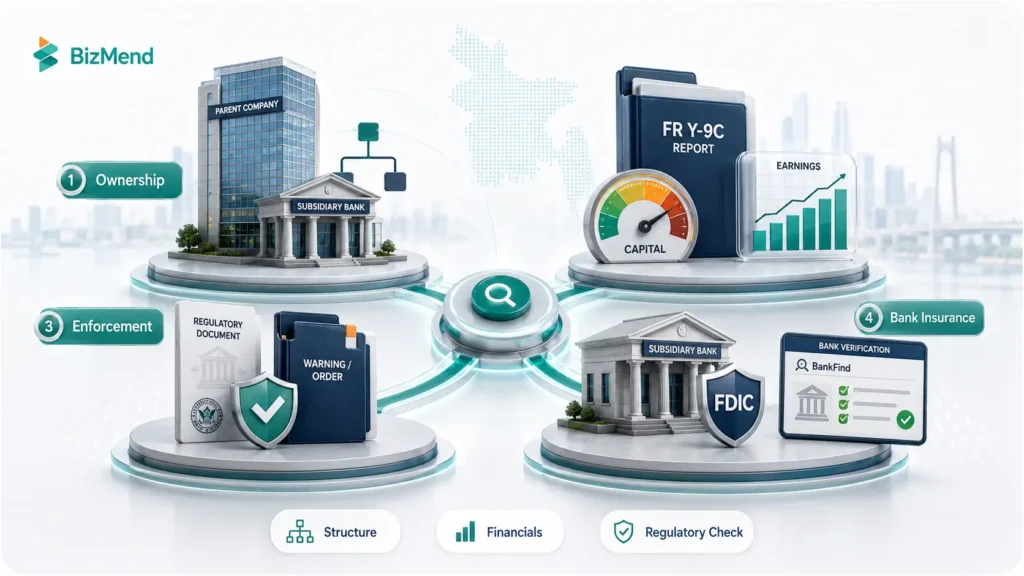
Consolidated capital position and asset size. A holding company with $3 billion or more in consolidated assets must file the FR Y-9C, a detailed quarterly financial statement covering capital ratios, earnings, and balance sheet composition for the entire organization. Smaller holding companies file lighter parent-only reports, so the depth of financial data you can pull depends heavily on size.
Regulatory standing. Check whether the Federal Reserve or FDIC has taken a formal enforcement action, such as a cease and desist order, written agreement, or civil money penalty, against the holding company or its subsidiary bank. An open or recent action is a direct signal that a regulator found a safety, soundness, or compliance problem.
FDIC insurance status of the subsidiary bank. This is the one factor people most often get backward. The holding company itself is never FDIC insured; only deposits at its FDIC-insured subsidiary bank are covered, up to $250,000 per depositor, per bank, per ownership category. Confirm the bank’s own insured status separately.
Ownership structure and number of subsidiary banks. A one-bank holding company built around a single institution carries a simpler, more concentrated risk profile than a multi-bank holding company spread across several charters and regions.
Public financial disclosure. Publicly traded holding companies file 10-K and 10-Q reports with the SEC on top of their Federal Reserve filings, giving outside readers more independently verified detail than a privately held company typically discloses.
Recent structural changes. A pending merger, acquisition, or divestiture involving the holding company can change which entity ultimately stands behind your bank, sometimes with little advance notice to depositors.
Each of these swaps a retail shopping question, like a monthly fee or an app rating, for a solvency and governance question, which is the actual lens regulators and analysts use.
Multi-Bank vs Single-Bank Holding Companies
Not every holding company owns just one bank, and the charter type underneath it varies too. A single holding company might control a national bank regulated by the Comptroller of the Currency. Others build around a state bank charter instead, supervised jointly by a state regulator and either the Federal Reserve or the FDIC. Smaller organizations are frequently built around a single community bank. Larger multi-bank groups sometimes grow instead into what functions as a regional bank footprint spanning several states.
Knowing which charter type sits underneath your holding company matters because it determines the bank’s primary regulator, separate from the Federal Reserve’s supervision of the holding company itself. A national bank subsidiary answers to the OCC day to day; a state-chartered subsidiary answers to its state regulator and either the Federal Reserve or the FDIC, depending on Federal Reserve membership.
Comparing Holding Companies by Size Category
| Size Category | Typical Threshold | Public Financial Data Available | Supervisory Intensity |
| Small bank holding company | Under 3 billion dollars in consolidated assets | Limited parent-only filings (FR Y-9SP); bank-level call reports still public | Lighter, off-site focused review |
| FR Y-9C filer | 3 billion dollars or more in consolidated assets | Full consolidated financial statements (FR Y-9C), quarterly | Regular, more detailed supervisory review |
| Publicly traded holding company | Varies; often larger, SEC-registered | FR Y-9C plus SEC filings (10-K, 10-Q, proxy statements) | Federal Reserve supervision plus SEC disclosure rules |
This is not a ranking of specific companies; it is a map of what data you can expect to find once you know which category your bank’s parent falls into. A small, privately held one-bank holding company will simply have less public financial detail than a large, publicly traded one, which is itself useful information about how much independent verification is realistically possible.
What the FR Y-9C Actually Shows
The FR Y-9C is a consolidated financial statement, meaning it rolls up the holding company and every subsidiary, bank and nonbank, into one set of numbers. It includes a balance sheet, an income statement, and detailed schedules on capital ratios, loan quality, and off-balance-sheet exposures. Analysts favor it over a single bank’s call report precisely because it captures parent-level debt and nonbank business lines that a call report, filed by the bank alone, does not show. The report is filed quarterly and is generally available within 40 to 45 days after each quarter ends.
Step-by-Step Guide to Researching a Bank Holding Company
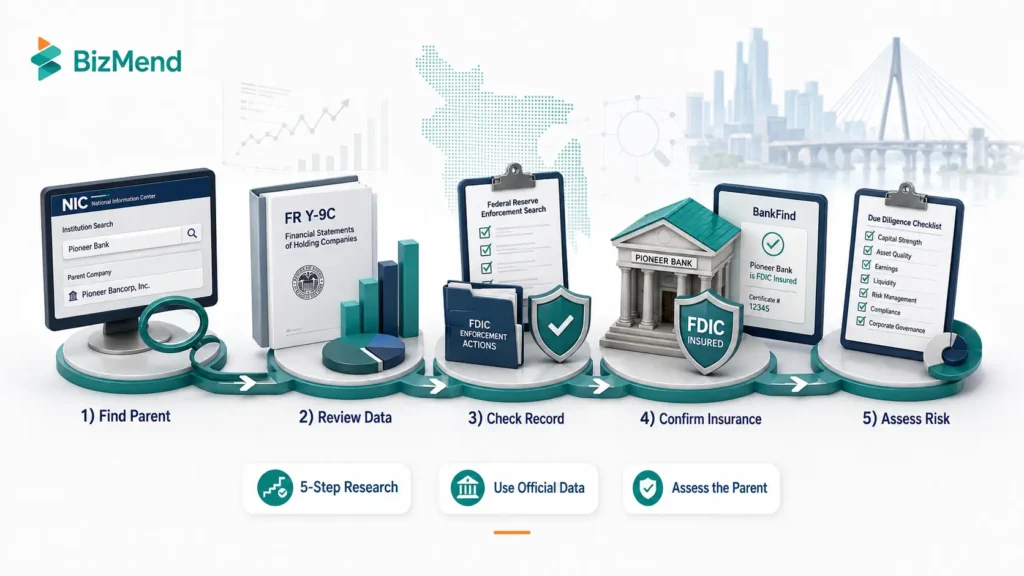
1. Identify the Holding Company
Search your bank’s name on the National Information Center (ffiec.gov/npw) to find its top-tier parent and RSSD ID. If the bank operates under a trade name different from its legal charter name, search the trade name first; the profile page will show the legal entity and its regulatory filings.
2. Pull Its Public Financial Data
If the holding company files an FR Y-9C, download it through the National Information Center’s financial data tool, which covers filings back to the year 2000. If it is publicly traded, its 10-K and 10-Q filings on SEC EDGAR add another layer of independently audited detail that smaller, privately held companies do not have to disclose.
3. Check Regulatory Standing
Search the Federal Reserve’s public enforcement action records and the FDIC’s enforcement action database for the holding company and its subsidiary bank by name. Final Federal Reserve enforcement orders have been public since 1989, and written agreements since 1990, so the historical record generally goes back further than most people expect.
4. Confirm Deposit Insurance at the Bank Level
Verify the subsidiary bank’s FDIC certificate and insured status directly through FDIC BankFind. This step confirms protection for your deposits specifically, since insurance attaches to the chartered bank and never to the holding company that owns it.
5. Match the Scrutiny to Your Situation
A casual depositor with a fully insured balance rarely needs to go past step one. A business client, large depositor, or investor should generally complete all four steps before treating the relationship as low risk.
Red Flags to Watch For
None of these signals alone means a bank is unsafe, since even strong institutions occasionally draw a minor enforcement action or file a late report. What matters is the pattern: multiple warning signs appearing together, or a serious action like a prompt corrective action directive, deserve more attention than an isolated, resolved issue.
- A recent Federal Reserve or FDIC enforcement action against the holding company or its subsidiary bank
- A holding company that has stopped filing its expected FR Y-9C or annual FR Y-6 report on schedule
- A sharp, unexplained increase in parent-level debt relative to the subsidiary bank’s size
- A credit rating downgrade, for the smaller number of holding companies that carry a public rating
- Sudden turnover among senior executives or a change in outside auditor without a clear explanation
- Marketing language from a fintech or neobank that blurs which FDIC-insured bank actually holds the deposits
How to Choose a Bank, Not a Bank Holding Company, in the US
Many readers who search for how to choose a bank holding company in the US are really trying to choose a bank to open an account with, and that is a different, more practical question with its own answer. If that describes you, our dedicated guides walk through the actual comparison factors for each bank type.
For everyday checking and savings, see how to choose an online bank if digital-first features matter most to you. If broad branch and ATM access matters more, how to choose a national bank covers that comparison instead. Readers who prefer a smaller, local relationship should see how to choose a community bank instead. Each of those guides covers fees, minimum balances, and service factors that genuinely apply to a retail bank account, which a holding company itself does not have.
Key Insights
- A bank holding company does not offer accounts, APYs, or ATMs directly; the subsidiary bank does.
- The holding company itself is never FDIC insured; only deposits at its subsidiary bank are covered.
- The National Information Center is the free, official way to find out who owns your bank.
- FR Y-9C filings, required at 3 billion dollars in consolidated assets, give the clearest public financial picture.
- Federal Reserve and FDIC enforcement action records are public and searchable by company name.
- Casual depositors rarely need this research; large depositors, business clients, and investors usually do.
Final Thoughts on Evaluating a Bank Holding Company
Evaluating a bank holding company is a research task, not a shopping comparison. The tools that matter are free and public: the National Information Center for ownership, FR Y-9C data for financial condition, and the Federal Reserve’s enforcement records for regulatory standing. Most depositors never need to look beyond FDIC insurance and their own bank’s reputation, but the picture changes once balances, business relationships, or investment decisions raise the stakes.
If you actually want to pick a bank to open an account with, the decision runs through different factors entirely, and this guide is not the place to make that call. Confirm any figure or filing status directly on federalreserve.gov or fdic.gov before relying on it for a financial decision.
Frequently Asked Questions
How do I find out which holding company owns my bank?
Search your bank’s name on the Federal Reserve’s National Information Center at ffiec.gov/npw. The institution profile shows the top-tier holding company and its RSSD ID, which is the standard way to trace ownership.
What should I look for when researching a bank holding company?
Focus on consolidated capital and asset size, any recent Federal Reserve or FDIC enforcement action, the number and location of subsidiary banks, and whether the company files public financial reports such as the FR Y-9C or SEC disclosures.
Is the bank holding company itself FDIC insured?
No. FDIC insurance covers deposits at an insured bank, not the holding company that owns it. Confirm your specific bank’s insured status through FDIC BankFind rather than assuming coverage extends to the parent organization.
What happens to my accounts if my bank’s holding company changes?
If your bank is acquired by a different holding company, your account typically continues at the same FDIC-insured bank, though the bank’s name, terms, or systems may eventually change. Deposit insurance is not affected by a change in the parent company alone.
Is a bigger bank holding company always safer?
Not automatically. Size affects how much public financial data is available and how closely regulators supervise the company, but capital adequacy, management quality, and enforcement history matter more than asset size alone when judging financial strength.
How is a bank holding company different from the bank I do business with?
The bank holds your deposits, issues your debit card, and operates under its own charter and regulator. The holding company is a separate parent entity that owns the bank’s stock and answers to the Federal Reserve, without directly serving retail customers itself.
Where can I find a bank holding company’s financial reports?
Larger holding companies file the FR Y-9C, available through the Federal Reserve’s National Information Center. Publicly traded holding companies also file 10-K and 10-Q reports with the SEC, accessible free through SEC EDGAR.
