

Learning how to choose an online bank in the US comes down to matching seven factors against your own habits, not picking whichever app has the flashiest interface or the loudest advertised rate. Fees, minimum balances, and digital tools matter differently depending on how you actually bank, and a polished app can still hide an unclear charter behind it, which matters more than it might first appear.
This guide walks through the factors worth comparing, a side-by-side look at common online bank profiles, a five-step selection process, and the red flags that should send you looking elsewhere before you apply.
Quick Answer: To choose an online bank, compare monthly fees, minimum balance rules, interest rates, ATM access, FDIC insurance, digital features, and customer service against your own habits, then confirm which FDIC-insured bank actually holds the deposits, and compare two or three current fee schedules before opening an account.
Key Factors to Compare When You Choose an Online Bank in the US
Monthly fees. Ask whether the fee is waived by direct deposit, a minimum balance, or account type, and compare that requirement against your actual paycheck and spending pattern rather than the advertised fee alone. Many online banks charge no monthly fee at all, so treat any fee as a reason to ask what you get in exchange for it, since a legitimate reason usually exists if one is charged.
Minimum balance requirements. Some accounts charge a fee below a set balance; others simply close the account after enough low-balance notices. Match this number against your lowest typical balance during a slow month, not your average balance, since online banks often set this requirement lower than a branch-based bank would, sometimes down to zero.
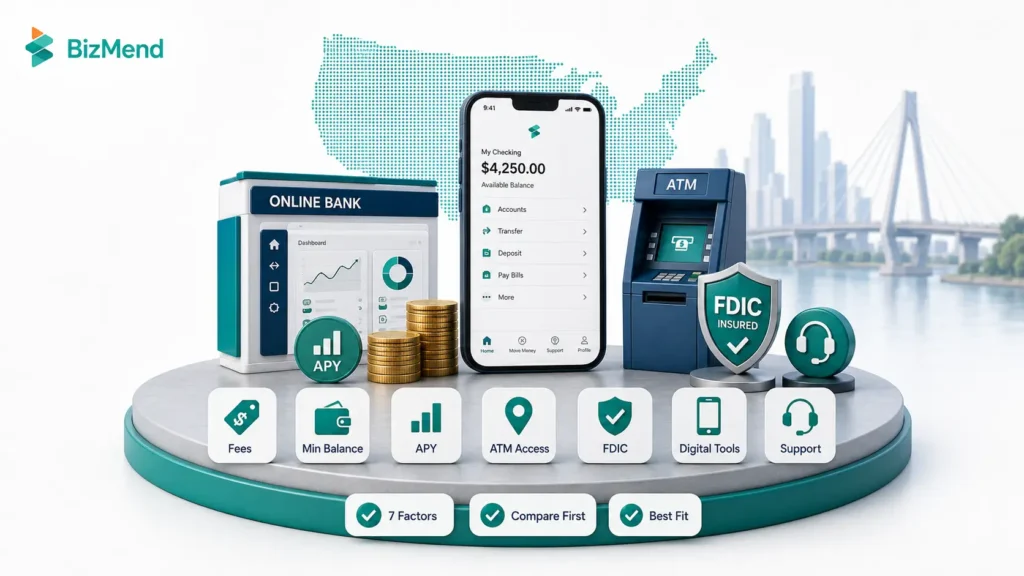
Interest rate and APY. Rates on online savings accounts change often and vary widely between providers, so treat any specific number in an old comparison chart as a snapshot rather than a guarantee. If a strong savings rate is the main draw, ask whether it applies to your full balance or only to a portion of it, and confirm the rate directly on the bank’s current site rather than a third-party ranking page.
ATM access. An online bank has no branch ATMs of its own, so ask whether it belongs to a large surcharge-free network and how many machines are actually near where you live, work, and travel. Some online banks also reimburse a limited number of out-of-network ATM fees each month, which can matter as much as the network size itself if you withdraw cash occasionally.
FDIC insurance. Confirm coverage directly through the FDIC’s BankFind tool rather than assuming from the app’s name or app-store rating. Every dollar up to $250,000 per depositor, per bank, per ownership category is protected identically, but this factor works differently for an online bank than for a branch-based one, since the FDIC-insured bank behind the app is not always obvious from the brand name alone and sometimes requires reading the account agreement or terms of service closely to identify correctly.
Digital features. Test the mobile app’s deposit, bill pay, and transfer speed before committing, and check whether it supports instant card lock and early direct deposit, features online banks often roll out faster than legacy branch-based competitors due to lighter technical infrastructure underneath the product.
Customer service. Since there is no branch to visit, phone, chat, and email support carry the entire weight of customer service. Ask what happens when a deposit posts wrong or a card gets compromised, and judge the specific answer and response time, not just whether a chat bubble exists on the home screen, since a fast bot reply is not the same as real human help.
Online Bank Comparison at a Glance
Real online banks vary too much by structure and specialty to rank fairly in a single table, so the comparison below groups common online bank profiles by the way they tend to operate day to day. Use it to decide which profile fits your situation, then compare actual providers against that profile rather than treating any single name as universally best.
| Profile | Typical Fees | FDIC Insurance Path | Best Fit For |
| Self-chartered online bank | Often $0 monthly fee | Direct | Straightforward savers wanting a clear charter |
| Fintech or neobank app | Often $0 monthly fee | Pass-through via partner bank | Mobile-first users comfortable verifying the partner bank |
| Online division of a traditional bank | Waivable with balance or direct deposit | Direct, same as parent bank | Customers who also want occasional branch access |
| Industrial loan company digital bank | Varies by provider | Direct | Niche savers drawn to a specific product or rate |
Every profile above still needs the same online bank guide background before you compare, since the underlying charter and FDIC-insurance path, not the app’s design, is what actually protects your money. A community bank can also offer a strong online experience. So can a regional bank, which means a polished app alone does not tell you whether you are dealing with a true online bank or a branch-based one with good technology.
Newcomers comparing a non-resident bank account against a standard online bank account will find the profile framework above still applies, since document requirements rarely change the underlying comparison factors. The identity and taxpayer number rules stay the same regardless of which profile the provider fits, so the seven factors from the previous section remain the real decision point once eligibility is confirmed.
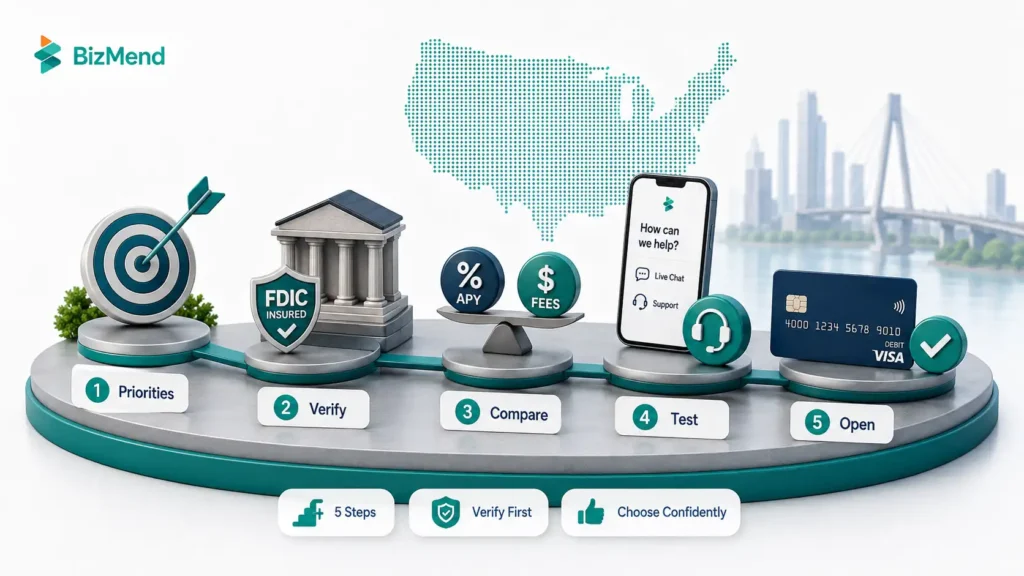
5 Steps to Choose the Right Online Bank
1. Rank your priorities. Decide which of the seven factors matters most for your situation, since no single online bank wins on every factor at once, and ranking them first prevents an eye-catching rate from distracting you from a real dealbreaker later. Write the ranking down before you start comparing apps.
2. Identify the actual FDIC-insured bank behind the app. Search the FDIC’s BankFind tool for the real bank name, not just the app’s brand, since many popular apps are fintech companies partnered with a separate chartered bank, similar to how you would confirm a state bank‘s charter before applying.
3. Compare current fee schedules and rates side by side. Pull the actual numbers from each provider’s website rather than relying on a comparison site that may already be outdated by months, and note whether any rate is promotional or permanent.
4. Test the digital experience and ask about service. Try the app if a demo is available, and ask directly about phone support hours, mobile deposit limits, and how the provider handles a fraud dispute before it happens to you.
5. Open the account that fits, and keep a runner-up in mind. Fund the account, set up direct deposit if that unlocks a better rate or waives a fee, and note a second-choice provider in case your needs change later on.
Working through the same process used when choosing a national bank applies here too, since the comparison factors barely change once FDIC coverage is confirmed on the actual institution behind the account. Reviewing the online bank requirements checklist alongside this guide is useful once you have narrowed your shortlist and are ready to actually apply for the account you have chosen.
Red Flags to Avoid When Choosing an Online Bank
An unclear or unverifiable FDIC-insured bank behind the app is the single biggest red flag for an online bank specifically. If the app’s own disclosures do not name the actual FDIC-insured institution, or support staff cannot answer the question directly, treat that as a reason to stop and look elsewhere immediately, no matter how attractive the advertised rate looks or how many downloads the app has.
A fee schedule the provider will not put in writing is a close second. A legitimate online bank publishes its fee schedule and minimum balance rules clearly; reluctance to share exact numbers before you apply is a sign the terms may be less favorable than the pitch suggests once you actually sign up and the honeymoon period ends.
An advertised rate that seems far above every competitor deserves scrutiny too. Confirm whether the rate applies to your full balance, only a small introductory tier, or a limited promotional window, since a headline number sometimes hides a much lower ongoing rate once the promotion ends and the fine print catches up with you.
Pressure to link outside accounts or share unnecessary financial data during signup is worth questioning as well. A legitimate online bank asks for what it needs to open and verify the account, not blanket access to every financial account you own before you have even funded anything or made a single deposit.
Reviewing the national bank requirements checklist alongside an online bank’s onboarding flow can help you tell a standard identity-verification step from an unusual data request that goes beyond what opening an account actually needs. Finally, a pattern of unresolved complaints about frozen funds or delayed transfers, verified through consumer complaint channels rather than a single bad review, is a serious signal to avoid a specific provider entirely, since frozen access to your own money is one of the more disruptive problems a banking relationship can create.
Key Insights
- Rank your own priorities first; no single online bank wins on every factor at once.
- Confirm the actual FDIC-insured bank behind any app before trusting it with a paycheck.
- FDIC insurance covers online banks identically to branch banks, once coverage is confirmed.
- Compare actual current fee schedules and rates directly rather than trusting an old chart.
- Test the app and ask about service hours before committing if digital banking matters most.
- An unverifiable FDIC-insured bank or a hidden fee schedule are the clearest reasons to walk away.
Final Thoughts
Choosing an online bank works best as a matching exercise, not a search for the flashiest app or the single highest advertised rate available. Rank the factors that matter most in your specific situation, whether that is fee avoidance, a strong savings rate, or fast customer support, then compare two or three real providers against that list instead of chasing a number alone.
Confirm the actual FDIC-insured bank behind the app through the official BankFind tool before applying anywhere, pull the current fee schedule, and test the digital experience if that matters to your daily banking routine. An online bank that fits your habits, with clearly documented protection, will usually beat a flashier app that leaves that important question unanswered.
Frequently Asked Questions
How do I choose an online bank?
Compare monthly fees, minimum balance rules, interest rates, ATM access, FDIC insurance, digital features, and customer service against your own banking habits, then confirm the actual FDIC-insured bank behind the app before comparing current fee schedules and applying anywhere.
What should I look for in an online bank?
Look for a clearly disclosed FDIC-insured bank behind the app, a fee schedule that matches your typical balance, digital tools that fit how you actually bank, and clear answers about customer service and fraud resolution rather than just a polished interface at signup.
What is the best online bank for my situation?
There is no single best online bank, since the right fit depends on your balance patterns, how much a savings rate matters to you, and whether you want a self-chartered bank or are comfortable with a fintech app partnered with one, so compare a shortlist against your own priorities.
Is an online bank FDIC insured?
A self-chartered online bank carries FDIC insurance directly, identical to a branch-based bank. A fintech app without its own charter can still offer FDIC protection through a partner bank, but only if the pass-through recordkeeping is accurate, so confirming which bank actually holds the money matters more than the brand name.
Can I switch online banks later if I change my mind?
Yes. Switching is common and usually straightforward: open the new account, redirect direct deposits and automatic payments, confirm they are landing correctly, then close the old account once the transition is fully complete and nothing is left pending.
