

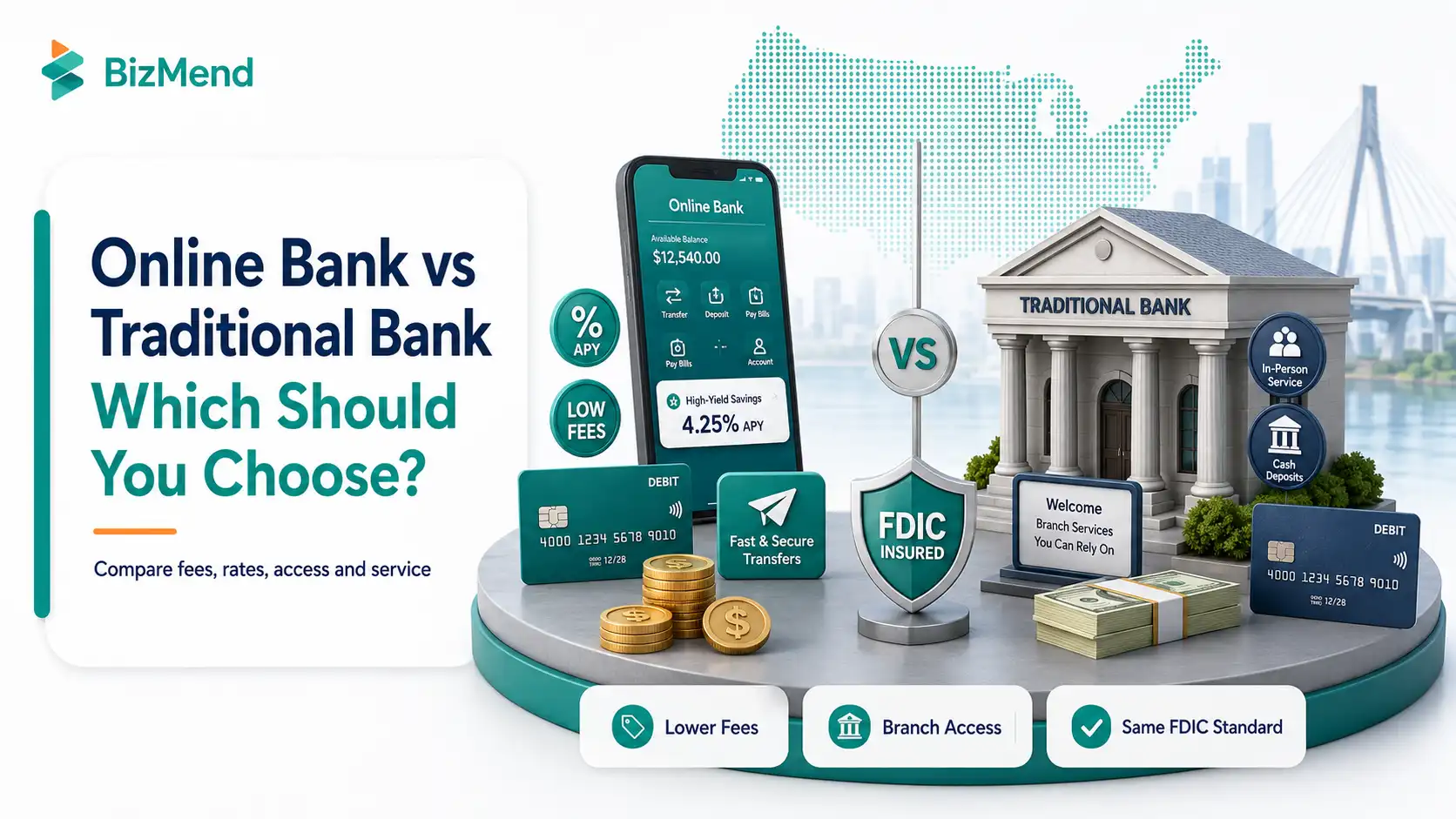
Online bank vs traditional bank comes down to a real tradeoff, not a clear universal winner: one typically pays more and charges less, the other gives you a branch to walk into when something goes wrong. Both hold FDIC insurance once you confirm the specific institution, so safety rarely settles the decision the way people assume it does.
This guide compares both on the factors that actually matter, gives a direct verdict on who should pick which, and walks through specific situations where one clearly beats the other.
Quick Answer: An online bank usually wins on fees and interest rates, while a traditional bank usually wins on branch access, cash handling, and in-person service. Both carry identical FDIC insurance up to $250,000 once you confirm the specific institution is covered, so the right choice depends on your habits, not on which one is safer.
Online Bank vs Traditional Bank: Quick Comparison
The table below covers the factors that actually decide most people’s choice between an online bank and a traditional bank, before the prose sections explain the reasoning behind each row.
| Criteria | Online Bank | Traditional Bank |
| Monthly fees | Often $0 | Commonly $5 to $25, waivable with conditions |
| Minimum balance or deposit | Often $0 to low minimums | Often higher, varies by account tier |
| Interest and APY | Typically well above the national average | Typically at or near the low national average |
| Access and liquidity | App, ATM network, limited or no cash deposit | Branch, ATM, teller, easy cash deposit |
| FDIC coverage | Up to $250,000, if the app itself is a bank or clearly discloses its partner bank | Up to $250,000, direct and straightforward |
| Best for | Digital-first savers comfortable without a branch | Cash-heavy users and those wanting in-person help |
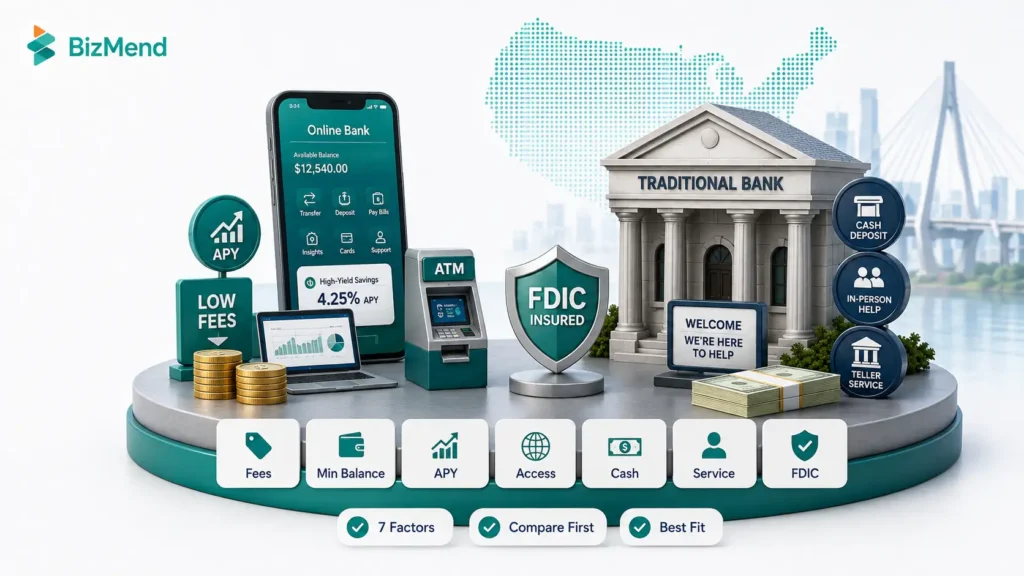
Bottom-Line Verdict: Online Bank vs Traditional Bank
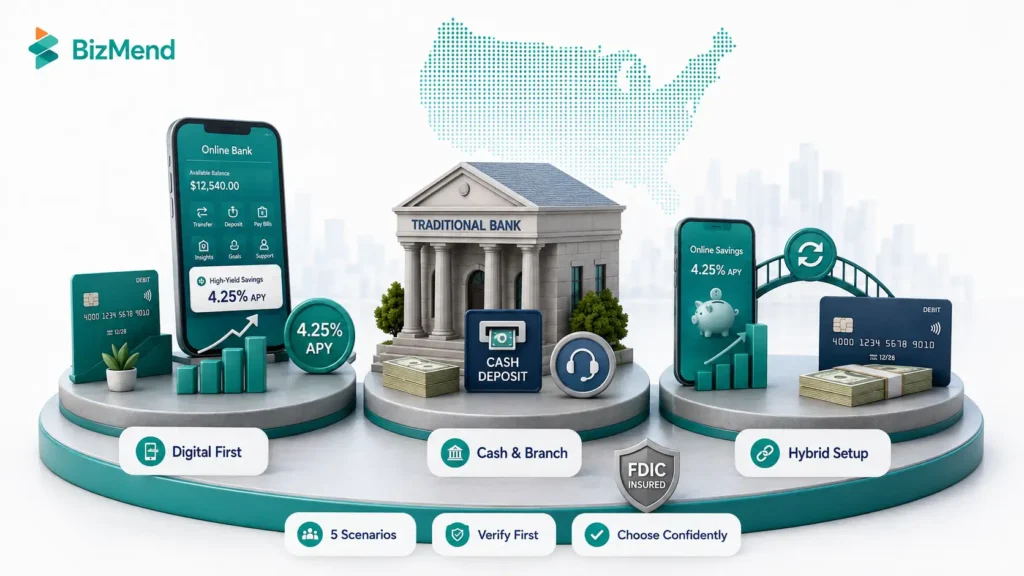
Pick an online bank if you rarely need cash deposits, are comfortable resolving problems by phone or chat, and want a stronger savings rate with fewer fees. Pick a traditional bank if you handle cash regularly, want a person to talk to for a complex issue, or need in-branch services like notarization, safe deposit boxes, or a bigger loan relationship. Neither choice is universally correct, and the right one depends entirely on which tradeoffs actually show up in your day-to-day banking rather than which option sounds more modern. Many people end up using both at once, an online bank for savings and a traditional bank for everyday cash needs, which is a completely reasonable way to split the decision rather than an either-or choice forced on you by marketing.
Key Differences Between an Online Bank and a Traditional Bank
The table above shows what differs; the reasons behind it matter just as much for making a real decision that fits your specific situation. An online bank’s lower fees and higher rates come directly from its cost structure. Without branch rent, teller staff, and vault security to fund, it can pass more of its revenue back to depositors, which is the entire economic logic behind the online model rather than a marketing gimmick dreamed up by a design team. The FDIC’s own national rate data shows traditional bank savings rates sitting well below the level many online banks routinely advertise, a gap that has held fairly consistently for years even as the overall rate environment shifts.
A traditional bank’s higher overhead pays for something an app cannot replicate: a person behind a desk who can review a complex loan application, notarize a document, or handle a large cash deposit on the spot without an appointment. That overhead shows up in the fee schedule, but it also funds services that matter more to some customers than a slightly better savings rate ever could on its own. The CFPB has tracked overdraft and fee policies across banks for years, noting that fee structures vary widely even among traditional banks themselves, so the online-versus-traditional label is only part of the fee picture.
Identity verification differs in a less obvious way. A traditional bank confirms identity with a teller’s visual check of your ID in person, while an online bank verifies identity through a photo ID upload and a live selfie match, a process that works well for most applicants but occasionally requires a manual review that a branch visit could have resolved on the spot in a single conversation.
Charter structure adds one more layer specific to online banking. Some online banks hold their own charter directly, insured by the FDIC the same way any community bank is insured. A regional bank follows the identical insurance path despite its larger size, which is worth keeping in mind since charter type, not scale, decides FDIC coverage. Others are technology companies partnered with a separate chartered bank behind the scenes, meaning the app you see and the bank actually holding your money are not the same company, a distinction that rarely comes up when comparing two traditional banks against each other. Confirming FDIC coverage details directly removes the guesswork either way.
When to Choose an Online Bank
Choose an online bank if your paycheck already arrives by direct deposit and you rarely need to deposit cash, since the lack of a branch stops mattering once cash handling is out of the picture. The stronger savings rate becomes pure upside with no real tradeoff in this situation, and setting up automatic transfers takes only a few minutes once the account is open.
Choose an online bank if you travel often or live somewhere without a convenient local branch of the bank you would otherwise pick, since a strong app and a wide surcharge-free ATM network can matter more than a specific branch location ever would in practice. Remote workers and people who relocate frequently tend to fit this pattern especially well.
Choose an online bank if you are a newcomer setting up your first US account and value speed. Someone researching a non-resident bank account often finds the online application process faster than scheduling a branch appointment, though the identity documents required stay essentially the same either way, and approval can arrive within minutes rather than requiring a scheduled visit.
When to Choose a Traditional Bank
Choose a traditional bank if you regularly handle cash, whether from a side business, tips, or family, since walking into a branch remains the simplest way to deposit cash without routing through a third-party retail network that may charge its own fee for the convenience.
Choose a traditional bank if you want a real relationship with a banker for a mortgage, a business loan, or a complex financial situation, since a loan officer who knows your history in person can sometimes move an application forward faster than a purely digital underwriting process would on its own. Older adults and anyone who simply prefers face-to-face service also tend to fit this pattern well, and that preference is a legitimate factor worth honoring, not something to talk yourself out of just because an app looks more modern.
Choose a traditional bank if charter familiarity matters to you. A national bank operates a branch network under a long-established federal regulatory framework. A state bank follows a similar path at the state level, and some savers find either easier to evaluate than confirming an unfamiliar app’s underlying charter structure before committing a paycheck to it.
Risks and Limitations to Consider on Both Sides
An online bank’s main limitation is cash handling. Depositing cash usually means routing through a retail partner network, mailing a money order, or transferring from another account first, all slower than a teller window. Confusing a fintech app for a directly chartered bank is the second real risk, since FDIC coverage depends on accurate pass-through recordkeeping when the app itself is not the insured institution; the FDIC’s BankFind tool resolves this uncertainty directly.
A traditional bank’s main limitation is cost and pace. Higher fees and lower rates are the trade for branch access, and larger institutions sometimes move slower on digital feature rollouts than a purpose-built online competitor with a smaller, newer technology stack to maintain. Branch hours also constrain when you can get in-person help, unlike an app that never technically closes for the day.
Reviewing the online bank requirements checklist before applying helps confirm which limitations actually apply to a specific online provider rather than to the category as a whole. The national bank selection process covers the equivalent comparison factors from the traditional side, since both categories include real variation from one institution to the next, and neither label guarantees a specific fee schedule or service level on its own without checking the actual account terms.
Key Insights
- Both online and traditional banks carry identical FDIC insurance once coverage is confirmed on the specific bank.
- Online banks typically win on fees and interest rates; traditional banks typically win on branch access.
- Cash-heavy users generally fit a traditional bank better than a purely online one.
- Confirm whether an online banking app is a chartered bank or a fintech partnered with one.
- Using both an online bank and a traditional bank at once is a common and reasonable split.
- Neither option is inherently safer; the FDIC-insured status of the specific bank is what matters.
Final Thoughts
Online bank vs traditional bank is not a contest with one universal winner; it is a tradeoff between cost and convenience on one side and access and personal service on the other. Confirm FDIC coverage on any specific institution first, since that removes safety as a deciding factor and leaves the real question: how you actually bank day to day.
Match the choice to your own habits rather than a marketing pitch or a rating. Cash-heavy users and anyone wanting in-person help generally fit a traditional bank better, while direct-deposit users comfortable with an app usually come out ahead with an online bank’s fees and rates. Using both together remains a practical middle path worth genuinely considering rather than dismissing.
Frequently Asked Questions
Is an online bank better than a traditional bank?
Neither is universally better. An online bank usually wins on fees and interest rates, while a traditional bank usually wins on branch access and in-person service, so the better choice depends on how you actually bank rather than on one option being objectively superior to the other.
Can I have both an online bank and a traditional bank?
Yes, and many people do. A common setup uses an online bank for savings and everyday spending and a traditional bank for cash deposits, larger loans, or in-person needs, giving you the practical advantages of both without giving up either one entirely.
Which is safer, an online bank or a traditional bank?
Both are equally safe once FDIC insurance is confirmed on the specific institution, covering up to $250,000 per depositor, per bank, per ownership category. Safety depends on confirming that coverage directly, not on whether the bank has physical branches you can visit.
Which has better returns, an online bank or a traditional bank?
Online banks typically offer stronger interest rates on savings, often well above the low national average that weighs down traditional bank rates, since lower overhead lets them pass more back to depositors. Always confirm the current rate directly with the provider, since it changes often.
What is the main downside of an online bank compared to a traditional bank?
The main downside is cash handling, since most online banks cannot accept a cash deposit directly the way a branch teller can. Anyone who regularly deals with cash from a job, a business, or family should weigh this limitation carefully before moving their full banking relationship online.
Do online banks have the same customer protections as traditional banks?
Yes, federal consumer protection rules apply to any FDIC-insured bank regardless of whether it operates branches, including rules on error resolution, overdraft disclosures, and account terms, so protections do not weaken just because the bank exists only online rather than on a street corner.
