If you’re thinking about using a merchant bank for an IPO, bond, sukuk, or portfolio management, one question comes very naturally:
“Who is watching these people? How do I know it’s not a scam?”
You’re not alone. A lot of founders, investors, and even finance students feel nervous because investment banking sounds complex and risky.
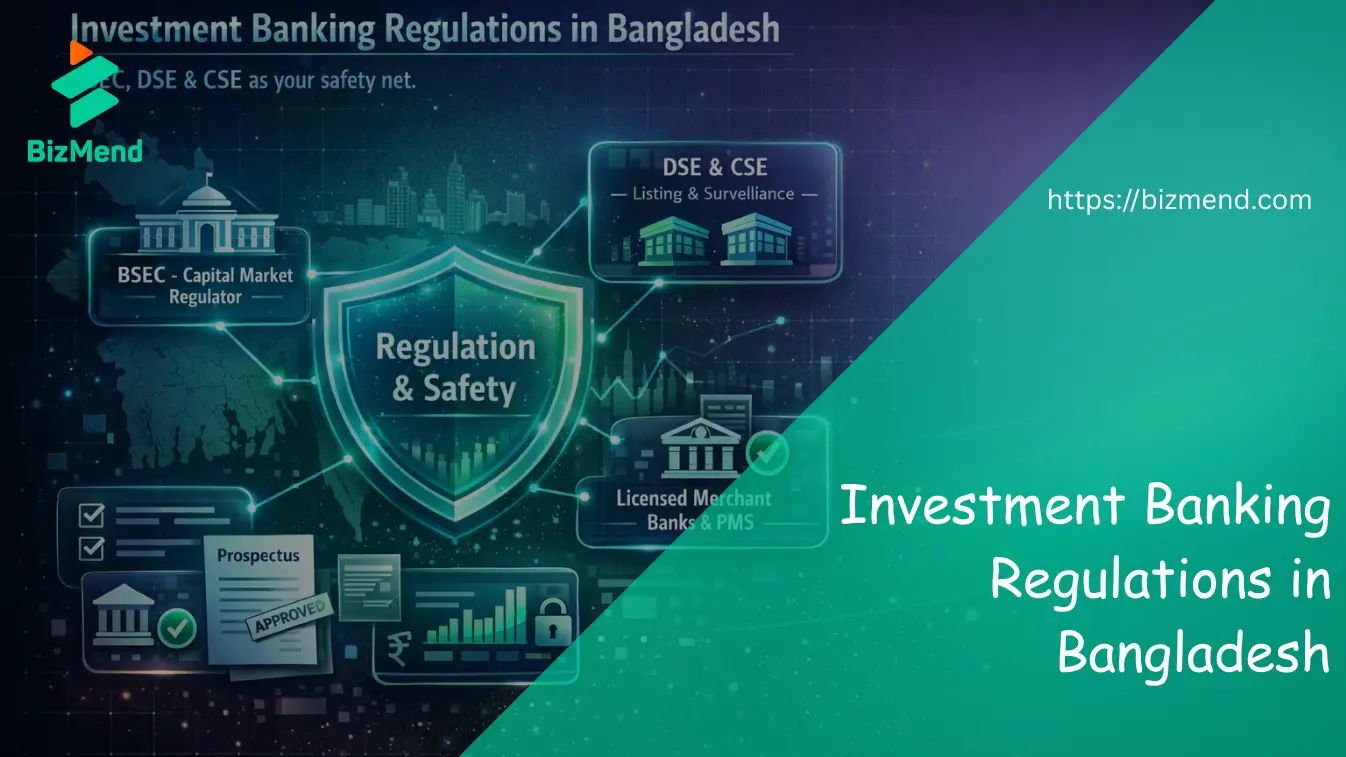
Investment banking in Bangladesh is mainly regulated by BSEC, supported by DSE and CSE listing rules and surveillance. Merchant banks, issue managers and portfolio managers must be formally licensed, follow KYC/AML rules, and provide proper disclosures (like an approved prospectus) before public offers.
This blog is a beginner-friendly guide to investment banking regulations in Bangladesh so you understand:
- What BSEC does
- What DSE and CSE do
- How licenses work for merchant banks and portfolio services
- Why all this matters for investors and issuers
- How you can quickly check safety basics
Big Picture: How Investment Banking Regulations in Bangladesh Work
When we say investment banking in Bangladesh, we mostly mean:
- Merchant banks (separate companies or subsidiaries), and
- Investment divisions of some commercial banks
They work in and around the capital market — shares, bonds, sukuk, funds, portfolios.
The main players in investment banking regulations in Bangladesh are:
- BSEC (Bangladesh Securities and Exchange Commission) – the primary capital-market regulator
- DSE and CSE – the stock exchanges that set listing rules and monitor trading
- Bangladesh Bank – regulates commercial banks (relevant when a bank owns a merchant bank)
Think of it like this:
- BSEC sets the rules for how investment banking is done
- DSE/CSE set rules for listed companies and trading
- Together they create a framework of approvals, disclosures and monitoring
Not a wild west – more like a layered safety net.
The Role of BSEC in Investment Banking Regulations in Bangladesh
When people talk about investment banking regulations in Bangladesh, they are usually talking about BSEC rules.
BSEC as the Capital Market Regulator
BSEC’s main job is to:
- Protect investors
- Ensure fair, transparent markets
- Oversee activities related to shares, bonds, sukuk, funds, and merchant banking
BSEC issues regulations and guidelines that cover:
- Licensing and operations of merchant banks and issue managers
- Rules and procedures for IPOs, rights issues, bonds, sukuk
- Standards for portfolio management services (PMS) and collective investment schemes
If you’re doing anything serious in the capital market, BSEC is involved somewhere.
BSEC and Merchant Banks / IPOs
Merchant banks and issue managers must follow BSEC rules for:
- Getting and keeping their merchant banker license
- Meeting minimum capital and reporting standards
- Preparing and filing prospectuses and other offer documents
- Treating investors and issuers fairly
For any public offer (like an IPO or bond):
- A prospectus or offer document must be drafted
- BSEC reviews it, asks questions, and may require changes
- Only after BSEC approval can the offer go to the public
So your IPO or bond isn’t just “designed by the merchant bank” – it’s checked by BSEC first.
BSEC and Portfolio Management (PMS)
Portfolio management services are also regulated. A merchant bank cannot just say:
“Give us money, we’ll invest it, trust us.”
Instead, BSEC rules require:
- Proper license/permission for PMS
- Written agreements with clients
- Clear risk disclosures and fee structures
- Segregation of client assets vs. the merchant bank’s own assets
- Periodic statements and reporting to clients
This is where investor protection becomes very real for HNWIs and NRBs using portfolios.
Role of DSE & CSE in Regulating Investment Banking Activities
DSE and CSE are not only “places where prices move”. They also help regulate the environment in which investment banking happens.
Listing Rules and Ongoing Obligations
When a company lists on DSE or CSE, it must follow:
- Listing regulations – conditions to get listed
- Ongoing obligations, such as:
- Publishing quarterly and annual financials
- Disclosing price-sensitive information (e.g., big contracts, major changes)
- Following corporate governance codes and related-party rules
Merchant banks typically advise issuers on how to meet these requirements, but the exchanges enforce them.
Surveillance and Market Integrity
Both exchanges run market-surveillance systems to:
- Spot unusual price or volume movements
- Flag possible insider trading or manipulation
- Halt or query trading in suspicious situations
This doesn’t remove all risk, but it makes it harder to abuse the market openly, supporting BSEC’s broader enforcement role.
Licensing of Merchant Bankers, Issue Managers & Portfolio Managers
A key part of investment banking regulations in Bangladesh is who is allowed to do what.
Merchant Banker License
Only licensed entities can act as merchant banks.
High-level requirements usually include:
- Minimum paid-up capital
- “Fit and proper” standards for owners/directors
- Adequate infrastructure, systems and staff
- Internal compliance and risk management framework
A licensed merchant bank may be allowed to:
- Act as issue manager
- Underwrite issues
- Provide portfolio management services
- Offer corporate advisory (M&A, restructuring, etc.)
Always check you are dealing with the actual licensed entity, not just a friendly “representative”.
Issue Manager License
An issue manager is the specialist who:
- Prepares IPO, rights, bond and sukuk offers
- Coordinates with BSEC, DSE, CSE and other stakeholders
- Manages the entire offer process for the issuer
Many merchant banks are licensed as both merchant banker and issue manager, but it’s still important to know who is officially responsible for your transaction.
Portfolio Manager / PMS License
Managing other people’s portfolios is not informal freelancing. It needs:
- Specific approval for portfolio management services
- Qualified investment professionals
- Systems to keep client money/assets segregated and properly tracked
- Clear reporting and risk disclosures
If someone claims to offer “PMS” but you can’t find their name on official license lists, that’s a big red flag.
Why Investment Banking Regulations in Bangladesh Mattergold
Rules are not just legal text. They create real-life benefits for both investors and issuers.
For Investors: HNWI, NRBs, Institutions
Good regulation means:
- Only licensed, supervised players handle your investments
- Key information and risks must be disclosed in writing
- There are clear channels to complain or escalate misconduct
- There are requirements for segregation of client funds and regular statements
In short, regulations make it harder for someone to take your money and disappear, and easier to demand accountability.
For Issuers: Companies Raising Capital
For companies, strong regulation:
- Builds credibility with investors
- Standardizes the process for IPOs, rights issues, bonds and sukuk
- Helps ensure fair treatment between different investor groups
- Improves the long-term depth and trust in the Bangladeshi capital market
Yes, compliance adds a bit of paperwork and time. But it also means investors are more likely to take your offer seriously.
Common Compliance Checks in Investment Banking in Bangladesh
Let’s decode some common buzzwords.
KYC (Know Your Customer) & AML (Anti-Money Laundering)
When a merchant bank asks for:
- NID/passport
- Proof of address
- Source-of-funds information
…it’s not personal. It’s KYC and AML compliance.
These checks:
- Help prevent money laundering and terrorism financing
- Are required by law and regulations
- Protect both the financial system and reputable clients
If a firm never asks you for proper KYC documents, that’s suspicious, not “convenient”.
Disclosure and Prospectus Requirements
A prospectus is the official document for public offers (like IPOs, some bonds and sukuk). It includes:
- Company background and business model
- Financial statements and key ratios
- Details of the offer (price, size, use of funds)
- Risk factors investors must know
BSEC must review and approve the prospectus before it is used.
As an investor, reading at least the summary and risk section is crucial. It’s your main protection against buying blindly.
Ongoing Reporting and Compliance
After listing or issuing a public instrument:
- The company must publish regular financials
- Disclose price-sensitive information
- Follow corporate governance norms
For PMS clients, merchant banks must send:
- Periodic portfolio statements
- Performance reports and valuation details
- Sometimes tax-related reports and summaries
If you’re not receiving regular reports, you should ask why.
How to Check Investment Banking Licenses and Stay Safe
How Do I Check If a Merchant Bank Is Licensed?
Simple safety steps:
- Visit the official BSEC website and look for the list of licensed merchant bankers / portfolio managers
- Confirm the exact legal name (as written in your agreement) appears on the list
- You can also cross-check with DSE/CSE for broker/custodian membership where relevant
Never rely only on a business card or a Facebook page. For serious money, always verify.
Simple Safety Checklist for Investors
Before you sign anything, ask yourself:
- Is this institution licensed for what it’s offering (merchant banking, PMS, issue management)?
- Are the fees and risks clearly explained in writing?
- Is the agreement in the official company name, not only a person’s name?
- Do I know how often I’ll get statements and reports?
- If something goes wrong, do I know how to complain to the firm and then to regulators?
If any answer is “no” or “I don’t know”, pause and ask more questions.
FAQ – Investment Banking Regulations in Bangladesh
How do I check if a merchant bank is licensed in Bangladesh?
You can check the BSEC website for official lists of licensed merchant bankers and portfolio managers. Make sure the full legal name on your contract matches the name on BSEC’s list.
What protections do I get as an investor?
You benefit from rules on licensing, disclosures, segregation of client assets, and reporting. You also have the right to complain to the merchant bank, and if needed, escalate to BSEC or the exchanges if there is serious misconduct.
What is a prospectus and why is it important?
A prospectus is the official document for a public offer like an IPO or bond. It explains the company, its financials, the offer structure and the key risks. It’s important because BSEC must approve it, and investors rely on it to make informed decisions.
Are investment products guaranteed by regulators in Bangladesh?
No. Regulators do not guarantee profits. They ensure fair process, disclosure and licensing, but market risk remains. Prices can still go up or down.
Do regulations make investment banking slower?
Regulation does add steps—documents, approvals, reviews—but that’s what reduces fraud and major mistakes. For serious companies and investors, a slightly slower but safer and more credible process is usually worth it.