How to Become a Daraz Seller in Bangladesh: Registration, Fees & Growth
Learn how to become a Daraz seller in Bangladesh, register an account, list products, understand fees, manage orders, and grow…
 by Sheikh Ornob

Everything a Bangladeshi founder needs to register a sole proprietorship: trade license fees, e-TIN, BIN thresholds, tax slabs, and yearly compliance for 2026.
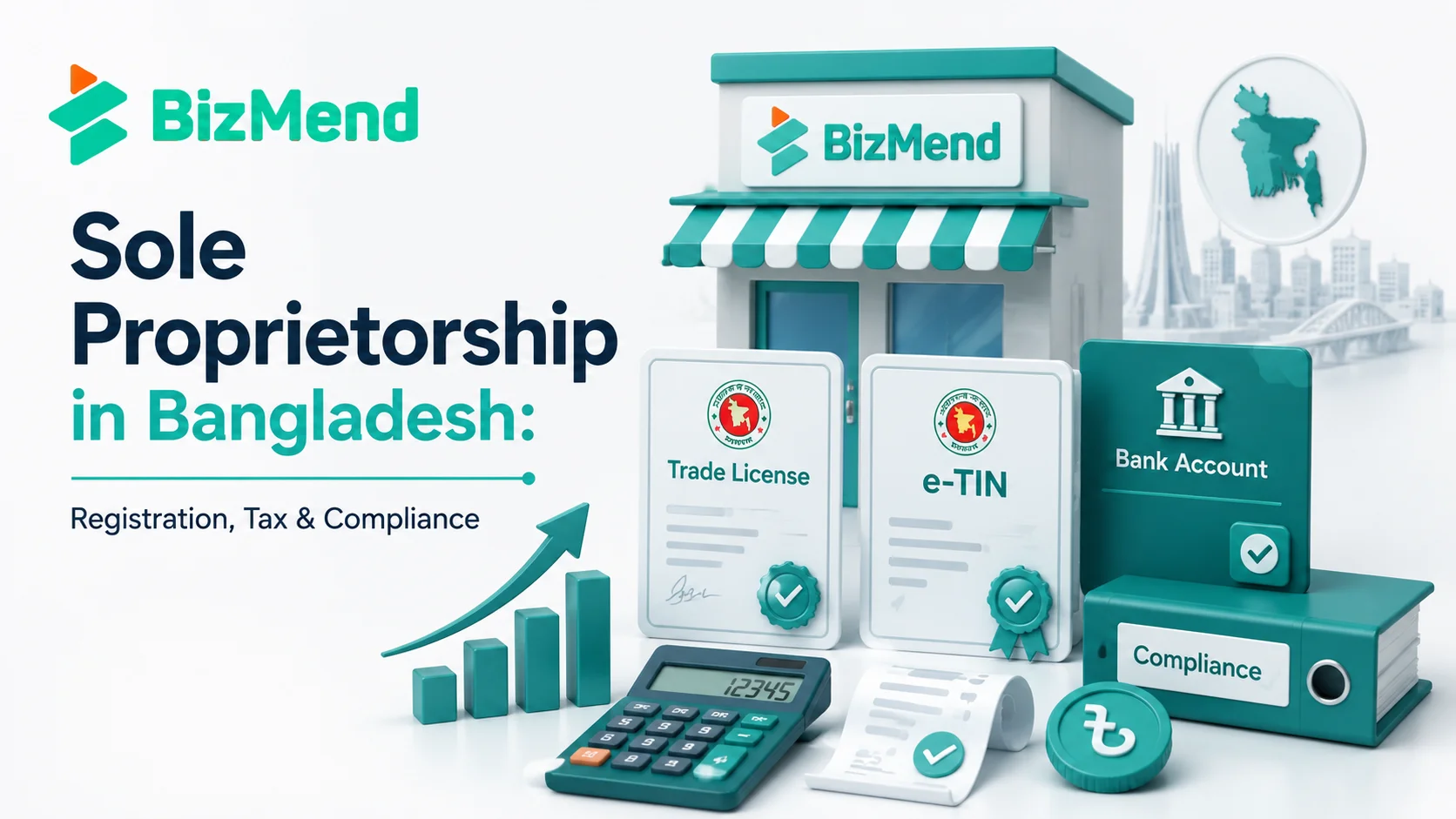
Most guides about starting a business in Bangladesh push you straight toward a private limited company. For a freelancer billing clients abroad, a tutor running classes from her flat, or a single-owner shop in Mirpur, that’s overkill.
Sole proprietorship in Bangladesh is the simplest legal wrapper. One person, one trade license, one TIN, and you’re trading. No RJSC, no shareholders, no AGMs. The catch is that it’s also the most exposed structure when revenue grows or things go wrong. The guide below walks every registration step, the tax math you’ll actually owe, and the compliance pieces nobody warns you about until you’re knee-deep.
| Quick answer: Sole proprietorship is Bangladesh’s simplest legal structure: get a trade license from your City Corporation (Tk 3,000 to Tk 10,000), register for an e-TIN with NBR (free), and add a BIN if turnover crosses Tk 30 lakh. Total setup runs Tk 5,000 to Tk 12,000 and takes 1 to 3 weeks. Profits are taxed as personal income. |
• Sole proprietorship is the cheapest, fastest legal structure in Bangladesh. Setup runs Tk 5,000 to Tk 12,000 and takes 1 to 3 weeks.
• You don’t register with RJSC. RJSC is for companies and partnerships, not individual traders.
• The three core documents: trade license (City Corporation, Pourashava, or Union Parishad), e-TIN (NBR), and a current bank account in the business name.
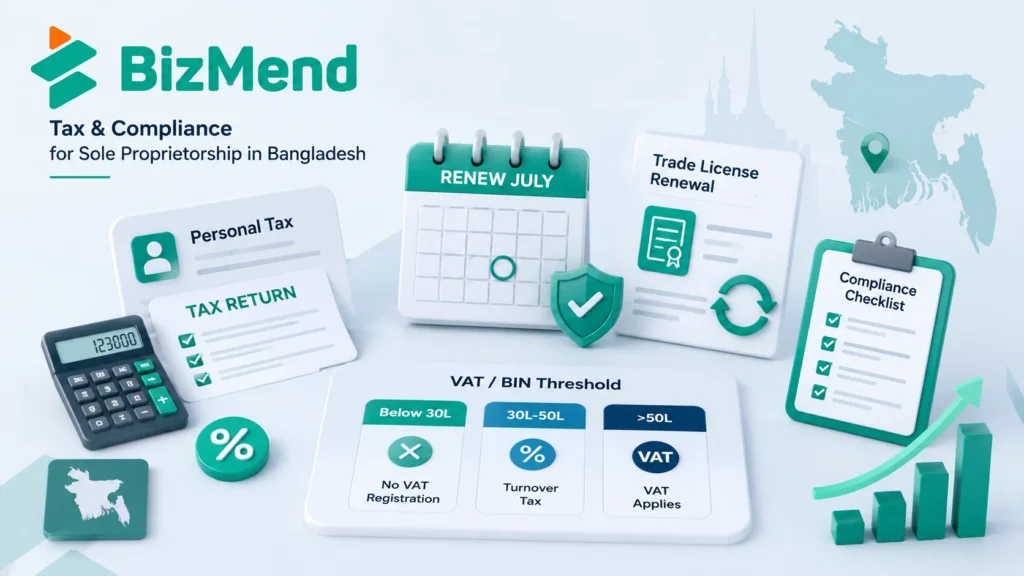
• VAT registration (BIN) is only required if your annual turnover crosses Tk 30 lakh. Below that, you don’t owe VAT.
• Profits are taxed as personal income. Tax-free threshold is Tk 350,000 for general taxpayers in assessment year 2025-2026.
• A flat minimum tax of Tk 5,000 applies to anyone whose income exceeds the threshold (Tk 1,000 for new taxpayers).
• Sole proprietorship gives no liability shield. Your personal assets and business assets are legally the same thing.
• Past Tk 30 to Tk 50 lakh annual turnover, the case for switching to a private limited company gets stronger fast.
A sole proprietorship is a business owned and run by one person, where the business and the owner are legally the same entity. Think of it like running a food cart in your own name. The cart isn’t a separate “company” suing or being sued. You are the cart.
That has consequences. Profits land on your personal tax return. Debts and lawsuits land on your personal balance sheet. The trade license names you, not a corporate entity. Nobody else holds shares, votes on decisions, or signs cheques.
The decision often comes down to one question. Are you a one-person operation that mostly wants legitimacy and a bank account, or are you building something that needs corporate scaffolding? If it’s the first, sole prop. If it’s the second, look at the broader company structures available in Bangladesh.
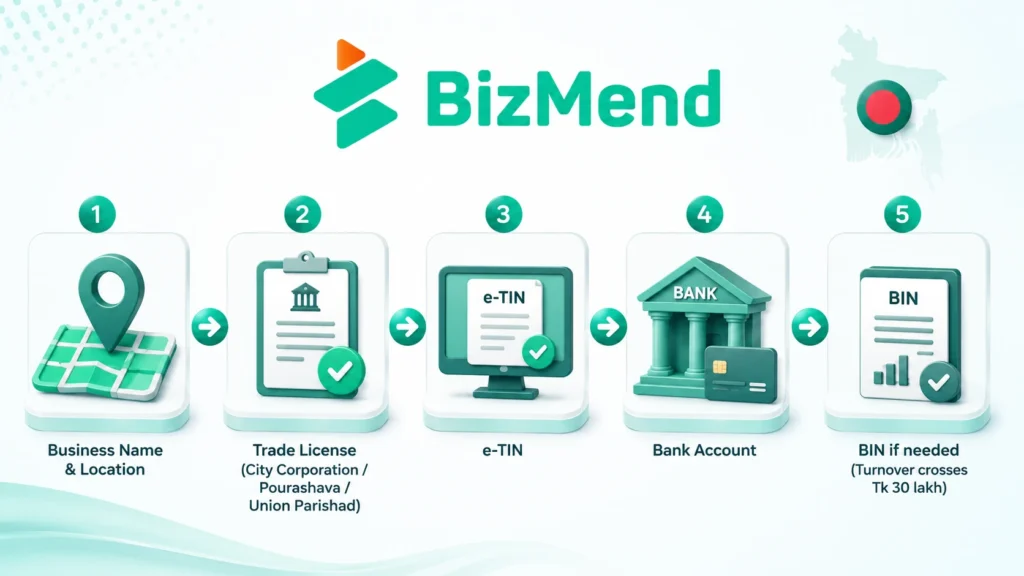
The actual registration is shorter than the Reddit threads suggest. Five steps. Most of them sit in two government offices and one bank branch.
Sole proprietors in Bangladesh don’t need a name clearance from RJSC. You just pick a name and use it. Two soft rules. Don’t pick a name that’s obviously trademarked by someone else. And don’t put “Limited” or “Pvt Ltd” anywhere in it, because you aren’t one.
You’ll also need a physical address. A rented shop, a home address, a small workspace, anything with a written rental agreement or proof of ownership. The City Corporation issuing your trade license will check.
This is the document that says you’re a real business in the eyes of the local government. It’s issued by:
Most applications now run online. Dhaka North uses erevenue.dncc.gov.bd. There’s a national portal at etradelicense.gov.bd. You’ll upload:
Government fees range roughly Tk 3,000 to Tk 10,000 depending on business type and location. A retail trader pays less than a manufacturer. Add Tk 1,000 to Tk 2,500 for stamps and ancillary charges.
The trade license is valid for one year. You renew it every July. Forget that and you’ll pay a small late fee plus the renewal cost.
A Tax Identification Number is mandatory for any business that earns above the personal exemption threshold, and it’s required to open a current account or pay VAT later. Apply free of cost at the NBR e-TIN portal. The form takes 15 minutes if you have your NID and address handy. The certificate prints instantly.
Quick heads up: don’t outsource this to a “consultant” charging Tk 2,000. The portal is in plain Bangla and English. You can do it yourself over a cup of cha.
Once your trade license and TIN are in hand, walk into the bank you already use and ask for a current account in your business’s name. Bring:
Most private banks process the account in 3 to 7 working days. BRAC, EBL, City Bank, and Dutch-Bangla are common picks for small business owners because their digital tools are workable. The state-owned banks are cheaper but slower. For a fuller breakdown of options, see how to open a bank account in Bangladesh and the major private banks in Bangladesh.
Below Tk 30 lakh annual turnover: you don’t need a BIN. Move on.
Above Tk 30 lakh: you must register for VAT and pull a Business Identification Number from NBR. The portal is vat.gov.bd. Registration is free. We cover the thresholds in detail further down.
Here’s the realistic 2026 picture for a small sole proprietor in Dhaka:
| Item | Cost (Tk) | Time |
| Trade license (small retailer/freelancer) | 3,000 to 7,000 | 5 to 14 days |
| e-TIN | Free | Instant (online) |
| Stamps, photos, photocopies | 500 to 1,500 | Same day |
| Bank account opening | Free, or Tk 500 to Tk 2,000 minimum balance | 3 to 7 working days |
| Optional: lawyer or filing assistant | 2,000 to 5,000 | N/A |
| BIN (only if over Tk 30 lakh turnover) | Free | 7 to 14 days |
| Total setup, no consultant | Tk 4,000 to Tk 11,000 | 1 to 3 weeks |
| Total setup, with help | Tk 6,000 to Tk 16,000 | 1 to 3 weeks |
Trade license fees vary widely by city corporation and business category. A goldsmith pays more than a tutor. Manufacturing pays more than retail. Always check the current fee schedule on your local City Corporation site before assuming a number.
This is where most first-time founders get nervous. Here’s the actual structure for assessment year 2025-2026.
A sole proprietorship’s profit isn’t taxed as a separate entity. It flows to the owner’s personal income tax return. You file under the same form (IT-11GA) any salaried Bangladeshi files, just with your business income reported in the relevant section.
Above the threshold, slabs climb in steps. The top rate is 30% on income above roughly Tk 35.75 lakh. Most small sole proprietors never reach the top slab; they sit comfortably in the 5% to 15% range.
Two extra rules worth knowing:
A sole proprietor’s tax life is just personal income tax with extra paperwork. Not a separate corporate machine.
Returns are due by November 30 each year for individual taxpayers (Tax Day). Miss it and the late filing penalty kicks in fast. The NBR e-Return portal lets you file online; many sole proprietors still drop a paper return at the local Taxes Circle office. Whichever you pick, keep your trade license, bank statements, and a basic income-expense log.
VAT trips up sole proprietors more than income tax does. The rules:
That 30 lakh line moves a lot of small businesses. Crossing it changes your monthly admin from “send an invoice” to “collect VAT, issue Mushak-6.3 invoices, file Mushak-9.1 monthly, reconcile inputs and outputs.” It’s not impossible. It is meaningfully more work. Many freelancers cap their billed turnover deliberately, or switch to a Pvt Ltd structure, the year they see Tk 30 lakh on the horizon.
Here’s the head-to-head most Bangladeshi founders actually weigh:
| Feature | Sole Proprietorship | Private Limited Company |
| Setup cost | Tk 5,000 to Tk 12,000 | Tk 25,000 to Tk 60,000+ |
| Setup time | 1 to 3 weeks | 4 to 8 weeks |
| Registration body | City Corporation + NBR | RJSC + City Corporation + NBR |
| Number of owners | One | Two to fifty |
| Liability | Unlimited personal | Limited to share capital |
| Tax | Personal income tax slabs | 27.5% corporate (standard) |
| Annual filings | Tax return, trade license renewal | Tax, AGM, RJSC, audit, more |
| Investor friendliness | None. Cannot issue shares. | High. Shares, equity rounds. |
| Bank credibility | Lower for big-ticket loans | Higher |
| Sells well to corporate clients | Sometimes | Yes |
Rule of thumb: stay sole prop while you’re a one-person operation under Tk 30 to Tk 50 lakh in turnover. The moment you take a co-founder, raise outside money, or court corporate buyers who care about formality, the private limited route earns its extra cost.
Registration is the easy part. Compliance is where founders bleed quietly.
The annual checklist for a sole proprietor:
The recurring mistakes:
Most sole proprietors don’t lose money on tax. They lose it on the small fines that pile up because nobody told them the trade license expired in July.
Sole proprietorship is the t-shirt of Bangladesh business structures. Cheap, comfortable, fits most situations under Tk 30 lakh in turnover. It won’t impress a venture investor, and it won’t shield your savings if a customer sues. Past a certain point, you outgrow it. Until then, it’s the cleanest way to go from idea to invoice.
If the paperwork starts to feel heavier than the work itself, Business Globalizer handles formation and compliance support across Bangladesh and beyond.
1. Do I need to register a sole proprietorship with RJSC in Bangladesh?
No. RJSC handles companies and partnerships. A sole proprietorship is registered through your local City Corporation, Pourashava, or Union Parishad via the trade license, plus your e-TIN with NBR. That’s it.
2. How much does it cost to start a sole proprietorship in Bangladesh in 2026?
Roughly Tk 5,000 to Tk 12,000 for most small operators. The trade license is the biggest single line (Tk 3,000 to Tk 10,000 depending on business type and city), the e-TIN is free, and the bank account opening is free or close to it.
3. At what turnover do I have to register for VAT as a sole proprietor?
Tk 30 lakh annual turnover is the threshold. Above that, you must register for BIN. Between Tk 30 lakh and Tk 50 lakh, you pay 3% Turnover Tax. Above Tk 50 lakh, standard 15% VAT applies.
4. Can a sole proprietor in Bangladesh hire employees?
Yes. You can hire staff, pay salaries, and deduct employee tax at source. You’ll need to handle relevant employment compliance, but the structure itself doesn’t cap your headcount.
5. Do I get personal liability protection as a sole proprietor?
No. The business and the owner are legally the same. Business debts are your debts. If a customer sues the business and wins, your personal assets are reachable. That’s the single biggest reason founders graduate to a private limited company.
6. Can a foreigner register a sole proprietorship in Bangladesh?
Generally no. Sole proprietorship in Bangladesh is reserved for Bangladeshi citizens. Foreign nationals route through a private limited company, branch office, or liaison office, depending on the activity.

Learn how to become a Daraz seller in Bangladesh, register an account, list products, understand fees, manage orders, and grow…
by Sheikh Ornob
Compare the cost of living in Bangladesh in 2026, including Dhaka and Chittagong rent, food, transport, utilities, inflation, and monthly…
by Sheikh Ornob
Learn MoA and AoA requirements in Bangladesh, key clauses, drafting basics, RJSC filing steps, amendments, and common company-registration mistakes. Suggested…
by Sheikh Ornob