
 by Sheikh Ornob
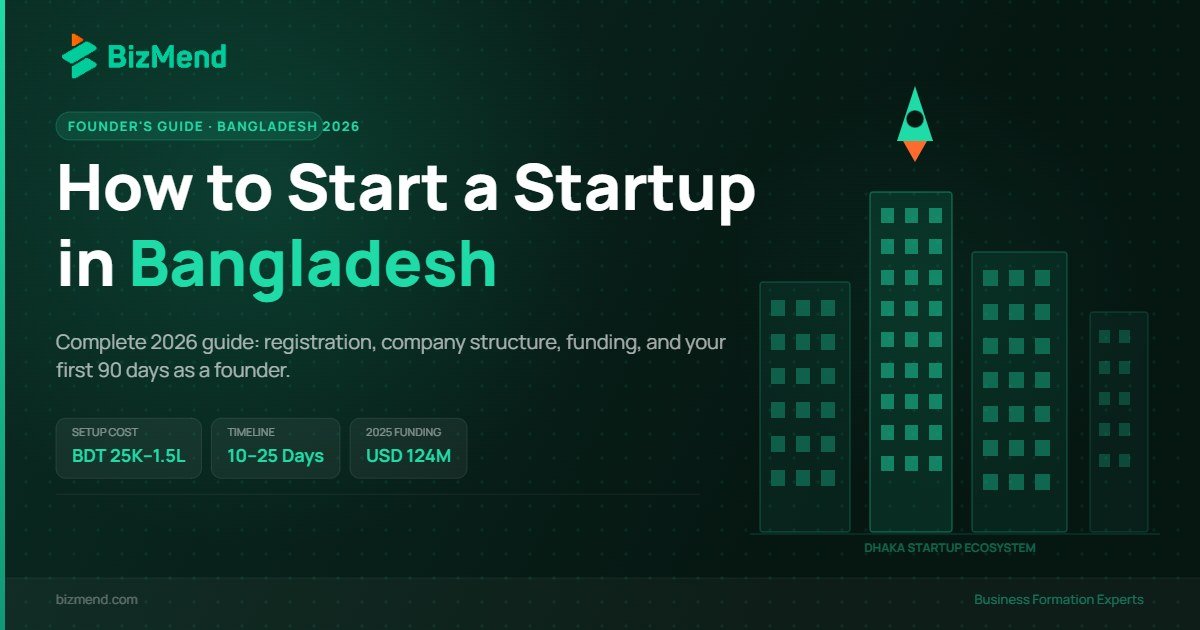
Quick answer: Starting a startup in Bangladesh in 2026 means registering a private limited company with RJSC under the Companies Act 1994, getting a trade license from your city corporation, and securing TIN and BIN from the NBR. The full setup costs around BDT 25,000 to 1,50,000 and takes 10 to 25 working days, with funding available through Startup Bangladesh Limited, the iDEA project, private VCs, and Bangladesh Bank’s startup loan scheme.
So you want to launch a startup in Bangladesh. Good. The country has more than 1,200 active startups in 2025, the ecosystem has pulled in roughly USD 1 billion in funding over the past decade, and the government just made it cheaper to borrow as a founder. But here’s the part most guides skip. Local investment dropped by 95% in 2024, the funding climate is tight, and registration still takes patience. This guide walks you through the real picture in 2026. Setup steps, costs, where the money actually is, and what working founders wish they’d known before signing the first paper.
What Counts as a Startup in Bangladesh Right Now
A startup in Bangladesh is a young company building something scalable. Usually tech-enabled, usually solving a problem the local market hasn’t solved well yet. Pathao did it for ride-hailing. bKash did it for mobile money. Chaldal did it for grocery. Most others are still trying.
The official definition matters too. Bangladesh Bank’s startup financing rules now define a startup as a registered entity that is not more than 12 years old (raised from 10), with paid-up capital under a set ceiling, and operating in innovation-driven sectors. That definition matters when you apply for the new low-interest startup loans we’ll cover later.
Startup vs Small Business: The Real Difference
A small grocery shop is a small business. A platform that connects 10,000 small grocery shops with B2B suppliers is a startup. The difference is scale ambition and the use of technology to grow without hiring at the same rate as revenue.
If your plan is to open one store and run it well, you don’t need this guide. You need a trade license and a tax file. If your plan is to build something that could serve millions of users or thousands of businesses, keep reading.
The State of Bangladesh’s Startup Scene in 2026
Honest take: the ecosystem is at a crossroads. The good news first.
Funding rebounded in 2025 to USD 124 million, up from USD 42 million in 2024. The startup ICT sector is projected to contribute 5% to GDP, up from 2.3%. Bangladesh Bank dropped startup loan rates to 4% and lifted the loan ceiling to 8 crore taka in July 2025. Startup Bangladesh Limited, the government VC fund, has 500 crore taka committed and active deployment ongoing.
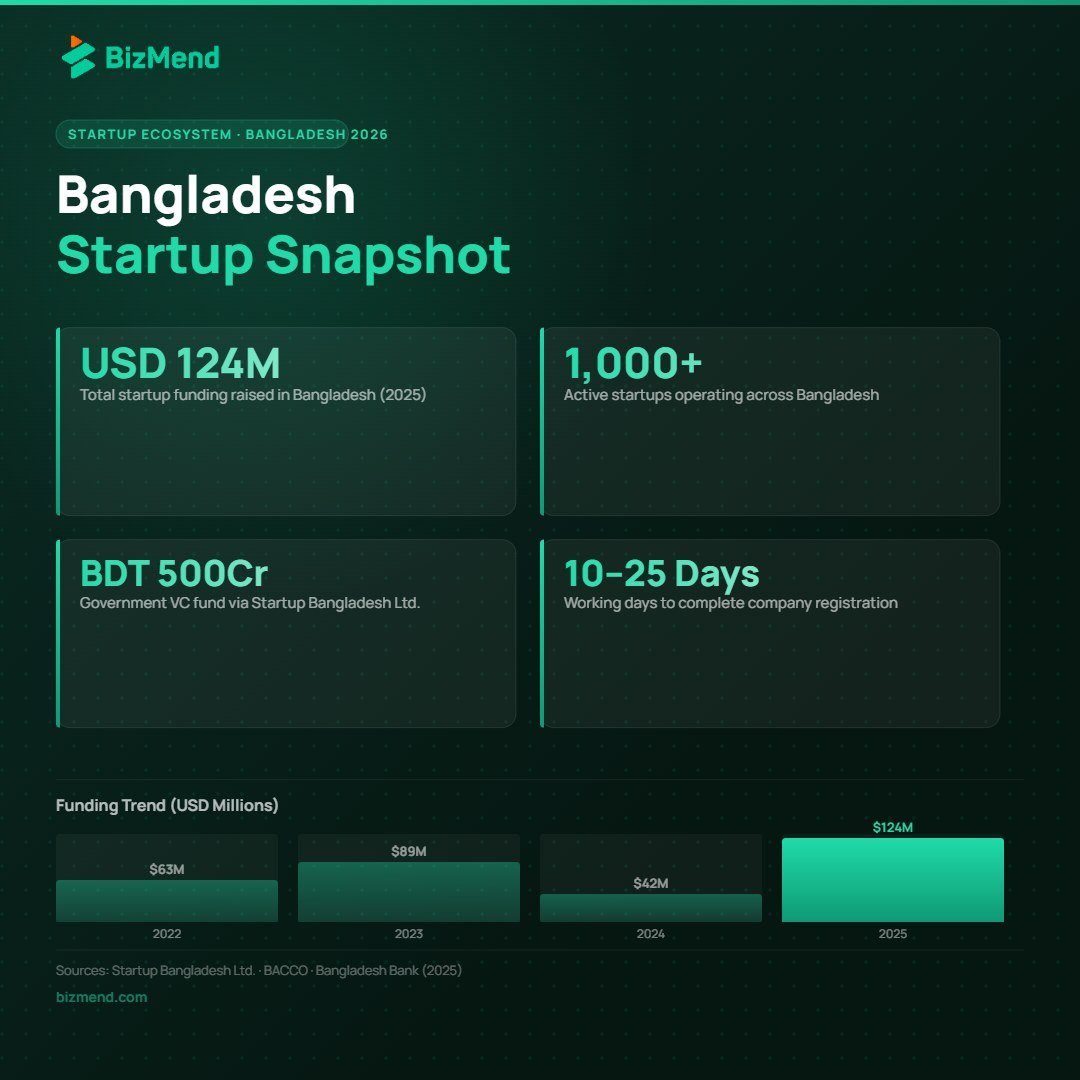
Now the harder truth. Local investors deployed only USD 1.1 million in 2024, a 95% drop from 2023. Mid-2025 saw just USD 625,000 from the local capital. Almost all funding now comes from foreign VCs, which makes the ecosystem fragile. Funding is also concentrated at the top: Series B captures nearly half of total VC deployment, while pre-seed and seed founders fight for crumbs.
Where the Money Comes From (and Doesn’t)
| Funding Stage | Share of Total Capital (2010 to 2025) | Reality Check |
| Pre-seed and Seed | Under 20% | Lots of deals, tiny tickets |
| Series A | Around 15% | Significant gap here |
| Series B and beyond | Nearly 50% | Money flows to scale stage |
| Debt and grants | Modest | Bangladesh Bank scheme expanding this |
If you’re at the idea or prototype stage, expect a long fundraising cycle. If you’ve got real traction, the money exists, but it’s foreign and selective.
Hot Sectors and Quiet Winners
Fintech still leads. bKash hit unicorn status with a USD 2 billion valuation, and the sector keeps drawing the most VC attention. Logistics and mobility (Pathao, Paperfly), B2B commerce (ShopUp), agritech (iFarmer, WeGro), edtech (Shikho, 10 Minute School), and healthtech (Praava Health, Maya) are all active.
Quietly emerging in 2025 and 2026: AI startups (about 15% of new venture formation per ecosystem analysis), enterprise SaaS, and climate-tech. If you’re picking a sector, pick one where the unit economics already work for someone, then build a sharper version.
For foreign founders weighing the market, our guide on starting a business in Bangladesh as a foreigner covers the equity rules, ownership structure, and BIDA approvals you’ll need.
Picking the Right Business Structure
Pick wrong here and you’ll redo it later. Worse, you might lose investor interest. Most founders have four real options.
| Structure | Best For | Min. Owners | Foreign Ownership | Liability |
| Private Limited Company | Most startups | 2 directors, 2 shareholders | 100% allowed in most sectors | Limited |
| Sole Proprietorship | Local solo founders, very small ops | 1 | Not allowed for foreigners | Unlimited |
| Public Limited Company | Larger ventures planning IPO | 7+ | Allowed | Limited |
| Branch or Liaison Office | Foreign companies testing the market | N/A | 100% (with BIDA approval) | Tied to parent |
Why Most Founders Pick a Private Limited Company
A Private Limited Company under the Companies Act 1994 is the default for a reason. Your personal assets stay separate. You can have foreign shareholders. You can issue equity to investors later. You can register with just two directors and two shareholders. There’s no fixed minimum paid-up capital under law, though most lawyers suggest BDT 1,00,000 to look credible to banks.
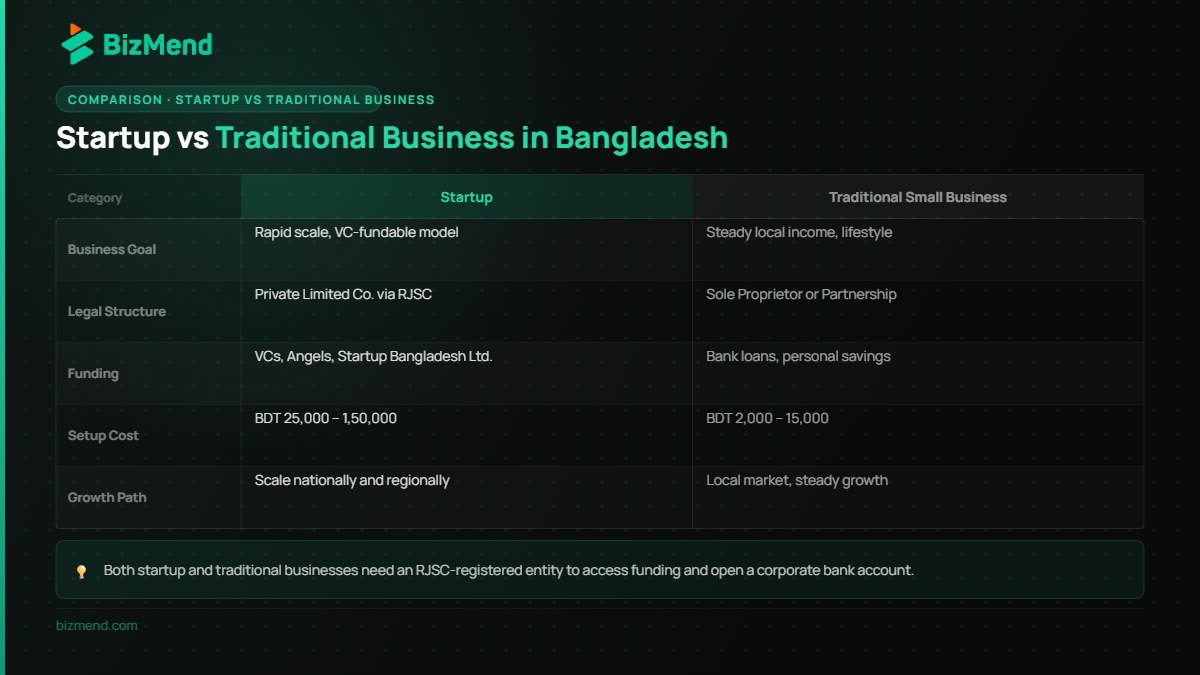
If you’re building a tech startup, this is almost always the right pick. For a deeper breakdown of company types and restrictions for foreigners in Bangladesh, the rules around branch offices and resident director requirements get nuanced fast.
How to Register Your Startup in Bangladesh (Step by Step)
The whole process is mostly online now, through the RJSC portal at roc.gov.bd. Here’s the actual sequence in 2026.
Step 1: Name Clearance from RJSC
Pick three name options in order of preference. Avoid words that imply government affiliation. Apply on the RJSC website, pay BDT 230, and get a Name Clearance Certificate valid for 30 days. Tip: use Chrome or Firefox. The portal is finicky on other browsers.
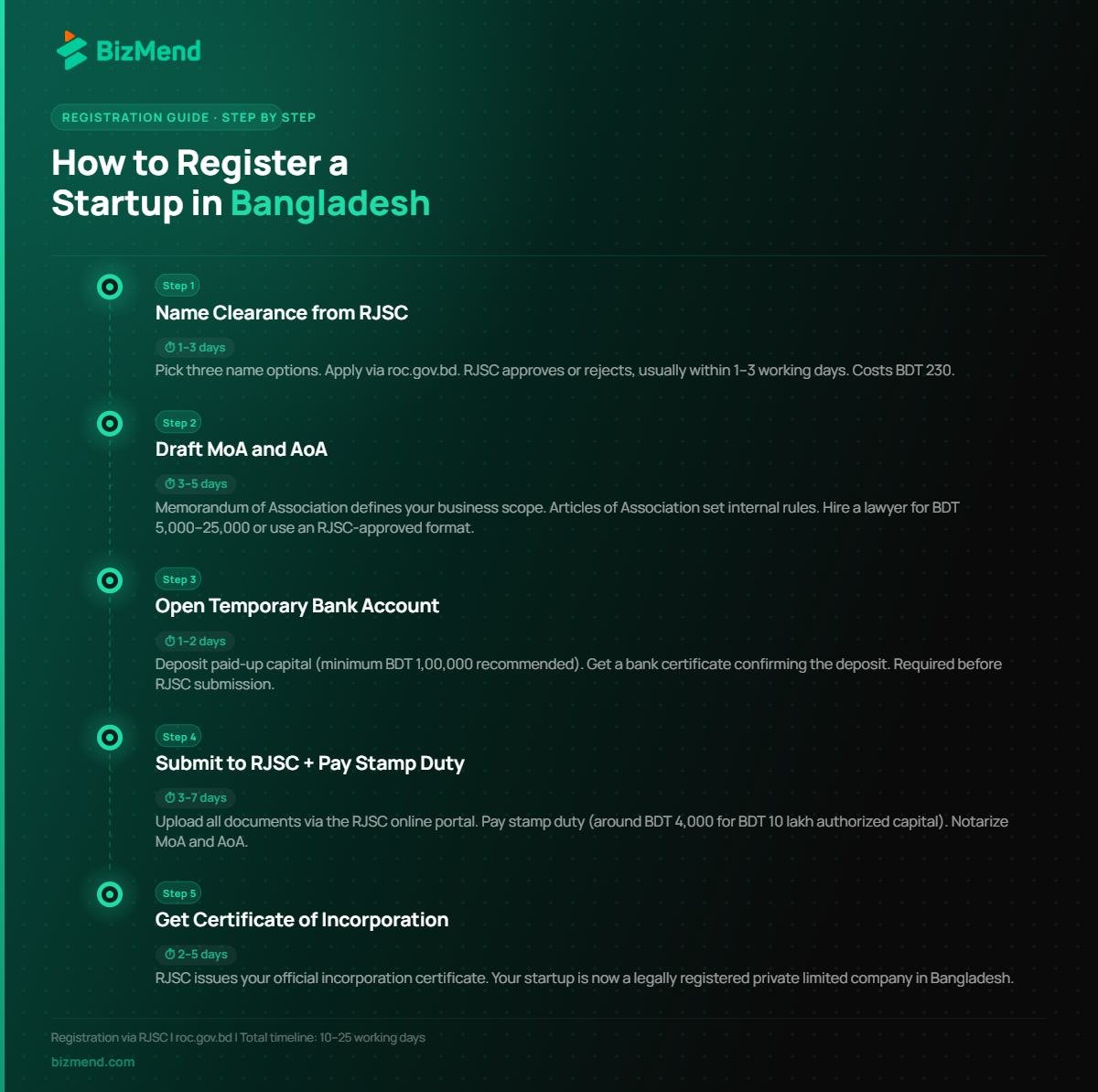
Step 2: Draft Your MoA and AoA
The Memorandum of Association lists what your company will do. The Articles of Association cover internal rules: how directors are appointed, how shares are issued, voting rights, all of it. Don’t copy and paste a template off the internet. A bad MoA limits what you can do later (and yes, you can amend it, but it costs time and money).
Get a corporate lawyer to draft these. Expect to pay BDT 5,000 to 25,000 depending on complexity.
Step 3: Open a Temporary Bank Account
Open a temporary account in the proposed company name with any scheduled bank. Shareholders deposit their paid-up capital here. For local companies, a basic bank certificate is fine. For foreign founders, the bank issues an Encashment Certificate showing capital has been remitted from abroad. This certificate is mandatory for RJSC submission.
Step 4: Submit to RJSC and Pay Stamp Duty
Upload the signed MoA, AoA, Form IX (director consent), Form XII (director list), and the subscriber page through the RJSC portal. Pay government registration fees and stamp duty at the designated bank. For an authorized capital of up to BDT 10,00,000, stamp duty is around BDT 4,000.
Step 5: Get Your Certificate of Incorporation
RJSC reviews the application in 3 to 7 working days. Once approved, you get a digital Certificate of Incorporation with your company registration number. From this date, your company legally exists. Total realistic timeline for a clean local application: 10 to 15 working days. Foreign founders should plan for 20 to 25.
Post-Registration: Trade License, TIN, VAT, and BIN
Incorporation is just the start. You can’t legally operate yet. Here’s what comes next.
Trade License from Your City Corporation
Apply at your local city corporation (DNCC, DSCC, Chittagong City Corporation, or your municipal office). Submit your incorporation certificate, TIN application, rental agreement for office space, and director ID copies. Fees range from BDT 500 for a small commercial office in Dhaka to BDT 40,000 plus for larger or factory operations. Plus signboard tax and 15% VAT.
Processing takes 3 to 7 working days. The license is valid for one fiscal year (July to June) and must be renewed every year. DNCC and DSCC now offer online renewal portals, which saves the queue. Penalties for late renewal can hit BDT 50,000 or more, so set a calendar reminder.
TIN from the National Board of Revenue
Apply for an electronic Tax Identification Number through the NBR e-TIN portal. It’s free and takes 1 to 2 working days. Submit your incorporation certificate, director NIDs or passports, and trade license. Without a TIN you can’t open a permanent bank account, sign contracts cleanly, or claim tax deductions.
VAT and BIN Registration
VAT registration is mandatory if your annual turnover exceeds BDT 30 lakh (3 million), or if you import or export. The BIN (Business Identification Number) is issued together with your VAT certificate. You’ll need it for invoices, tenders, e-commerce platforms, and most business banking.
Apply through the NBR online portal with your trade license, TIN, MoA, AoA, and bank account details. Standard VAT is 15%. Some sectors have reduced rates. Processing takes 6 to 7 days.
A heads-up: even if you’re below the BDT 30 lakh threshold, certain manufacturing, trading, and service categories still require VAT registration regardless of turnover. Check your sector before assuming you’re exempt.
Startup Funding in Bangladesh: Where to Actually Look
You don’t have to chase silicon valley dreams to get funded. Bangladesh has more capital options now than three years ago, but you need to know where to knock.
Government Programs (Startup Bangladesh Limited, iDEA, BB Circular)
Startup Bangladesh Limited is the government’s flagship VC fund, started in March 2020 with a 500 crore taka commitment. It backs pre-seed, seed, and growth stage startups through equity, convertible debt, and grants. It has invested in 10 Minute School, Chaldal, Hishab, Truck Lagbe, and Shuttle, among others.
The iDEA project under the ICT Division offers pre-seed grants of up to BDT 10 lakh to early-stage founders, plus mentorship and free co-working space. Apply through idea.gov.bd.
Bangladesh Bank’s master circular issued on July 9, 2025 is a real game-changer for debt funding. The maximum loan ceiling jumped from 1 crore to 8 crore taka. Interest rates dropped to 4%. The upper age cap was lifted entirely, and the lower cap brought down to 21. Banks can now also take equity stakes, not just lend. This is patient capital, and it’s worth a serious look if you’re at the seed or early growth stage.
Private VCs and Angel Networks
The active private side includes Anchorless Bangladesh (New York-based, backed by Pathao and Agroshift), SBK Tech Ventures (women-owned, Singapore network), BD Venture (since 2012), Bangladesh Venture Capital, and Bangladesh Angels (the country’s first angel investing platform).
Foreign VCs like 500 Global, Sequoia, and SoftBank have also made selective bets. The catch: most foreign VCs want to see a proven local founding team and clear unit economics before they cut a cheque.
Bootstrapping: Still the Most Common Path
Honestly, most successful Bangladeshi founders bootstrapped for the first 1 to 3 years. With the funding climate tight and local capital thin, building a product that earns revenue from day one beats burning runway you don’t have. Future Startup, the local startup media, has predicted more bootstrapped companies in 2025 and 2026 than any year before. They’re probably right.
Common Startup Ideas in Bangladesh That Still Have Room
Picking an idea is half art, half spotting an unsolved problem. Here are sectors where the gap is real in 2026.
- AI tools for SMEs: Local accounting, inventory, and customer support tools built for Bangladeshi small business owners. Most existing tools are clones of Western products that don’t fit.
- Agritech for smallholder farmers: iFarmer and WeGro proved the model. Sub-niches like crop disease detection, weather-based insurance, and farm-to-supermarket logistics are still wide open.
- Healthtech for Tier 2 cities: Telemedicine, diagnostic delivery, and pharmacy management software (Pulse Tech is one example) underserved outside Dhaka and Chittagong.
- B2B logistics and last-mile delivery: Outside the metro areas, delivery is still painful. Founders who can solve the union-level cash-on-delivery problem have a real shot.
- Enterprise SaaS for export-driven sectors: RMG, leather, jute. These industries earn billions in foreign currency and run on spreadsheets and WhatsApp.
- Climate and clean energy: Solar microgrids, e-rickshaw battery management, and waste-to-resource startups are getting early attention from impact investors.
Mistakes That Kill Bangladeshi Startups Early
I’ve watched a few good ideas die from preventable mistakes. Avoid these.
- Skipping the trade license to “save time.” It’s not a save. Banks won’t open accounts, suppliers won’t issue invoices, and one inspection can shut you down.
- Picking a sole proprietorship to dodge paperwork. Then trying to raise from a VC two years later. Doesn’t work. Investors want shares, not handshakes.
- Building without revenue validation. The “we’ll figure out monetization later” play almost never survives in a market this price-sensitive.
- Hiring too fast after the first round. Bangladeshi salaries are climbing, and burn rates are scarier than founders expect.
- Ignoring annual RJSC and tax filings. Penalties stack up. Late annual returns can cost BDT 5,000 to 5,00,000, and dissolution is a real risk if you keep ignoring it.
Your First 90 Days as a Founder: A Practical Checklist
Day 1 to 15:
- Pick your business structure (almost always PLC)
- Get name clearance from RJSC
- Draft MoA and AoA with a lawyer
- Open temporary bank account, deposit paid-up capital
- Submit to RJSC, pay stamp duty
Day 15 to 30:
- Receive Certificate of Incorporation
- Apply for trade license at city corporation
- Apply for e-TIN through NBR
- Open permanent corporate bank account
Day 30 to 60:
- Apply for VAT and BIN if turnover threshold applies
- Set up basic accounting (Tally, QuickBooks, or local equivalents)
- Register with relevant trade body if applicable
- Hire a part-time accountant or tax consultant
Day 60 to 90:
- File any required quarterly TDS returns
- Build your founding team (max 3 to 5 people)
- Talk to 50 potential customers
- Apply to iDEA or Startup Bangladesh Limited if you have an MVP
- Set up board meeting cadence (minimum 4 per year)
If you’re juggling tax and compliance,our guide on company types and restrictions for foreigners is also a useful reference for ongoing director and reporting rules.
Key Insights
- Bangladesh has 1,200 plus active startups in 2025, with the ecosystem ranked #79 globally and #4 in South Asia, according to StartupBlink data.
- Total startup funding in 2025 hit USD 124 million across 12 deals, a sharp jump from USD 42 million in 2024, but heavily concentrated in one big deal (the ShopUp and Sary M&A worth USD 110 million).
- Local investment collapsed 95% in 2024, falling to just USD 1.1 million, and stayed flat through mid-2025. Almost all early-stage capital now comes from foreign VCs.
- Bangladesh Bank’s July 2025 circular raised the startup loan ceiling to 8 crore taka at 4% interest, and removed the upper age cap entirely. This is a real shift for founders who want debt over equity.
- RJSC registration takes 10 to 15 working days for local companies and 20 to 25 days for foreign founders. Most of it is now online through roc.gov.bd.
- Private Limited Company is the default choice for over 90% of Bangladeshi startups because it offers limited liability, easier funding, and 100% foreign ownership in most sectors.
- Trade license fees range from BDT 100 to over BDT 40,000 depending on business type, location, and paid-up capital, and must be renewed every fiscal year (July to June).
Final Thoughts
Look, building a startup in Bangladesh in 2026 is harder than the success stories suggest.The Local capital is thin. The funding gap between seed and Series A swallows good companies whole. Bureaucracy still bites. But the foundation is real. Over USD 1 billion has flowed into the ecosystem in a decade. The government’s startup loan scheme is finally serious. And the ground is full of problems waiting for someone smart enough to fix them.

If you’ve got an idea you can’t stop thinking about, your first move isn’t pitching VCs. It’s getting registered cleanly, finding 10 paying users, and proving the math works at a small scale. Once you’ve done that, the funding paths open up in ways they never do for founders with only a deck.
So what are you building?
Frequently Asked Questions
How much does it cost to start a startup in Bangladesh in 2026?
Starting a startup in Bangladesh costs roughly BDT 25,000 to BDT 1,50,000 in total setup fees for a private limited company. This covers RJSC name clearance (BDT 230), stamp duty (around BDT 4,000 for BDT 10 lakh authorized capital), legal fees for MoA and AoA drafting (BDT 5,000 to 25,000), trade license (BDT 500 to BDT 40,000+), and TIN/VAT registration. Foreign founders should budget USD 1,500 to USD 3,000 minimum.
How long does RJSC registration take in Bangladesh?
RJSC registration takes 10 to 15 working days for local Bangladeshi founders and 20 to 25 working days for foreign founders. The process includes name clearance (1 to 2 days), MoA and AoA drafting, bank account opening, document submission, and final issuance of the Certificate of Incorporation (3 to 7 days). Most of the process is now online through roc.gov.bd, but document errors or high application volume can delay things.
Can foreigners own 100% of a startup in Bangladesh?
Yes, foreigners can own 100% of a startup in Bangladesh in most sectors under the Foreign Private Investment Act 1980. Restricted sectors include arms, nuclear energy, and parts of mining and forestry, where foreign ownership is capped at 40 to 49%. Foreign founders need to register with RJSC, remit paid-up capital through banking channels, and obtain BIDA approval for manufacturing or industrial setups.
What is the minimum capital required to register a startup in Bangladesh?
There is no legally fixed minimum paid-up capital for a private limited startup in Bangladesh. Most lawyers suggest BDT 1,00,000 as a practical minimum to satisfy banks and regulators. Foreign founders applying for an investor visa need at least USD 100,000 invested. For a foreign-owned company hiring expat staff, USD 50,000 is the practical floor most banks expect.
What funding options are available for startups in Bangladesh?
Startups in Bangladesh can access funding through Startup Bangladesh Limited (the government’s 500 crore taka VC fund), the iDEA Project (grants up to BDT 10 lakh), Bangladesh Bank’s startup loan scheme (up to 8 crore taka at 4% interest as of July 2025), private VCs (Anchorless, BD Venture, SBK Tech Ventures), and angel networks like Bangladesh Angels. Bootstrapping is still the most common path for early-stage founders.
Do I need a trade license if my startup is online only?
Yes, even fully online startups in Bangladesh need a valid trade license under their registered business address. A trade license is mandatory for opening corporate bank accounts, issuing invoices, signing contracts, and registering for VAT or BIN. E-commerce, SaaS, and digital service startups all fall under this rule. Apply at your local city corporation or municipal office, and renew every fiscal year (July to June) to avoid penalties.