
 by Sheikh Ornob
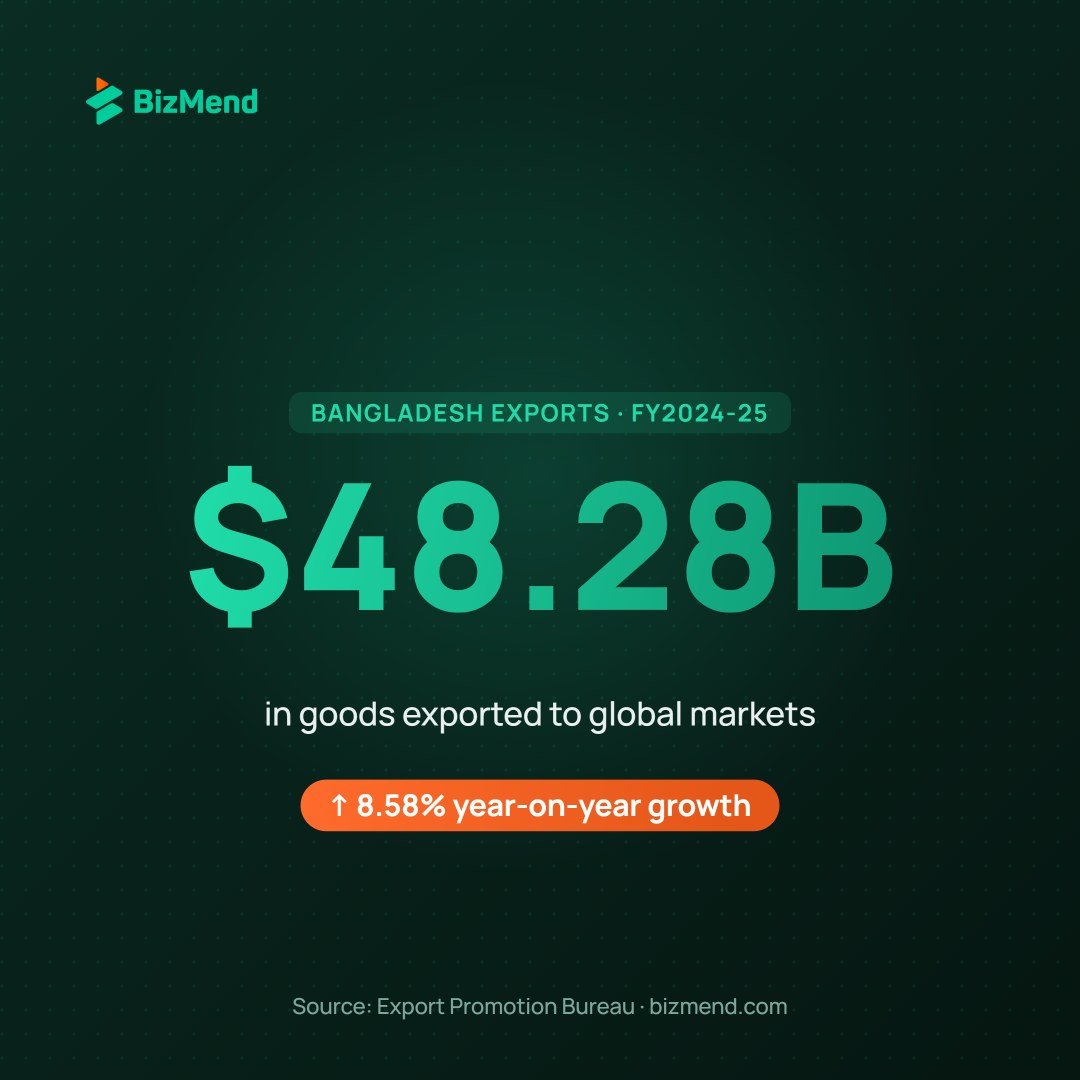
Bangladesh shipped $48.28 billion worth of goods to international markets in fiscal year 2024-25, an 8.58 percent jump from the previous year, according to EPB data released in July 2025. And that number keeps climbing. Most of those exports don’t come from giant corporations. They come from manufacturers, SME owners, and product suppliers who figured out the process and started selling to the world.
You can do the same. But there’s a system. This guide walks you through exactly how to start an export business in Bangladesh in 2026, step by step, from registering your business to shipping your first order.
Quick Answer:
To start an export business in Bangladesh, register your business (sole proprietorship, partnership, or private limited company), get a trade license, TIN, and VAT certificate, then apply for an Export Registration Certificate (ERC) online through CCI&E’s OLM portal at olm.ccie.gov.bd. The ERC costs BDT 11,500 (with VAT) and takes 7 to 15 working days. Once issued, choose your product, find international buyers, prepare your export documents, and receive payment via Letter of Credit.
Why Bangladesh Is Worth Exporting From
Bangladesh is the second-largest garment exporter in the world. But garments aren’t the only story anymore. Leather goods, jute products, ceramics, frozen seafood, pharmaceuticals, and agricultural items are all finding international buyers.
The government actively supports exporters through the Export Promotion Bureau (EPB). Cash incentives, duty drawback schemes, and preferential trade access to the EU, UK, Canada, and Japan under the Generalized System of Preferences (GSP) make exporting genuinely attractive for new entrepreneurs. That said, Bangladesh is scheduled to graduate from its Least Developed Country (LDC) status in November 2026, which will gradually affect certain preferential tariff arrangements in key markets. More on that in Step 5.
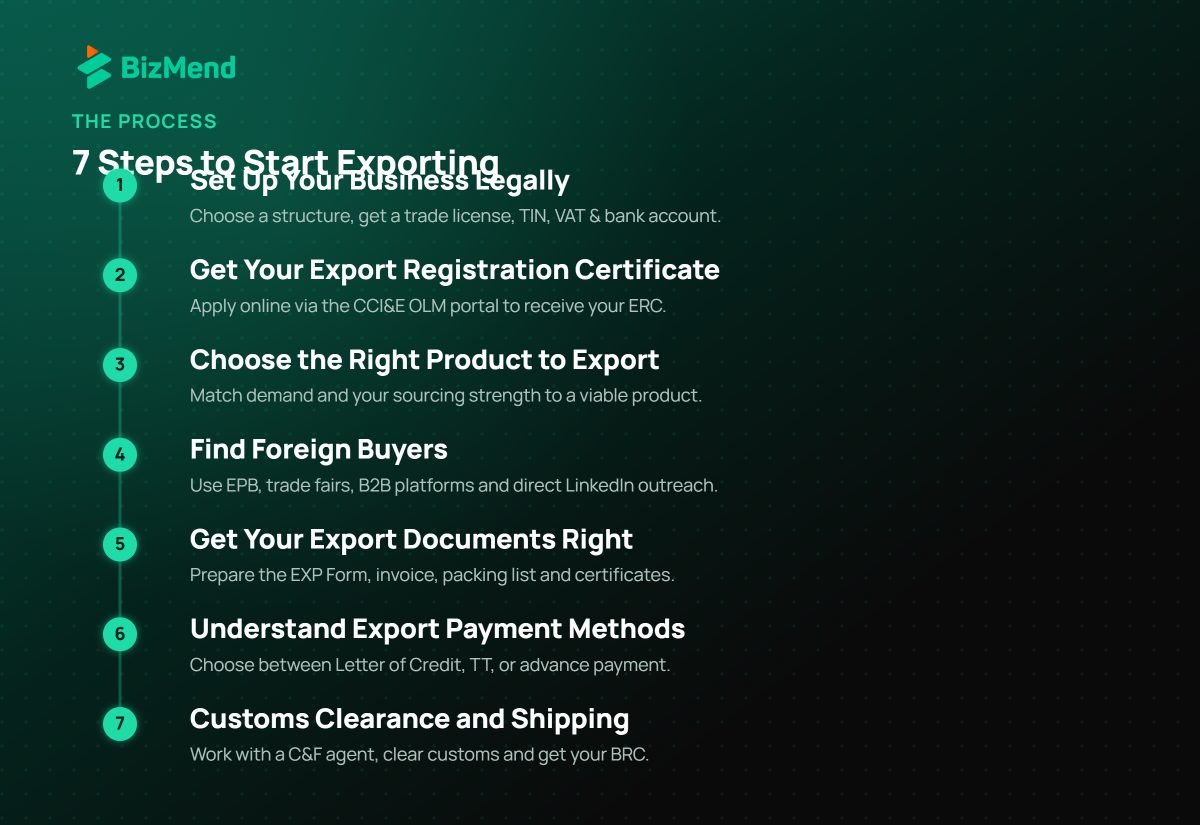
Step 1: Set Up Your Business Legally
You can’t apply for an Export Registration Certificate without a registered business. But the right structure for your situation matters. Here’s what you need to know before you pick one.
Choose Your Business Structure First
Sole proprietors and partnerships can apply for an ERC without registering with the RJSC. If you’re operating as a sole proprietor, your trade license, TIN, VAT certificate, bank account, and chamber membership are enough to apply. That’s the lighter setup route, and it works well for many first-time exporters.
If you’re forming a Private Limited Company, that’s where the RJSC comes in. Register with the Registrar of Joint Stock Companies and Firms (RJSC) and you get a Certificate of Incorporation. This gives you limited liability protection, stronger credibility with international buyers, and easier access to trade financing. Most experienced exporters recommend this route if you’re serious about scaling.
Not sure which structure fits your situation? This guide to company types and restrictions for businesses in Bangladesh breaks it down clearly.
Get a Trade License
Every business structure needs a trade license. Apply to your local city corporation, pourashova, or union parishad. In Dhaka, you’ll deal with Dhaka North or South City Corporation. Renew it every year without fail.
TIN, VAT, and Bank Account
These three are non-negotiable across all business structures:
- TIN certificate: Apply online through the NBR’s e-TIN portal. Free and takes one to two days.
- VAT registration (BIN): Apply through the NBR VAT portal. Exports are zero-rated for VAT, but you still need the registration for banking and compliance.
- Business bank account: Open one with any scheduled commercial bank. BRAC Bank, Eastern Bank, Dutch-Bangla Bank, and Standard Chartered are all common choices. You’ll need it for LC transactions and all foreign currency payments.
Step 2: Get Your Export Registration Certificate (ERC)
This is the single most important document for any exporter in Bangladesh. Without it, banks won’t process your export payments and customs won’t clear your shipment.
The ERC is issued by the Office of the Chief Controller of Imports and Exports (CCI&E) under the Ministry of Commerce. Since July 2019, the entire process is done online through CCI&E’s Online Licensing Module (OLM). No office visit to Motijheel required. Here’s how it works.
Documents You Need
Prepare all of these as scanned copies before you start the online application:
- Valid trade license (current year)
- TIN certificate
- VAT registration certificate (BIN)
- Bank solvency certificate from your bank
- Membership certificate from a recognized Chamber of Commerce or trade association (DCCI, FBCCI, BGMEA, BKMEA, or your relevant sector body)
- National ID card or passport of the owner/directors
- Company incorporation certificate (for limited companies only)
- Memorandum and Articles of Association (for limited companies only)
- Partnership deed (for partnerships)
- Office rent agreement or ownership documents
- Passport-size photograph of the applicant (scanned)
- Previous year’s income tax payment certificate (if applicable)
The Online Application Process (OLM)
1. Go to olm.ccie.gov.bd and create a new OLM account using your email, phone number, and basic business details.
2. Log in to your OLM dashboard and click the ERC option. Select General ERC or Indenting Services ERC as applicable.
3. Fill out the online ERC application form completely and accurately.
4. Upload scanned copies of all required documents directly through the portal.
5. Pay the registration fee online through the OLM system. Payment goes directly to the government treasury.
| Certificate Type | New Registration Fee | Annual Renewal Fee |
| Export Registration Certificate (ERC) | BDT 11,500 (includes VAT) | BDT 8,050 (includes VAT) |
6. Submit the application. Track your application status in real time from your OLM dashboard.
7. CCI&E verifies your documents. First-time applicants may have a field inspection of their office address, which can add two to five working days.
8. Once approved, your ERC and passbook are issued digitally through OLM. Download and print directly from your dashboard. Total processing time: 7 to 15 working days.
Renew the ERC every year through the same OLM portal. A lapsed ERC means you can’t legally export until it’s renewed.
Step 3: Choose the Right Product to Export
Honestly, a lot of new exporters skip this step and jump straight to paperwork. That’s backwards. Your product determines your market, your buyers, your logistics, and your margins.
Here’s what Bangladesh exports well right now:
- Ready-made garments and knitwear (over 81% of total export value in FY2024-25, earning $39.35 billion)
- Leather products and footwear ($1.15 billion in FY2024-25, up 10.19%)
- Jute and jute goods
- Frozen fish and seafood
- Agricultural products including vegetables, spices, and tea
- Ceramics and homeware
- Pharmaceuticals
- Handicrafts and gift items
If you’re a manufacturer, start with what you already make. If you’re a trader, find a product where you have reliable supplier relationships and can consistently maintain quality.
One thing experienced exporters agree on: pick a product you understand deeply. For a broader look at which sectors are generating the most international interest right now, this rundown of top export-oriented industries in Bangladesh is worth reading before you decide.
Step 4: Find Foreign Buyers
Getting the ERC is the easy part. Finding buyers who will actually send purchase orders? That takes consistent effort across multiple channels.
Use the Export Promotion Bureau (EPB)
The EPB (epb.gov.bd) organizes trade delegations, sponsors participation in international fairs, and gives exporters access to buyer databases. Their Trade Information Centre (TIC) provides access to Trade Map (by ITC), which shows active importers by product and country.
Attend International Trade Fairs
The Dhaka International Trade Fair (DITF) runs every January and draws international buyers. Global events like the Global Sourcing Expo in Australia, the Canton Fair in China, and sector-specific fairs in Germany and the UAE attract serious sourcing managers. The EPB often subsidizes participation for Bangladeshi exporters.
List on B2B Platforms
Alibaba is the obvious starting point. Create a verified supplier profile, list your products with clear photos and specifications, and respond to inquiries within hours. Also worth trying: Global Sources, Europages (for European buyers), and TradeKey.
Use LinkedIn for Direct Outreach
Search for “Sourcing Manager,” “Import Buyer,” or “Procurement Manager” on LinkedIn and filter by country. A short, direct message with your product catalog gets more responses than a generic email blast. Small exporters in Bangladesh have landed their first EU buyer this way within three months.
Step 5: Get Your Export Documents Right
Once you have an order, the paperwork has to be correct. Errors in export documents delay shipments, hold up payments, and sometimes result in customs rejection at the destination.
- Commercial Invoice: Describes the goods, quantity, price, and terms of sale. Your ERC number and the HS code of the goods must appear on the invoice.
- Packing List: Details the contents, dimensions, and weight of each package in the shipment.
- EXP Form: Issued and certified by your Authorized Dealer (AD) bank under the Foreign Exchange Regulation Act. It certifies you are a bonafide exporter and your bank guarantees repatriation of export proceeds within 4 months of shipment. You submit the bank-certified EXP Form to customs along with your shipping documents.
- Bill of Export (Shipping Bill): The customs export declaration. Your C&F agent submits this electronically to customs through the ASYCUDA World system. It is the export equivalent of a Bill of Entry for imports and must be filed before your goods leave Bangladesh.
- Bill of Lading (sea) or Airway Bill (air): The carrier’s receipt and a key document in the payment process. Get this right, every field.
- Certificate of Origin (CO): Proves your goods were made in Bangladesh. A preferential CO from the EPB lets buyers claim duty-free or reduced tariffs under GSP, SAFTA, and APTA. A non-preferential CO from your Chamber of Commerce covers standard customs requirements.
- Insurance Certificate: Required for most shipments, especially under CIF or CIP terms.
LDC Graduation Note (2026): Bangladesh is scheduled to graduate from Least Developed Country status in November 2026. The EU has offered a 3-year transition period keeping EBA (Everything But Arms) duty-free access until November 2029. Other markets such as India, Turkey, and Australia may apply standard MFN tariffs from November 2026 onward. Before quoting prices to buyers and factoring in their import duties, verify the current preferential tariff status for your specific product and destination country. The situation is active and changing.
For food, agricultural products, or pharmaceuticals, you’ll also need quality certificates from BSTI, the Department of Agricultural Extension, or your sector’s regulatory body.
Step 6: Understand Export Payment Methods
Getting paid safely is the whole point. So take this seriously.
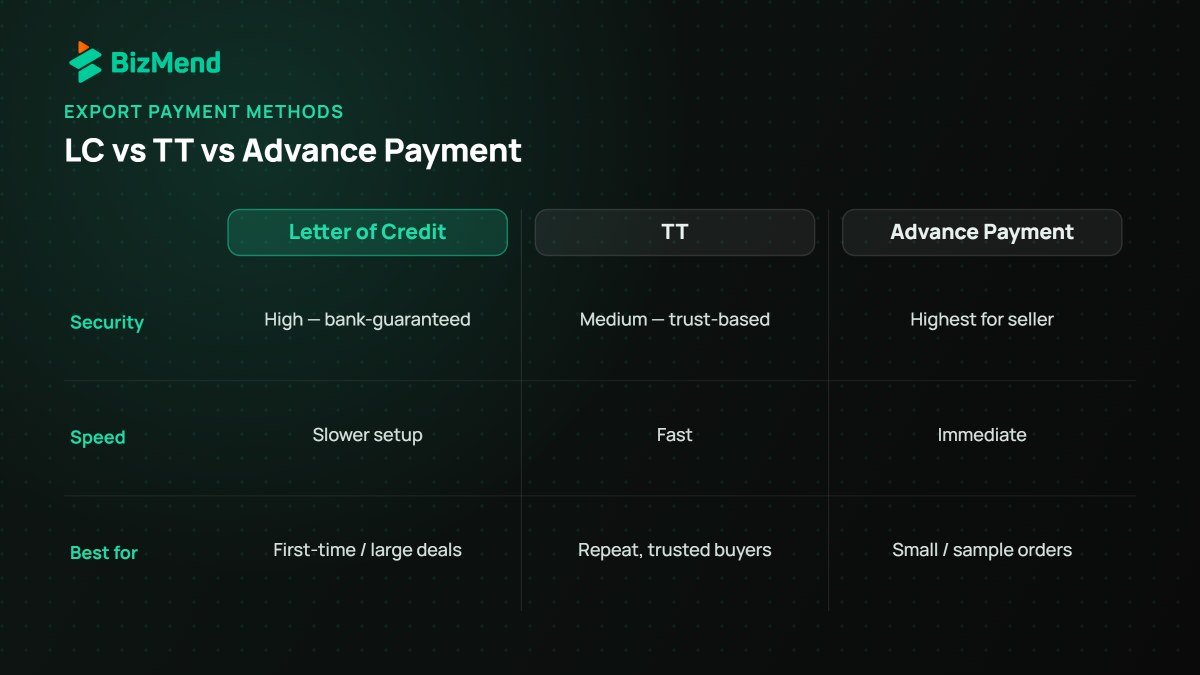
Letter of Credit (LC)
The safest option for new exporters. An LC is a bank guarantee that the buyer’s bank will pay you once you submit the correct documents. It protects both sides. For your first exports, insist on LC. Don’t negotiate this away to win a buyer.
Telegraphic Transfer (TT)
A direct bank transfer. Faster and simpler than LC, but you’re relying on the buyer’s goodwill. TT is common once you’ve built a track record with a specific buyer. Some exporters do 30% advance TT and 70% TT after shipment as a middle ground.
Advance Payment
The buyer pays before shipment. Best for you, but buyers won’t agree to full advance unless they already trust you. You might get this with long-term repeat clients.
One additional note: some exporters find it useful to set up a US business entity to receive international payments through Stripe or PayPal, especially for digital services alongside physical exports.
Step 7: Customs Clearance and Shipping
You’re almost there. Now you actually need to move the goods.
Work with a C&F Agent and Freight Forwarder
A Clearing and Forwarding (C&F) agent handles customs clearance at the port on your behalf. A freight forwarder books your container and manages logistics from your warehouse to the port.
For your first few shipments, don’t try to handle customs yourself. The documentation is detailed and errors are expensive. Hire a licensed C&F agent.
Chittagong Port and Air Freight
Over 90% of Bangladesh’s trade moves through Chittagong Port (Chattogram Port), about 240 km southeast of Dhaka. Sea freight to major European ports takes roughly 20 to 30 days.
Hazrat Shahjalal International Airport (HSIA) in Dhaka handles air freight. Transit to the US or Europe is 2 to 5 days by air, but costs are much higher per kilogram. Good for samples and urgent orders.
Build in buffer time. Most Bangladeshi manufacturers need 60 to 120 days from order placement to shipment. Make sure your buyer knows this before they confirm the order.
Get Your Bank Realization Certificate (BRC)
After your buyer pays and the foreign currency arrives in your account, collect a Bank Realization Certificate (BRC) from your bank. It confirms you received foreign currency for your export. You’ll need it for export cash incentives, duty drawback, and tax filings.
Key Insights
- The ERC is legally required, full stop. Apply online at olm.ccie.gov.bd. Cost is BDT 11,500 (with VAT) for new registration. Renew annually. Without it, banks won’t process your export payments and customs won’t clear your goods.
- Sole proprietors don’t need RJSC registration to export. A trade license, TIN, VAT, bank account, and chamber membership are enough for a sole proprietor or partnership to apply for an ERC. RJSC registration is only required when forming a Private Limited Company.
- The ERC application is now fully online. Since July 2019, CCI&E’s Online Licensing Module (OLM) at olm.ccie.gov.bd handles everything. Create an account, upload documents, pay online, submit, and track from your dashboard.
- EXP Form and Bill of Export are two different documents. The EXP Form is certified by your Authorized Dealer bank and guarantees export proceeds repatriation. The Bill of Export (Shipping Bill) is the customs export declaration filed electronically through ASYCUDA World by your C&F agent.
- GSP benefits are real but check Bangladesh’s LDC status. Bangladesh graduates from LDC status in November 2026. The EU has a 3-year transition period to November 2029. Other markets may apply MFN tariffs from November 2026. Verify destination-specific tariff status before quoting buyers.
- LC is the smartest payment method for beginners. A Letter of Credit gives you a bank guarantee of payment. Don’t trade it away to seem flexible. Once trust is established with a buyer, you can move to TT arrangements.
- Annual renewals are not optional. Trade license, ERC, and chamber membership all need renewal every year. A lapsed ERC means you can’t legally export until it’s renewed, which can derail active orders.
Frequently Asked Questions
What is the ERC and why do I need it?
The Export Registration Certificate (ERC) is a mandatory license issued by the CCI&E under Bangladesh’s Ministry of Commerce. Without it, banks won’t process your export payments and customs won’t clear your shipment. Apply online at olm.ccie.gov.bd. Cost: BDT 11,500 (with VAT) for new registration, BDT 8,050 for annual renewal.
Do I need to register with RJSC to get an ERC?
No, not necessarily. Sole proprietors and partnerships can apply for an ERC without RJSC registration, using their trade license, TIN, VAT certificate, bank solvency certificate, and chamber membership. RJSC registration is required only when forming a Private Limited Company.
How do I apply for an ERC in Bangladesh?
Apply online through CCI&E’s Online Licensing Module (OLM) at olm.ccie.gov.bd. Create an account, select ERC, fill the application form, upload scanned documents, pay online, and submit. Track your status from your OLM dashboard. Processing takes 7 to 15 working days. The ERC is issued digitally and downloaded from your account.
How much does it cost to start an export business in Bangladesh?
Key fees: trade license (BDT 5,000 to 20,000 by location), TIN registration (free), VAT registration (free), chamber membership (varies by association), ERC registration (BDT 11,500 with VAT). Add RJSC company registration costs if forming a private limited company. A realistic all-in budget for the registration phase is BDT 60,000 to BDT 1,50,000.
How do I find international buyers for my products?
Use multiple channels. The EPB’s Trade Information Centre gives access to Trade Map, a buyer database by product and country. List on B2B platforms like Alibaba and Global Sources. Attend international trade fairs in your sector. Use LinkedIn to reach sourcing managers directly. Contact Bangladesh Missions in your target countries for local buyer introductions.
Will Bangladesh’s LDC graduation affect my GSP export benefits?
Yes, eventually. Bangladesh graduates from LDC status in November 2026. The EU has offered a 3-year transition period keeping EBA duty-free access until November 2029. Other markets like India, Turkey, and Australia may apply MFN tariffs from November 2026. Before quoting buyers and pricing in their import duties, verify the current tariff status for your specific product and destination country.
What is the difference between the EXP Form and the Bill of Export?
They are two different documents serving different purposes. The EXP Form is issued and certified by your Authorized Dealer (AD) bank under the Foreign Exchange Regulation Act. It’s a Bangladesh Bank foreign exchange control document guaranteeing repatriation of export proceeds within 4 months of shipment. The Bill of Export (Shipping Bill) is the customs export declaration your C&F agent files electronically through ASYCUDA World before goods leave Bangladesh.
What payment method should I use as a first-time exporter?
Insist on a Letter of Credit (LC) for your first exports. An LC is a bank guarantee that you get paid once you submit the correct documents. It’s the standard in international trade. As you build trust with specific buyers, you can move to TT arrangements or partial advance payment.
Do I need a freight forwarder or C&F agent?
You’re not legally required to hire one, but in practice, yes. A C&F agent handles customs clearance at the port, and a freight forwarder manages container booking and logistics. For new exporters, handling customs documentation alone is a high-risk move. A reputable C&F agent typically charges BDT 5,000 to 15,000 per shipment.
What are the top products to export from Bangladesh?
Ready-made garments dominate (over 81% of FY2024-25 total exports, earning $39.35 billion). Strong demand also exists for leather products ($1.15 billion in FY2024-25), jute goods, frozen seafood, ceramics, agricultural produce, handicrafts, and pharmaceuticals.
Can foreigners start an export business in Bangladesh?
Yes. Foreign nationals can register a company in Bangladesh and apply for an ERC. A foreign-owned company must meet the same documentation and compliance requirements as local companies. For a complete breakdown, see this guide to starting a business in Bangladesh as a foreigner.
Final Thoughts
Look, exporting from Bangladesh in 2026 is more accessible than it’s ever been. $48.28 billion shipped last fiscal year, 8.58% up from the year before. The OLM portal means you can apply for your ERC from your desk. And international buyers are actively looking for new Bangladeshi suppliers beyond garments.
But here’s what I’d say to someone starting today: don’t wait for everything to be perfect. Get your ERC. Find one buyer. Ship one clean order. That first shipment teaches you more than any guide can.
Important Information
[COMPLIANCE-ADDED DISCLAIMER — REVIEW BEFORE PUBLISH]
This article is for general informational purposes only and does not constitute legal, tax, or financial advice. Information is current as of the published date but laws, fees, and procedures change. Consult a qualified professional before making decisions about your specific situation.
The tax information in this article describes general concepts that may not apply to your specific tax situation. Tax laws, rates, deadlines, and reporting requirements change frequently and vary by jurisdiction and circumstance. Consult a licensed Certified Public Accountant (CPA), Enrolled Agent (EA), or tax attorney before acting on any tax matter. Bizmend is not a tax preparer or tax advisor.
This article describes general legal concepts and procedures for educational purposes only. It does not constitute legal advice, and reading it does not create an attorney-client relationship with Bizmend. Laws vary by jurisdiction, change over time, and depend on individual facts. Consult a licensed attorney in the relevant jurisdiction before acting on any legal matter.
Banking products, fees, eligibility requirements, and processing times described in this article are set by individual banks and financial institutions and are subject to change without notice. Always verify current terms directly with the bank or institution before applying. Eligibility for any banking product depends on your individual circumstances and the institution’s discretion. Bizmend does not guarantee approval or specific banking outcomes.
This article discusses business formation matters only. Forming a business entity does not in itself confer immigration benefits, visa eligibility, residency rights, or work authorization. Immigration matters require qualified guidance — consult a licensed immigration attorney for any visa, residency, or immigration-related decisions. Bizmend is not an immigration service.