
 by Sheikh Ornob
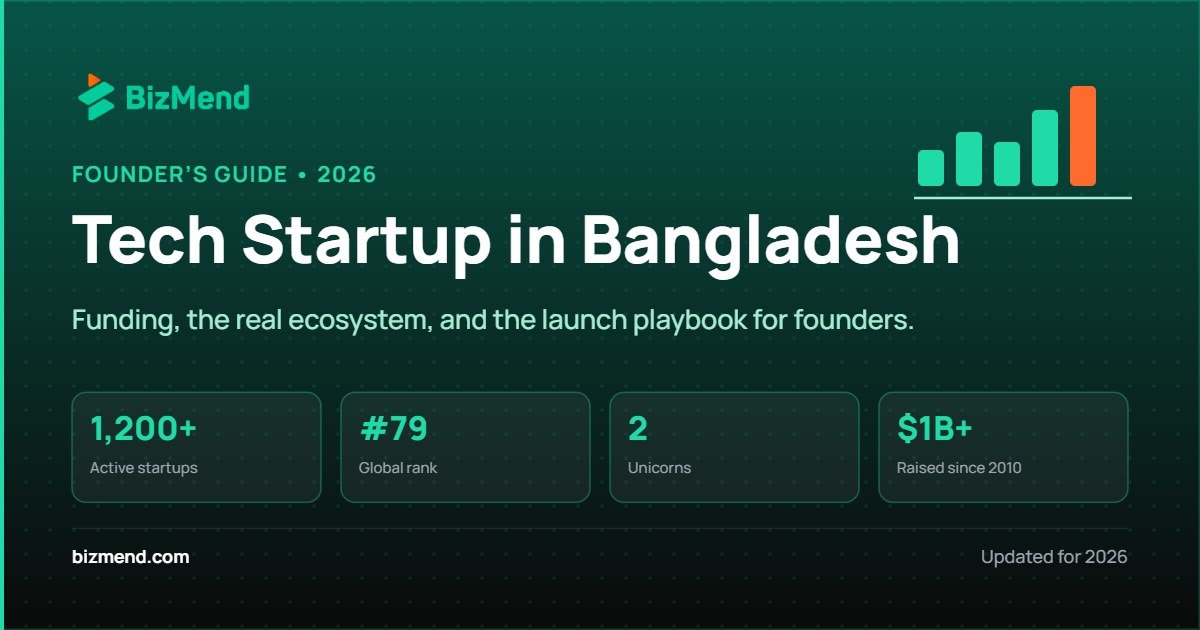
Quick answer: A tech startup in Bangladesh operates inside a maturing but cautious ecosystem of 1,200+ companies that have raised over $1 billion since 2010. In 2025 the market raised about $124M across 12 deals, mostly from a single ShopUp–Sary deal. Bangladesh ranks #79 in the Global Startup Ecosystem Index 2025. Strong sectors: fintech, logistics, B2B commerce, agritech, and AI.
Bangladesh has 1,200+ active tech startups, two unicorns, and a story that’s a lot messier than the LinkedIn posts suggest. Funding peaked at $434M in 2021. Last year? It was $124M, and almost all of it came from a single deal. So is launching a tech startup in Bangladesh smart in 2026, or are you walking into a slowdown? Honest answer: it depends on what you’re building, how you fund it, and whether you understand the real ecosystem. This guide gives you the numbers, the players, and the founder playbook, no fluff.
The State of the Bangladeshi Tech Ecosystem in 2026
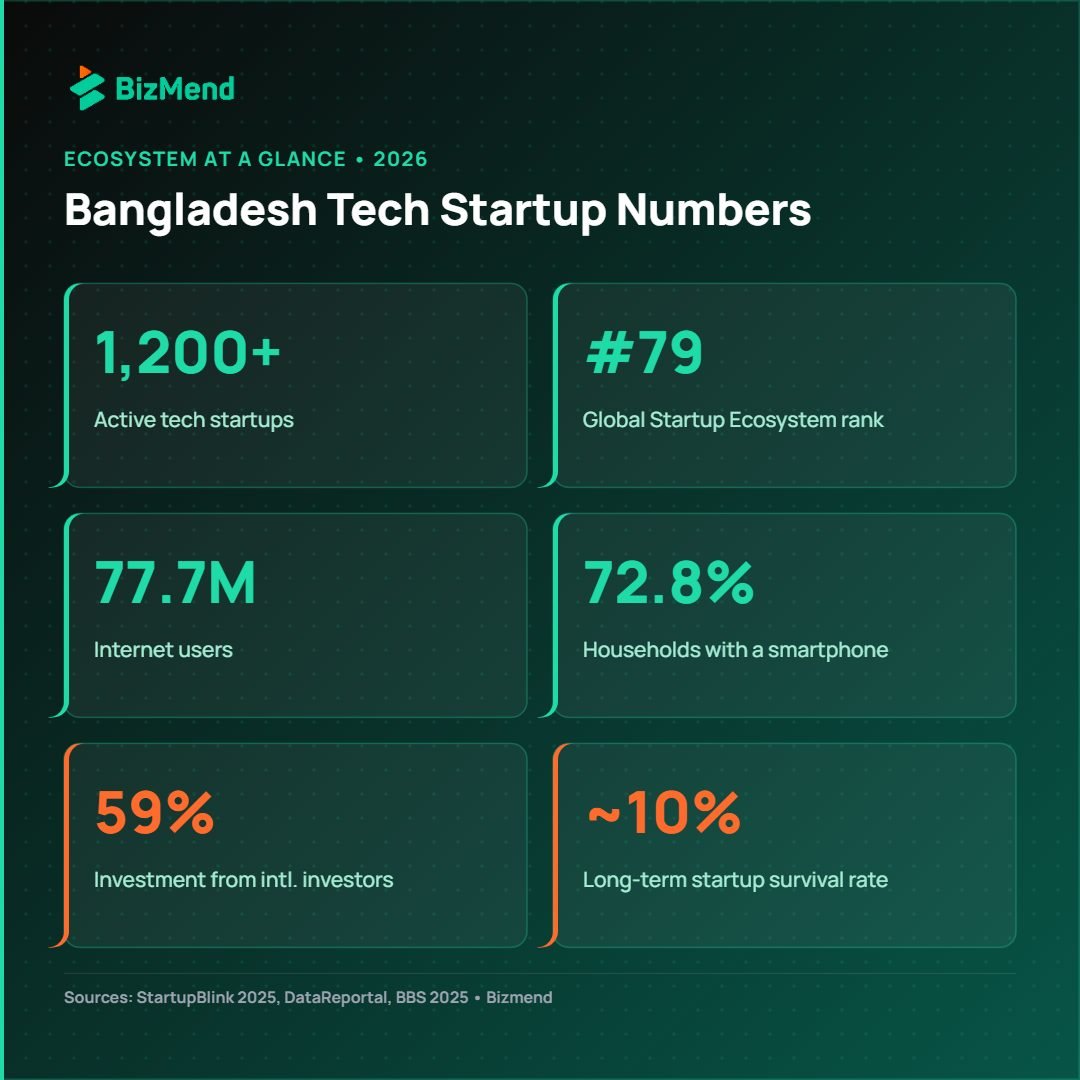
Bangladesh sits at #79 on StartupBlink‘s Global Startup Ecosystem Index 2025, up four spots from the previous year, and #4 in South Asia. The country has 170 million people, a median age of 26.0, and 77.7 million internet users at the start of 2025 (44.5% penetration, per DataReportal). Smartphone adoption hit 72.8% of households in the latest BBS survey. That’s the demand side, and it’s strong.
The supply side is where things get interesting. Around 1,200 active startups have raised roughly $1 billion in cumulative funding since 2010, with 1.5 million jobs created along the way. Two companies have crossed unicorn status: bKash (mobile financial services, backed by SoftBank’s $250M round in 2021) and Nagad (the most recent addition).
But the boom slowed hard. The 2021 peak of $434M across 94 deals collapsed to $42M across 41 deals in 2024, and only 12 deals closed in 2025. So the ecosystem is real, but it’s in a correction phase. Founders launching now are doing it in a buyer’s market for talent and a tougher market for capital.
If you’re based abroad and weighing this market, the basics of starting a business in Bangladesh as a foreigner apply to tech founders too, just with a few extra layers we’ll cover below.
How the Funding Numbers Actually Break Down
Here’s the part most articles get wrong. The headline “$124M raised in 2025” reads like recovery. It isn’t.
According to LightCastle Partners‘ H1 2025 report and The Daily Star’s analysis, $110M of that $124M came from a single transaction: a strategic M&A between ShopUp (Bangladesh’s B2B commerce platform) and Saudi-based Sary, which formed SILQ Group. That’s 89% of the year’s funding from one deal. Series B+ contributed about $4.5M, Seed about $4.2M, Pre-Seed just $60K. Pre-Series A and Series A? Zero deals reported in H1 2025.
| Year | Total Funding | Deals | Notable Detail |
| 2021 | ~$434M | 94 | bKash $250M from SoftBank |
| 2024 | ~$42M | 41 | Broad slowdown, smaller checks |
| 2025 | ~$124M | 12 | $110M ShopUp–Sary M&A only |
Global investors have driven 59% of total startup investment in Bangladesh, per ecosystem reports, and that dependency cuts both ways. When global venture funding crashed from $643B in 2021 to $285B in 2023 (Crunchbase), Bangladesh felt it harder than larger ecosystems. Local capital remains thin. Domestic angel networks like Bangladesh Angels are growing, but family offices and institutional money still sit on the sidelines.
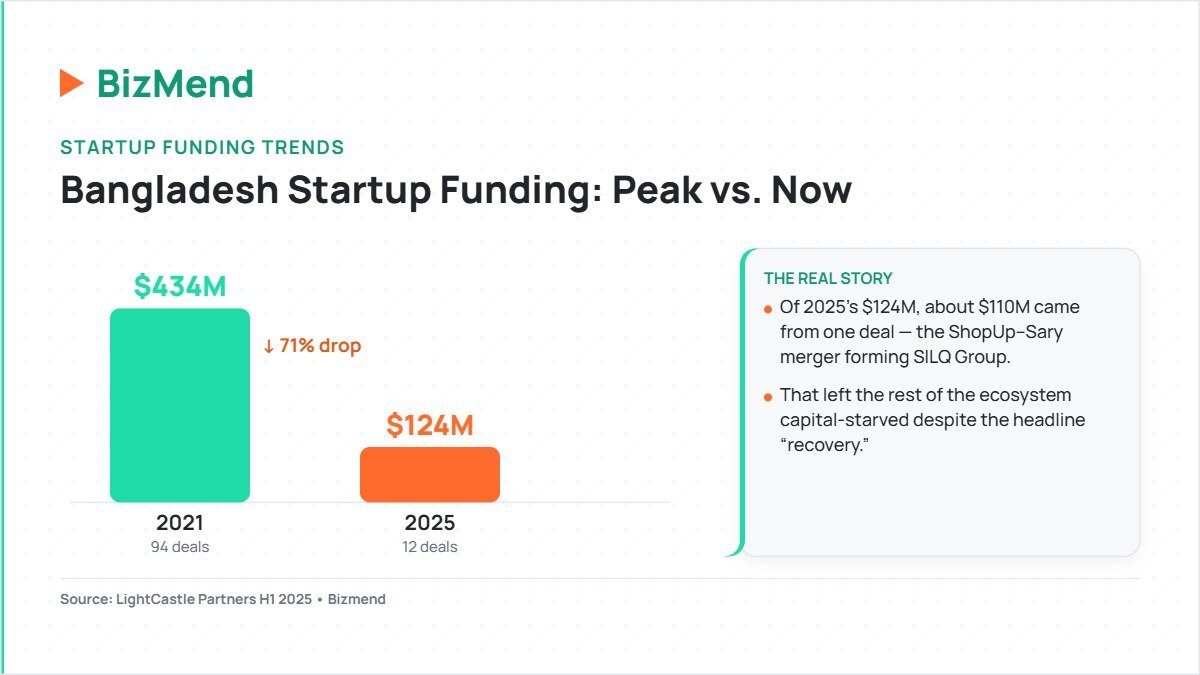
So when someone tells you “Bangladesh raised $124M last year,” ask: from whom, and how concentrated. The answer matters.
The Sectors Where Bangladeshi Startups Are Winning
Not every category is healthy. These are.
Fintech: bKash and Nagad Lead the Pack
bKash is still Bangladesh’s flagship startup story. Subsidiary of BRAC Bank, equity partners include IFC, Bill & Melinda Gates Foundation, and SoftBank. It’s the country’s first unicorn and has effectively become national infrastructure for digital payments. Nagad, the second unicorn, scaled by partnering with the Bangladesh Post Office, hitting massive distribution in rural areas where traditional banking is thin. Newer fintech players like Apon Wellbeing (which raised $1.5M led by Startup Bangladesh) target industrial workers and the unbanked.
Logistics and Mobility: Pathao’s Quiet Empire
Pathao started in 2015 as a courier service, pivoted to ride-hailing, and now runs a super-app spanning rides, food delivery, parcel, and digital credit (Pathao Pay). Founded by Hussain Elius, Shifat Adnan, and the late Fahim Saleh, the company has raised over $50M, expanded to Nepal (operating in 22 cities there plus 64 districts in Bangladesh), and is profitable. Pathao is the #1 courier delivery company in the country, and a clear case study in how operational depth beats flashy tech in emerging markets. Paperfly, also in last-mile logistics, covers union-level delivery across the entire country.
B2B Commerce and E-commerce: ShopUp, Chaldal, PriyoShop
ShopUp, founded by Afeef Zaman, raised close to $200M from Valar Ventures, Prosus, and Tiger Global before merging with Saudi Arabia’s Sary in 2025 to form SILQ Group. Chaldal, the online grocery pioneer founded by Waseem Alim, raised about $40M between 2015 and 2025 and grew to $55M annual revenue at its peak during COVID. (Chaldal also publicly struggled with payroll in 2025, a sobering reminder that “scale” doesn’t equal “safe.”) PriyoShop runs a B2B marketplace connecting micro-merchants directly to brands, fixing a fragmented retail supply chain that handles 97% of Bangladesh’s retail transactions through small shops.
AgriTech: iFarmer Leading the Way
iFarmer, co-founded by Fahad Ifaz and Jamil Akbar, is the standout in agritech. The platform gives smallholder farmers access to financing, quality inputs, and market connections, addressing a sector that still employs 40% of the population. iFarmer raised a $2.1M round in 2022 from Startup Bangladesh and global impact investors, and has built measurable rural penetration. Fashol, an iDEA-backed agri-startup, focuses on direct farm-to-retailer logistics.
HealthTech and EdTech: Praava, Arogga, 10 Minute School
Praava Health built premium tech-enabled clinics that serve urban consumers wanting healthcare on par with international standards. Arogga delivers prescription and OTC medicine to your door, currently the leading on-demand pharma app. ToguMogu serves over 200,000 parents with personalized parenting and pregnancy support. On the edtech side, 10 Minute School (founded by Ayman Sadiq) has become Bangladesh’s largest online learning platform with millions of students, though it’s also been through public funding setbacks.
AI and SaaS: The New Wave
This is where 2026 gets interesting. AI startups now make up 15% of new ventures forming in Bangladesh, per ecosystem analysis. Markopolo AI builds AI-powered ad optimization. Hishab Technologies builds a telephony-driven generative AI platform (Startup Bangladesh invested BDT 2 crore in 2024). Alice Labs is a global SaaS for AI-driven sales and customer support, also backed by Startup Bangladesh. Dana provides AI credit scoring for unbanked populations. If you’re building a B2B SaaS targeting Bangladesh, this is your peer group.
If you’re a foreign founder eyeing one of these sectors, also look at the broader industries in Bangladesh open for foreign investment for context on incentives and entry points.
How to Launch a Tech Startup in Bangladesh, Step by Step
This is the part most “ecosystem reports” skip. Here’s the actual playbook.
Step 1: Validate the Local Problem with Real Customers
Bangladesh punishes founders who copy Silicon Valley playbooks. The successful companies above all built infrastructure-first, not app-first. Pathao didn’t start with ride-hailing, it started with delivery, because that was the broken thing. Chaldal didn’t enter a healthy grocery market, it entered one with no working last-mile, and they built warehouses before apps. HungryNaki beat Foodpanda in early years because they understood Dhaka’s restaurant operators better, not because their tech was prettier.
So before you write a line of code, do this: spend 30 days talking to 50 real users. In their language. In their neighborhoods. Find out what they pay for now and what they hate about it. iFarmer’s founders spent months with farmers in rural Bangladesh before designing their product. That’s why it works.
Step 2: Register Your Bangladesh Entity
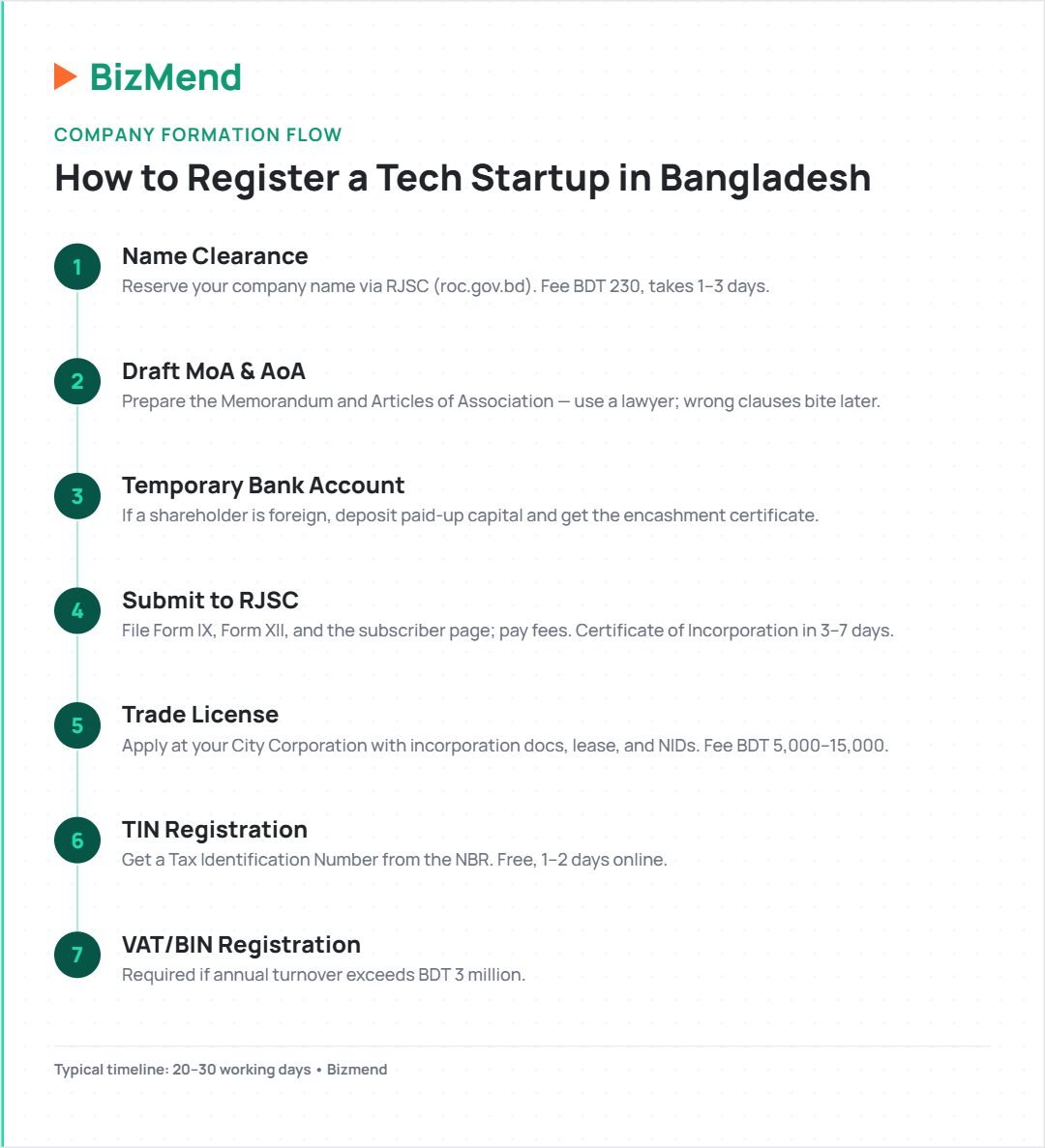
Most Bangladeshi tech startups operate as a Private Limited Company under the Companies Act 1994. Here’s the actual sequence:
1. Name clearance from RJSC (Registrar of Joint Stock Companies). Online via roc.gov.bd, fee BDT 230, takes 1–3 days.
2. Draft MoA and AoA (Memorandum and Articles of Association). Get a lawyer; templates exist but the wrong clauses bite later.
3. Open a temporary bank account if any shareholder is foreign, deposit paid-up capital, get the encashment certificate.
4. Submit to RJSC with Form IX, Form XII, subscriber page, and pay stamp duty plus registration fees. Receive your digital Certificate of Incorporation in 3–7 working days.
5. Trade License from your local City Corporation. You need: a copy of your incorporation certificate, MoA/AoA, lease agreement for your office, NID copies of directors, and passport-size photos. Fee varies by area, usually BDT 5,000–15,000.
6. TIN (Tax Identification Number) from the National Board of Revenue. Bring your incorporation documents, trade license, and director NIDs. Free, takes 1–2 days online.
7. VAT/BIN registration if your turnover exceeds BDT 3 million annually.
Total realistic timeline: 20–30 working days. Total minimum cost: roughly $1,500–$3,000 USD if you’re lean, more if you use a full-service firm. Different company structures available in Bangladesh exist (branch office, joint venture, PLC), but for tech founders the Private Limited is almost always the answer.
Step 3: Set Up a US C-Corp or Singapore HoldCo for International Capital
This is the step almost every successful Bangladeshi tech founder eventually takes, and the one local advisors won’t push you toward early enough.
Hussain Elius, Pathao’s founder, has written publicly about why he wishes someone had told him this in 2015: Bangladeshi corporate law doesn’t support multiple share classes, employee stock option pools, or the convertible-note structures that international VCs require. Investors and their lawyers don’t want to read Bangladesh law. They want clean Delaware C-Corp paper or a Singapore Pte Ltd they recognize.
So most international-backed Bangladeshi startups (Pathao, ShopUp, Chaldal) are structured with a holding entity in Delaware or Singapore, with the Bangladeshi entity as an operating subsidiary. Doing this early costs around $1,000–$3,000. Doing it during a funding round costs months and tens of thousands in legal fees, plus a stalled deal.
Singapore is often preferred for lower corporate taxes and neutrality (some Chinese investors won’t touch a US HoldCo). The US C-Corp is what Y Combinator and most American VCs want. If you’re going the Delaware route, services exist to help you register a US C-Corp from Bangladesh remotely, including EIN, registered agent, and US bank account.
Step 4: Tap the Right Funding Sources
You have more options than you think, and they stack:
- Startup Bangladesh Limited is the government-backed VC under the ICT Division, with an allocated BDT 500 crore (~$45M USD) fund. It writes checks of BDT 25 lakh to BDT 5 crore (roughly $25K to $500K) into seed and growth-stage startups. From September 2024 to January 2025 alone, it deployed BDT 11.10 crore across nine companies including 10 Minute School, ShareTrip, and Sheba Platform.
- iDEA Project grants under the ICT Division offer up to BDT 10 lakh (~$10K) for early-stage ideas. Less paperwork, no equity dilution.
- Bangladesh Angels is the country’s first formal angel network, writing $10K–$100K checks. Founded to fix the gap between bootstrap and Series A.
- Local VCs include Bangladesh Venture Capital, BD Venture, SBK Tech Ventures (women-led, with Silicon Valley connections), DIVC, and Anchorless Bangladesh (NY-based, focused on Bangladesh).
- International VCs active here include Y Combinator (Chaldal), Tiger Global (ShopUp), Valar Ventures (ShopUp), Prosus, Omidyar Network, and Anchorless. They mostly invest into your foreign HoldCo.
- Bank loans and NBFI options exist for revenue-stage companies. Several non-bank financial institutions like IDLC and IPDC offer SME-friendly products, though valuation-based startup lending is still rare.
Step 5: Build Lean and Survive the First 24 Months
Office costs eat early-stage runway fast in Dhaka. Many founders skip the Gulshan/Banani office altogether and use co-working spaces (Hubdhaka, Moar, Sailor) for 6–12 months, then move into Bangladesh Hi-Tech Parks, which offer subsidized rent, tax holidays, and incubation support specifically for ICT, AI, and software startups. iFarmer scaled for years from a small shared office before raising. So did ShareTrip.
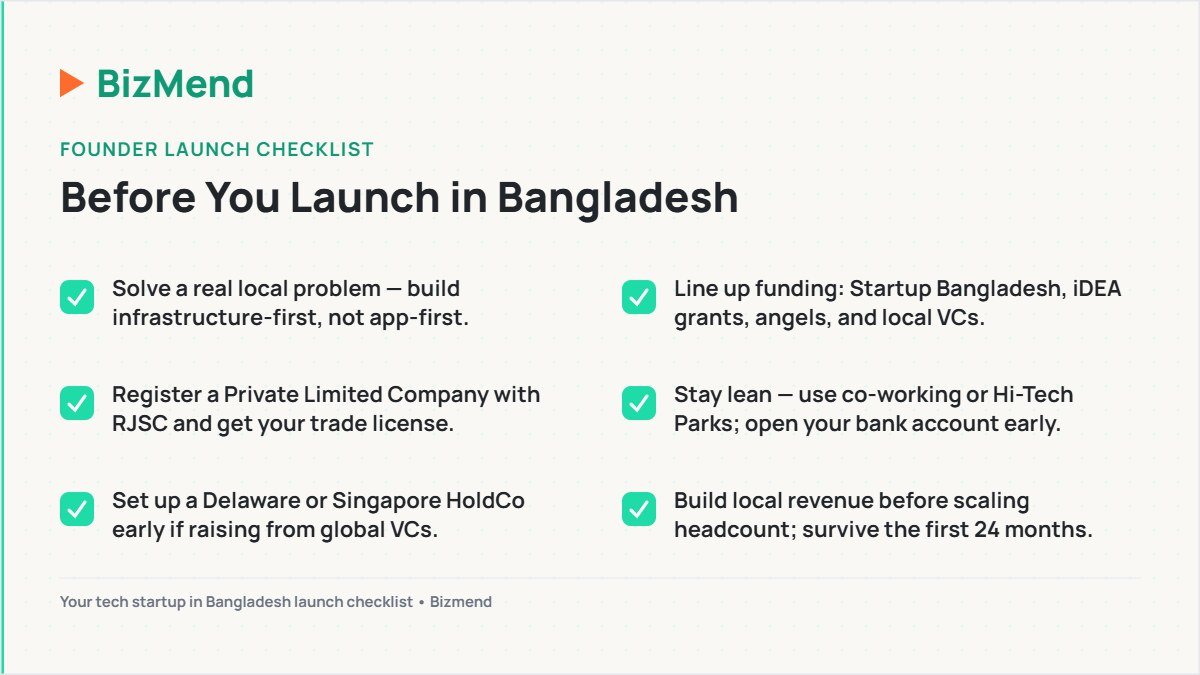
Open your operational bank account early. Some founders waste weeks because they didn’t expect the documentation back-and-forth. The full process for opening a business bank account in Bangladesh is more straightforward when you’ve got your incorporation, trade license, TIN, and director NIDs in one folder before you walk in.
Real Challenges Founders Are Beating Right Now
- Capital scarcity at pre-Series A. The “missing middle” is the gap between $50K seed and $2M Series A. Founders close it by raising bridge rounds from angels, doing revenue-funded growth, or co-investing with Startup Bangladesh.
- Talent shortage in senior product/engineering roles. Companies like Pathao and bKash absorbed most of the experienced talent. Newer startups solve this by hiring smart juniors and bringing back NRBs (non-resident Bangladeshis) for senior roles.
- Regulatory uncertainty. Fintech in particular is heavily watched by Bangladesh Bank. Startups like bKash and Apon work directly with regulators from day one rather than asking forgiveness later.
- Infrastructure gaps. Power, internet, and traffic still slow execution. Hi-Tech Parks solve part of this. Remote-first cultures solve more of it.
- Currency and repatriation risk. Foreign investors worry about getting profits out. The Singapore/Delaware HoldCo solves most of this.
Why Only 1 in 10 Startups Survive
The survival rate hovers around 10%, per ecosystem reports. Common patterns I’ve watched in failed Bangladeshi startups:
- Premature scaling. Hiring 30 people before product-market fit. Chaldal expanded aggressively during COVID, then couldn’t sustain payroll when revenue normalized.
- Foreign capital dependency without domestic revenue. When global VC dried up post-2022, companies that hadn’t built durable local revenue had nothing to fall back on.
- Wrong corporate structure. Founders who didn’t set up a Delaware/Singapore HoldCo at incorporation lost months and deals during fundraising.
- Founder disputes. Equity splits without vesting, founders without operating agreements. Boring problems, fatal outcomes.
- Building for the top 5%. Bangladesh’s premium urban segment is small. Real scale lives in tier-2 cities and rural markets, and most app-first founders never go there.
Key Insights
- Bangladesh’s tech ecosystem ranks #79 globally on StartupBlink’s 2025 index and #4 in South Asia, with 1,200+ active startups and roughly $1B raised since 2010.
- The 2025 funding “recovery” was mostly one deal. Of $124M raised across 12 deals, $110M came from the ShopUp–Sary merger forming SILQ Group, leaving the rest of the ecosystem capital-starved.
- International investors drive 59% of total startup investment, which means founders who structure with a Delaware C-Corp or Singapore HoldCo from day one save months during fundraising.
- bKash and Nagad are the only two unicorns, both in mobile financial services, while Pathao, Chaldal, and ShopUp lead the next tier across logistics, e-commerce, and B2B.
- Government funding is real and underused. Startup Bangladesh Limited writes BDT 25 lakh to BDT 5 crore checks, and the iDEA Project offers grants up to BDT 10 lakh for early-stage ideas.
- Smartphone penetration jumped to 72.8% of households per BBS 2025 data, and 77.7M Bangladeshis use the internet, giving founders a real digital base to build on.
- Only about 1 in 10 startups survive long-term, mostly due to premature scaling, foreign capital dependency, and wrong corporate structure at incorporation.
Frequently Asked Questions
Is it a good time to launch a tech startup in Bangladesh in 2026?
Yes, if you’re capital-efficient and solving a real local problem. The funding environment is tighter than 2021’s peak, but talent is more available, customer acquisition is cheaper, and the surviving startups now have proven playbooks. Expect 18–24 months of bootstrapping or angel-funded growth before serious institutional money becomes realistic.
How much money do I need to start a tech startup in Bangladesh?
For a Private Limited Company registration plus basic operations, plan for $1,500 to $3,000 USD just for setup costs (RJSC fees, legal, trade license, TIN, basic office). Realistic 12-month runway with 3–4 people: $30,000–$60,000. If you want a Delaware C-Corp HoldCo, add $1,000–$3,000 in formation costs.
Can foreigners start a tech startup in Bangladesh?
Yes. Bangladesh allows 100% foreign ownership for most tech businesses. You’ll need at least two shareholders and two directors (foreign nationals are fine), an RJSC-registered company, BIDA registration if bringing in foreign capital, a trade license, and a local bank account. Hi-Tech Parks specifically welcome foreign tech founders with tax holidays and full profit repatriation.
What are the top tech startups in Bangladesh right now?
The leaders are bKash and Nagad in fintech (both unicorns), Pathao in logistics and ride-hailing, ShopUp (now SILQ Group) in B2B commerce, Chaldal in online grocery, 10 Minute School in edtech, Praava Health and Arogga in healthtech, iFarmer in agritech, and rising AI players like Markopolo, Hishab, Alice Labs, and Dana.
How do I get funding from Startup Bangladesh Limited?
Apply directly through startupbangladesh.vc with your pitch deck, financials, and incorporation documents. They invest BDT 25 lakh to BDT 5 crore in seed and growth-stage startups across fintech, agritech, healthtech, and edtech. The fund prefers companies with traction, a local Bangladesh entity, and clear social or economic impact.
Do I need to register my company in the US or Singapore?
Not legally, but practically yes if you plan to raise from international VCs. Most successful Bangladeshi startups (Pathao, ShopUp, Chaldal) use a Delaware C-Corp or Singapore Pte Ltd as the holding company with the Bangladesh entity as an operating subsidiary. International investors prefer it because they understand the law and standard convertible note structures.
What sectors are best for a tech startup in Bangladesh?
Strong demand right now in B2B SaaS, AI-powered fintech (especially credit scoring and fraud detection), agritech, logistics-tech, healthtech (telemedicine, e-pharmacy), and edtech for skills training. Saturated or risky: consumer e-commerce, food delivery, ride-hailing.
How long does it take to register a tech company in Bangladesh?
Realistically, 20 to 30 working days from name clearance to your trade license being in hand. The RJSC incorporation itself takes 3–7 days once documents are submitted, but trade license, TIN, and VAT/BIN registration add another 2–3 weeks. Using a legal firm cuts a week or two off the timeline.
What is the survival rate of startups in Bangladesh?
About 10%. Most failures happen in the first 24 months, driven by premature hiring, dependency on foreign funding that dried up after 2022, founder disputes, and wrong corporate structure that blocked fundraising. Companies that survive past year three usually have local revenue, a clean cap table, and a Delaware or Singapore HoldCo.
Can a tech startup in Bangladesh become a unicorn?
It has happened twice (bKash and Nagad), and several companies including Pathao and SILQ Group are scaling toward that range. The path is harder than India because the local market is smaller, but cross-border expansion (Pathao’s Nepal play, ShopUp’s Saudi merger) makes regional unicorns plausible. Expect 2–3 more before 2030.
Final Thoughts
Look, building a tech startup in Bangladesh in 2026 is harder than it was in 2021. Foreign money is cautious, deals are rarer, and the headlines are mostly about who’s struggling. But here’s what I keep coming back to: every founder I respect in this country told me their hardest year was the one before their breakthrough. Hussain Elius spent six months just figuring out how to incorporate Pathao properly. Waseem Alim built warehouses before he built apps. The boring work is the work.
If I were starting a tech company in Dhaka next month, I’d validate with 50 customers before writing code, register the local entity and a Singapore HoldCo on day one, and aim for revenue before I aimed for headlines. What sector would you build in?