How to Become a Daraz Seller in Bangladesh: Registration, Fees & Growth
Learn how to become a Daraz seller in Bangladesh, register an account, list products, understand fees, manage orders, and grow…
 by Sheikh Ornob

Learn how education loans in Bangladesh work, what banks check, and how to compare loans, scholarships, student files, and family funding.
Higher study costs can corner a family fast. Education loans in Bangladesh can help, but they’re only one part of a smart funding plan. Before you sign anything, you need to know what the bank is really financing.
Some products cover local university fees. Some support study abroad through a student file. Others are personal loans taken by parents or guardians. That distinction matters because approval, documents, and repayment pressure change with each route before you pay any fee. The goal isn’t to borrow more. It’s to borrow only when the course, repayment plan, and family cash flow can carry the weight.
Let’s keep this practical. There isn’t one single national student loan system where every student applies through the same portal and gets a fixed offer. Bangladesh has bank products, student file services, scholarships, stipends, and family-backed financing routes.
That difference matters. If you search for education loans in Bangladesh, you may find products that are really personal loans for parents. You may also find secured overdraft options against fixed deposits or student file services that help send money abroad but don’t automatically provide new money.
The label says student loan, but the repayment risk usually sits with the family.
So the right question isn’t, “Which bank gives the biggest amount?” The better question is, Which funding route fits your admission plan, cash flow, and repayment comfort? That answer changes for a Dhaka undergraduate program, a private medical college, and a master’s degree in Canada.
Banks tend to look at education costs in pieces. Tuition is the obvious one, but many families forget admission fees, semester fees, lab charges, hostel costs, living expenses, visa costs, health insurance, and currency conversion.
For example, BRAC Bank’s Agami Personal Loan page says the bank may finance up to 130 percent of total tuition fees, with a maximum of BDT 40 lakh and repayment over 12 to 60 months. Prime Bank also lists an education-related personal loan for local education needs, with up to BDT 40 lakh and semester-based disbursement.
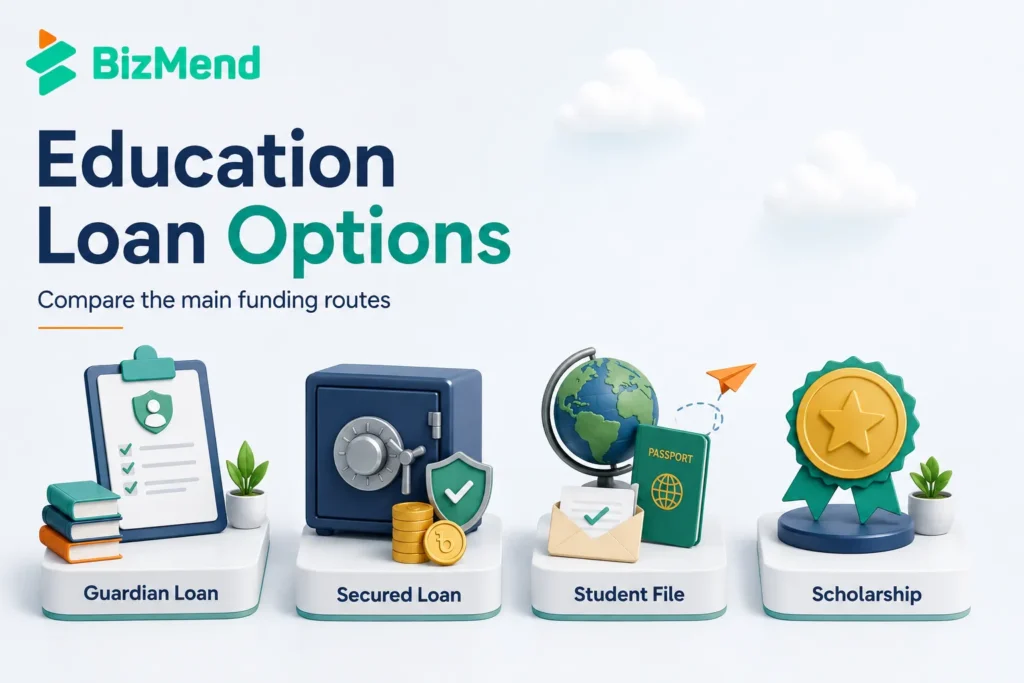
A good comparison starts by separating four routes. They may all support education, but they behave very differently once repayment begins.
| Route | Best Fit | What To Check |
|---|---|---|
| Guardian education loan | Local university or professional course fees | Monthly income, guarantor rules, rate, processing fee, EMI size |
| Secured loan or overdraft | Families with fixed deposits or savings instruments | Margin against deposit, renewal terms, total interest cost |
| Student file with bank support | Study abroad tuition and living expense remittance | Opening fee, documents, AD branch, bank charge, remittance timing |
| Scholarship or stipend | Merit-based or need-based support | Deadline, eligibility, amount, renewal condition, payment timing |
Prime Bank’s student file page lists support up to BDT 20 lakh and a tenor up to 5 years. That doesn’t mean every applicant will receive that amount. Your admission, financer profile, security, income, and bank policy will shape the actual offer.
Ask each bank for the same written details so the comparison is fair. A lower headline rate can still cost more if the processing fee, insurance premium, renewal charge, or early settlement rule is heavier than another offer.
Banks don’t approve education financing because a student has ambition. They approve it when they can see a reliable repayment source. That’s usually a parent, guardian, salaried applicant, professional, or business owner.
If the bank asks for a guarantor, don’t treat it as a formality. A guarantor is taking legal and financial risk. That person should understand the loan amount, EMI, tenure, and what happens if the borrower misses payments.
Families should also check existing debt before adding education debt. A home loan, car loan, credit card balance, or business loan can reduce the amount a bank is willing to approve, even when the admission is strong.
A student file is not the same thing as a loan. It is a banking arrangement used by Bangladeshi students to send tuition and living expenses abroad through formal channels. For overseas education, this can be just as important as the admission letter.
Sonali Bank describes its student file as a service for students abroad that covers tuition remittance, living expense remittance, approval processing, and compliance with Bangladesh Bank foreign exchange rules. EBL, UCB, IFIC, and Bank Asia describe similar study abroad support through authorized banking channels.
For study abroad, the student file solves the money transfer problem, not always the money shortage.
The document list is usually serious. EBL asks for an overseas offer letter, tuition and living expense information, certificates, financer details, bank details, a passport, and a visa copy if available. UCB lists offer letters, fee estimates, transcripts, a passport, a student photo, and the financer’s NID.
Charges are not identical across banks. EBL lists a new student file opening fee of BDT 8,625 and a renewal fee of BDT 7,475. Bank Asia lists Tk. 5,500 for first-time opening and Tk. 5,000 for renewal after one year. Check the latest schedule before you apply.
Borrowing should rarely be the first move. Start with scholarships, stipends, university waivers, department aid, and family savings. Even a small grant can reduce the loan amount and save interest over several years.
The Prime Minister’s Education Assistance Trust lists several education support services. Its e-service page mentions admission assistance for poor and meritorious students, including Tk. 10,000 for undergraduate and equivalent admission support. The trust also lists stipend and fellowship routes, including M.Phil. and PhD fellowship support.
Okay, let’s not make this sound fancier than it is. A scholarship of Tk. 10,000 won’t fund a full private university degree. But it can reduce admission pressure, protect family savings, and lower the amount you need to borrow.
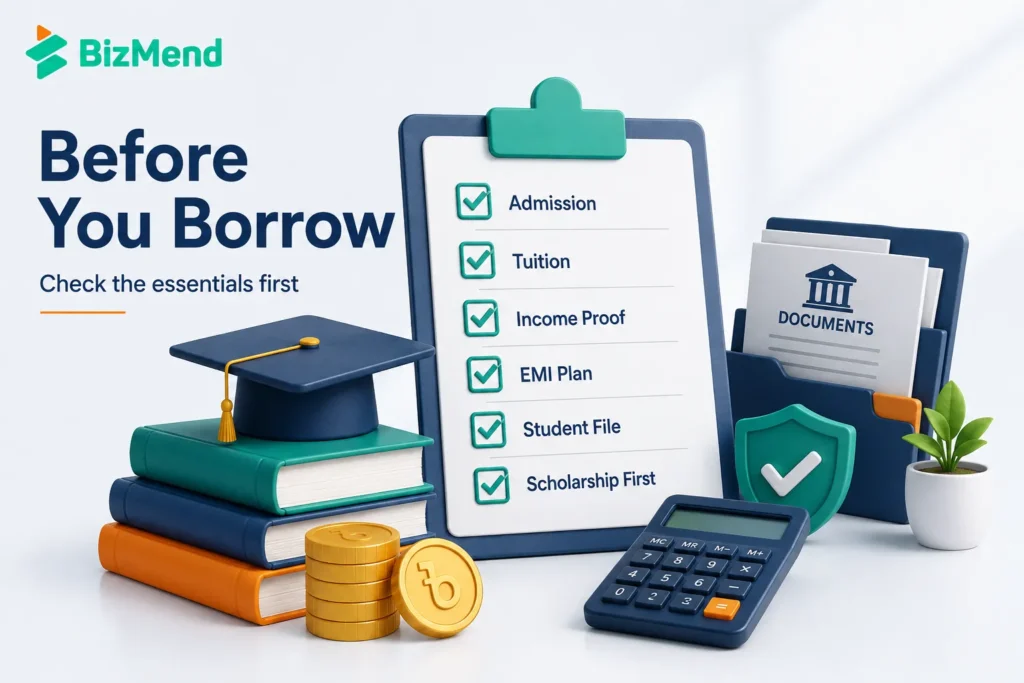
A loan makes sense only if the expected benefit is strong enough and the repayment plan is realistic. The degree should improve earning potential, skill depth, career access, or migration prospects in a way your family can explain in plain words.
Use a simple test before applying. Write the total course cost, expected family contribution, confirmed scholarships, required loan amount, estimated EMI, and expected repayment source on one page. If you can’t explain the numbers to a cautious relative, the plan needs more work.
Private university fees, medical education, and overseas degrees can all be worth financing. But the loan should follow the academic and career plan. It shouldn’t become the reason for choosing a program the family can’t sustain.
Start with the full cost, not the first semester bill. For local study, include admission, semester tuition, transport, books, devices, coaching, exam fees, and emergency costs. For overseas study, add visa fees, airfare, health insurance, rent, food, currency shifts, and bank charges.
This is where many families get trapped. They compare admission prestige, but not repayment pressure. A better plan compares both. The best university option is the one that stays academically strong and financially survivable.
If the student expects part-time income abroad, keep it outside the base repayment plan. Visa rules, job markets, class schedules, and health can change. Treat that income as a bonus, not the foundation of the loan.
The biggest mistake is treating approval as affordability. A bank may approve more than your family should borrow. Your real limit is the EMI your household can pay without cutting essentials or creating constant stress.
Let’s not sugarcoat it. Education debt can be useful, but it can also create years of pressure if the degree choice, household income, and repayment plan don’t match.
Education financing works best when it’s planned, not rushed. Compare loans, scholarships, student files, and savings before committing to fees. Verify current bank terms, keep the loan smaller than the dream, and make sure repayment still works after the excitement of admission fades.
Some banks offer education-related loans, but many are approved based on a parent or guardian’s income. The student may be the beneficiary, while the adult applicant carries repayment responsibility.
Yes, some banks support overseas education through loans, secured facilities, or student file-related services. You should confirm whether the bank is lending money, helping with remittance, or doing both.
A student file is a banking service used to send tuition and living expenses abroad through formal channels. It usually requires an admission letter, cost estimate, passport, financer details, and bank compliance checks.
Scholarships are usually better because they don’t create repayment pressure. Still, they may be limited, delayed, or conditional. Many families use scholarships and savings first, then borrow only for the remaining gap.
Check the interest rate, rate type, processing fee, insurance or hidden charges, EMI, tenure, guarantor rule, early settlement cost, and what happens if payment is delayed.

Learn how to become a Daraz seller in Bangladesh, register an account, list products, understand fees, manage orders, and grow…
by Sheikh Ornob

Compare the cost of living in Bangladesh in 2026, including Dhaka and Chittagong rent, food, transport, utilities, inflation, and monthly…
by Sheikh Ornob
Learn MoA and AoA requirements in Bangladesh, key clauses, drafting basics, RJSC filing steps, amendments, and common company-registration mistakes. Suggested…
by Sheikh Ornob