
You’ve got some savings sitting in a bank account earning almost nothing. Or maybe you’ve heard people talking about FDR and you’re wondering if it’s actually worth it. Good news: an FDR in Bangladesh is one of the simplest, safest investments you can make. FDR has low market risk and fixed-return clarity, but bank risk, inflation risk, tax, and early-withdrawal rules still matter. But with dozens of banks competing for your money, the rate differences are real, the tax rules matter, and picking the wrong bank can cost you. This guide covers all of it, including which bank actually offers the most right now.
Quick Answer: An FDR (Fixed Deposit Receipt) in Bangladesh is a savings instrument where you deposit a lump sum with a bank for a fixed period at a fixed interest rate. In 2026, FDR rates remain elevated, but the exact rate varies by bank, tenure, deposit amount, and product type. Bangladesh Bank kept the policy/repo rate at 10% for January-June FY26. Tax is deducted at source from FDR interest under applicable NBR rules. For individual depositors, the rate is commonly treated as 10%, while different depositor types may face different rates; confirm the latest rate with the bank or NBR before opening.
What Is an FDR in Bangladesh?
FDR stands for Fixed Deposit Receipt. It’s the official document a bank gives you when you lock a lump sum for a set period at a pre-agreed interest rate. In Bangladesh, people use “FDR” and “fixed deposit” interchangeably, but technically the FDR is the receipt confirming your deposit.
Here’s the simple version: you hand the bank a lump sum. The bank locks it for your chosen period (anywhere from 1 month to 5 years at most banks). At maturity, you get your money back plus interest. The rate is fixed from day one, so no surprises.
It’s not the flashiest investment. But it’s one of the most reliable ones in Bangladesh, and honestly, for most people that matters more than chasing high returns. Understanding the full range of types of bank accounts in Bangladesh helps you see where FDR fits in relation to savings accounts, DPS, and other deposit products.
How Does an FDR Actually Work?
Opening an FDR is straightforward. You choose an amount, a tenure, and a payout preference. The bank locks the rate, issues you an FDR certificate (now often digital), and the clock starts.
You can’t partially withdraw. If you need some money in an emergency, you can’t take out half. It’s all or nothing. Break it early, and you’ll typically get interest at the savings account rate for the period you held it, not the FDR rate.
Auto-renewal is your friend. Most banks offer an auto-renewal option. At maturity, the bank rolls over your FDR for the same tenure at whatever rate is current. If you want to change anything, you need to act before maturity.
Choosing Your Tenure
Banks in Bangladesh generally offer FDR tenures of 1 month, 3 months, 6 months, 1 year, 2 years, 3 years, and 5 years. Tenure-wise rates vary by bank, and longer tenures do not always offer the highest rate. Right now, with rates elevated due to Bangladesh Bank’s tight monetary policy, locking in a longer tenure can protect you from rate drops later.
Monthly Profit FDR vs. Lump-Sum at Maturity
Most guides skip this, but it matters. You have two main payout options at most Bangladeshi banks.
Monthly Profit Scheme FDR: Your interest is calculated annually but paid to your linked account every month. Good if you want regular income. Retirees love this option.
Maturity FDR: You get both your principal and all interest in one shot at the end of the tenure. The interest may compound more favorably depending on the bank’s calculation method. Ask the bank whether they calculate on 360 or 365 days, as it affects your actual return.
Fixed Deposit Interest Rate in Bangladesh 2026
Rates are genuinely the highest they’ve been in years. Bangladesh Bank kept the policy/repo rate at 10% in its January-June FY26 monetary policy, as inflation remained above target. That pushed commercial banks to compete aggressively for deposits, and the FDR rate in Bangladesh reflects that competition directly.
Important note: FDR rates change frequently. Every bank updates them based on treasury conditions and Bangladesh Bank policy. The ranges below reflect broadly accurate market conditions as of early 2026, per Arthik Alap’s December 2025 market review and other current sources. Always verify the exact rate directly with your bank before opening.
| Tenure | Approximate Rate Range (2026) |
|---|---|
| 1 month | 6% to 8% p.a. |
| 3 months | 7% to 9% p.a. |
| 6 months | 8% to 10% p.a. |
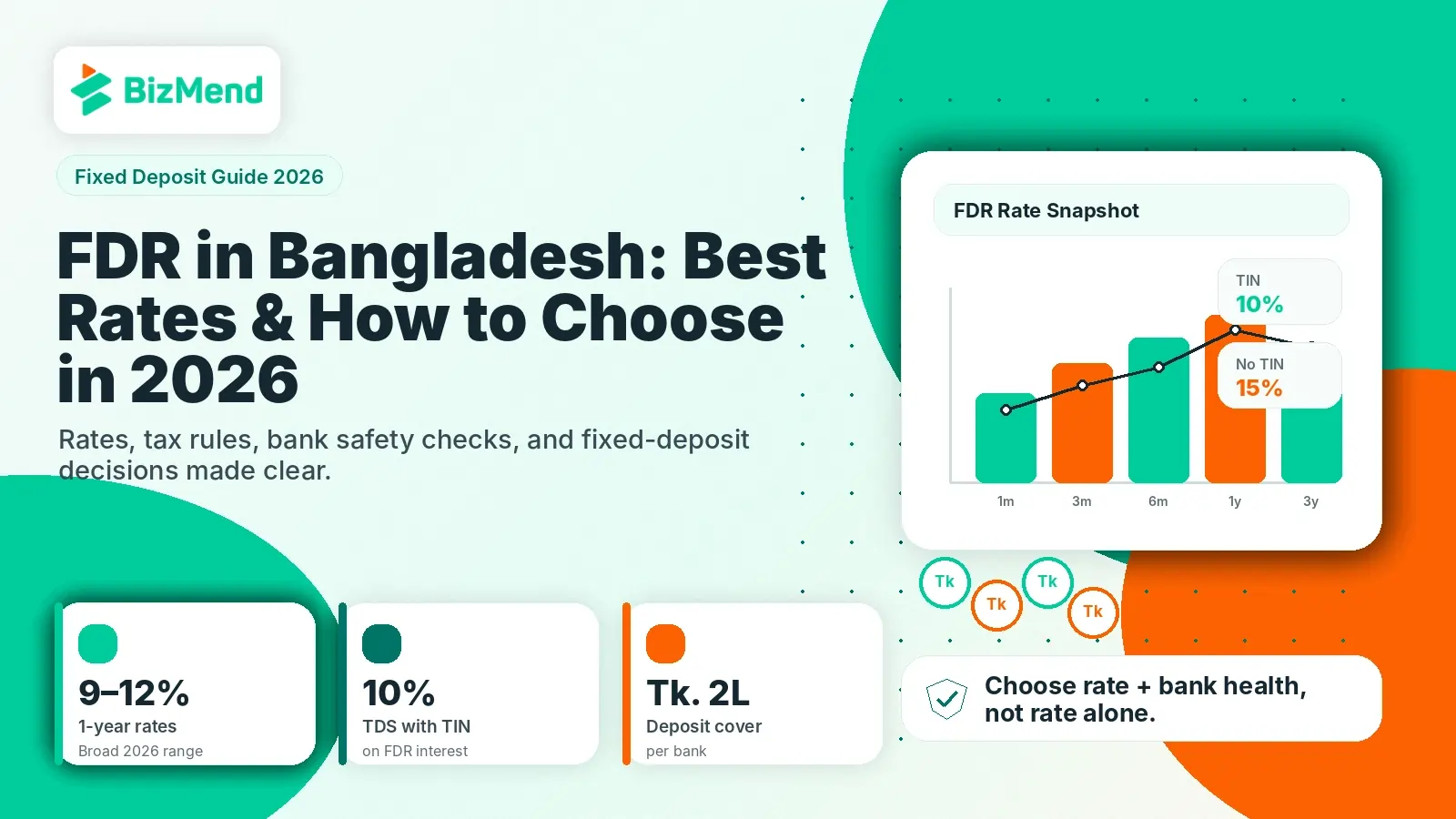
| 1 year | 9% to 12% p.a. |
| 2 years | 9% to 11% p.a. |
| 3 years | 9% to 11% p.a. |
Verify current rates at bb.org.bd (Bangladesh Bank publishes average deposit rates for all scheduled banks monthly) or directly at individual bank branches.
What’s Pushing Rates Higher Right Now
Two things. First, Bangladesh Bank’s contractionary monetary policy. The repo rate at 10% raised borrowing costs for banks, so they have to offer more on deposits to attract the liquidity they need. Second, Bangladesh’s banking sector is under real stress. The non-performing loan (NPL) ratio peaked at nearly 36% in late 2025, per Arthik Alap’s January 2026 analysis citing Bangladesh Bank data. Banks under pressure need deposits more than ever.
That second point is important. High FDR rates sound great. But some of those rates come from banks that are aggressively chasing deposits to cover their own holes. Rate alone is not enough. The commercial banks in Bangladesh guide covers how banks operate and which ones have the strongest footings for long-term deposits.
Highest FDR Rate in Bangladesh: Where the Best Returns Are
So who’s actually offering the most right now? The honest answer: it varies by month, by bank, and by tenure. But here’s the framework that holds consistently.
Smaller and mid-sized private banks tend to offer the highest headline FDR rates. Some smaller and mid-sized private banks may offer higher headline FDR rates, but rates change frequently and should be verified directly from each bank’s latest deposit-rate schedule. Their rates for 1-year tenures can touch the upper end of the 9-12% range.
But here’s the thing: a higher rate often means a higher need for deposits, which sometimes signals financial stress. A bank offering 12% may genuinely be competitive, or it may be chasing deposits to patch liquidity gaps. You need to check both the rate and the bank’s zone classification before committing.
If you have a larger amount (Tk. 10 lakh or more), bank managers at many private banks will negotiate rates slightly above published figures. It’s worth asking directly, especially if you’re bringing significant business.
For government-backed savings, Sanchayapatra can be compared with FDR, but its rates are revised periodically. Verify the latest National Savings/IRD rate before comparing it with bank FDRs. But there are strict investment ceilings, and the 5-year lock-up is real. FDR gives you more flexibility on tenure and access.
Which Bank Is Best for Fixed Deposit in Bangladesh?
Rate is only one factor. The safety of your bank matters just as much, maybe more. Here’s how the three main categories break down.
Government Banks: Safety First, Rates Second
State-owned banks including Sonali Bank, Janata Bank, Agrani Bank, and Rupali Bank typically offer FDR rates slightly below the market-leading private banks. Their rates tend to sit in the 8-10% range for 1-year FDRs in the current environment.
But they carry implicit government backing. If a state-owned bank faces severe stress, the government’s track record suggests depositors get protected. For large amounts above the deposit insurance ceiling of Tk. 2 lakh, this implicit backing carries real weight. If you’re risk-averse and sleeping soundly is worth 1% less in return, government banks are a solid choice.
Private Banks: Competitive Rates and Better Digital Access
Large established private banks like BRAC Bank, Dutch-Bangla Bank Limited, Eastern Bank Limited, and Prime Bank offer competitive fixed deposit interest rates in Bangladesh, generally ranging from 9% to 11% for 1-year tenures in the current environment. They also offer better digital infrastructure: FDR opening via app, instant renewal, and online interest tracking.
For amounts under Tk. 2 lakh per bank, deposit insurance covers you fully here. For amounts above that, you need to check each bank’s zone classification carefully. Use the red, yellow, and green zone bank classification from Bangladesh Bank as your primary filter. Only consider green-zone banks for any amount above your emergency fund.
Islamic Banks: Mudarabah Term Deposits
Islamic banks in Bangladesh offer Mudarabah Term Deposits (MTDs) as the Shariah-compliant FDR equivalent. Instead of a guaranteed interest rate, your deposit shares in the bank’s profits at a provisionally declared rate. In practice, rates are competitive with conventional FDRs.
Established Islamic banks like Islami Bank Bangladesh and Al-Arafah Islami Bank have solid track records. Check the top Islamic banks in Bangladesh for a full comparison before choosing.
Bangladesh Bank moved to restructure five Islamic banks, but the Sammilito Islami Bank process remained uncertain/stalled as of May 2026, so this should not be written as a completed merger. If your FDR was with any of these banks, your deposit remains protected during the transition. If you’re opening new, stick to banks with clean regulatory histories.
How FDR Compares to Other Bank Interest Rates in Bangladesh
To understand whether FDR makes sense for you, you need to see it next to the alternatives. Here’s how the bank interest rate picture in Bangladesh looks right now:
| Product | Approximate Rate | Risk Level | Liquidity |
|---|---|---|---|
| Savings account | 3% to 5% p.a. | Very low | Instant |
| FDR (1 to 3 months) | 6% to 9% p.a. | Very low | At maturity |
| FDR (1 year) | 9% to 12% p.a. | Very low | At maturity |
| DPS (monthly savings) | 9% to 12% p.a. | Very low | At tenure end |
| Sanchayapatra (5-year) | Around 11.28% before tax | Sovereign | 5-year lock |
| Government treasury bills | 11%+ p.a. | Sovereign | Short-term |
The savings account rate in Bangladesh has historically been around 3-5%. With inflation running at 8-9% (per Arthik Alap citing Bangladesh Bank data from late 2025), money sitting in a savings account is actively losing purchasing power. An FDR at 10% gives you a real return of roughly 1-2% after inflation. Not spectacular, but genuinely wealth-preserving.
For people who want the absolute safest return and don’t need access for 5 years, Sanchayapatra beats FDR on security and is competitive on rate. But for anything under 5 years, or for amounts above the Sanchayapatra investment ceiling, FDR is the practical choice. Understanding how government banks in Bangladesh facilitate these instruments is useful if you want to open a Sanchayapatra alongside your FDR.
FDR Tax Rules You Must Know
The bank deducts tax at source from FDR interest before crediting your account. Here are the current rates:
| Depositor Type | Tax Deducted at Source |
|---|---|
| Has valid 12-digit TIN | 10% of interest |
| No TIN | 15% of interest |
| Tax-exempt funds (pension, gratuity, provident fund) | 5% of interest |
| Non-resident depositors | 20% of interest |
So if your 1-year FDR earns Tk. 12,000 in interest and you have a TIN, the bank deducts Tk. 1,200 and credits you Tk. 10,800. No TIN? You lose Tk. 1,800 instead.
Getting a TIN takes about 20 minutes online through the NBR portal at etaxnbr.gov.bd. If you don’t have one, get one before opening a large FDR. This tax is treated as advance income tax and can be adjusted when you file your annual return.
Loan Against FDR
Many banks allow loans against FDR, but the eligible loan amount, interest rate, and terms vary by bank. Say you have Tk. 5 lakh locked in a 2-year FDR and suddenly need cash. Instead of breaking the FDR, you take a loan against it. The loan interest rate is usually slightly higher than your FDR rate, but you keep earning on the deposit at the same time. It’s a practical emergency liquidity option that most people don’t know exists until they’ve already broken their FDR unnecessarily.
DPS vs. FDR: Which One Is Right for You?
Both are safe, bank-backed savings products. But they work very differently.
| Feature | FDR | DPS |
|---|---|---|
| How you deposit | Lump sum, one time | Monthly installments |
| Minimum to start | Usually Tk. 10,000 to Tk. 1,00,000 | Often Tk. 500 per month |
| Best for | People with existing savings | Regular earners building savings |
| Early exit | Allowed at savings rate, no penalty at most banks | Usually loses interest or incurs penalty |
| Tenure | 1 month to 5 years typically | 3 to 10 years typically |
| Interest type | Fixed rate, guaranteed | Fixed rate, guaranteed |
If you already have a lump sum and want to grow it safely, FDR wins. If you want to build savings over time from your salary, DPS is the better fit. Many people run both: one FDR for existing savings, one DPS to build the next lump sum over time.
How to Open an FDR in Bangladesh
- Choose your bank based on rate, zone classification, and your comfort with their digital access.
- Prepare documents: National ID (NID) or passport, TIN certificate (strongly recommended), recent passport-size photograph, and your savings account details at the same bank.
- Visit a branch or use the bank’s app. BRAC Bank, Dutch-Bangla Bank, Eastern Bank Limited, and others allow FDR opening via their apps. Verify the current minimum amount threshold with each bank directly, as minimums change.
- Fill the FDR application form. State the amount, tenure, payout option (monthly profit or maturity), and nominee details.
- Deposit the funds from your linked savings account or pay at the counter.
- Receive your FDR certificate (physical or digital). Check your name, amount, rate, tenure, and maturity date carefully. Flag any errors immediately.
If you don’t have a bank account yet, the guide on how to open a bank account in Bangladesh walks through the whole process. NRBs managing money across borders should also explore broader strategies for growing savings internationally. The guide on how to start a business in the USA from Bangladesh covers complementary options for Bangladeshis living abroad.
Key Insights
- FDR rates hit multi-year highs in 2026, broadly ranging from 9% to 12% per annum for 1-year tenures, driven by Bangladesh Bank’s repo rate at 10% and intense competition for deposits among banks under NPL stress.
- Tax costs you 5% if you skip the TIN. Tax at source runs 10% with a valid 12-digit TIN and 15% without one. Getting a TIN through the NBR portal (etaxnbr.gov.bd) takes about 20 minutes and saves real money on any large FDR.
- The highest FDR rates often come from smaller private banks. AB Bank, One Bank, and Midland Bank have been competitive in recent market analysis. But always cross-check bank zone status before chasing the headline number.
- Government banks offer slightly lower rates but stronger implicit safety. Sonali, Janata, Agrani, and Rupali Bank are sound choices for large deposits where security matters more than squeezing an extra half-percent.
- Deposit insurance covers only Tk. 2,00,000 per depositor per bank. If you have more than Tk. 2 lakh to invest, split it across two or more green-zone banks for full protection on each portion.
- FDR beats a savings account by 5 to 8 percentage points right now. With savings accounts paying roughly 3-5% and inflation at 8-9%, a savings account is actively losing you real purchasing power. A 1-year FDR at 10% gives you a genuine real return.
- You can borrow up to 90% of your FDR value as a loan without breaking the deposit, keeping your savings intact and still earning while you handle any cash emergency.
Frequently Asked Questions
What is FDR in Bangladesh?
FDR stands for Fixed Deposit Receipt, a bank-issued savings instrument where you deposit a lump sum for a fixed period at a fixed interest rate. In Bangladesh, FDR rates in 2026 broadly range from 9% to 12% per annum for 1-year tenures. The bank issues a certificate as proof of your deposit, and interest is taxed at source before you receive payment.
What is the FDR interest rate in Bangladesh in 2026?
Fixed deposit interest rates in Bangladesh in 2026 broadly range from 6-8% for shorter tenures (1-3 months) to 9-12% for 1-year and longer tenures, depending on the bank. Rates change frequently as Bangladesh Bank’s repo rate at 10% has pushed banks to compete aggressively for deposits. Always verify current rates directly with the bank or at bb.org.bd before opening.
Which bank is best for fixed deposit in Bangladesh?
The best bank depends on your priority. For the highest FDR rates, competitive private banks like AB Bank, One Bank, and Midland Bank have been highlighted in recent market analysis. For safety alongside competitive rates, large established private banks like BRAC Bank, Dutch-Bangla Bank, and Eastern Bank are reliable. For maximum security, government banks like Sonali Bank carry implicit government backing. Always check zone status first.
What is the highest FDR rate in Bangladesh right now?
The highest FDR rates can change month to month, especially among private banks. Always verify the latest published rate directly with the bank before mentioning a specific “highest” rate. Rates at this level should be verified directly with the bank and cross-checked against the bank’s zone classification before committing any large deposit.
How is FDR interest taxed in Bangladesh?
Banks deduct tax at source from FDR interest automatically. The rate is 10% for depositors with a valid 12-digit TIN and 15% for those without a TIN. Tax-exempt funds like pension, gratuity, and provident funds pay 5%. Non-resident depositors face 20% deduction. The amount deducted counts as advance income tax and can be adjusted at your annual return filing.
Can I break my FDR before maturity in Bangladesh?
Yes, premature encashment is allowed at most banks, but you’ll earn interest at the savings account rate (not the FDR rate) for the period held. Before breaking your FDR, consider taking a loan against it instead. Most banks allow you to borrow up to 90% of the FDR value, keeping the deposit intact and continuing to earn the agreed rate throughout.
What is the difference between DPS and FDR in Bangladesh?
FDR requires a one-time lump sum deposit and suits people who already have savings to invest. DPS is a recurring monthly deposit scheme suited to people building savings over time. Both offer fixed guaranteed returns, but FDR has shorter minimum tenures starting at 1 month, while DPS typically runs 3 to 10 years. Many savers run both products simultaneously for different financial goals.
Is Islamic bank FDR available in Bangladesh?
Yes. Islamic banks in Bangladesh offer Mudarabah Term Deposits (MTD) as the Shariah-compliant equivalent of FDR. Instead of a fixed interest rate, your deposit shares in the bank’s profits at a provisionally declared rate. Islami Bank Bangladesh, Al-Arafah Islami Bank, and Shahjalal Islami Bank offer these products. Provisional rates are typically competitive with conventional FDR rates.
How much of my FDR is protected by deposit insurance in Bangladesh?
Under Bangladesh’s deposit insurance framework, deposits up to Tk. 2,00,000 (2 lakh) per depositor per bank are protected. If you have more than Tk. 2 lakh to invest, consider spreading it across multiple financially stable green-zone banks to ensure full insurance coverage on each separate deposit.
The Bottom Line
FDR in Bangladesh is a genuinely solid option right now. Rates are at multi-year highs relative to the last decade, the product is simple, and you don’t need to watch a market or make active decisions.For example, a Tk. 1 lakh FDR at 10% would earn Tk. 10,000 before tax, but the final net amount depends on the applicable source-tax rate and the bank’s calculation method. That’s real money for doing essentially nothing except choosing the right bank.
The one thing I’d stress: don’t chase the highest rate without checking the bank’s zone classification first. A 0.5% higher rate means nothing if your bank is under regulatory pressure. Check the green/yellow/red zone status, keep your per-bank deposit at or under Tk. 2 lakh for full insurance coverage, and get your TIN sorted before you open. Those three steps protect you more than any rate negotiation will. Which bank are you considering, and have you checked their zone status yet?