How to Become a Daraz Seller in Bangladesh: Registration, Fees & Growth
Learn how to become a Daraz seller in Bangladesh, register an account, list products, understand fees, manage orders, and grow…
 by Sheikh Ornob

See the tax free income limit in Bangladesh for 2025-26, who pays no tax, and when a return may still be required even if no tax is due.
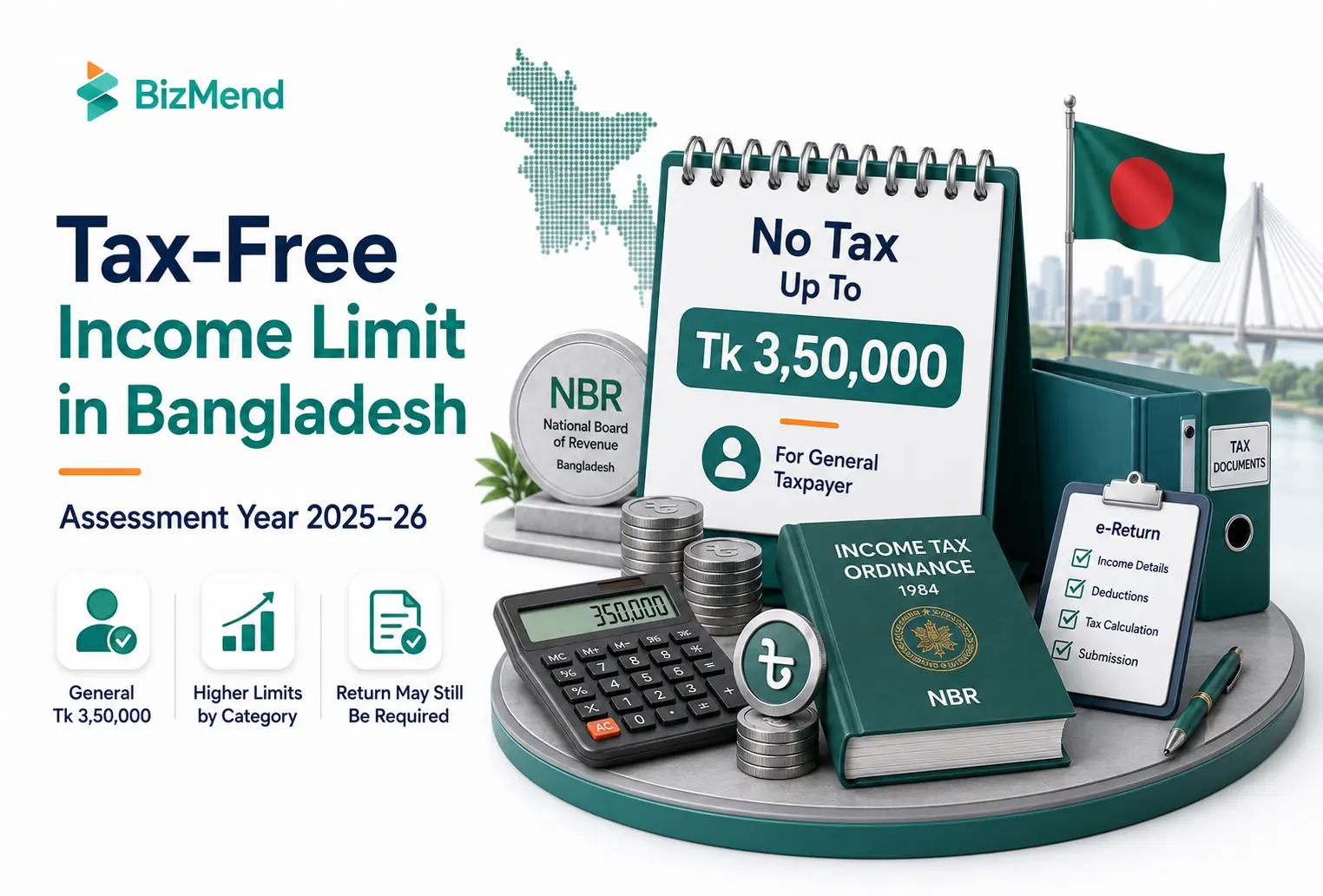
If you are searching the tax free income limit in Bangladesh, the first number to know is Tk 3.5 lakh. That is the general no tax threshold for assessment year 2025 to 26.
The problem starts when the second half comes into play that most articles skip. NBR’s filing rules pull in plenty of zero tax taxpayers based on trade licenses, credit cards, property deeds, and company roles. This guide handles both the category by category thresholds, and the filing rules that don’t care about your income level.
For a general individual taxpayer, the answer is simple: annual taxable income up to Tk 3,50,000 is not chargeable to income tax for assessment year 2025-26. That is the figure most people mean when they search for the tax free income limit in Bangladesh, the minimum taxable income in Bangladesh, or the tax exemption limit in BD.
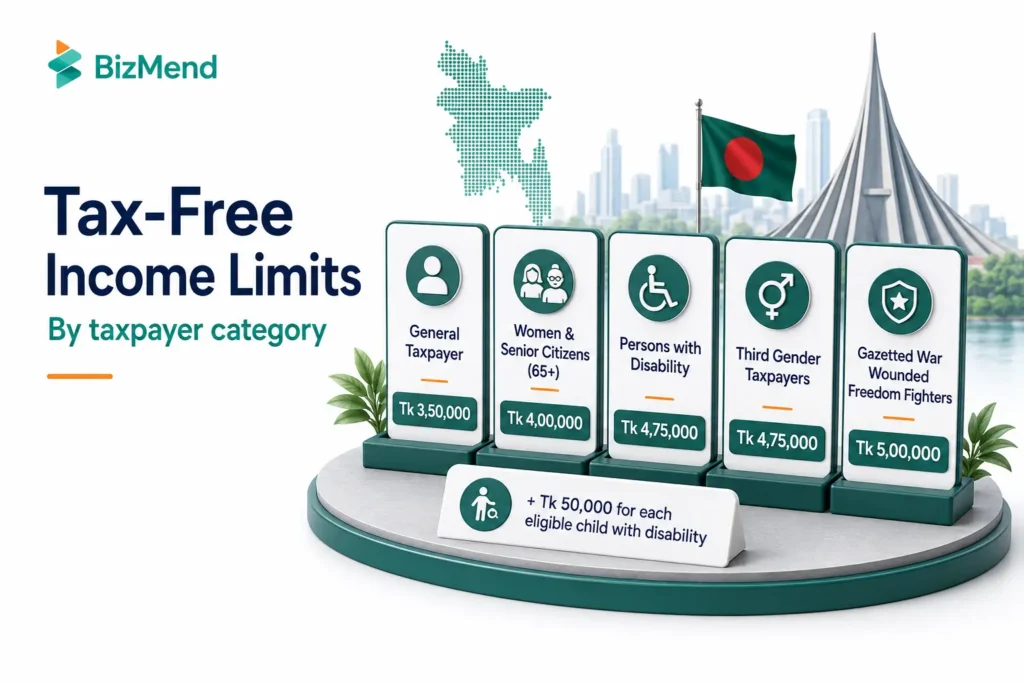
Bangladesh also uses higher limits for a few protected categories. So before you decide whether you owe tax, check which taxpayer category applies to you. For 2025-26, the no tax thresholds look like this:
| Taxpayer category | Annual income with no tax |
|---|---|
| General taxpayer | Tk 3,50,000 |
| Women and senior citizens aged 65 or above | Tk 4,00,000 |
| Persons with disability | Tk 4,75,000 |
| Third gender taxpayers | Tk 4,75,000 |
| Gazetted war wounded freedom fighters | Tk 5,00,000 |
One timing point matters here. The NBR guidance for assessment year 2025-26 shows the income year as 1 July 2024 to 30 June 2025. So readers searching in late 2025 or early 2026 are usually talking about the return filed for income earned in that period, not income earned after 1 July 2025.
You pay no income tax when your taxable income stays within the threshold for your category. For a salaried employee with no special category, that means taxable income of Tk 3,50,000 or less. For a woman taxpayer or a taxpayer aged 65 or above, the no tax cap is Tk 4,00,000. For a person with disability or a third gender taxpayer, it is Tk 4,75,000.
Gazetted war wounded freedom fighters get the highest threshold listed for 2025-26, which is Tk 5,00,000. On top of that, the tax free threshold rises by Tk 50,000 for each child with disability or adopted child with disability for a parent or legal guardian who qualifies to claim that relief.
Going above the threshold does not suddenly make your whole income taxable. The nil slab still covers the first part. For a general taxpayer in 2025-26, the first Tk 3,50,000 is taxed at nil, and the next Tk 1,00,000 falls into the 5 percent slab. That is why the threshold is best understood as the point where tax starts, not as a line that taxes everything below it again.
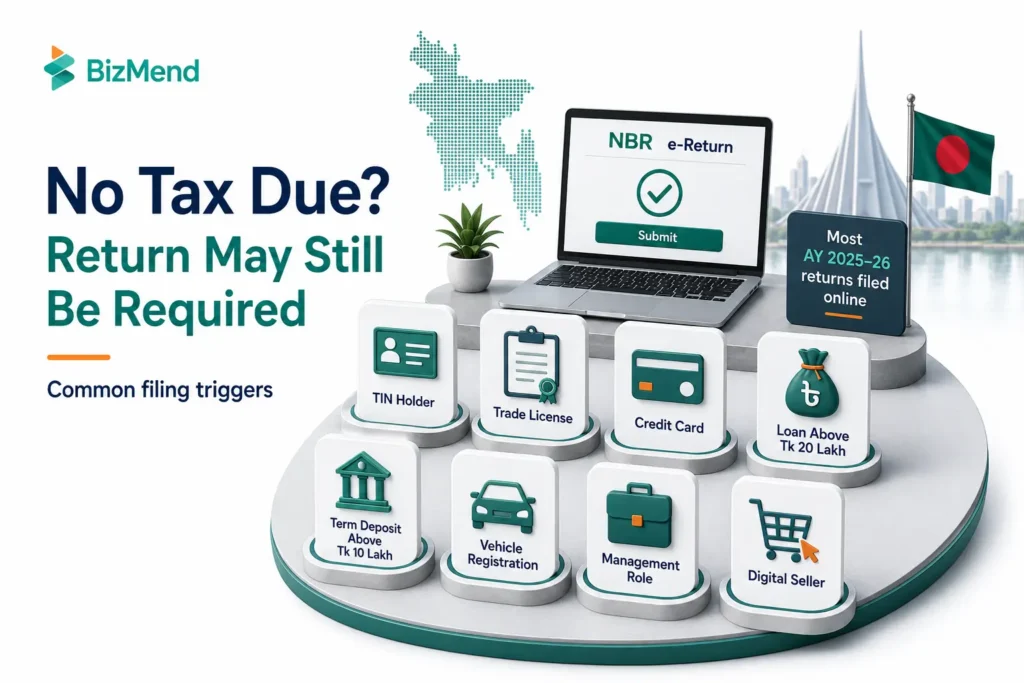
Very often, yes. This is the part people miss. Section 166 of the Income Tax Act, 2023 does not limit return filing only to people whose income crosses the tax free threshold. It also pulls in several other groups.
In plain English, you may still need to file even with no tax payable if you were assessed in any of the last three years, if you are already registered as an assessee, if you are a public servant, if you hold an executive or management role in a business, if you are a partner in a firm, or if you need proof of return submission for a legally specified transaction.
Section 264 of the same law is why many people below the tax free limit still end up filing returns. It ties proof of return submission to a long list of practical actions. Some of the most common ones are easy to recognize:
So if your income is below the no tax threshold but you are running a small business, working in a qualifying role, or using one of these services, you may still need a valid return receipt. That is why no tax due and no return needed are not the same thing.
Bangladesh also changed how many individuals file. NBR issued Special Order No. 01/2025 in August 2025 and shifted most individual taxpayers for assessment year 2025-26 to online return filing through the e return system. The main exceptions named by NBR were senior citizens aged 65 or above, physically challenged or special needs taxpayers, Bangladeshi taxpayers living abroad, and foreign citizens working in Bangladesh.
Under the Income Tax Act, the standard tax day for most non company assessees is 30 November following the end of the income year. But for this assessment year, NBR later extended the filing window for individual and Hindu undivided family taxpayers. That matters if you are checking old notices and seeing different dates for the same 2025-26 return cycle.
For the wider Bangladesh tax picture on the business side, see our Bangladesh tax guide. It is not a personal tax pillar page, but it is the closest related Bangladesh tax article currently visible in the Bizmend archive.
If your taxable salary is within the threshold for your category, you may owe no tax. But if you are a public servant or hold a management, administrative, or supervisory role, filing may still be required.
Low income on its own does not always remove filing. If you receive qualifying payments, use banking products that require proof of return, or sell through digital platforms, the compliance side can still catch you.
If you have a TIN, a trade license in a city corporation or paurashava, a business banking trail, or supplier contracts with companies and firms, return filing often matters even before your tax bill starts to matter.
You can file on your own, but many people get stuck on the forms, the category questions, and the proof of return rules tied to everyday transactions. If you would rather hand the paperwork off, consider working with a professional service provider. They are providers in this space, not endorsements, and they are worth knowing if the filing side is what is slowing you down.
For Bangladesh assessment year 2025-26, the basic no tax number is Tk 3,50,000, but that is only the first check. Your category can raise the threshold, and your filing duty can still stay alive even when tax payable is zero. If you only remember one thing, remember this: no tax due does not always mean no return needed.
For a general individual taxpayer, the tax free income limit for assessment year 2025-26 is Tk 3,50,000. Higher thresholds apply to women, senior citizens aged 65 or above, persons with disability, third gender taxpayers, and gazetted war wounded freedom fighters.
Yes. For assessment year 2025-26, women taxpayers and senior citizens aged 65 or above pay no income tax up to Tk 4,00,000.
Possibly, yes. If you fall into any filing trigger under section 166 or need proof of return submission under section 264, you may still need to file even when your income stays below the no tax threshold.
That is risky. Registered assessees can still fall under the filing rule, and many TIN holders also need proof of return submission for banking, licensing, employment, vehicle, or property related actions.
For most individual taxpayers, yes. NBR moved assessment year 2025-26 filing to the online system, while keeping limited exceptions for certain categories such as senior citizens, persons with disability or special needs, Bangladeshi taxpayers abroad, and foreign citizens working in Bangladesh.

Learn how to become a Daraz seller in Bangladesh, register an account, list products, understand fees, manage orders, and grow…
by Sheikh Ornob
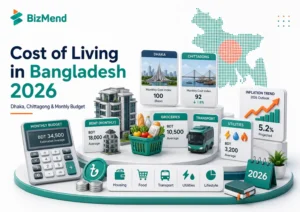
Compare the cost of living in Bangladesh in 2026, including Dhaka and Chittagong rent, food, transport, utilities, inflation, and monthly…
by Sheikh Ornob

Learn MoA and AoA requirements in Bangladesh, key clauses, drafting basics, RJSC filing steps, amendments, and common company-registration mistakes. Suggested…
by Sheikh Ornob