
How to Become a Daraz Seller in Bangladesh: Registration, Fees & Growth
Learn how to become a Daraz seller in Bangladesh, register an account, list products, understand fees, manage orders, and grow…
 by Sheikh Ornob

Learn how tax rebate Bangladesh works, which investments may qualify, how the 15% rebate is calculated, and how to claim it correctly on your return.

A lot of taxpayers hear the phrase “tax rebate in Bangladesh” and assume it means a general cut in taxes. It does not. In most personal cases, this relief is tied to specific investments, contributions, and approved payments that the law treats as rebate-eligible.
That is why people get stuck. You may have paid into DPS, bought savings instruments, or kept a life insurance policy and still feel unsure about what actually lowers your tax bill. Let us make it plain: what qualifies, how the 15% rule works, where the cap bites, and how to claim it without guessing.
Think of it this way: a deduction reduces the income that gets taxed, but a rebate reduces the tax after the tax is calculated. That distinction matters. If you have heard friends say, “I invested, so my taxable income dropped,” they are usually mixing up two different ideas.
Under the Income Tax Act, 2023, the common personal tax rebate route is tied to a list of eligible investments and allowances in Part 3 of the Sixth Schedule. So the first question is not “Did I save money?” It is “Did I put money into a category the law actually recognizes for a rebate?”
The current Sixth Schedule wording applies this general rebate to resident individual assessees and Bangladeshi non-resident individual assessees. That means it is primarily a personal income tax rule, not a generic business credit that everyone can use.
If you are filing as an individual and you made eligible contributions during the income year, you are in the right lane. If you are looking at a company, partnership, or some other structure, do not assume the same rebate rules apply in the same way.

This is where many returns go off track. People use the phrase “investment” very loosely, but the law is pickier than that. The safest approach is to match your payment to the current Act and the NBR return schedule, line by line.
| Category | Current note from the Act or NBR forms |
|---|---|
| Life insurance premium | Allowed subject to a limit of 10% of the actual sum assured, excluding the bonus or other benefits. |
| Provident fund contributions | Includes contributions under the Provident Fund Act, 1925, and contributions to a recognized provident fund, subject to the relevant rules. |
| Superannuation fund | Ordinary annual contributions to an approved superannuation fund are included. |
| Deposit pension scheme | The current Sixth Schedule shows up to Tk 1.2 lakh in DPS with a scheduled bank or finance company. |
| Government securities and savings instruments | The current Act includes government securities up to Tk 5 lakh, and NBR Schedule 24D also includes approved savings certificate lines. |
| Units, mutual funds, ETFs, and joint investment scheme units | Covered where issued by qualifying institutions such as ICB, asset managers, or fund managers, subject to the statutory limits. |
| Listed securities | The Act includes sums invested in securities listed on a stock exchange under the Bangladesh Securities and Exchange Commission framework. |
| Benevolent fund and group insurance | Included if the fund or scheme is approved by the Board. |
| Zakat and certain donations | Zakat Fund payments and some approved charitable, educational, welfare, and memorial donations can qualify. |
| Universal Pension Scheme | The Sixth Schedule now includes contributions payable to the Universal Pension Scheme. |
Two practical warnings: first, a product can sound tax-friendly without actually fitting the statutory list. Second, names change in marketing materials. Do not rely on the brochure headline. Match the instrument to the legal category and keep the paper trail.
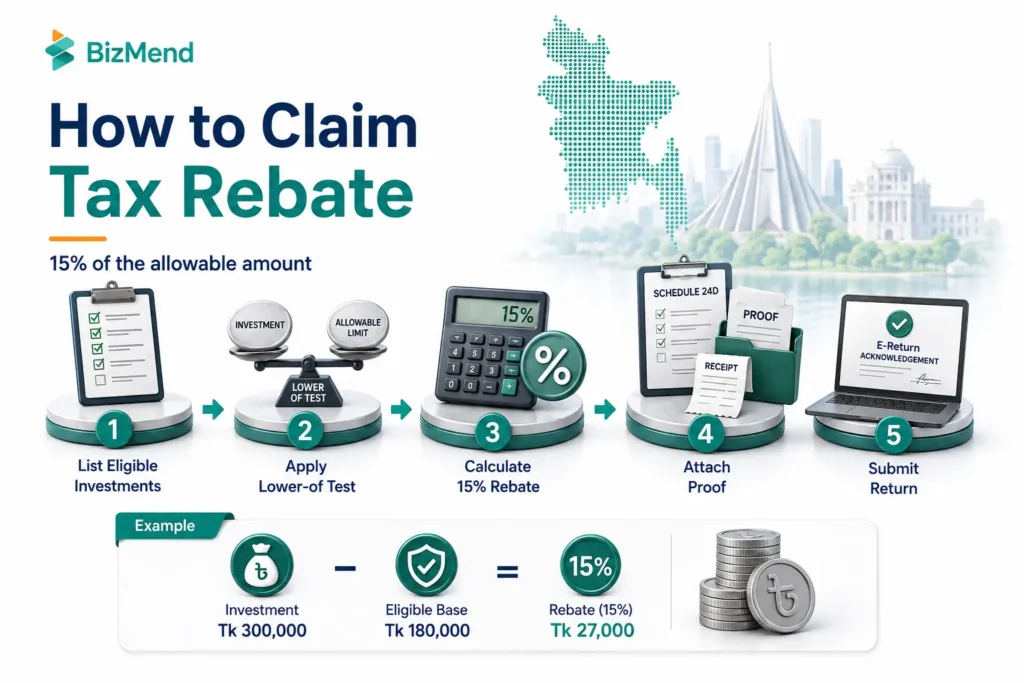
This is the part people usually misunderstand. The rebate is not 15% of your tax bill, and it is not always 15% of everything you invested. You first compute the amount that is allowed to enter the rebate formula.
The current NBR Schedule 24D says the eligible amount for rebate is the lesser of three figures: your total allowable investment, the income-based ceiling under section 44, and Tk 1.5 crore. Once that eligible amount is settled, the rebate is calculated under section 44(2)(b).
Current professional summaries updated after the late 2025 changes indicate that the income-based ceiling is 3% of the relevant total income after carving out certain exempt, reduced rate, and final tax items. Because the NBR worksheet points you back to section 44, treat that percentage as something to confirm in the filing year if the law changes again.
Suppose your eligible investments total Tk 300,000 and your relevant total income for the ceiling test is Tk 6,000,000. If the current ceiling is 3%, that ceiling gives you Tk 180,000. The lowest of Tk 300,000, Tk 180,000, and Tk 1.5 crore is Tk 180,000.
Your rebate would then be 15% of Tk 180,000, which is Tk 27,000. So even though you invested Tk 300,000, your tax reduction in this example is Tk 27,000, not Tk 45,000. That is the part many people miss.
The claiming process is not mysterious, but it does punish sloppy paperwork. NBR’s Schedule 24D is the working sheet for tax credit or rebate, and it explicitly says you should attach proof of the claimed investment or contribution.
The current NBR e-Return user manual also shows that the system includes rebate, expenditure, and assets and liabilities tabs and then lets you download your return and certificates after submission. That is useful because you can keep the final record in one place instead of chasing paper after the fact.
One date point worth knowing: for assessment year 2025 to 2026, NBR set the filing date for individual and Hindu undivided family taxpayers to 31 March 2026 through a public notice dated 26 February 2026. Do not hard code that into future planning, though. Bangladesh filing dates often move by notice.
This part is boring. It is also where valid claims get saved. If a tax official cannot tie your number to an actual payment, your clean calculation will not rescue the claim.
Even when someone has made rebate-eligible investments or payments, the claim can still go wrong because of small filing mistakes. These are the ones to watch carefully:
A tax rebate in Bangladesh is useful, but only when you treat it as a rule-based claim, not a rumor. Check whether the investment is actually eligible, apply the ceiling before the 15% step, and keep proof for every figure you enter. That is what turns a hopeful claim into a defensible one.
No. A deduction reduces the income that gets taxed. A rebate reduces the tax payable after the relevant calculation is done. In this context, Bangladesh’s investment-linked relief is generally handled as a rebate against tax, not a simple deduction from income.
No. The product or payment has to fit the categories allowed in the current law and NBR forms. A good investment is not automatically a rebate-eligible investment.
Not always. You first apply the lower of the tests. If your actual investment is higher than the income-based ceiling, your rebate is computed on the lower ceiling amount, not on the full amount you invested.
Yes. Schedule 24D itself says to attach proof of the claimed investment, contribution, or payment. Even where you file online, you should keep the receipts, statements, certificates, and supporting records ready.
Follow the latest NBR notice for your assessment year. For individual and Hindu undivided family taxpayers in assessment year 2025 to 2026, NBR set the date at 31 March 2026 through a public notice dated 26 February 2026, but these dates can be extended again.

Learn how to become a Daraz seller in Bangladesh, register an account, list products, understand fees, manage orders, and grow…
by Sheikh Ornob

Compare the cost of living in Bangladesh in 2026, including Dhaka and Chittagong rent, food, transport, utilities, inflation, and monthly…
by Sheikh Ornob

Learn MoA and AoA requirements in Bangladesh, key clauses, drafting basics, RJSC filing steps, amendments, and common company-registration mistakes. Suggested…
by Sheikh Ornob