
How to Become a Daraz Seller in Bangladesh: Registration, Fees & Growth
Learn how to become a Daraz seller in Bangladesh, register an account, list products, understand fees, manage orders, and grow…
 by Sheikh Ornob

Understand provident fund in Bangladesh, including PF rules, contribution rates, withdrawal, tax recognition, payroll planning, and employer duties.
Provident fund rules can look simple until payroll has to run. In Bangladesh, that simplicity disappears fast. One missed policy detail can change salary cost, tax treatment, or withdrawal timing.
This guide explains provident fund in Bangladesh for employees, HR teams, employers, and founders who need the working picture, not a law school maze. You’ll see how PF usually works, where the Labour Act fits, why private and government funds aren’t the same, how contribution rates connect to basic salary, and what tax recognition can change. Treat it as a practical map, then confirm your own policy with HR, legal, or tax professionals before making payroll decisions.
Quick Answer: Provident fund in Bangladesh is a long-term employee savings benefit where eligible workers and employers contribute to an individual account. Private sector PF rules historically sit mainly under Section 264 of the Bangladesh Labour Act, where a qualifying provident fund can involve matching employee and employer contributions of 7% to 8% of monthly basic wages; recent 2026 updates may add separate obligations for larger employers, so the current Gazette should be checked before setting policy. .
A provident fund is a long-term savings arrangement for employees. The employee contributes part of salary, the employer may contribute a matching amount, and the money is credited to the employee’s individual account. Over time, the balance can grow through contributions and income earned by the fund.
In Bangladesh, PF usually matters in three places: employment law, payroll design, and tax. That is where many people get tangled. The Labour Act question is about whether a fund must exist and who contributes. The payroll question is about how much is deducted. The tax question is about recognition, exemption, and reporting.
Think of PF as a locked savings drawer inside the employment relationship. It helps the employee build a lump sum for retirement or job exit, while the employer treats it as part of the total benefit package. The lock matters because early or informal withdrawal can create tax, policy, and audit problems.
A PF benefit is only as clean as the payroll rule, trust rule, and tax recognition behind it.
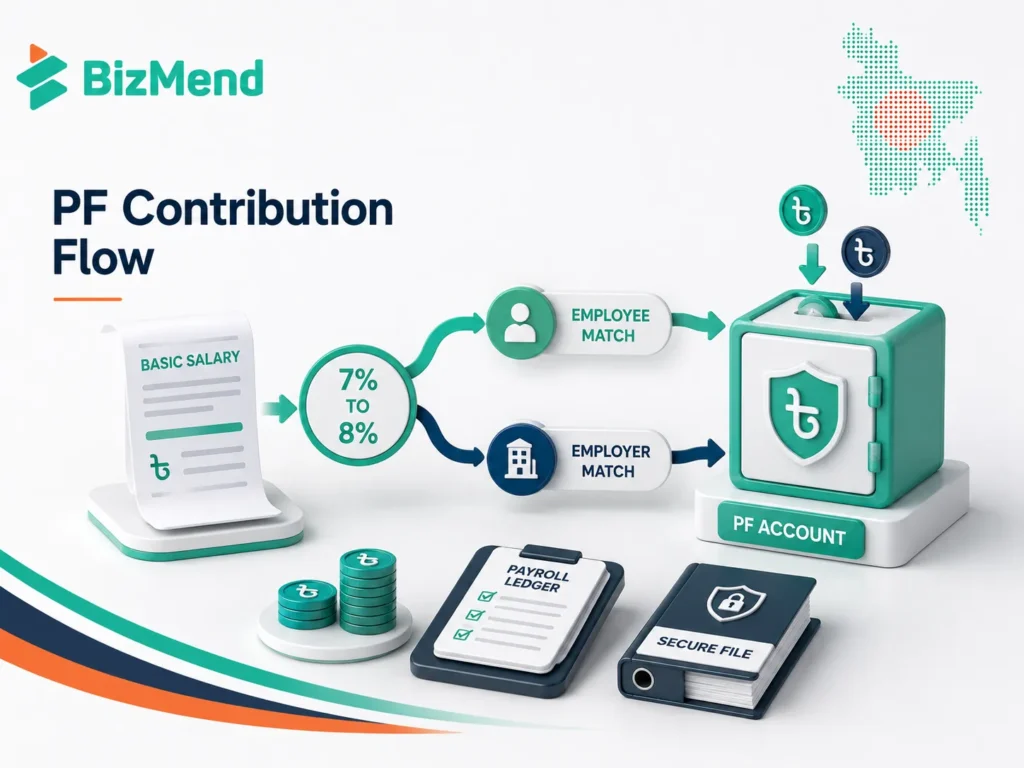
The basic flow is monthly. Payroll deducts the employee contribution, records the employer contribution, and credits both to the employee’s PF account. A trustee or approved management structure then keeps the fund records, tracks income, and handles payment when the employee becomes eligible.
| Step | What happens | Why it matters |
| 1 | Eligibility is checked against employment status, service length, and fund rules. | Temporary, probationary, permanent, worker, and officer categories may be treated differently. |
| 2 | Employee and employer contributions are calculated from the agreed wage base. | Most PF confusion starts when basic salary and gross salary are mixed up. |
| 3 | Amounts are credited to individual PF accounts and supported by payroll records. | The employee needs traceable records, not just a line on the salary slip. |
| 4 | The fund follows its trust deed, policy, recognition terms, and investment rules. | Good governance protects both the employee balance and the employer’s tax position. |
The word usually matters here. Bangladesh doesn’t have one single private sector PF pattern for every worker in every business. Sector rules, headcount, worker demand, the 2026 amendment path, and the company trust deed can all affect the final answer.
Private provident fund Bangladesh rules are not the same as government provident fund Bangladesh rules. Private establishments usually look at the Labour Act, Labour Rules, trust documentation, and NBR recognition. Government servants look at separate rules such as the General Provident Fund Rules, 1979, or Contributory Provident Fund Rules, 1979.
| Type | Who it usually covers | Main practical point |
| Private PF | Eligible workers or employees in private establishments. | Usually managed through a fund structure, employer policy, trustees, and tax recognition if claimed. |
| Government GPF | Government servants eligible under GPF rules. | The fund is maintained in Bangladesh in Taka, and government sets the interest rate for each year. |
| Government CPF | Certain non-pensionable government servants covered by CPF rules. | Both subscriber and government contribution rules can apply under the CPF framework. |
| Progoti pension | Private organization employees or owners under Universal Pension. | This is a pension scheme, not the same as a private PF trust, and it uses fixed subscription options. |
This difference is more than vocabulary. A startup founder can’t copy a government GPF rule into a private employment policy and call the job finished. An employee also shouldn’t assume a private PF withdrawal follows the same process as a government employee’s GPF payment.
The commonly cited labor act PF rate is 7% to 8% of monthly basic wages, so employers should also understand the minimum wage in Bangladesh before setting the basic salary and PF contribution. The employer generally matches the worker’s contribution. That doesn’t mean every employer can announce any rate on gross salary and move on.
The wage base is the quiet detail that changes the number. If PF is calculated on basic salary, a higher basic portion increases both the employee deduction and employer cost. If a policy says gross salary, that needs legal and tax review because it may not match the statutory wording or the approved trust rules.
| Monthly salary item | Example amount | At 8% PF |
| Gross salary | Tk 60,000 | Not used in this example |
| Basic salary | Tk 30,000 | Tk 2,400 employee contribution |
| Employer match | Tk 30,000 base | Tk 2,400 employer contribution |
| Total monthly PF credit | Employee plus employer | Tk 4,800 |
At 7%, the same Tk 30,000 basic salary would produce Tk 2,100 from the employee and Tk 2,100 from the employer. Small rate differences become large across 200 employees and 12 payroll cycles. Yeah, payroll math has a way of becoming strategy.
For employee PF Bangladesh planning, HR should first separate legal eligibility from company generosity. A company may offer a richer benefit than the minimum, but it shouldn’t offer a weaker one where the law or trust rules set a floor. That floor can depend on worker status, service period, and whether the PF has been properly formed.
Recent labour reform commentary adds another layer for larger employers. It describes a PF obligation for establishments with 100 or more permanent workers, with a possible Universal Pension Progoti alternative. Verify the official Gazette and legal advice before changing benefits.
PF withdrawal usually starts when employment ends: resignation, retirement, termination, death, or another event allowed by the fund rules. The Income Tax Act’s recognized PF provisions say the accumulated balance is payable when the employee ceases to be an employee of the employer maintaining the fund, subject to the fund regulations.
Before leaving, employees should ask HR for three things: the latest individual PF statement, the withdrawal form or claim process, and the tax position if the fund is recognized. If there is a nomination, death benefit processing should follow that record first, then the applicable succession process where needed.
Fast withdrawal sounds attractive until the tax and trust rules disagree with it.
Avoid shortcuts. Borrowing from PF, partial withdrawal, or early release can be allowed only if the relevant law, fund rules, and approval process permit it. A payroll manager shouldn’t release money just because an employee has a genuine emergency. The paper trail still matters.
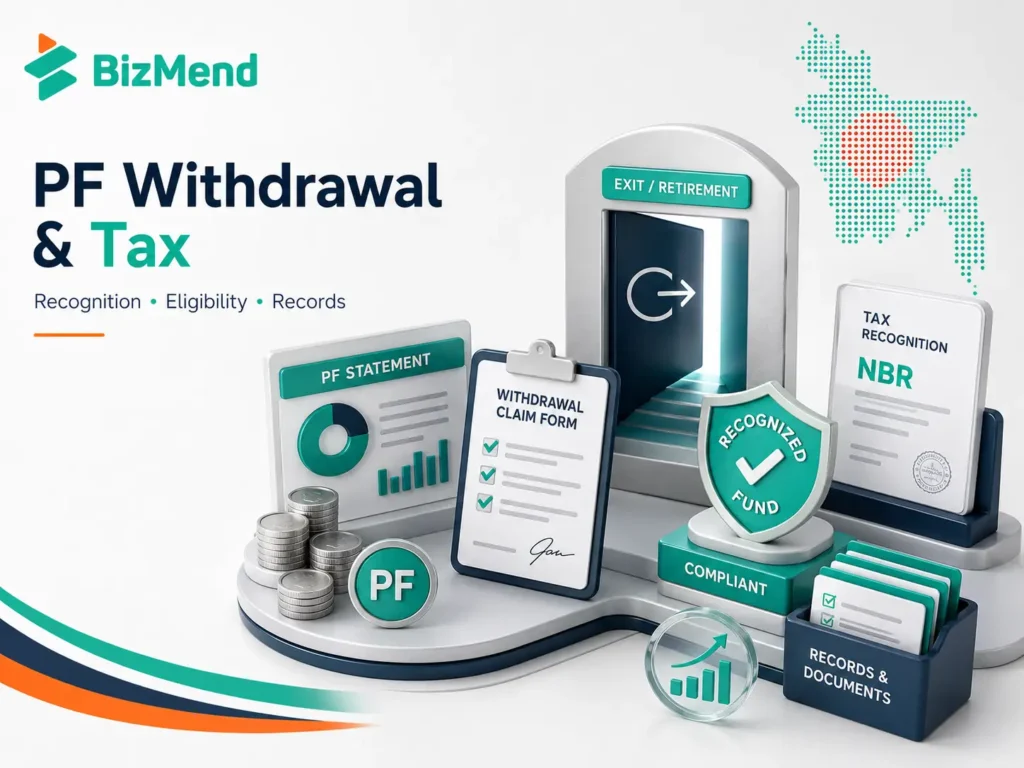
The tax angle is where provident fund rules BD can feel technical, especially when employers connect PF treatment with income tax in Bangladesh 2026. Under the Income Tax Act, 2023 framework, a recognized provident fund is one that has been and continues to be recognized by the Commissioner, subject to the conditions set for recognized provident funds. The same law sets conditions around employee contributions, employer contributions, trustees, accounts, recognition, withdrawal, and tax treatment.
There are exceptions and traps. The Commissioner may allow tax exemption with less than five years of service if the job ended for ill health, business discontinuance, or another cause beyond the employee’s control. If conditions aren’t met, payment can become taxable and withholding may apply. Get tax advice before treating a payout as clean.
PF belongs inside salary structure planning. If a company writes a high basic salary, PF cost rises when contribution is based on basic wages. If the basic salary is unusually low, the structure may look artificial and invite questions from employees, auditors, or inspectors.
A clean salary structure normally shows basic salary, house rent, medical allowance, transport allowance, other allowances, employee PF deduction, employer PF contribution, tax deduction at source if any, and net pay. It should also state whether employer PF is outside gross salary or included in cost to company.
Employers should treat PF as governance work, not a one line salary perk. The fund needs policy, trustees or proper administration, payroll controls, employee communication, accounting, audit support, and tax review. A messy PF can hurt trust faster than almost any other benefit.
| Common mistake | Better practice |
| Copying Indian EPF rates | Use Bangladesh law, fund rules, and local tax advice. |
| Using gross salary by habit | Confirm whether the contribution base is basic wages or another approved base. |
| Calling any savings plan recognized PF | Apply for and maintain recognition under the Income Tax Act if tax treatment matters. |
| Ignoring trustee records | Keep minutes, statements, bank records, fund accounts, and audit files. |
| Mixing PF with gratuity | Explain both benefits separately in policy and salary documents. |
| Releasing funds informally | Follow the withdrawal trigger, approval process, and tax review. |
Startups often make the same mistake in a different way. They promise PF to hire talent, then delay the trust, accounting, NBR recognition work, or proper business consulting before building employee benefit systems. If you aren’t ready to run PF properly, say what benefit exists today and what will start later.
Ask for professional review when you cross a headcount threshold, change salary structure, create a new PF trust, apply for NBR recognition, merge entities, close a factory, terminate many workers, or process a large withdrawal. These are not good moments to guess.
Employees should also ask for help when the PF statement doesn’t match payslips, employer contribution is missing, a resignation payout is delayed, or HR says a withdrawal will be taxed but doesn’t explain why. Calm questions, written records, and the right professional review solve more problems than angry hallway arguments.
Provident fund in Bangladesh is part savings plan, part payroll rule, and part legal promise. Employees should understand what is being deducted and when it can be withdrawn. Employers should keep PF aligned with the Labour Act, tax recognition, trust rules, and salary documents. The safest answer is rarely the fastest one. It is the one your records can prove.
It depends on the establishment, worker coverage, and current law. Historically, private establishments had to form a PF when the required share of eligible workers demanded it in writing under Section 264. Recent 2026 update commentary describes an added obligation for establishments with 100 or more permanent workers, with a possible Progoti pension route, so check the final Gazette and your legal adviser.
The commonly cited Labour Act range is 7% to 8% of monthly basic wages for eligible permanent workers where the PF rule applies, with the employer contributing an equal amount. Don’t use that as a universal gross salary rule. Your fund rules and employment category matter.
Sometimes, but only if the law, fund rules, and approval process allow it. Many recognized PF rules focus payment on cessation of employment, while advances or partial withdrawal may need specific conditions. Employees should ask HR for the written rule before relying on early access.
Tax depends on recognition status, service period, payout reason, and current NBR rules. A recognized PF accumulated balance can be exempt after at least five years of continuous service, with limited exceptions. If conditions aren’t met, tax and withholding may apply.
PF is usually a funded account built from monthly employee and employer contributions. Gratuity is usually an end of service benefit calculated under a different rule or employer policy. They can both support employee benefit planning, but they shouldn’t be merged in payroll records.
No, not directly. Government GPF and CPF rules apply to covered government servants. Private employees usually look to the Labour Act, company PF rules, trust documents, NBR recognition, and possibly Universal Pension Progoti if that route applies.

Learn how to become a Daraz seller in Bangladesh, register an account, list products, understand fees, manage orders, and grow…
by Sheikh Ornob

Compare the cost of living in Bangladesh in 2026, including Dhaka and Chittagong rent, food, transport, utilities, inflation, and monthly…
by Sheikh Ornob

Learn MoA and AoA requirements in Bangladesh, key clauses, drafting basics, RJSC filing steps, amendments, and common company-registration mistakes. Suggested…
by Sheikh Ornob