
 by Sheikh Ornob
Fire insurance in Bangladesh helps property and business owners reduce the financial impact of fire, lightning, and any additional perils specifically included in the policy. It can protect buildings, machinery, furniture, stock, and other declared assets, but the exact protection depends on the policy wording, sum insured, location, construction, occupancy, and selected extensions.
A basic fire policy is not automatically an all-risk policy, and flood, cyclone, explosion, riot, machinery breakdown, or business interruption may require additional cover. Before buying, compare the insured property list, exclusions, deductible, valuation method, safety conditions, and claim-document requirements rather than choosing only by the lowest premium.
Quick Answer: Fire insurance in Bangladesh compensates covered property damage caused by fire, lightning, and only those additional perils that are expressly included in the policy schedule or endorsement. Premiums depend on property value, construction, occupancy, location, fire protection, and selected extensions. Claims usually require immediate notice, evidence of loss, records of ownership or stock, and inspection by the insurer or surveyor.
How Fire Insurance in Bangladesh Works
Fire insurance is a contract between the policyholder and a licensed non-life insurer. The policyholder pays a premium, declares the property and its value, and receives protection for loss or damage caused by insured events during the policy period. The insurer does not pay for every fire-related cost automatically; it pays only within the policy terms, limits, deductibles, warranties, and exclusions.
Pragati Insurance’s fire-insurance page is a useful product example: it describes fire insurance as protection for insured assets damaged by fire and/or lightning, while Fire & Allied Perils adds selected risks such as riot/strike damage, cyclone, flood, and explosion for an additional premium. It also states that policies are commonly issued for one year. This is a useful market example, but every insurer’s quotation and final schedule should be checked separately.
What Property Can a Fire Policy Cover?
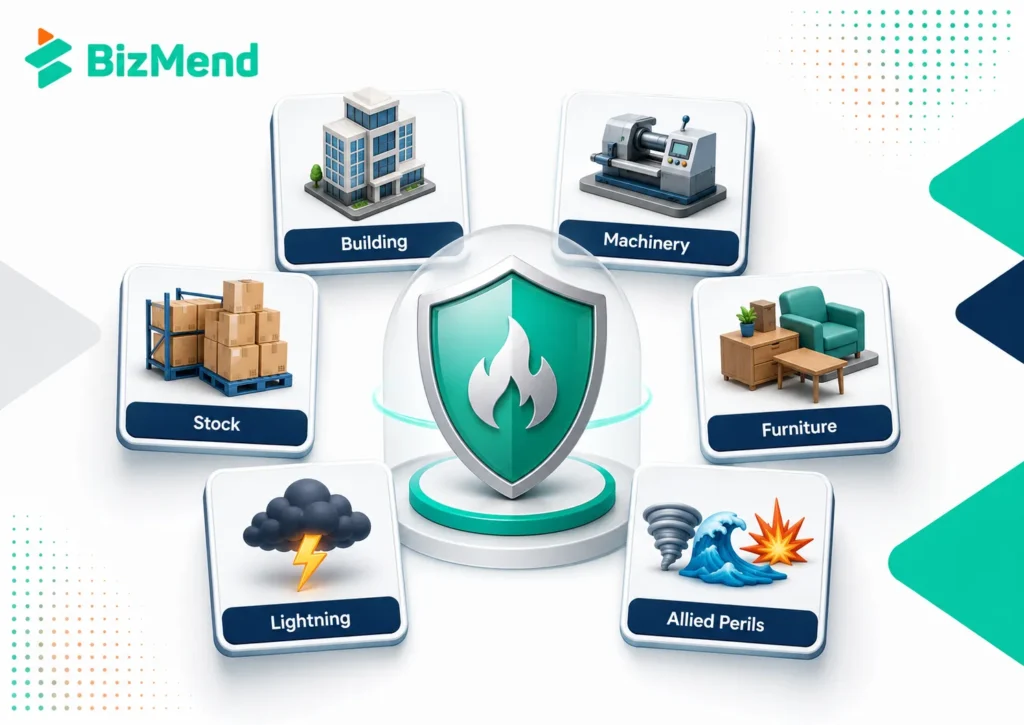
A commercial fire policy can insure one or more clearly described asset categories. The schedule should identify the premises, ownership interest, use of the property, and separate sums insured where appropriate.
- Buildings, sheds, offices, shops, factories, and warehouses
- Machinery, plant, generators, electrical installations, and equipment
- Furniture, fixtures, office equipment, and interior improvements
- Raw materials, work in progress, finished goods, and trading stock
- Landlord-owned building portions or tenant-owned contents, when separately declared
- Other approved assets specifically listed in the policy schedule
Land itself is generally not treated like a building or movable asset because fire does not destroy the land in the same way. The insurable amount should normally reflect the appropriate rebuilding, replacement, or stock value basis stated by the insurer, not simply the property’s sale price.
Common Fire and Property Policy Options
Basic fire cover
The narrowest form usually focuses on fire and lightning. It may suit a simple risk only when the buyer understands that other causes of loss are not automatically included.
Fire and allied perils
Additional perils may be added for extra premium, subject to underwriting. Pragati publicly lists examples such as riot and strike damage, cyclone, flood, and explosion. The exact wording, definitions, sublimits, and exclusions must be confirmed in the issued policy.
Industrial all-risks or property all-risks cover
Larger factories and complex commercial risks may need broader property-damage protection. Pragati describes Industrial All Risks Insurance as an improved version of Fire & Allied Perils Insurance with broader risk coverage, and its public page states a minimum sum insured or asset value of Tk 50 crore for that product. That threshold is provider-specific, not a universal market rule.
Declaration policy for fluctuating stock
Businesses with stock that rises and falls during the year may be offered a declaration-based structure, but declaration policies may have strict eligibility rules and should not be assumed suitable for retail stock or stock-in-process. The insured provides periodic stock declarations, and the provisional premium may later be adjusted. This arrangement has conditions and may not be suitable for every stock category or retail operation.
Business interruption extension
Property damage cover pays for insured physical loss. Business interruption insurance is different: when added and triggered by covered property damage, it may address lost revenue, continuing expenses, or additional costs during the recovery period. It should not be assumed to be included in a standard fire policy.
Covered Risks and Common Exclusions
| Area | What to Check |
| Core insured events | Fire and lightning; confirm the policy definition and any special conditions. |
| Optional allied perils | Explosion, cyclone, flood, riot, strike, malicious damage, or other named perils only when included. |
| Electrical damage | Check whether short circuit, electrical arcing, or damage limited to the affected machine is excluded or restricted. |
| Stock and valuables | Confirm valuation, records, location, storage conditions, and whether cash or jewellery is excluded. |
| War and nuclear risks | Commonly excluded unless a special arrangement applies. |
| Intentional or fraudulent loss | Deliberate damage, misrepresentation, or fabricated evidence can invalidate a claim. |
| Poor maintenance or wear | Gradual deterioration, corrosion, inherent defect, and ordinary wear are generally not fire losses. |
| Unoccupied or changed premises | Vacancy, altered business activity, hazardous materials, or structural changes may require prior notice. |
The policy schedule, clauses, endorsements, and exclusions form one contract. A brochure is not a substitute for reading the issued documents. Ask the insurer to explain any warranty relating to fire extinguishers, hydrants, electrical inspection, storage distance, security, or housekeeping while separately reviewing the workplace-safety duties that may apply under labour law in Bangladesh.
Who Should Consider Business Fire Insurance?
- Retail shops carrying stock, fixtures, and electronic equipment
- Factories with machinery, raw materials, finished goods, and production downtime risk
- Warehouse operators holding their own goods or customers’ goods
- Restaurants, offices, clinics, schools, and service businesses with fitted premises
- Landlords involved in real estate investment in Bangladesh may need fire insurance for the building structure and common-area assets, while tenants should separately insure their stock, equipment, and fit-outs.
- Tenants responsible for fit-outs, equipment, or stock under a lease
- Lenders or borrowers where property insurance is required by financing terms
Ownership and responsibility matter. A landlord’s building policy may not cover a tenant’s stock, and a tenant’s contents policy may not cover the landlord’s structure. Warehouse operators should also distinguish property insurance from legal liability cover for customers’ goods.
What Determines the Fire Insurance Premium?
There is no reliable one-price answer for fire insurance premiums in Bangladesh. The insurer assesses the exposure and applies the applicable tariff or underwriting basis, risk coverage, taxes, stamp duty, and policy conditions shown in the quotation.
| Pricing factor | Why it matters |
| Sum insured | A higher declared value increases the amount exposed to loss. |
| Construction | Concrete, steel, timber, roofing, partitions, and fire separation affect severity. |
| Occupancy | An office, garment factory, chemical store, restaurant, and warehouse present different hazards. |
| Location and surroundings | Access for firefighters, congestion, nearby hazardous premises, and flood or cyclone exposure may matter. |
| Fire protection | Extinguishers, alarms, hydrants, sprinklers, trained staff, and maintenance can affect underwriting. |
| Claims history | Past losses and unresolved safety issues may influence terms. |
| Selected perils | Adding flood, cyclone, explosion, riot, or business interruption increases the scope. |
| Deductible and limits | A higher deductible may reduce premium but increases the policyholder’s share of a loss. |
Pragati’s current public example states that the premium is based on the sum insured multiplied by the applicable premium rate, and that cost commonly includes premium, VAT, and stamp duty. Pragati’s public sample calculation shows VAT at 15% on premium, but buyers should review the current rules for VAT in Bangladesh and confirm the applicable VAT, stamp duty, tariff rate, and final payable amount in the insurer’s quotation.
How to Set the Sum Insured Correctly
Underinsurance is one of the most expensive mistakes. If a building, machine, or stock portfolio is insured below the required value, an average or contribution clause may reduce the claim even when the loss is partial. Overstating value does not create a profit either; property insurance is generally designed to indemnify actual covered loss.
1. List each asset category and location separately.
2. Choose the valuation basis required by the insurer, such as reinstatement or replacement value for buildings and machinery.
3. Use current stock records and consider seasonal peaks.
4. Separate owned property, leased property, customers’ goods, and landlord or tenant interests.
5. Review the values at renewal and after major purchases, expansion, renovation, or inflation-driven cost changes.
Fire Insurance Claim Process in Bangladesh
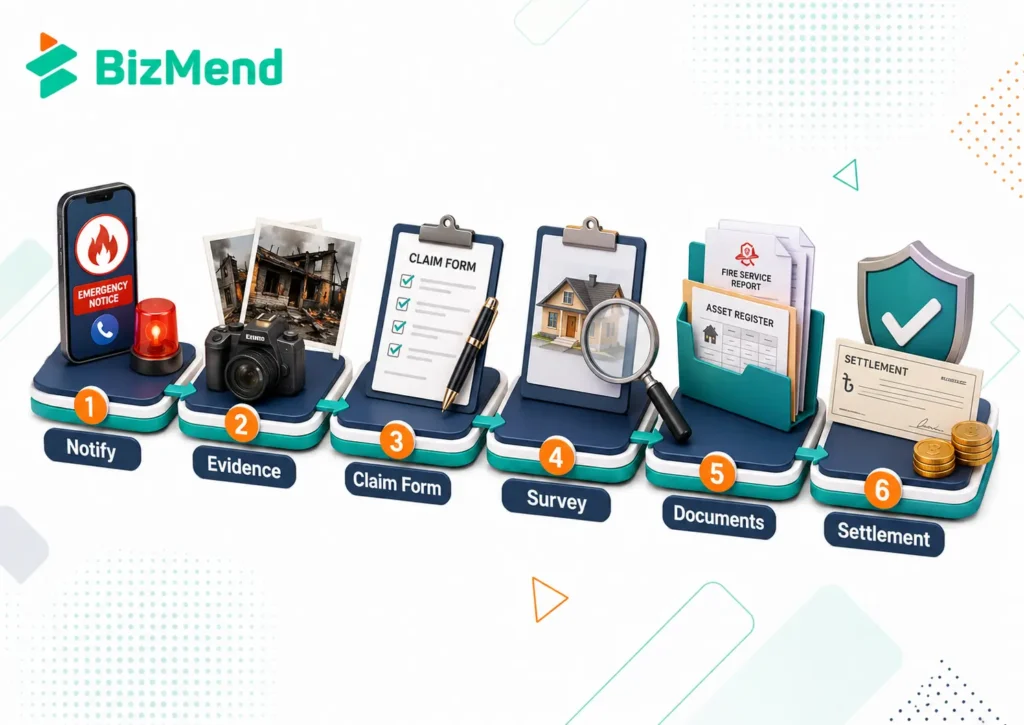
A claim should be handled as an evidence-preservation process, not only as a request for payment. The exact deadlines and documents come from the policy, so contact the insurer or authorized representative immediately.
1. Protect life first and call the Fire Service or emergency authority. Do not take unsafe steps merely to protect insured property.
2. Notify the insurer promptly through the required channel and obtain a claim reference.
3. Take reasonable steps to reduce further damage without destroying evidence. Keep damaged items unless disposal is authorized.
4. Photograph and video the scene, damaged property, entry points, electrical panels, and affected stock where safe.
5. Submit the claim form and initial loss estimate within the policy’s required time.
6. Cooperate with the appointed surveyor, provide access, and answer document requests accurately.
7. Obtain approval before permanent repairs or major disposal, except urgent work needed for safety or loss reduction.
8. Review the survey findings, deductible, underinsurance adjustment, salvage, and settlement offer before signing discharge documents.
Documents Commonly Required for a Fire Claim
The insurer may request different evidence depending on whether the claim involves a home, shop, warehouse, factory, financed property, or business interruption. A typical commercial file may include:
- Completed claim form and written loss statement
- Policy schedule, endorsements, and premium-payment evidence
- Fire Service report and, where relevant, police report or general diary
- Ownership documents, lease, mortgage, or proof of insurable interest
- Asset register, purchase invoices, stock register, inventory reports, and VAT records
- Audited accounts, sales and purchase records, or production records for stock and interruption claims
- Photos, videos, CCTV records, incident logs, and witness details
- Repair or replacement quotations and technical reports
- Bank or lender information when the property is financed
- Any additional records requested by the surveyor or insurer
Missing records do not always mean that a genuine loss never occurred, but weak documentation makes valuation and verification much harder. Businesses should maintain off-site or cloud backups of stock, asset, accounting, and policy records.
Inspection, Survey, and Claim Settlement Basics
The insurer may appoint a surveyor or loss assessor to inspect the site, investigate the cause, verify the insured interest, evaluate damage, review safety compliance, and estimate the covered amount. The surveyor does not simply total replacement invoices; the assessment may consider depreciation, reinstatement conditions, salvage, deductible, policy limits, underinsurance, and excluded damage.
Settlement timing depends on the scale of the fire, evidence quality, cause investigation, repair estimates, accounting records, third-party reports, and whether the insurer needs clarification. Never assume that a submitted claim is automatically approved. If there is a dispute, request the insurer’s written position and use the complaint or regulatory process available under the policy and applicable Bangladesh insurance framework.
Practical Fire Insurance Examples
Example 1: Retail shop
A clothing shop insures stock, shelves, air conditioners, computers, and interior improvements. A fire damages stock and fittings. The claim depends on the listed assets, stock records, insured perils, deductible, valuation, and whether the declared sum insured reflects the actual exposure.
Example 2: Factory with production downtime
A factory insures its building, machinery, and stock under property cover and separately adds business interruption. After covered fire damage, the property section addresses physical loss, while the interruption section may respond to insured loss of revenue and continuing expenses, subject to the indemnity period and financial evidence.
Example 3: Landlord and tenant
A landlord insures the building, while the tenant insures stock, equipment, and fit-out. After a fire, each party claims under its own insured interest. Assuming one policy covers everything can leave a major gap.
Common Mistakes to Avoid
- Buying the cheapest policy without comparing covered perils and exclusions
- Insuring only the building while forgetting stock, machinery, or fit-out
- Using outdated asset values and ignoring seasonal stock peaks
- Assuming flood, cyclone, explosion, or business interruption is automatic
- Failing to disclose hazardous materials, business activity changes, or renovations
- Ignoring fire-safety warranties and maintenance requirements
- Repairing or discarding damaged property before the surveyor documents it
- Keeping all invoices and stock records only inside the insured premises
- Expecting the sum insured to be paid in full regardless of actual covered loss
How to Choose a Fire Insurance Provider
Compare licensed non-life insurers on policy wording, underwriting support, survey capability, branch or service access, claims communication, reinsurance strength, and experience with your type of property. Sadharan Bima Corporation is Bangladesh’s state-owned non-life insurer and an important part of the country’s general-insurance and reinsurance market. Private property owners can obtain quotations from IDRA-regulated non-life insurers, but they should verify the insurer, branch or intermediary, payment channel, policy schedule, and official receipt before paying.
Do not treat brand recognition as proof that every policy is identical. Ask for a written quotation showing the insured locations, assets, sums insured, perils, exclusions, deductible, warranties, taxes, stamp duty, and claim-contact process, and ensure the person accepting the policy on behalf of the company is an authorized signatory. For a factory, warehouse, or high-value commercial property, involve a qualified insurance adviser, engineer, valuer, or risk surveyor before finalizing cover.
Key Insights
- A basic fire policy is narrower than fire-and-allied-perils or all-risks cover.
- The schedule must clearly identify each property category, location, and sum insured.
- Premium depends on exposure and protection measures, not property value alone.
- Business interruption normally needs separate wording and a covered property-damage trigger.
- Fast notification and reliable records are central to a defensible claim.
- Policy wording and endorsements control the claim, not advertising summaries.
Final Thoughts
Fire insurance in Bangladesh can protect a shop, factory, warehouse, office, home, or commercial building from a loss that might otherwise disrupt cash flow or close the business. The useful policy is not automatically the cheapest one; it is the policy that accurately lists the property, uses realistic values, covers the relevant perils, and has conditions the owner can meet.
Before signing, review exclusions, deductibles, valuation, safety warranties, business interruption needs, and claim documents with the insurer or a qualified adviser. Recheck the policy whenever stock, machinery, occupancy, construction, or location changes.
Frequently Asked Questions
Is fire insurance mandatory in Bangladesh?
Fire insurance is not universally mandatory for every property owner. It may, however, be required by a lender, lease, contract, regulator, buyer, or sector-specific arrangement. Confirm the requirements that apply to your property and business.
Does a standard fire policy cover flood and cyclone?
Not automatically. Flood, cyclone, explosion, riot, strike, and other allied perils should be checked in the quotation and policy schedule. Additional premium and underwriting conditions may apply.
How is the fire insurance premium calculated?
The insurer considers the sum insured, property construction, occupancy, location, fire protection, claims history, selected perils, deductible, taxes, and duties. Request a written calculation rather than relying on a generic percentage.
Can a tenant buy fire insurance?
Yes. A tenant can insure property in which it has an insurable interest, such as stock, equipment, furniture, and fit-out. The landlord may separately insure the building.
Does fire insurance cover lost business income?
Only when appropriate business interruption cover is included and its conditions are met. Standard property damage cover should not be assumed to replace lost revenue.
What should I do immediately after a fire?
Protect people, contact emergency services, notify the insurer promptly, prevent further loss where safe, preserve evidence, and document the damage. Follow the policy’s notice and claim instructions.
Can an insurer reject a fire claim?
A claim may be reduced or declined when the event is excluded, the property is not insured, conditions are breached, values are materially misstated, evidence is insufficient, or fraud is involved. The insurer should explain its decision under the policy and applicable process.