How to Become a Daraz Seller in Bangladesh: Registration, Fees & Growth
Learn how to become a Daraz seller in Bangladesh, register an account, list products, understand fees, manage orders, and grow…
 by Sheikh Ornob

Quick Answer: The business environment in Bangladesh in 2026 is active, reform-driven, and uneven. Bangladesh still offers a large consumer base, competitive manufacturing strength, export potential, and improving digital investor...
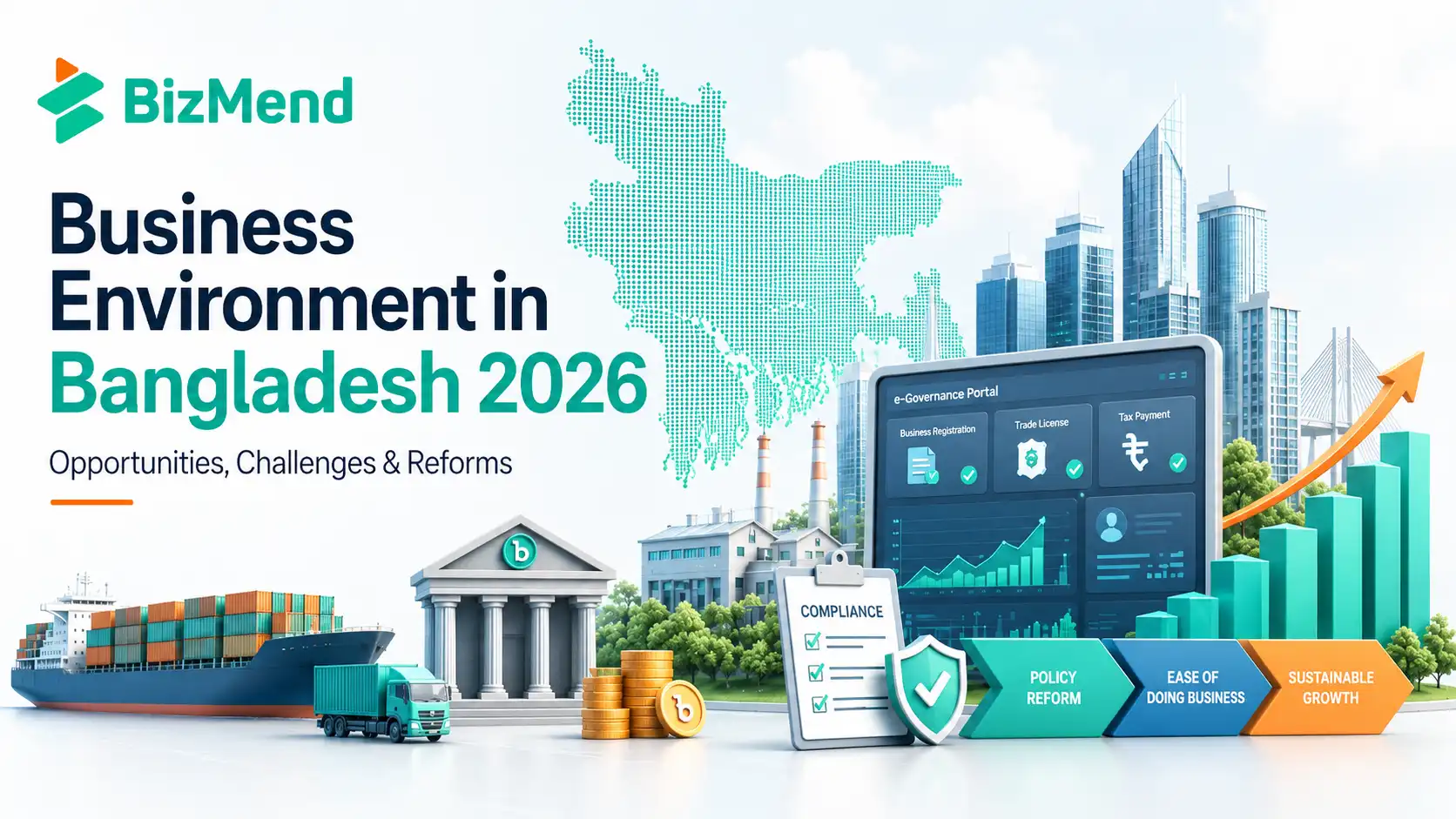
Quick Answer: The business environment in Bangladesh in 2026 is active, reform-driven, and uneven. Bangladesh still offers a large consumer base, competitive manufacturing strength, export potential, and improving digital investor services. At the same time, businesses must plan for inflation pressure, banking-sector stress, tax complexity, infrastructure gaps, customs delays, policy uncertainty, and slower growth. The safest reading is simple: Bangladesh is not a low-risk market, but it remains a serious opportunity for prepared investors.
Bangladesh is still investable, but it is harder to read. Growth is slower. Reform now matters as much as opportunity.
For years, Bangladesh was discussed mainly through fast GDP growth, ready-made garment exports, low-cost labor, and a rising domestic market. That story still matters, but the business environment in Bangladesh now needs a more balanced reading.
In 2026, entrepreneurs and investors are looking at a market with real demand, industrial experience, and digital reform efforts. They are also looking at higher operating costs, fragile banking conditions, and compliance systems that can slow execution.
Key Insights
Bangladesh remains one of South Asia’s important production and consumer markets. Its strengths are clear: a large population, export manufacturing capacity, remittance-supported demand, a growing services economy, and a business community used to operating under pressure.
The weaker side is also visible. The World Bank’s April 2026 Bangladesh update pointed to slower growth, persistent inflation, a stressed banking sector, weak revenue mobilization, and subdued private investment. It also linked a stronger recovery to reforms in revenue, finance, jobs, and the broader business environment.
This makes the 2026 picture mixed. Bangladesh is not a market to enter casually. It rewards local knowledge, cost control, compliance planning, working-capital discipline, and patience with approvals.
The Bangladesh economy 2026 outlook is cautious rather than overheated. Forecasts differ by institution, which is normal during a transition period. The World Bank projected FY26 growth at 3.9%, while ADB’s April 2026 outlook placed Bangladesh growth at 4.0% in 2026 and 4.7% in 2027.
The direction matters more than one forecast. Bangladesh is recovering, but not at the pace investors became used to in earlier high-growth years. Inflation still affects wages, purchasing power, raw material costs, inventory planning, and working capital.
| Business signal | What it means for investors |
| Slower growth | Demand still exists, but sales planning should be conservative. |
| High inflation | Pricing, payroll, imports, and financing need regular review. |
| Banking-sector stress | Credit access and transaction documentation need extra care. |
| FDI recovery signal | Investor engagement exists, but confidence is still rebuilding. |
BIDA reported that net FDI inflows increased 39.36% in 2025 to USD 1.77 billion, citing Bangladesh Bank survey data. That is encouraging, but it should not be treated as a complete recovery. It shows investor interest while the operating environment still needs stronger execution.
Ready-made garments remain Bangladesh’s most visible export engine. The sector has deep supplier networks, an experienced workforce, and long buyer relationships. For companies planning an export business, the next opportunity is not only basic production, but also design, compliance, sustainability, higher-value products, and faster logistics.
Beyond garments, major industries in Bangladesh have room to grow in pharmaceuticals, agro-processing, leather and footwear, jute products, light engineering, electronics, plastics, ceramics, healthcare, logistics, IT, digital services, and renewable energy support services. Many of these sectors benefit from domestic demand and export diversification pressure.
Some emerging areas need extra caution. Semiconductors, high-tech manufacturing, and green industries are gaining policy attention, but projects will depend on skills, power quality, finance, land access, and reliable public services.
Bangladesh business opportunities are strongest where demand, cost advantage, and reform pressure meet. A local SME or startup in Bangladesh may find growth in distribution, food processing, logistics, digital commerce, packaging, accounting support, or compliance services. A foreign investor may look at export production, supplier development, industrial inputs, health services, or technology-enabled business support.
The domestic market also matters. Urban consumers are more digitally connected, and businesses increasingly need better accounting, software, payment, delivery, quality-control, and customer-support systems. That creates space for service providers, not only manufacturers.
The main business challenges in Bangladesh are often operational, not theoretical. A company may be legally registered but still struggle with permits, banking, VAT, customs, electricity, land, or foreign exchange documentation. These issues affect cost, timelines, and investor confidence.
Financing is another pressure point. Banking stress can affect credit availability, lending cost, payment discipline, and supplier confidence. Businesses that depend heavily on short-term borrowing should test their cash-flow model before expansion.
Infrastructure can directly change the investment case. Exporters should model port handling, customs documentation, export documents, inland transport, warehouse capacity, and power backup needs before pricing orders. Even when electricity access improves, reliability, outage planning, logistics costs, and customs delays can still affect delivery promises.
Many older articles still mention Bangladesh’s World Bank Doing Business rank. That should be handled carefully. The World Bank discontinued the Doing Business report in 2021 after data irregularities, so Bangladesh does not have a current annual World Bank Doing Business rank.
For ease of doing business BD discussions, the better approach is to explain practical business conditions and use newer references such as the World Bank Business Ready, or B-READY, dataset. B-READY looks at regulatory framework, public services, and operational efficiency across business topics.
World Bank B-READY data shows Bangladesh scored 74.1 out of 100 for Business Entry in 2024, while the overall Regulatory Framework pillar score was 56.9. That means entry procedures may show some relative strength, but regulatory quality, public services, dispute resolution, taxation, and trade facilitation still need careful review.
A typical formal setup may involve RJSC registration for companies, a trade license, e-TIN, VAT or BIN registration where applicable, bank account opening, and sector-specific permits. The exact path depends on ownership, activity, location, industry, and whether the investor is local or foreign.
Digital services are improving the process. BIDA’s One Stop Service portal, BanglaBiz, NBR e-services, e-Return, e-TIN, e-BIN, eVAT, e-Payment, a-Chalan, and the Bangladesh Trade Portal all point toward a more digital compliance environment. However, digital availability does not remove the need to verify current rules.
Tax and banking deserve early planning. Businesses should understand corporate tax exposure, VAT duties, withholding tax, customs duties, payroll obligations, foreign exchange documentation, and audit records before operations become complex. Fixing weak records later is usually more expensive.
The investment climate in Bangladesh is being shaped by reform pressure. BIDA describes its OSS platform as a single-window service for investor support, and BanglaBiz presents itself as a one-stop platform for starting and running a business. The Bangladesh Trade Portal also supports trade transparency by collecting import and export regulatory information.
Recent Bangladesh economic reforms are not only about digital portals. BIDA said in March 2026 that BIDA, BEZA, PPPA, and MIDA had unveiled a joint 180-day action plan focused on core improvements to the business climate for local and foreign investors. That gives the reform section a current signal, but execution will decide the real value.
The IMF has also emphasized tax policy reform, stronger tax administration, banking-sector reform, exchange-rate flexibility, governance, and central bank autonomy. For businesses, these reforms may improve confidence over time, but they can also bring transition costs, stricter enforcement, and new documentation demands.
Before entering Bangladesh, businesses should test the market with a practical checklist. The first question is not only whether demand exists. It is whether demand can be served profitably after tax, compliance, logistics, staffing, finance, and approval costs.
Foreign investors should also assess ownership structure, dividend and royalty remittance rules, sector restrictions, dispute resolution options, exit planning, and global business setup options before entering the market. Local entrepreneurs should focus on accounting discipline, VAT records, payroll compliance, working capital, and reliable supplier relationships.
The business environment in Bangladesh in 2026 is neither weak enough to ignore nor smooth enough to romanticize. It is a market with demand, industrial depth, and reform momentum, but also real friction in banking, taxation, infrastructure, approvals, and policy execution.
The best-positioned businesses will not enter only because Bangladesh looks affordable. They will enter because they understand the investment climate in Bangladesh, the compliance load, the financing limits, the logistics reality, and the reforms that may shape future growth.
That balanced view is the safest one. Bangladesh can still reward serious entrepreneurs and investors, but it rewards preparation more than optimism.
Bangladesh can be a good place to do business for prepared investors and entrepreneurs. It offers a large domestic market, export capacity, competitive labor, and growing digital services. However, inflation, regulatory complexity, banking stress, and infrastructure limits must be planned carefully.
Strong opportunity areas include ready-made garments, agro-processing, pharmaceuticals, light engineering, logistics, digital services, healthcare, packaging, and export-support services. The best sector depends on capital, compliance capacity, buyer access, and local execution strength.
No. The World Bank discontinued the Doing Business report in 2021. Any old Bangladesh Doing Business ranking should be treated as historical, not current. For 2026, it is better to discuss practical business conditions and B-READY indicators.
Common challenges include regulatory complexity, tax and VAT compliance, banking-sector stress, access to finance, infrastructure reliability, customs procedures, skills gaps, and policy uncertainty. These vary by sector, location, and company structure.
Investors should avoid treating old Doing Business rankings as current. They should review business registration steps, tax procedures, trade rules, dispute resolution, utility reliability, digital services, and B-READY indicators for a more practical view.
Yes. BIDA OSS, BanglaBiz, NBR e-services, e-Return, eVAT, and trade-related portals show steady digitalization. Still, businesses should verify the latest process because paper documents and agency-level requirements may still apply.
Useful sources include the World Bank, IMF, ADB, Bangladesh Bank, BIDA, NBR, BBS, Bangladesh Trade Portal, and official ministry publications. For laws, taxes, and sector licensing, official gazettes and regulator websites should be checked directly.

Learn how to become a Daraz seller in Bangladesh, register an account, list products, understand fees, manage orders, and grow…
by Sheikh Ornob
Compare the cost of living in Bangladesh in 2026, including Dhaka and Chittagong rent, food, transport, utilities, inflation, and monthly…
by Sheikh Ornob

Learn MoA and AoA requirements in Bangladesh, key clauses, drafting basics, RJSC filing steps, amendments, and common company-registration mistakes. Suggested…
by Sheikh Ornob