How to Become a Daraz Seller in Bangladesh: Registration, Fees & Growth
Learn how to become a Daraz seller in Bangladesh, register an account, list products, understand fees, manage orders, and grow…
 by Sheikh Ornob

Quick Answer: Economic zones in Bangladesh are planned industrial and investment areas created to make manufacturing, exports, technology businesses, and large-scale industrial projects easier to set up. BEZA manages broader...
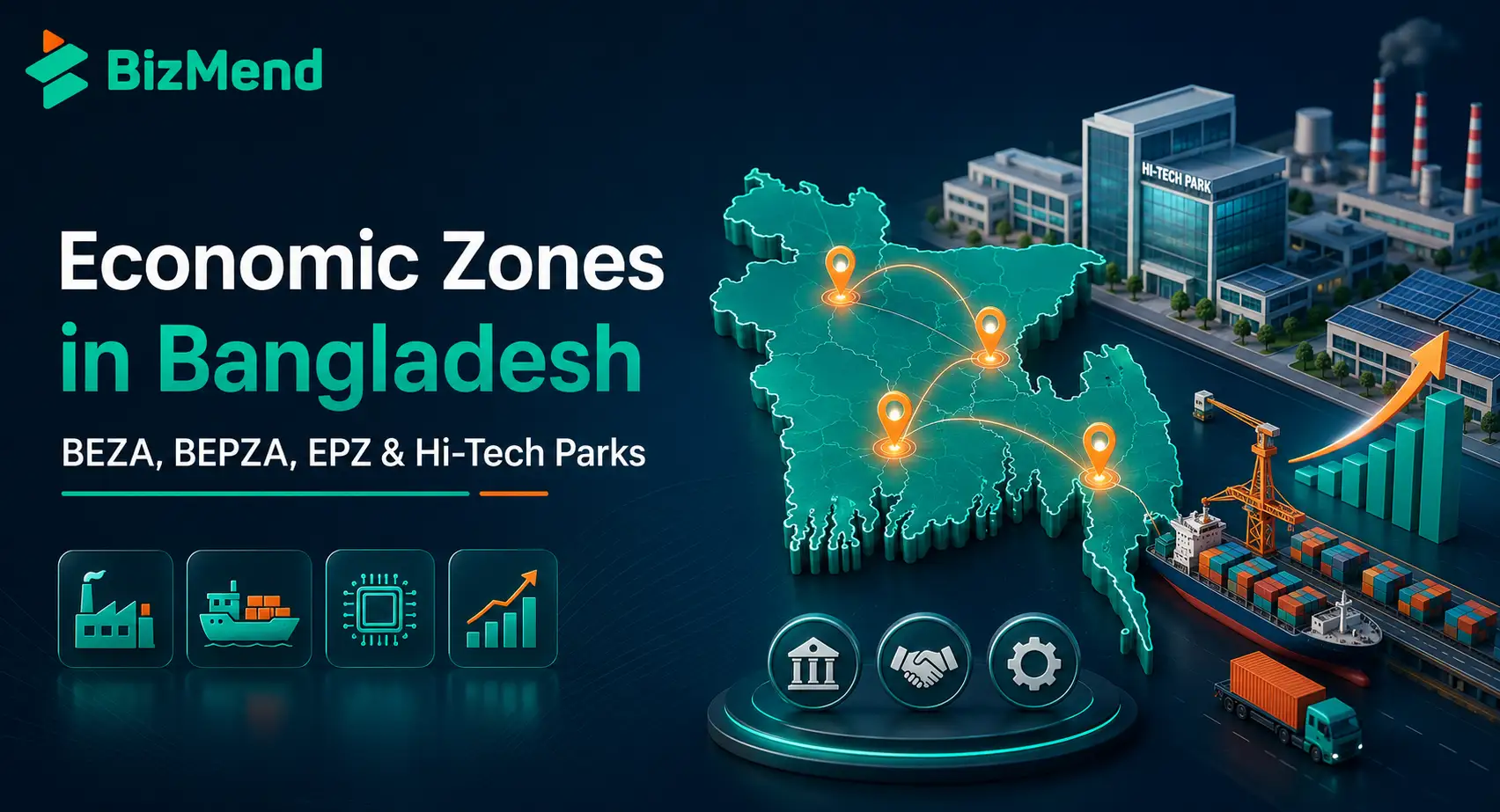
Quick Answer: Economic zones in Bangladesh are planned industrial and investment areas created to make manufacturing, exports, technology businesses, and large-scale industrial projects easier to set up. BEZA manages broader economic zones; BEPZA manages export processing zones and its own economic zone, and the Bangladesh Hi-Tech Park Authority focuses on technology-based parks, software technology parks, and incubation facilities.
Industrial land is where Bangladesh’s investment story becomes real. Economic zones in Bangladesh promise ready plots, customs support, utilities, and export access. But the right choice depends on authority, sector, location, and zone readiness.
For local entrepreneurs and foreign investors exploring BEZA or Hi-Tech Parks, the opportunity is clear. Bangladesh wants more factories, more export diversification, more technology businesses, and stronger investment infrastructure. Economic zones are part of that plan.
Still, doing business inside a zone is not automatic success. A BEZA zone, a BEPZA EPZ, and a Hi-Tech Park may all sound similar, but they differ in purpose, regulation, facilities, incentives, and investor fit.
Economic zones in Bangladesh are designated areas where industrial, commercial, export, or technology businesses can operate with planned infrastructure and regulatory support. The basic idea is to reduce the usual pain of industrial setup: land search, utility access, permits, customs movement, and coordination with several agencies.
BEZA’s OSS FAQ describes economic zones as areas declared by the government for industry, small and cottage industry, commercial activity, and tourism-related establishments, with the goal of accelerating development, production, employment, and exports. That definition is useful because it shows the wider scope of Bangladesh economic zones beyond only garment exports.
In practice, investors should treat each zone as a separate project. Some zones are mature and operating. Some are under development. Some are sector-focused. Some are better for exports, while others are better for domestic-market manufacturing, logistics, or technology operations.
Fixed line:
Bangladesh has long depended on ready-made garments, but the next phase of industries in Bangladesh needs wider industrial capacity. Zones help by creating serviced industrial space where investors can build factories faster than they could on scattered private land.
The Export Policy 2024-2027 also points in this direction. It emphasizes export diversification, stronger business conditions, better standards, more competitive production, infrastructure improvement, and support for non-RMG sectors such as processed food, leather goods, footwear, light engineering, jute products, pharmaceuticals, ICT services, software, BPO, and tourism.
That is why investment zones in Bangladesh matter. They connect land, logistics, utilities, compliance, and policy support into one industrial platform. When they work well, they can lower setup friction and make Bangladesh easier to compare with competing manufacturing destinations.
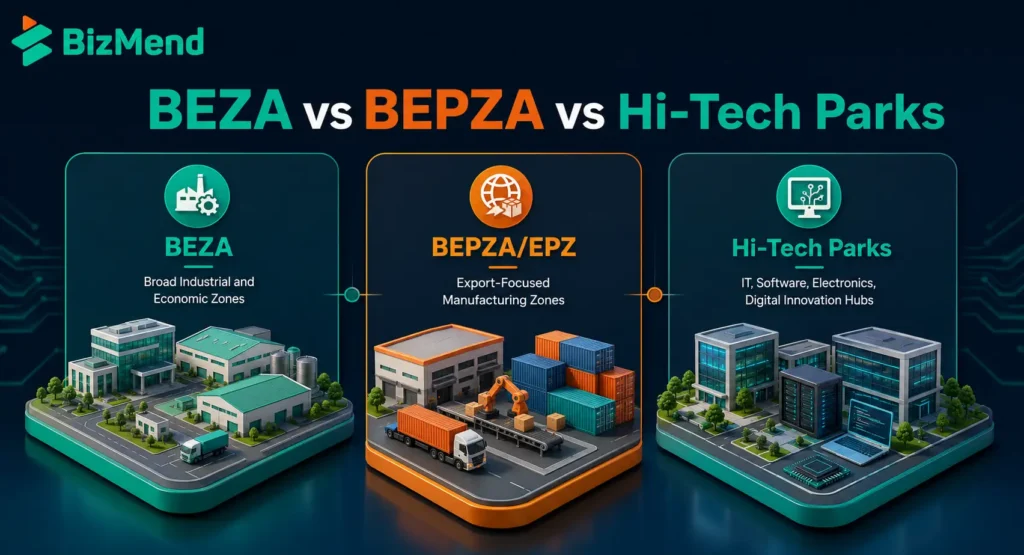
The biggest mistake is to use all zone terms interchangeably. BEZA, BEPZA, EPZ, and Hi-Tech Parks are connected to investment policy, but they are not the same structure.
| Facility type | Main authority | Best fit | Investor note |
| BEZA economic zones | Bangladesh Economic Zones Authority | Manufacturing, logistics, tourism, mixed industrial projects, export and domestic-market projects | Zone readiness varies. Check land, utilities, developer, permits, and sector eligibility. |
| EPZ Bangladesh facilities | Bangladesh Export Processing Zones Authority | Export-oriented manufacturing | BEPZA is the older and more tested model for export-focused factories. |
| BEPZA Economic Zone | BEPZA | Larger industrial investment inside BEPZA’s newer zone model | BEPZA says its Mirsharai zone covers 1,138.55 acres and has operating companies. |
| Hi-Tech Parks | Bangladesh Hi-Tech Park Authority | IT, ITES, software, electronics, digital services, incubation, and innovation businesses | Better fit for technology companies than heavy manufacturing. |
A simple rule helps: choose BEPZA when the core plan is export manufacturing, BEZA when the plan needs broader industrial land and zone flexibility, and Hi-Tech Park facilities when the business is technology-based.
BEZA Bangladesh was created under the Bangladesh Economic Zones Act, 2010, to establish, license, operate, manage, and regulate economic zones. Compared with the older EPZ model, BEZA is designed for a wider industrial strategy, including public, private, public-private partnership, government-to-government, specialized, and tourism-oriented zones.
BEZA’s role is not only to allocate land. Its one-stop service system lists services such as investment registration, investment clearance, name clearance, company incorporation, trade license, work permit, import and export permits, local purchase and sales permits, commercial operation, land use plan, and several environment-related services from the Department of Environment.
For investors, this means a BEZA zone can be attractive when the project needs industrial land, access to a larger production ecosystem, and coordination support. But the investor still has to check whether the selected zone has ready plots, working roads, power, gas, water, drainage, effluent treatment, telecom access, and port connectivity.
BEPZA Bangladesh is the authority behind the country’s export processing zones. BEPZA says it was established under the BEPZA Act, 1980, and is mandated to create, develop, operate, manage, and control EPZs. Its first EPZ was Chattogram EPZ in 1983, followed by Dhaka, Mongla, Cumilla, Uttara, Ishwardi, Karnaphuli, and Adamjee EPZs.
This makes EPZ Bangladesh facilities especially important for manufacturers planning an export business. They are built around export production, serviced industrial plots or factory buildings, customs support, banking and logistics support, and investor services within a controlled industrial environment.
BEPZA also runs its own BEPZA Economic Zone in Mirsharai, Chattogram. BEPZA’s current profile says the zone was launched in 2018, covers 1,138.55 acres, and has companies already operating there. That makes it different from an older EPZ, even though it sits under the BEPZA umbrella.
Hi-tech parks in Bangladesh are different from general industrial zones. They are designed for knowledge-based and technology-based activity, including software, IT-enabled services, electronics, data-driven services, incubation, training, and innovation-led businesses.
The Bangladesh Hi-Tech Park Authority says its work includes operating and managing Hi-Tech Parks, attracting FDI into hi-tech and software technology parks, developing skilled human resources, and encouraging private software technology parks. Its portal also states that it has set up 28 Hi-Tech Parks, Software Technology Parks, and IT Training and Incubation Centers, with four completed and business activity ongoing.
This matters because a software company does not need the same facility as a garment factory. A manufacturer may prioritize land, gas, customs, and port distance. A technology investor may care more about office space, internet reliability, talent pipeline, data security, tax treatment, and nearby universities or training centers.
The main benefit of industrial zones in Bangladesh is concentration. Instead of solving every setup issue alone, investors can enter a planned environment where land, approvals, and infrastructure are at least partly organized through a responsible authority or zone developer.
Benefits, including any tax holiday, should never be assumed. BEPZA lists incentives such as tax holidays, duty-free import of machinery and raw materials, duty-free export of finished goods, relief from double taxation, and profit or capital repatriation. BEPZA and Hi-Tech Park incentives are also linked to laws, SROs, and current policy documents, so investors should verify the latest rules before making cost projections.
The industry mix depends on the facility. EPZs historically support export-heavy sectors such as garments, textiles, footwear, leather products, accessories, electronics, and light manufacturing. BEPZA’s own Mirsharai profile lists products such as shoe accessories, textiles, and ready-made garments among current activities.
BEPZA zones can be broader. Depending on the specific zone, the investment may involve garments, agro-processing, food processing, light engineering, pharmaceuticals, consumer goods, logistics, packaging, chemicals, tourism, or specialized industrial activity.
Hi-Tech Parks support Bangladesh’s growing ICT sector and focus on a different direction. Their natural users include software firms, IT-enabled service providers, electronics companies, digital service exporters, startups, BPO companies, hardware-related firms, and training or incubation operators.
Most investors start with land or factory space. In an EPZ, this may mean a serviced plot or standard factory building, depending on availability. In a BEZA zone, it may mean a developer-managed lease arrangement, a government zone plot, or a private economic zone arrangement. In a Hi-Tech Park, the offer may be office space, technology park space, or incubation facilities.
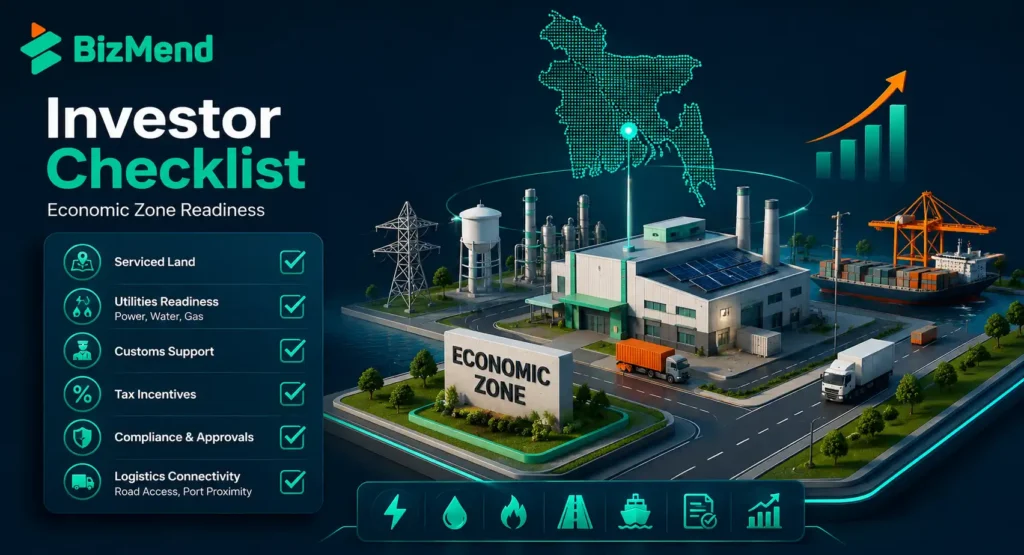
| Need | What to check before committing |
| Land or building | Plot size, lease terms, handover condition, floor loading, expansion option, and developer obligations. |
| Utilities | Power load, backup arrangement, gas access, water source, drainage, internet, and tariff assumptions. |
| Customs | Import/export permit route, bonded warehouse rules, BSW requirements, and port clearance process. |
| Tax and incentives | Current SRO, eligibility, duration, sector exclusions, reporting duties, and NBR interpretation. |
| Compliance | Environment clearance, fire safety, labor rules, building approval, waste treatment, and audit readiness. |
This is where investors need patience. A zone may look attractive in a brochure, but a factory lives or dies on power reliability, customs movement, port access, and compliance execution.
The first challenge is infrastructure readiness. Some Bangladesh economic zones have stronger road access, utilities, and investor services than others. A project in an underdeveloped zone may face delays if roads, drainage, gas, power, CETP, or internal logistics are still incomplete.
The second challenge is logistics. Distance from Chattogram Port, Mongla Port, airports, ICDs, and major highways affects cost and delivery time. Exporters should also check customs movement, container availability, freight forwarder support, and whether the facility can handle peak-season pressure.
The third challenge is regulatory coordination. One-stop service helps, but investors still need environmental clearance, fire safety, labor compliance, tax registration, VAT, customs, work permits, and sector-specific approvals. ADB has also noted that weak trade infrastructure and business-enabling factors can undermine Bangladesh’s export competitiveness, so practical due diligence is not optional.
Economic zones are not separate from Bangladesh’s wider growth plan. They support the country’s push for export diversification, industrial clustering, employment creation, FDI attraction, and higher-value production.
The Export Policy 2024-2027 says Bangladesh needs competitive production, export-friendly processes, better infrastructure, modern port management, energy support, standards, and stronger non-RMG sectors. Economic zones are one of the tools for turning those goals into factory-level capacity.
Recent reform language points in the same direction. BIDA’s March 2026 joint 180-day action plan for BIDA, BEZA, PPPA, and MIDA highlights port modernization, ready-to-use industrial park plots, economic zone conversion, energy initiatives, BanglaBiz single-window rollout, and stronger investor servicing. That matters because investors care less about slogans and more about execution.
Before choosing between BEZA, BEPZA, EPZ, or Hi-Tech Park facilities, investors should start with the business model. A 100% export-oriented garment factory, a domestic-market food processor, a pharmaceutical plant, and a software exporter should not all choose the same facility by default.
Foreign investors should also review profit repatriation, financing, banking, land lease rights, dispute resolution, foreign worker permissions, parent-company reporting, and global company formation needs before committing capital. Local investors should check financing access, collateral structure, utility deposits, and working capital pressure during the setup stage.
Economic zones in Bangladesh can make industrial investment more structured, but they do not remove every business risk. BEZA, BEPZA, EPZs, and Hi-Tech Parks each solve different problems for different investors.
The best decision starts with fit. Match the facility with your product, export plan, utility needs, compliance burden, logistics route, and timeline. Then verify the current rules directly from the relevant authority before committing capital.
Economic zones in Bangladesh are designated industrial or investment areas created to support manufacturing, exports, services, tourism, and technology businesses through planned land, infrastructure, and regulatory support.
BEZA Bangladesh means the Bangladesh Economic Zones Authority. It develops, licenses, manages, and regulates economic zones under the Bangladesh Economic Zones Act, 2010.
BEPZA Bangladesh means the Bangladesh Export Processing Zones Authority. It manages export processing zones and supports export-oriented industrial investment through EPZs and its BEPZA Economic Zone.
An EPZ is mainly designed for export-oriented manufacturing under BEPZA. A BEPZA economic zone can be broader and may support export, domestic-market, mixed industrial, logistics, tourism, or specialized projects depending on the zone.
BEPZA says it has eight operational EPZs: Chattogram, Dhaka, Mongla, Cumilla, Uttara, Ishwardi, Karnaphuli, and Adamjee. It also has a BEPZA Economic Zone in Mirsharai, Chattogram.
They are usually better for technology-based businesses than heavy manufacturing. Software, ITES, electronics, digital services, incubation, and innovation-led companies are a stronger fit for Hi-Tech Park facilities.
No. Incentives vary by authority, zone, sector, ownership structure, approval date, and current SRO. Investors should verify the latest tax and customs treatment before preparing financial projections.
There is no single best option. BEPZA may suit export manufacturing, BEZA may suit broader industrial projects, and Hi-Tech Park facilities may suit technology companies. The right choice depends on sector, market, utilities, logistics, and regulatory needs.

Learn how to become a Daraz seller in Bangladesh, register an account, list products, understand fees, manage orders, and grow…
by Sheikh Ornob
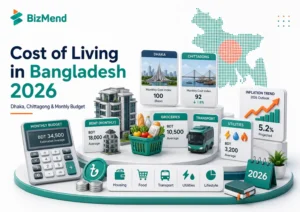
Compare the cost of living in Bangladesh in 2026, including Dhaka and Chittagong rent, food, transport, utilities, inflation, and monthly…
by Sheikh Ornob

Learn MoA and AoA requirements in Bangladesh, key clauses, drafting basics, RJSC filing steps, amendments, and common company-registration mistakes. Suggested…
by Sheikh Ornob