
 by Sheikh Ornob
Bangladesh is a $460 billion economy (at current GDP prices in 2025) built on a handful of industries that most people outside South Asia know little about. The garment factories get attention. The rest often don’t. But Bangladesh’s pharmaceutical sector exports to over 150 countries and meets most domestic medicine demand through local production. The IT industry hit $724.6 million in service exports last fiscal year. And agriculture still employs more than 40% of the entire workforce. This guide breaks down the biggest industries in Bangladesh, what the real numbers say, and the honest challenges facing each sector right now.
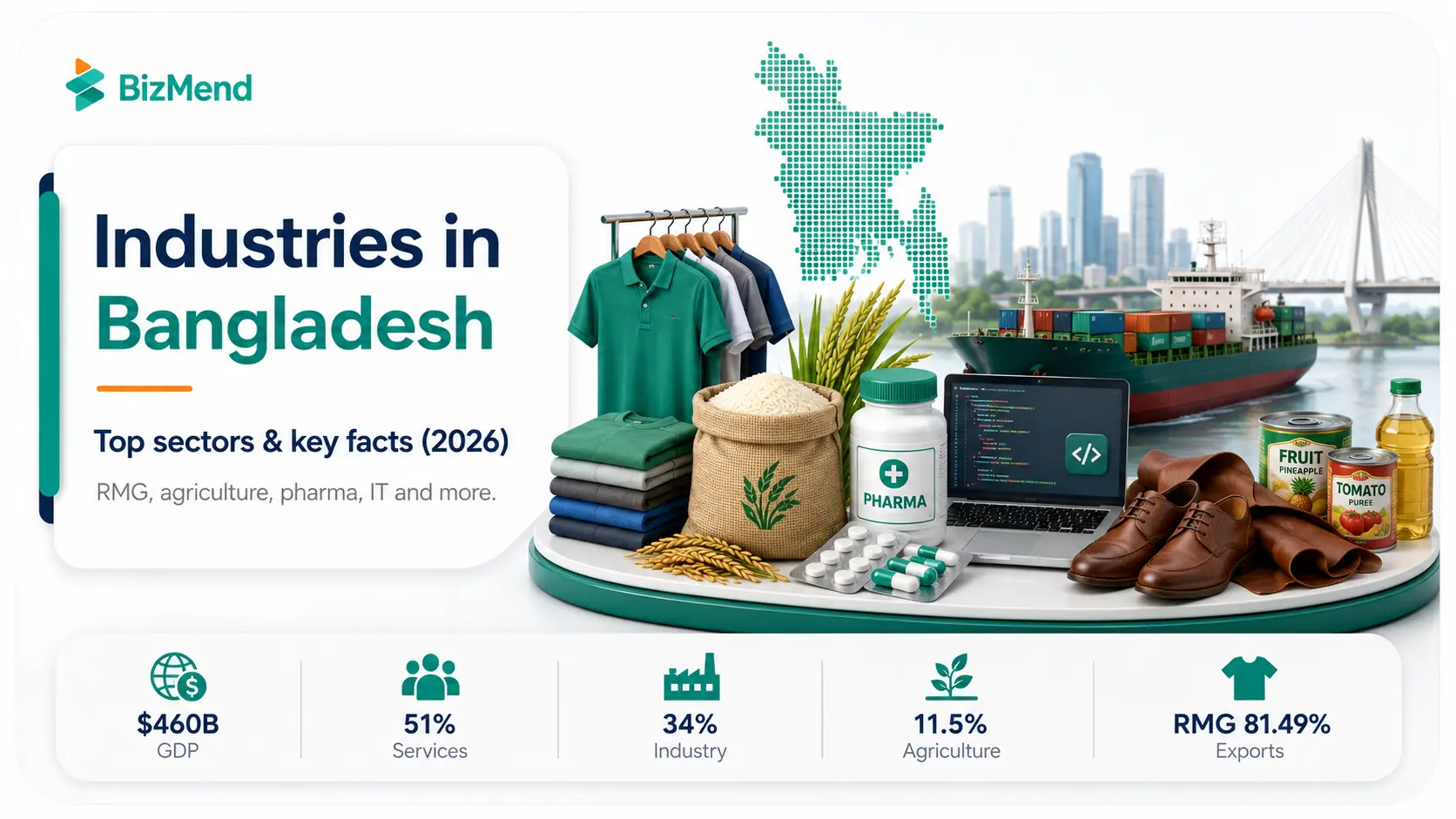
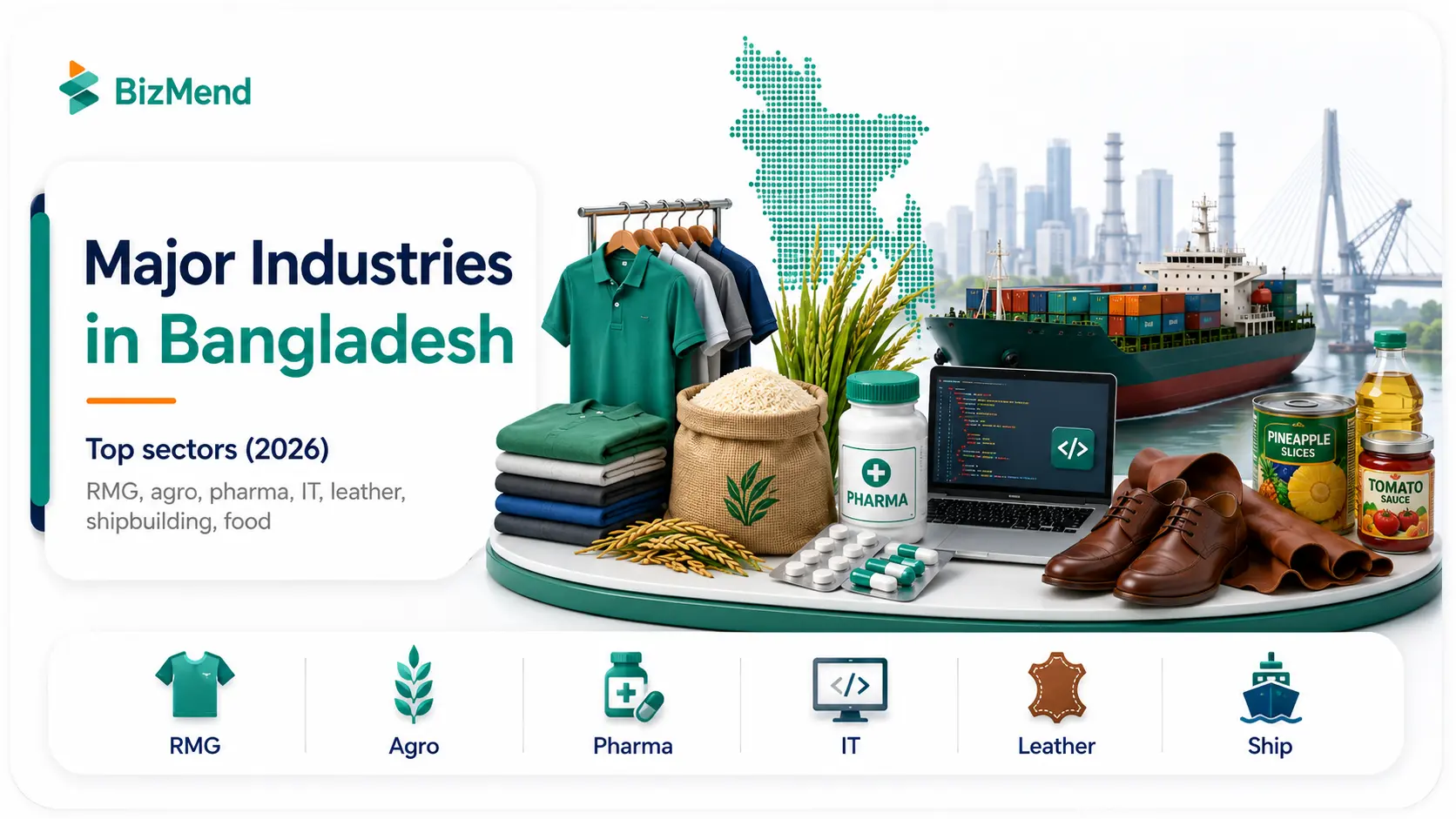
Quick Answer: Bangladesh’s biggest industries in 2026 are ready-made garments (RMG), agriculture, pharmaceuticals, information technology, leather and footwear, shipbuilding, and food processing. The RMG sector alone accounts for over 81% of total export earnings, making Bangladesh the world’s second-largest garment exporter. Services contribute about 51% of GDP, industry about 34%, and agriculture approximately 11.5% of GDP while employing over 40% of the workforce.
 How Bangladesh’s Economy Is Structured
Bangladesh is the 34th-largest economy in the world by nominal GDP and the second-largest in South Asia, per Wikipedia’s economy of Bangladesh entry (updated May 2026). In FY2024-25, Bangladesh’s GDP growth slowed to around 3.97% according to provisional BBS data, the lowest since the post-Covid period.
Three sectors drive the economy. Services account for roughly 51% of GDP. The industrial and manufacturing sector contributes about 34%. Agriculture sits at approximately 11.5% of GDP but remains the largest employer, covering about 40.6% of the workforce. Total exports in FY2024-25 were approximately $48.28 billion, per BGMEA data.
One important context to carry through this entire article: Bangladesh is scheduled to graduate from Least Developed Country (LDC) status in November 2026. That graduation changes trade preferences for almost every export industry discussed below.
1. Ready-Made Garments: The Industry That Built Modern Bangladesh
No discussion of industries in Bangladesh starts anywhere other than here. Ready-made garments (RMG) accounted for $39.35 billion in exports in FY2024-25, representing 81.49% of Bangladesh’s total export receipts of $48.28 billion, per research published in the Journal of Economics, Finance and Management Studies (November 2025, citing BGMEA 2024 data).
Bangladesh is the world’s second-largest garment exporter after China. The sector employs an estimated 4 million workers, the majority of them women. Over 3,500 export-oriented garment factories were operational as of December 2024, per the Mapped in Bangladesh database. The RMG industry contributes approximately 11% to national GDP, per IIX Global analysis (May 2026).
Bangladesh has the highest number of LEED-certified green garment factories in the world, as confirmed by Wikipedia’s economy entry (updated March 2024). From an investor perspective, RMG factories enjoy a 12% corporate tax rate, compared to the standard 27.5% for most businesses. Green-certified factories pay even less at 10%, per LightCastle Partners’ June 2025 sector brief.
What the US Tariff Means for the RMG Sector
In April 2025, the US Trump administration imposed 37% reciprocal tariffs on Bangladesh, the second-highest in South Asia after Sri Lanka’s 44%. Multiple US buyers halted orders immediately. The tariff situation changed again in February 2026, when the US-Bangladesh reciprocal trade framework introduced a general 19% reciprocal tariff and a mechanism for zero reciprocal tariff on certain textile and apparel goods using US-origin inputs. But the damage to buyer confidence was real.
Between August 2024 and July 2025, nearly 245 factories shut down, affecting around 100,000 workers, per Wikipedia’s economy of Bangladesh (updated May 2026). Companies like Nassa Group and Beximco Group laid off thousands of workers due to financial and operational crises. By March 2026, goods exports had fallen year-on-year for eight consecutive months, per FocusEconomics.
This doesn’t mean the industry is collapsing. But anyone presenting RMG as a risk-free investment in 2026 is not giving you the full picture.
2. Agriculture: Still the Biggest Employer
Agriculture is often underestimated in conversations about Bangladesh’s economy because its GDP share has declined significantly. It now contributes approximately 11.5% to GDP (FY2021-22 data, Bangladesh Consulate General Dubai). But it employs roughly 40.6% of the country’s entire labor force.
Rice is the dominant crop. Bangladesh produces tens of millions of metric tons of food grains annually and has largely achieved self-sufficiency in food production, supported by government subsidies and yield improvements from high-yielding variety seeds. Fisheries are a meaningful sub-sector. Fish, shrimp, and prawns account for about 0.7% of total exports, per Seair Exim Solutions (June 2025). The US, Japan, and EU are the primary export markets for Bangladeshi seafood.
Agriculture faces real structural challenges: climate vulnerability, inadequate irrigation infrastructure, limited credit access for small farmers, and fuel shortages in 2026 (driven in part by the Iran conflict’s disruption of refined fuel imports) that are threatening the main summer rice crop, per FocusEconomics.
3. Pharmaceuticals: Self-Sufficient at Home, Ambitious Abroad
This is probably Bangladesh’s most impressive industry story outside RMG. Domestic pharmaceutical manufacturers meet 98% of Bangladesh’s total medicine demand, per Wikipedia’s pharmaceutical industry in Bangladesh entry (updated January 2026). That’s near-total self-sufficiency for a country of 170 million people.
The pharmaceutical industry has maintained an average annual growth rate of 12%, per Wikipedia (as of 2024). The sector is an important manufacturing industry, but its exact GDP contribution should be verified from the latest BBS, BIDA, or industry data before publishing. Bangladesh exports pharmaceuticals to over 150 countries, including regulated markets such as the USA, UK, EU, Canada, and Australia.
In the first eight months of FY2024-25 (July to February), pharma exports reached $134.15 million, a 13% increase compared to the same period the previous year, per Wikipedia’s pharmaceutical industry entry (updated January 2026). The full-year export figure for FY2025 is expected to exceed $225 million, per pharmabossbd.com (July 2025). Within SAARC, Bangladesh ranks second after India in medicine export volume.
Major players include Square Pharmaceuticals, Beximco Pharmaceuticals, Incepta, Renata, and ACI. The sector produces over 450 generic drugs under 5,300 brands, per Invest Bangladesh data. One honest note: Bangladesh benefits from a TRIPS waiver on pharmaceutical patents as an LDC. That waiver is under pressure as LDC graduation approaches in November 2026.
For investors looking at the pharma sector alongside broader financial infrastructure, investment opportunities in Bangladesh covers how pharma fits into the overall investment landscape alongside other priority sectors.
4. IT and Software Services: Real Numbers Behind the Hype
The IT sector in Bangladesh is genuinely growing. The honest thing is to give you the actual numbers rather than the aspirational ones.
Bangladesh’s ICT service exports reached $724.6 million in FY2024-25, a 7.7% year-on-year increase, per TBS News citing Export Promotion Bureau data (November 2025). That’s real growth. But the government had set a target of $5 billion in IT exports by 2025. The actual figure fell short by more than $4 billion.
For context: Pakistan hit $3.8 billion in IT exports in the same period, and India’s IT exports were an estimated $224.4 billion. Bangladesh is a distant third in South Asia for IT exports despite having a large young workforce.
The domestic ICT market is more encouraging. Bangladesh’s ICT market reached $8.88 billion in 2025 and is projected to reach $12.07 billion by 2030, per Mordor Intelligence (cited by TBS News, November 2025). More than 4,500 software and IT-enabled service companies operate in Bangladesh, employing over 300,000 professionals, per BASIS data. About 87% of ICT exports come from computer services including software development, outsourcing, and IT-enabled services.
If you’re thinking about setting up a business in Bangladesh’s IT space, how to register a company in Bangladesh is a practical starting point for the formal process.
5. Leather and Footwear: The Underrated Export Earner
Bangladesh’s leather and footwear sector is often overlooked in investment conversations, but it’s a consistent export performer. Footwear accounts for about 2.5% of total export revenue, while leather and animal gut products add roughly 1%, per Seair Exim Solutions (June 2025). The Netherlands, India, South Korea, France, and Spain are the primary export markets for Bangladeshi footwear.
BIDA’s FDI Heatmap identifies footwear as one of the manufacturing sectors prioritized for immediate FDI attraction, per LightCastle Partners (June 2025). The sector benefits from competitive labor costs and proximity to the established RMG supply chain. For anyone comparing investment vehicles alongside this sector, the non-bank financial institutions in Bangladesh guide covers alternative financing options relevant to leather and manufacturing sector investment.
6. Shipbuilding and Ship-Breaking: Niche but Significant
Bangladesh has a two-part story in the maritime industry: building ships and breaking them.
On the breaking side, Bangladesh has the world’s largest ship-breaking industry. Over 200,000 Bangladeshis are employed in ship-breaking, which accounts for approximately half of all the steel produced in Bangladesh, per Wikipedia. Chittagong Ship Breaking Yard is the world’s second-largest ship-breaking area.
On the building side, Bangladesh has developed a credible shipbuilding industry capable of building ocean-going vessels up to 35,000 DWT (deadweight tonnage), with exports primarily to European buyers, per DataIntelo’s Bangladesh Market Research Report (2025). Khulna Shipyard Limited (KSY), with over five decades of operation, leads domestic shipbuilding and has built vessels for both domestic and international clients.
7. Food Processing and Fisheries
Food processing is a smaller but growing part of Bangladesh’s industrial picture. The sector benefits from agricultural surpluses in rice, vegetables, and fisheries. Bangladesh is a significant exporter of frozen fish, shrimp, and prawns. These account for about 0.7% of total exports, per Seair Exim Solutions (June 2025). The primary buyers are the US, Japan, and EU markets.
Frozen food processing plants, mostly concentrated in Chittagong, Khulna, and Dhaka, supply both domestic supermarket chains and international seafood buyers. As domestic incomes rise and cold chain infrastructure improves, food processing has solid investment potential within the broader investment opportunities in Bangladesh picture.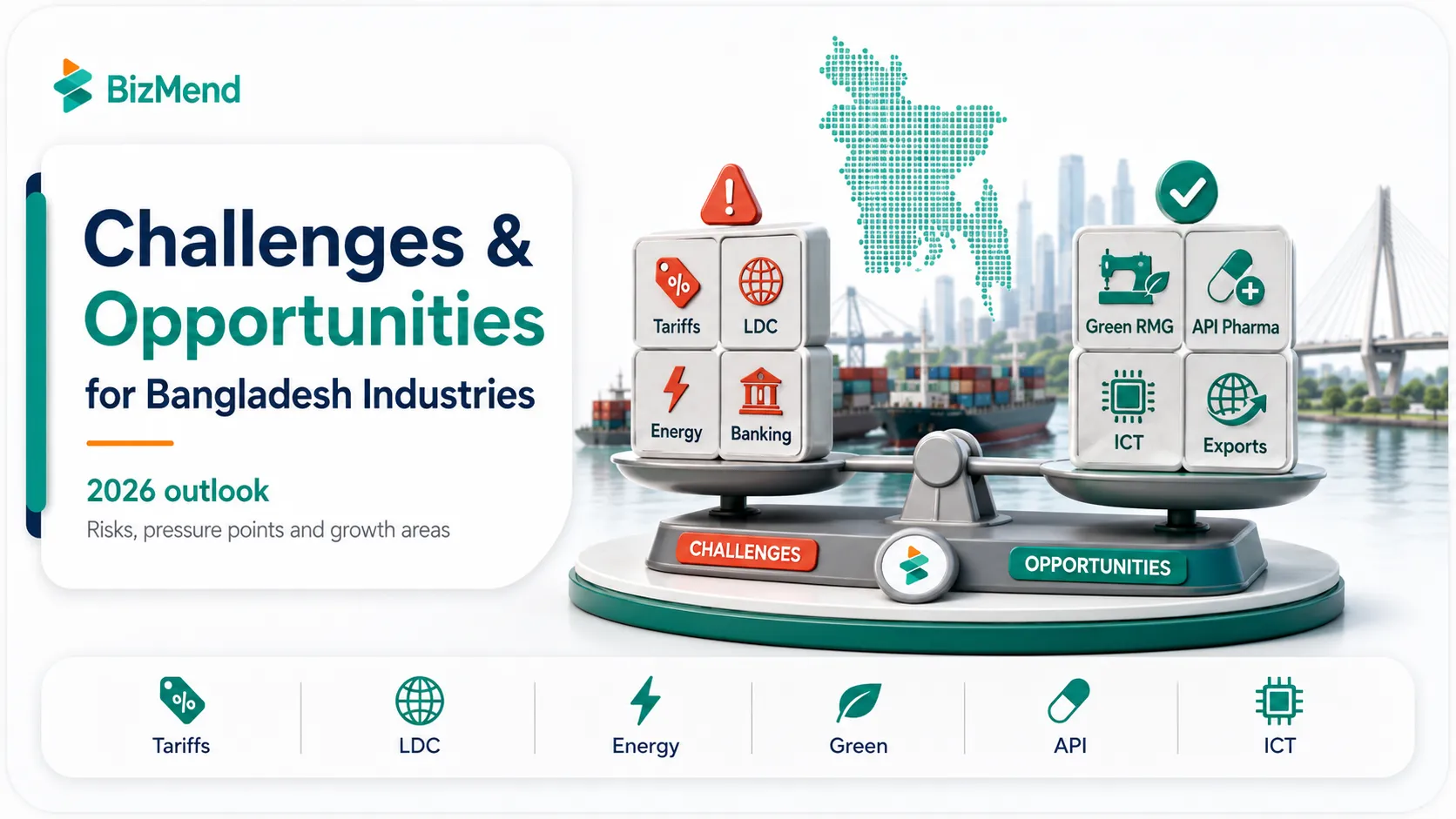
The Challenges Every Industry Faces in 2026
This section is the one most industry guides skip. Bangladesh’s industries share several structural challenges that are not unique to any one sector.
- US tariffs on garment exports. After the February 2026 US-Bangladesh trade framework, the general reciprocal tariff was reduced to 19%, with potential zero-tariff treatment for certain textile and apparel goods tied to US-origin inputs. Buyers are diversifying to Vietnam, Cambodia, and other suppliers.
- LDC graduation in November 2026. Bangladesh loses preferential trade access in many markets. For RMG, this affects EU EBA preferences. For pharma, it puts the TRIPS waiver under pressure.
- Banking sector stress. Bangladesh’s banking sector faced serious stress in 2025, with non-performing loans reported at around 36% of total loans by September 2025, making access to credit for manufacturers and exporters genuinely difficult.
- Energy shortages. Energy reliability, fuel costs, irrigation pressure, and climate risk remain important challenges for agriculture and industrial production.
- Factory closures from 2024 political disruption. The July 2024 mass uprising and subsequent instability contributed to nearly 245 factory closures between August 2024 and July 2025, impacting around 100,000 workers.
Understanding Bangladesh’s banking infrastructure is useful context for investors in any of these industries. The commercial banks in Bangladesh guide covers which financial institutions are positioned to support industrial investment, and the red, yellow, and green zone bank classifications explain which banks are under regulatory stress.
Business Opportunities Across Bangladesh’s Sectors
Despite the headwinds, specific opportunities do exist across Bangladesh’s industries in 2026.
In RMG: Sustainable and green manufacturing is where international buyer interest is strongest. Bangladesh’s LEED factory stock is the largest in the world, and brands willing to invest in supply chain compliance have a real advantage.
In pharma: API (active pharmaceutical ingredient) manufacturing is the biggest gap. Bangladesh imports 85-95% of its APIs. Entry into API production addresses a $1.3 billion annual import bill and builds long-term export capacity.
In IT: The domestic ICT market at $8.88 billion in 2025 and growing to $12 billion by 2030 offers real opportunity for SaaS products, fintech, and IT-enabled services targeting Bangladeshi businesses.
In leather and footwear: The sector is undercapitalized relative to its export potential and is listed as an immediate FDI target by BIDA.
The government banks in Bangladesh offer project financing for many of these sectors. The investment banking in Bangladesh landscape shows how capital market access works for mid-to-large industrial ventures.
Key Insights
- RMG dominates Bangladesh’s export economy, accounting for $39.35 billion or 81.49% of total exports in FY2024-25, per BGMEA data published in November 2025 research. Bangladesh is the world’s second-largest garment exporter.
- Bangladesh’s GDP growth slowed to 3.49% in FY2024-25, the slowest in recent years, driven by political disruption, factory closures, energy shortages, and US tariff pressure on garment exports.
- The pharmaceutical sector meets 98% of domestic demand and exports to 79 countries. Pharma exports grew 13% year-on-year in July-February FY2024-25 to $134.15 million, per Wikipedia (January 2026 update).
- ICT exports hit $724.6 million in FY2024-25, missing the $5 billion government target by a wide margin but still growing at 7.7% year-on-year, per TBS News citing EPB data. The domestic ICT market reached $8.88 billion in 2025.
- Agriculture employs over 40% of the workforce despite contributing only about 11.5% to GDP. It remains the largest employment sector and faces energy and climate-related disruptions in 2026.
- Bangladesh graduates from LDC status in November 2026, affecting trade preferences across RMG, pharma, and other export industries. Every sector needs a post-LDC strategic plan now.
Frequently Asked Questions
What is the biggest industry in Bangladesh?
Ready-made garments (RMG) is the biggest industry in Bangladesh by export value. In FY2024-25, RMG exports reached $39.35 billion, accounting for 81.49% of Bangladesh’s total exports of $48.28 billion, per BGMEA data. Bangladesh is the world’s second-largest garment exporter after China, employing approximately 4 million workers.
What percentage does RMG contribute to Bangladesh’s GDP?
The RMG sector contributes approximately 11% to Bangladesh’s national GDP, per IIX Global analysis (May 2025). The sector also accounts for over 3,500 export-oriented factories as of December 2024, and employs approximately 4 million workers, the majority of whom are women.
What are the major industries in Bangladesh beyond garments?
Beyond RMG, Bangladesh’s major industries include agriculture (employing 40.6% of the workforce), pharmaceuticals (98% self-sufficient in domestic demand, exporting to 79 countries), IT and software services ($724.6 million in ICT exports in FY2024-25), leather and footwear (about 3.5% of total exports), shipbuilding and ship-breaking, and food processing and fisheries.
How big is Bangladesh’s pharmaceutical industry?
Bangladesh’s pharmaceutical industry meets 98% of domestic medicine demand, maintains an average 12% annual growth rate (Wikipedia, 2024), and exports to 79 countries. July to February FY2024-25 pharmaceutical exports reached $134.15 million, a 13% increase year-on-year, per Wikipedia’s pharmaceutical industry entry (January 2026 update). Bangladesh ranks second within SAARC in medicine export volume, after India.
What is the state of Bangladesh’s IT industry?
Bangladesh’s ICT service exports reached $724.6 million in FY2024-25, a 7.7% growth from the prior year, per Export Promotion Bureau data cited by TBS News (November 2025). The domestic ICT market hit $8.88 billion in 2025. More than 4,500 software and IT-enabled service companies operate in Bangladesh, employing over 300,000 professionals, per BASIS data.
How does the US tariff affect Bangladesh’s industries?
In April 2025, the US imposed 37% reciprocal tariffs on Bangladesh’s exports, particularly impacting garments. The rate was reduced to 20% on August 1, 2025, per Wikipedia. Multiple US buyers halted or reduced orders. By March 2026, goods exports had fallen year-on-year for eight consecutive months, and nearly 245 factories shut down between August 2024 and July 2025, per Wikipedia (updated May 2026).
What is LDC graduation and how does it affect Bangladesh’s industries?
Bangladesh is scheduled to graduate from Least Developed Country (LDC) status in November 2026. LDC status gives Bangladesh preferential trade access in many markets, including the EU’s Everything But Arms (EBA) scheme for garments and the TRIPS patent waiver for pharmaceuticals. Losing LDC status means higher tariffs for RMG in the EU and greater pressure on pharma patent exemptions, requiring every export sector to develop post-graduation strategies now.
Is Bangladesh’s economy growing in 2026?
Bangladesh’s GDP growth rate in FY2024-25 was 3.49%, the slowest in recent years, per Wikipedia (updated May 2026). Industrial production expanded 3.6% annually in July 2025-January 2026, below the 4.1% rise seen in FY2025, per FocusEconomics. The slowdown reflects the combined impact of political disruption from the July 2024 uprising, US tariffs, energy shortages, and banking sector stress.
What business opportunities exist in Bangladesh’s industries in 2026?
The strongest near-term opportunities include API manufacturing for the pharma sector (Bangladesh imports 85-95% of active pharmaceutical ingredients), sustainable RMG manufacturing for LEED-compliant factories, the domestic ICT market (projected to reach $12 billion by 2030), and leather and footwear (identified as an immediate FDI target by BIDA). The government’s BIDA One-Stop Service portal has reduced business registration from 17 days to approximately 9 days as of 2025.
Closing Thoughts
Bangladesh’s industries are more complicated than the “second-largest garment exporter” headline suggests. There’s genuine economic depth here: a pharma sector serving 79 countries, an IT market approaching $9 billion domestically, and agricultural employment covering 40% of the population. But 2026 brings real structural tests including US tariffs, LDC graduation, and a banking sector under serious stress.
If you’re researching Bangladesh’s industries for investment, sourcing, or market entry, the most useful thing you can do is look at the sector-specific BIDA data and cross-check with which financial institutions are in good standing. What sector are you most seriously considering, and what’s the one thing you still need to figure out before deciding?