How to Become a Daraz Seller in Bangladesh: Registration, Fees & Growth
Learn how to become a Daraz seller in Bangladesh, register an account, list products, understand fees, manage orders, and grow…
 by Sheikh Ornob

An accurate overview of the ICT sector in Bangladesh: FY26 export data, top IT companies, freelancing figures, government policy, and investor entry points.
Bangladesh’s ICT sector gets a lot of attention, but the numbers are often presented without context. The export targets were ambitious. The actual results tell a more nuanced story, and for anyone evaluating this market seriously, the nuance matters.
This guide covers the domestic market size, FY26 export performance, freelancing figures, key companies, government initiatives, and where real opportunities exist, based on verified data from EPB, BASIS, Mordor Intelligence, and other credible sources.
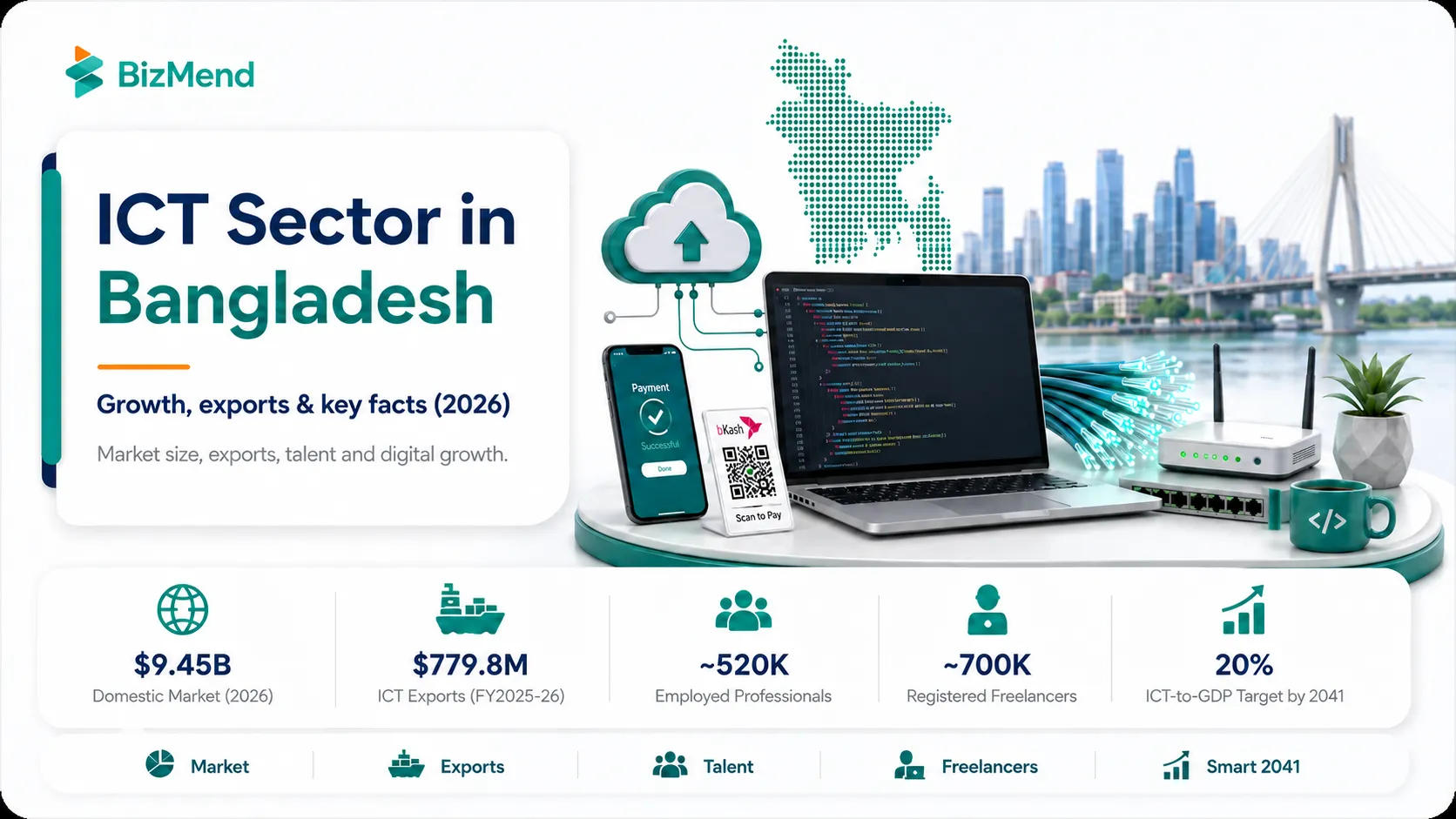
| Quick Answer: Bangladesh’s ICT market is estimated at $9.44 billion in 2026, up from a 2025 base of about $8.82 billion, and is projected to reach $12.79 billion by 2031, according to Mordor Intelligence’s 2026 forecast. ICT service exports reached $724.6 million in FY2024-25, growing 7.7% year-on-year. The sector employs approximately 500,000 professionals and includes an estimated 650,000 registered freelancers. The government’s Smart Bangladesh 2041 plan sets a long-term target of 20% ICT contribution to GDP. |
Bangladesh’s ICT sector is broader than software exports. It spans software development, IT-enabled services (ITES), business process outsourcing (BPO), telecommunications, fintech, e-commerce infrastructure, hardware distribution, and e-government services.
On the telecom side, Grameenphone reported over 84.2 million subscribers in Q1 2026, down from 85.6 million in Q3 2025. Robi Axiata and Banglalink round out the major operators. Fintech platforms bKash and Nagad have become central to how millions of Bangladeshis make payments, including for government services.
The sector is overseen by the ICT Division of the government. It works alongside BASIS (Bangladesh Association of Software and Information Services), the national trade body for software and IT services; BHTPA (Bangladesh Hi-Tech Park Authority); BCC (Bangladesh Computer Council); and Startup Bangladesh Limited, the government’s early-stage venture arm.
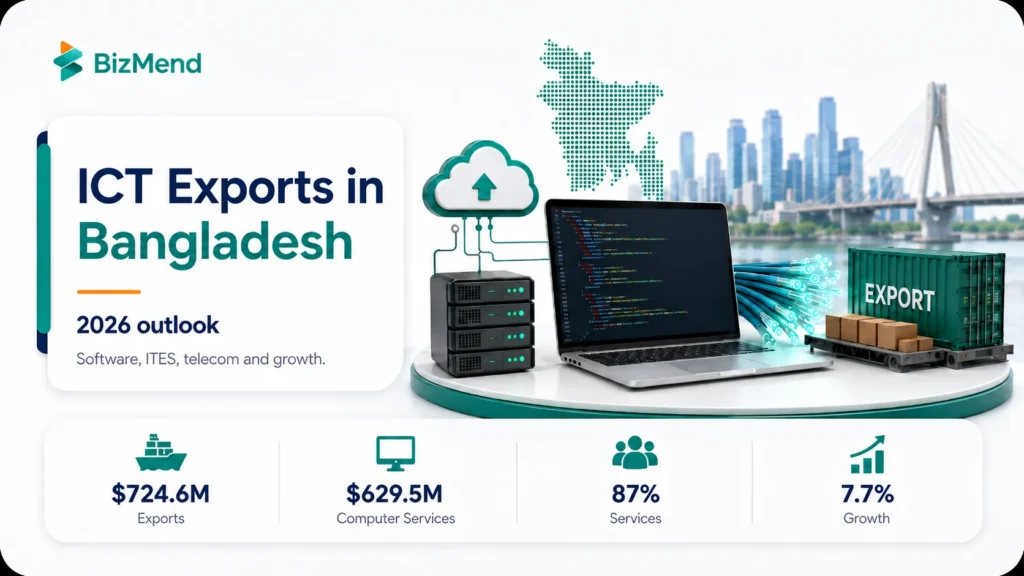
ICT service exports reached $724.6 million in FY2024-25, according to Export Promotion Bureau (EPB) data. That’s 7.7% year-on-year growth. Computer services, including software development, outsourcing, and IT-enabled services, made up 87% of total exports. Telecommunications services accounted for 13%, and information services less than 1%.
| Fiscal Year | Computer Services Exports | Total ICT Exports | Growth |
| FY 2018-19 | $239.9 million | — | 23.63% |
| FY 2023-24 | ~$580 million | ~$672 million | — |
| FY 2024-25 | $629.5 million | $724.6 million | 7.7% |
Source: EPB data, The Business Standard (November 2025)
To put this in regional context: Pakistan’s IT exports hit $3.8 billion in the same period, an 18% increase. India’s IT exports reached approximately $224 billion. Bangladesh’s growth rate is positive, but the scale gap is significant.
The ICT Division had set a $5 billion export target for 2025. The sector reached $724.6 million. That gap deserves a direct explanation rather than a footnote.
Foreign exchange friction. IT firms that earn abroad often leave earnings offshore to avoid a 15% tax on repatriation. Former BASIS president Habibullah Neyamul Karim has noted that actual earnings could exceed $1 billion when informal freelance income is included, but those funds don’t always enter formal banking channels.
Skills mismatch. Demand for cloud architecture, AI implementation, and cybersecurity services is growing. Supply of graduates trained in these areas isn’t keeping pace. Most graduates enter the workforce in lower-value service categories.
Infrastructure gaps. Reliable broadband connectivity outside Dhaka remains inconsistent. The five-day internet blackout in July 2024, triggered by political unrest, caused widespread client losses and negative platform reviews for thousands of freelancers.
Freelancing is a substantial part of Bangladesh’s ICT activity, though much of it sits outside formal export statistics.
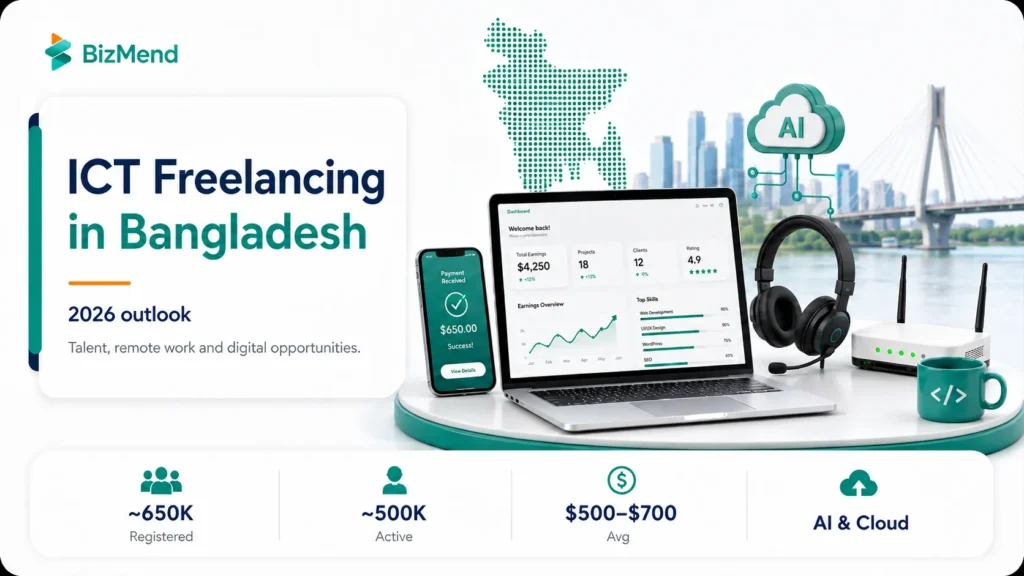
The ICT Division registers approximately 650,000 freelancers, with around 500,000 considered active. The Oxford Internet Institute has ranked Bangladesh as the second-largest supplier of online labor globally. Platforms like Upwork and Fiverr have large concentrations of Bangladeshi workers, primarily in graphic design, digital marketing, WordPress development, and video editing.
Freelancer earnings vary widely by skill, platform, location, and experience. A 2026 social-protection analysis shows Dhaka-based freelancers averaging around $850/month, Chattogram around $720/month, and other regions often around $500–650/month, but these should be treated as estimates, not a fixed national average. That’s well above Bangladesh’s average entry-level corporate salary of around $100 to $115 per month, which helps explain the sector’s growth.
Earnings vary significantly by skill area. The 60% of freelancers working in creative and multimedia generally earn less than the 16% in software development. Freelancers in programming, data analytics, and SEO with two or more years of experience regularly earn $2,000 to $5,000 per month.
The government has taken some steps in response. freelancers.gov.bd now issues official Freelancer IDs, which serve as proof of income for banking and loan applications. Training programmes are running across all 64 districts through 2026.
Bangladesh has an established tier of IT export companies. According to BASIS data from June 2024, the top ICT exporters by volume include Service Engine, Graphic People, BJIT, Therap (BD), Brain Station 23, Secure Link Services Bangladesh, Cefalo Bangladesh, KAZ Software, Golden Harvest Infotech, and Dynamic Solution Innovators.
These aren’t small operations. Brain Station 23 and BJIT each serve clients across North America and Europe. Therap (BD) has built a notable position in healthcare IT software, a niche that’s less commoditised than general outsourcing. BJIT’s focus on embedded systems and IoT puts it in a higher-value technical bracket.
Bangladesh’s startup ecosystem has grown from fewer than 100 companies a decade ago to over 1,200 active startups today. These companies have collectively raised nearly $1 billion in funding, with 76% from venture capital, according to ICT Division Secretary Shish Haider Chowdhury at the Bangladesh Investment Summit in April 2025.
Fintech leads investment activity, followed by logistics, e-commerce, healthtech, and agricultural technology. Startup Bangladesh Limited and iDEA (Innovation Design and Entrepreneurship Academy) provide government-backed funding and mentorship for early-stage companies.
The current policy framework is built around the Smart Bangladesh 2041 Master Plan, organised around four pillars: Smart Citizen, Smart Government, Smart Economy, and Smart Society. The ICT Division’s long-term target is for the sector to contribute 20% to GDP by 2041.
The plan replaced the Digital Bangladesh 2021 agenda. The current interim government has maintained the Smart Bangladesh framing and continued most of the sector’s active programmes.
Bangladesh’s Hi-Tech Parks are managed by BHTPA and are specifically designed for ICT, R&D, software, AI, and digital services. Companies operating inside these parks can access tax holidays and a clear 100% foreign ownership framework.
For foreign companies evaluating Bangladesh as an operational base, setting up in Bangladesh’s BEZA or Hi-Tech Parks is a more structured entry than going through the general market. The infrastructure inside the parks is more reliable than what most firms would find outside Dhaka.
The Hi-Tech Park Authority was targeting 60,000 trained IT professionals by 2025, with 37,800 completing programmes as of the most recent official count. A 2024 NSDA study found that most Bangladeshi freelancers perform well in graphic design but trail competitors in programming, cybersecurity, and data work, precisely the skills that command higher rates globally.
BASIS estimates around 500,000 professionals are currently employed in the ICT sector. Approximately 80,000 to 90,000 engineering graduates enter the job market each year, many of whom face a skills mismatch with available roles.
The cost advantage is real. A mid-level developer in Dhaka earns considerably less than an equivalent hire in Warsaw, Manila, or Bogota. Companies that have found ways to invest in in-house training, like Brain Station 23 and BJIT, have built strong export businesses on this foundation.
The challenge is that cost advantages are narrowing as more countries compete for outsourcing contracts and as clients become more selective about work quality.
For investors and entrepreneurs looking at Bangladesh’s ICT sector, several areas show genuine potential:
If you’re considering setting up a business here, this guide on how to start a business in Bangladesh as a foreigner covers the registration process and what BIDA approval involves. The top industries in Bangladesh for foreign investment is useful for understanding how ICT compares to other sectors in terms of policy support and entry requirements.
Banking is also worth understanding early. Foreign banks in Bangladesh like HSBC and Standard Chartered are commonly preferred by international businesses for their compliance infrastructure and international wire capabilities.
For Bangladeshi entrepreneurs looking to access US clients, payment processors, or venture investors, incorporating a US company is a common first step. Business Globalizer provides a practical guide on how to start a business in the USA from Bangladesh legally and entirely online.
The domestic market was estimated at $8.88 billion in 2025, according to Mordor Intelligence, projected to grow to $12.07 billion by 2030. ICT service exports reached $724.6 million in FY2024-25, according to EPB.
BASIS data from June 2024 lists Service Engine, Graphic People, BJIT, Therap (BD), Brain Station 23, Secure Link Services Bangladesh, Cefalo Bangladesh, KAZ Software, Golden Harvest Infotech, and Dynamic Solution Innovators as the top ICT exporters by volume.
The ICT Division registers approximately 650,000 freelancers, with around 500,000 active. The Oxford Internet Institute ranks Bangladesh second globally in online labor supply. Average earnings were $500 to $700 per month in 2025, per Payoneer data.
Yes. Bangladesh allows 100% foreign ownership in ICT companies. Companies in Hi-Tech Parks managed by BHTPA receive tax holidays. Registration goes through BIDA (Bangladesh Investment Development Authority), which operates an online One-Stop Service portal.
It’s the government’s long-term digital development framework, built around four pillars: Smart Citizen, Smart Government, Smart Economy, and Smart Society. Smart Bangladesh 2041 is the government’s long-term digital transformation framework built around Smart Citizen, Smart Government, Smart Economy, and Smart Society. Publicly reported policy targets include raising ICT’s GDP contribution toward 20% by 2041, but this should be presented as a policy target, not a current contribution.
Bangladesh’s ICT sector has a real base, not just potential. The exports are growing, the startup ecosystem is attracting meaningful capital, and the freelancing workforce is genuinely large. The gap between aspiration and current output is mostly structural, which means it can be addressed, though it will take time.
If you’re doing serious due diligence on this market, the data is available, the regulatory framework is navigable, and the opportunities are specific enough to evaluate. Start with a clear entry strategy, understand the infrastructure constraints, and don’t rely on export target figures when the actual EPB numbers tell a more precise story.

Learn how to become a Daraz seller in Bangladesh, register an account, list products, understand fees, manage orders, and grow…
by Sheikh Ornob
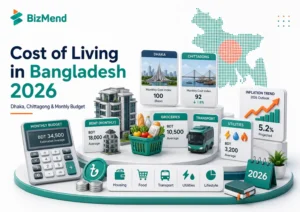
Compare the cost of living in Bangladesh in 2026, including Dhaka and Chittagong rent, food, transport, utilities, inflation, and monthly…
by Sheikh Ornob

Learn MoA and AoA requirements in Bangladesh, key clauses, drafting basics, RJSC filing steps, amendments, and common company-registration mistakes. Suggested…
by Sheikh Ornob