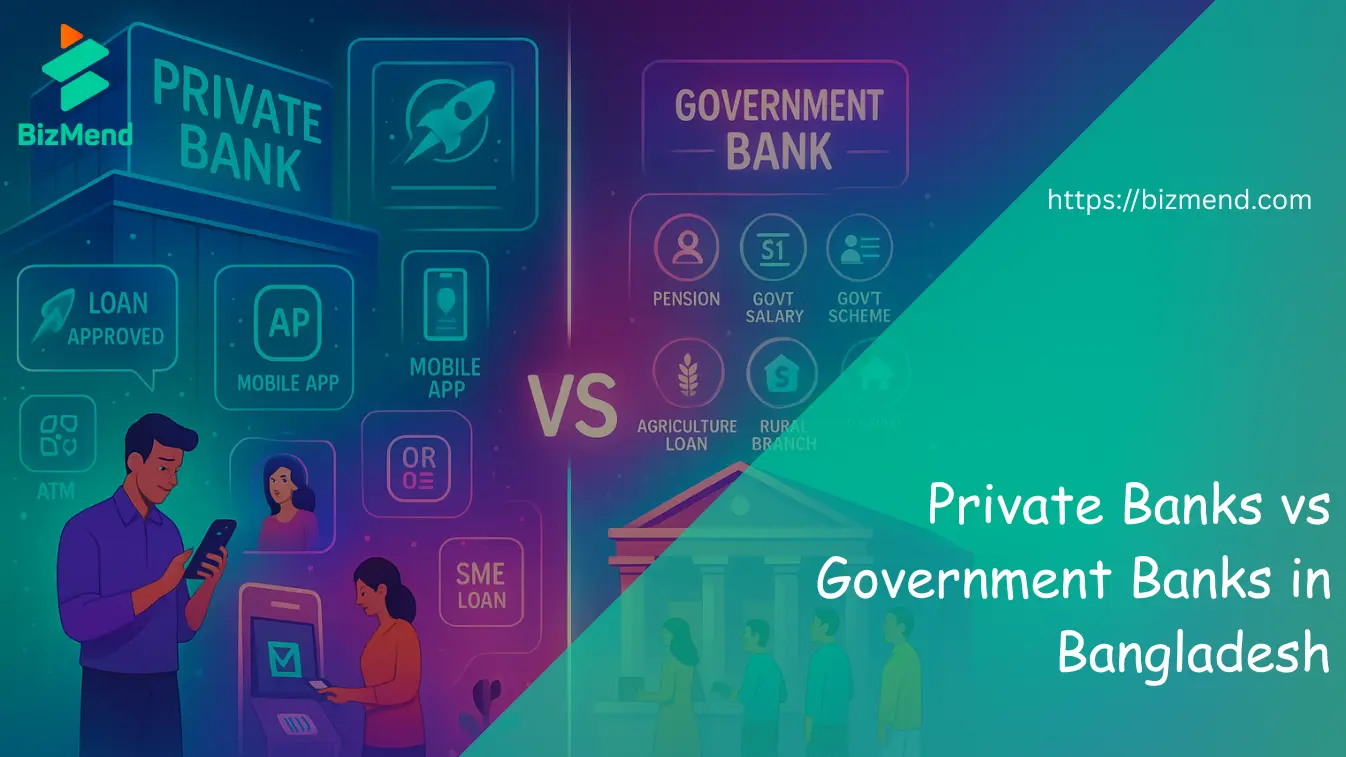
If you’ve ever opened a bank account, taken a loan, or started a job in Bangladesh, you’ve probably had this question in your mind: “Should I go with a private bank or a government bank?” That’s really what private banks vs government banks in Bangladesh is all about.
In simple terms:
- Most people choose private banks for better service, faster processing, and strong digital banking.
- They use government banks for pensions, government payments, some schemes, and long-term trust.
Both types are important for the countries economy. This blog will help you understand the differences clearly so you can decide what actually fits your money, your habits, and your goals.
What Are Private and Government Banks in Bangladesh?
Let’s start with very simple definitions.
What is a private bank?
A private bank in Bangladesh is a commercial bank that is owned mainly by private shareholders. It is:
- regulated by Bangladesh Bank
- profit-driven (but must follow strict rules)
- always competing with other banks to attract customers
Examples (just to give context): BRAC Bank, City Bank, Eastern Bank (EBL), Dutch-Bangla Bank, Bank Asia, and many more.
What is a government bank?
A government bank (state-owned commercial bank) is a bank where the Government of Bangladesh owns the majority share. These banks are:
- older and often have very large networks
- deeply involved in government payments, pensions, and priority sectors like agriculture
- still regulated by Bangladesh Bank
Examples include Sonali Bank, Janata Bank, Agrani Bank, Rupali Bank, BASIC Bank, etc.
So they co-exist. The real question is: how are they different for you as a customer?
Service Experience: How It Feels to Use Each Type
Speed, queues, and counters
One of the biggest reasons people compare private banks vs government banks in Bangladesh is simply: “How long do I have to stand in line?”
- In many cases, private banks:
- have shorter queues
- use better token systems
- process simple tasks (deposit, withdrawal, statement) faster
- have shorter queues
- Government banks often:
- handle a huge volume of customers (pensions, govt salaries, utility payments)
- can feel more crowded and slower
- handle a huge volume of customers (pensions, govt salaries, utility payments)
Of course, this can vary branch to branch, but the general perception is: private banks feel faster and lighter.
Staff behaviour and communication
Customers also pay attention to how they are treated.
- Private bank staff are usually trained to be more:
- polite
- customer-focused
- solution-oriented
- polite
- In government banks, service quality is improving but many people still feel the environment is more formal, old-style, and less flexible.
When people say, “I prefer private banks,” this service experience is often a big reason.
Loans and Credit: Who Helps You Faster?
Loan processing time
For many people, the decision comes down to loans: personal, home, car, SME, or business.
- Private banks are usually preferred when you want:
- faster processing
- structured retail loan products
- clear EMIs and timelines
- They also follow up by phone and SMS and push to close files quickly, because lending is a core business.
- Government banks:
- may offer loans under special government schemes at lower rates (for farmers, specific sectors, etc.)
- but the process can be slower, with more documents and internal steps
- may offer loans under special government schemes at lower rates (for farmers, specific sectors, etc.)
Flexibility and packaging
Private banks are very good at packaging:
- salary loans for employees
- SME loan bundles
- co-branded credit cards
- app-based pre-approved offers
Government banks are more scheme-based and policy-based rather than marketing-based. So if you want a clean, packaged loan product, you’ll often find it first at a private bank.
Digital Banking: Apps, Cards, and Online Payments
If you like doing everything from your phone, this part matters a lot.
Apps and online portals
Private banks in Bangladesh have invested heavily in:
- mobile apps for balance checks, transfers, bill payments
- internet banking for businesses and individuals
- QR codes and digital wallets integrations
Government banks also offer online services now, but their apps and portals are still catching up in terms of design, speed, and user-friendliness.
Cards and payments
Private banks are usually more active with:
- debit and credit cards
- e-commerce payments
- EMI offers
- discounts with partner brands
Government banks provide cards too, but the product range, user experience, and offers are generally richer on the private bank side.
Bottom line: if you’re mobile-first and online-heavy, a private bank usually feels more comfortable.
Safety and Trust: Which One Is Safer?
Many people worry: “Is my money safer in a government bank?” It’s a reasonable question.
Here’s the honest, simple view:
- Both private and government banks are regulated by Bangladesh Bank.
- Government banks have state ownership, which some people mentally associate with “guaranteed safety.”
- Strong private banks are also very safe because they must meet strict capital, reporting, and risk standards.
For a normal depositor, the key point is:
👉 choose a reputable bank (private or govt), not just any bank with a fancy sign.
Fees, Charges, and Minimum Balances
There’s a trade-off here.
- Private banks often:
- have more service fees (card fees, SMS charges, account maintenance)
- but give you more features and more comfort in return
- have more service fees (card fees, SMS charges, account maintenance)
- Government banks sometimes:
- have simpler fee structures and may feel “cheaper”
- but with fewer extras and slower, more basic service
- have simpler fee structures and may feel “cheaper”
So the question is:
Do you want basic and cheaper, or richer features with some extra cost?
Many people don’t mind paying a bit more if the experience and speed save them time and stress.
Branches, ATMs, and Access: Where Are They?
Accessibility is a big factor too.
- Government banks:
- have huge branch networks, especially in rural and semi-urban areas
- handle many services linked to govt offices
- have huge branch networks, especially in rural and semi-urban areas
- Private banks:
- stronger in cities and towns
- increasingly use agent banking and sub-branches to reach further
- often have better ATM uptime and card experience in urban centers
- stronger in cities and towns
If you live outside major cities, a government bank branch might be closer. In cities, you’ll usually have multiple private bank options nearby.
So, Which Should You Choose?
Let’s keep it practical.
A private bank may be better for you if:
- You value fast service and smooth branch experience
- You use apps, ATMs, and online banking regularly
- You need quick personal or SME loans
- You like clear products: salary accounts, loan packages, cards
A government bank may be better for you if:
- You receive pension, govt salary, or govt scheme payments
- You need access to specific government-backed loan schemes
- You live somewhere with only govt branches nearby
- You feel more comfortable with a state-owned institution
Using both can be smart
Many people in Bangladesh actually do both:
- keep one account in a government bank for pension or govt-related matters
- keep another account in a private bank for salary, daily usage, and digital convenience
You don’t have to choose sides forever. You can use each type of bank as a tool for a different job.
FAQs about Private Banks vs Government Banks in Bangladesh
What is the main difference between private banks and government banks in Bangladesh?
Private banks are owned by private shareholders and focus heavily on service quality, competition, and innovation. Government banks are majority-owned by the state, handle many government-related transactions, and often have larger legacy networks.
Are private banks better than government banks?
“Better” depends on your needs. Private banks usually win on service, speed, and digital tools. Government banks are strong for pensions, govt payments, rural reach, and some special schemes.
Which is safer: a private bank or a government bank?
Both are regulated by Bangladesh Bank. Government banks have state backing, while strong private banks are also very safe under strict regulations. For most people, the key is choosing a reliable, well-known bank, regardless of type.
Which bank type is better for loans?
If you want fast processing and packaged retail or SME loans, private banks usually work better. Government banks may have lower-interest schemes in specific sectors but can involve more paperwork and time.
Which bank should I use for salary and daily transactions?
Many salaried people prefer private banks for better apps, cards, and customer service. But if your employer uses a government bank, you might end up with accounts in both — which is not a bad thing.
Can I use both private and government banks at the same time?
Yes, and many people do. You might use a private bank for daily banking, digital transactions, and loans, and a government bank for pensions, savings, or specific govt-linked purposes.
Do private banks charge more fees than government banks?
Often yes, private banks may have more or higher service fees. But they also usually offer more value in terms of speed, convenience, digital options, and overall experience.