

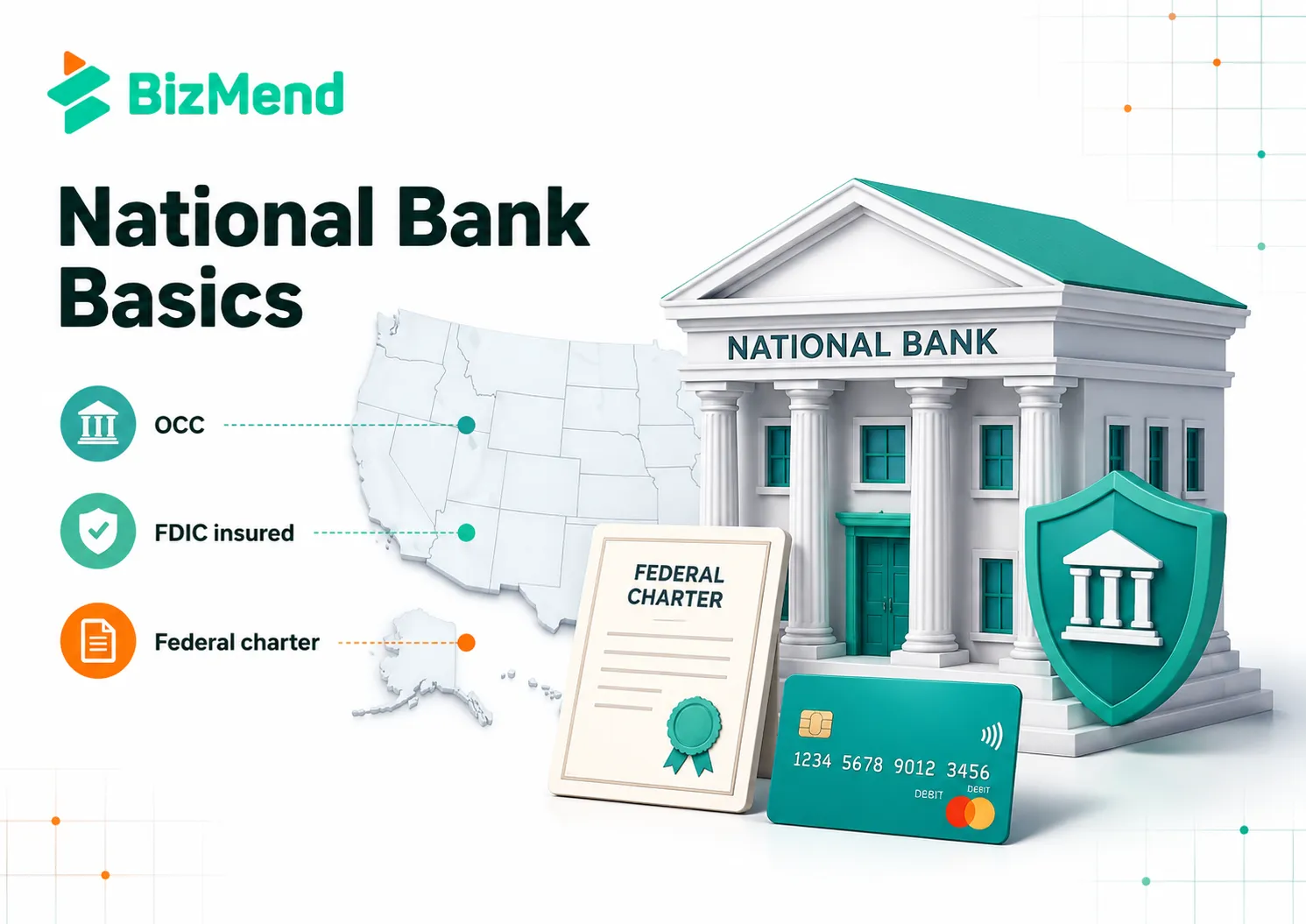
What is a national bank? It is a US bank chartered by the federal government instead of a state regulator, and that distinction shapes everything from who supervises it to how your deposits are protected. Chase, Bank of America, Wells Fargo, and Citibank all fall into this category, which is why the term shows up constantly in banking conversations without much explanation.
This page breaks the term down in plain language: what a national charter actually means, how the system works day to day, who tends to use these banks, and the basic tradeoffs worth knowing before opening an account.
Quick Answer: A national bank is a commercial bank chartered and supervised by the Office of the Comptroller of the Currency (OCC) rather than a state banking department. It must join the Federal Reserve System and carry FDIC deposit insurance up to $250,000 per depositor. Chase, Bank of America, and Wells Fargo are common examples.
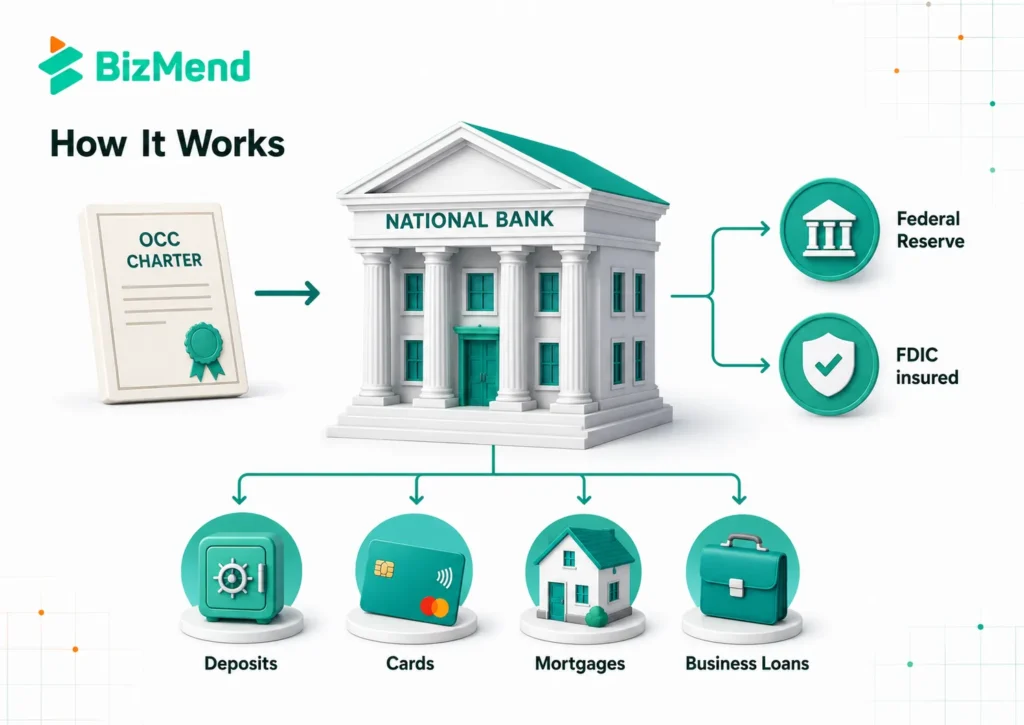
How Does a National Bank Work?
A national charter comes from the Office of the Comptroller of the Currency, an independent bureau inside the US Department of the Treasury. Once the OCC approves the charter, the bank must join the Federal Reserve System and register for FDIC deposit insurance before it opens its first account. OCC examiners then review the bank’s finances and lending practices on a recurring schedule to confirm it stays financially sound.
Day to day, a national bank works like most banks: it accepts deposits, pays a small amount of interest on some accounts, and lends that money back out through mortgages, credit cards, and business loans. The federal charter mainly affects who regulates the bank and which rules apply, not the products on offer. Look for the word National, or the letters N.A. or NT&SA, in a bank’s legal name to spot the charter type quickly.
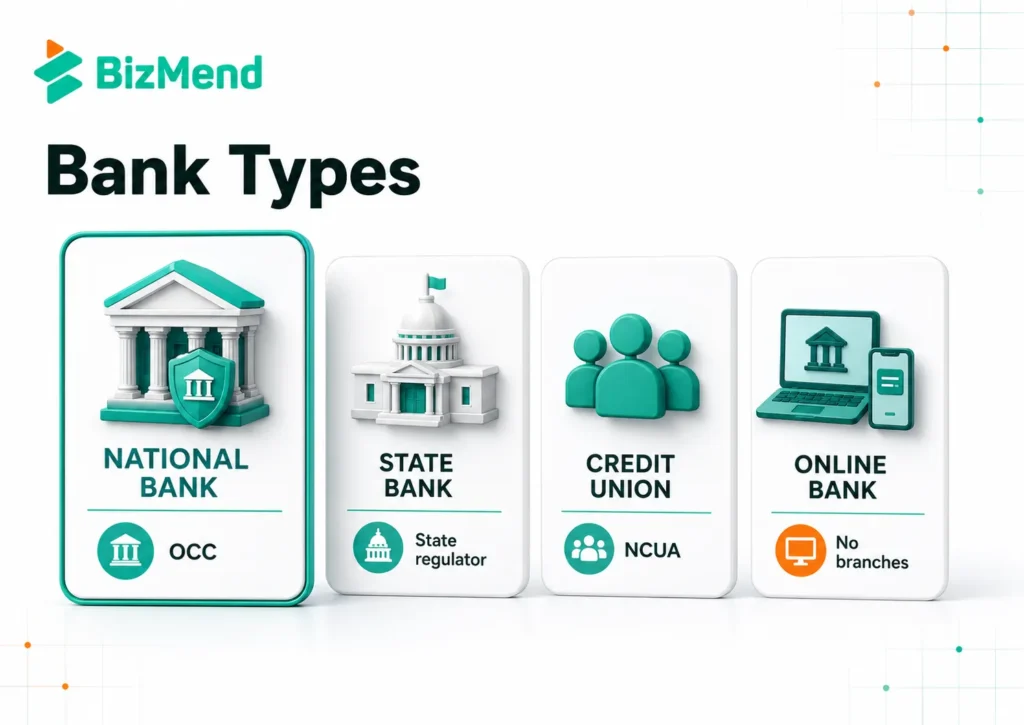
What Makes a National Bank Different From Other Account Types
Three comparisons come up most often. A state bank answers to a state banking department instead of the OCC, though both carry FDIC insurance and offer nearly identical products to depositors. A credit union is member owned and insured by the National Credit Union Administration rather than the FDIC, with coverage that works similarly but comes from a separate agency. An online bank usually is not a separate charter type at all; many are simply divisions of a nationally or state chartered bank that skipped branches to cut costs.
Reviewing the bank account types available at any of these institutions matters more for daily use than the charter itself, since checking, savings, and CD products work almost the same everywhere. The charter changes the regulator, not the interest rate on the account.
Who Uses a National Bank, and Why
Everyday consumers make up the largest share of national bank customers, drawn mainly by branch networks that work the same way whether the account was opened in Ohio or opened in Oregon. People who move often, or who want in-person help available nationwide, tend to prefer this consistency over a smaller local bank.
Business owners are the second major group, often opening accounts to receive customer payments, pay vendors, and separate personal from business finances. Non-resident founders who register a US company typically need a national bank account soon afterward. Most banks ask for the business’s EIN and formation paperwork before approving a business application. Working through a US formation checklist in advance avoids a wasted trip to the branch. A US bank account guide covers the remote application steps in more depth for founders who cannot visit in person.
Pros and Cons of a National Bank
Pros
- Nationwide branch and ATM access under a single account.
- A wide product range, including checking, savings, mortgages, credit cards, and business banking, in one place.
- FDIC insurance and OCC oversight apply the same way regardless of location.
- Established mobile apps and a long operating history at most large national banks.
Cons
- Savings and checking APY at the largest national banks is often minimal compared to online banks.
- Monthly maintenance fees are common unless a waiver condition, such as direct deposit, is met.
- Customer service can feel less personal than at a community bank or credit union.
- Fee schedules and account terms vary widely between national banks, so the charter alone does not guarantee the best deal.
- For a full walkthrough of comparing fees, APY, and account features side by side, see this national bank overview, which covers the complete decision process in more depth.
Key Insights
- A national bank is defined by its federal OCC charter, not by size or branch count.
- Federal Reserve membership and FDIC insurance are required, not optional, for every national bank.
- State banks and national banks offer nearly identical products; the regulator differs, not the account.
- Credit unions use NCUA insurance instead of FDIC, though coverage works similarly.
- Business owners typically need an EIN and formation documents to open a business account.
- Confirm a bank’s charter status directly through the OCC or FDIC rather than assuming.
Final Thoughts
A national bank is simply a bank that answers to a federal regulator instead of a state one, and for most everyday customers that distinction matters less than the practical details: monthly fees, branch access, digital tools, and interest rates. The federal charter guarantees a baseline of safety and consumer protection, not a better deal than the bank down the street with a state charter.
Before opening any account, confirm the bank’s current charter status and FDIC-insured standing through the OCC or FDIC’s own lookup tools, rather than assuming a familiar name is automatically the safest or cheapest option. Compare the specific account terms carefully, since those terms vary widely even among banks that share the same federal charter type.
Frequently Asked Questions
What is a national bank?
A national bank is a commercial bank chartered by the Office of the Comptroller of the Currency instead of a state regulator. It must belong to the Federal Reserve System and carry FDIC deposit insurance. Chase, Bank of America, Wells Fargo, and Citibank are common examples, though many smaller banks also hold federal charters.
How does a national bank work?
Once the OCC approves a charter, the bank joins the Federal Reserve System, registers for FDIC insurance, and accepts regular safety and soundness examinations. From there it operates like most banks: accepting deposits, paying limited interest, and lending that money out through mortgages, credit cards, and business loans.
Is a national bank FDIC insured?
Yes. Every national bank must carry FDIC deposit insurance as a condition of its charter, covering up to $250,000 per depositor, per bank, per ownership category. Confirm any specific bank’s current insured status through the FDIC’s BankFind tool rather than assuming coverage from the name alone.
Who needs a national bank?
Anyone who wants nationwide branch access, a wide range of banking products in one place, or a long operating history may prefer a national bank. Frequent travelers, people who relocate often, and business owners needing merchant services and business loans are common users, though a national charter is not required for any of them.
How do I open a national bank account?
Bring a government issued photo ID and, for US citizens, a Social Security number; non-citizens can typically use an Individual Taxpayer Identification Number instead. Business accounts additionally require the company’s EIN and formation documents. Requirements and minimum deposits vary by bank, so confirm current rules on the bank’s website first.
