
How to Become a Daraz Seller in Bangladesh: Registration, Fees & Growth
Learn how to become a Daraz seller in Bangladesh, register an account, list products, understand fees, manage orders, and grow…
 by Sheikh Ornob

How to register a partnership firm in Bangladesh under the 1932 Act. RJSC steps, deed clauses, fees, taxes, and the registered vs unregistered split.

Two co-founders, a profit-sharing chat, and a handshake. That’s a partnership in Bangladesh, legally speaking. The Partnership Act 1932 doesn’t require a single page of paperwork to make one valid. It’s the moment things go sideways that the absence of paperwork starts costing people real money.
Registration with RJSC is optional, technically. It’s also the difference between being able to sue a deadbeat client and being legally barred from courthouse steps. Below is what a partnership firm actually is under Bangladeshi law, how to register one with RJSC, what the Partnership Act 1932 expects from your deed, and how registered and unregistered firms diverge in practice.
Quick answer: To register a partnership firm in Bangladesh, draft a partnership deed on Tk 2,000 non-judicial stamp paper, get it notarized, then file Form I and the deed with RJSC. RJSC fees run about Tk 5,750. Total cost lands at Tk 5,000 to Tk 15,000. The Partnership Act 1932 caps partners at 20 and processing takes 7 to 10 working days.
The Partnership Act 1932, Section 4, defines a partnership as the relationship between persons who have agreed to share the profits of a business carried on by all or any of them acting for all. Three ingredients matter: an agreement, a business, and the principle that any partner can bind the firm.
Think of it like two cooks sharing one kitchen. Both can buy groceries, both can take orders, and both are on the hook if a customer slips on a wet floor. That mutual agency is what separates a partnership from co-ownership of property or a joint venture for a single deal.
Bangladesh follows the Indian-origin 1932 act almost word for word. The headline rules:
Who it fits well: small-team consultancies, professional service partnerships (law firms, audit firms, design studios), family-run retail chains, and two or three co-founders testing a venture before they incorporate. Who it doesn’t fit: anyone planning to take outside investment, anyone needing a liability shield, or any group of co-founders bigger than 20.
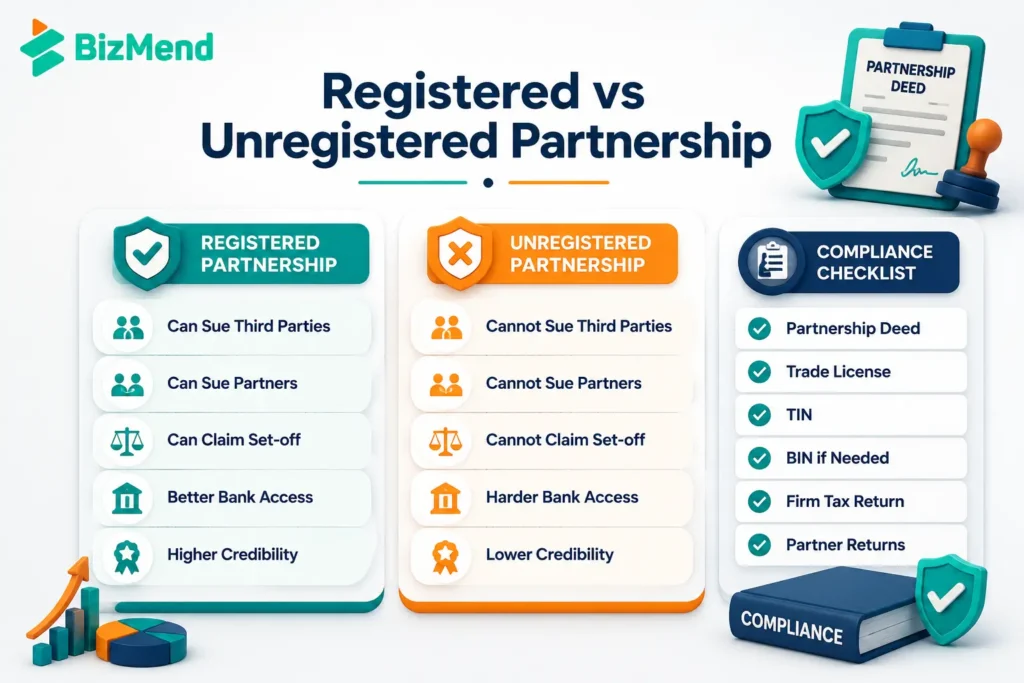
This is where most readers get lost, so it’s worth stopping. Under the Partnership Act 1932, you do not legally have to register your firm. A two-person partnership that exists on a verbal understanding is still a partnership in the eyes of Bangladeshi law. There’s no fine, no penalty, no closure notice for staying unregistered.
But Section 69 of the act quietly drops a lever on unregistered firms that almost nobody warns first-time partners about. If your firm isn’t registered with RJSC:
Now flip it. Third parties can still sue an unregistered firm. The disability is one-sided. So you absorb every legal risk a registered firm would absorb, while losing every legal weapon a registered firm gets to use. The act also doesn’t shield unregistered partners from criminal liability (fraud, cheating, breach of trust), so don’t read “unregistered” as “off the radar.”
Unregistered partners enjoy all the duties and none of the protections. The 1932 act lets you stay in the shadows. It just won’t follow you there if you need help.
This is the practical reason most serious operations register. Tk 5,000 to Tk 15,000 today versus an enforcement disability tomorrow is rarely a hard call.
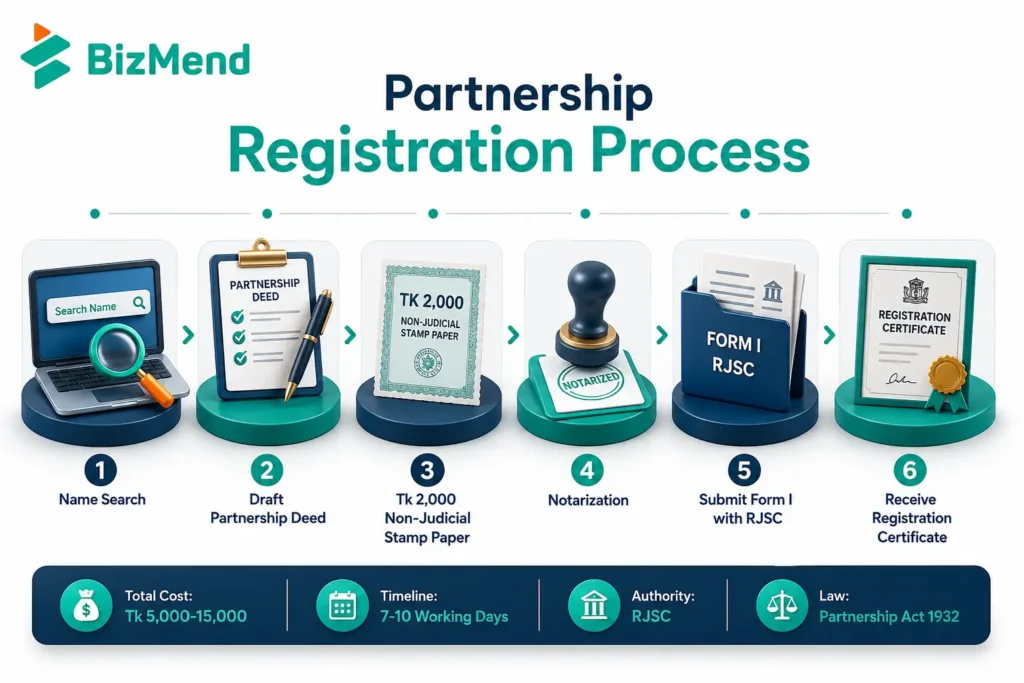
The registration path runs through the Registrar of Joint Stock Companies and Firms (RJSC), the same body that handles private limited registrations. Here’s the actual sequence.
Your firm’s name can’t conflict with an existing registered firm or company. The RJSC name search runs through the online portal at app1.roc.gov.bd. Avoid names that imply government affiliation (Bangladesh Bank, RJSC, Ministry of) or restricted terms.
This is the document that defines who owns what, who decides what, and what happens when things change. It must be on non-judicial stamp paper valued at Tk 2,000, signed by every partner, and notarized by a Notary Public (a practising advocate in most cases). Skipping the notary step is the #1 reason RJSC kicks files back.
Form I is the RJSC partnership registration form. It captures the firm name, principal place of business, names and addresses of all partners, date the partnership started, and duration (fixed term or partnership-at-will). The form is filed with RJSC along with a true copy of the deed and the registration fee.
The breakdown for 2026:
| Item | Cost (Tk) |
|---|---|
| Non-judicial stamp paper for deed | 2,000 |
| Notary Public fee | 500 to 1,500 |
| RJSC government fee | 5,750 |
| Miscellaneous (printing, filing) | 500 to 2,000 |
| Total | 8,750 to 11,250 |
Costs can climb past Tk 15,000 if you bring in a lawyer or formation consultant. They can drop below Tk 9,000 if you do the filing yourself.
Once RJSC accepts the file, the Registrar of Firms issues a Certificate of Registration. Realistic timeline: 7 to 10 working days from clean submission. After that, you can open a corporate bank account in the firm’s name, apply for a trade license from your City Corporation, and pull a TIN for the firm from NBR.
For paperwork-heavy filings, Business Globalizer handles the registration end-to-end if you’d rather not deal with stamps and queues yourself.
The deed is where most partnerships live or die. The Partnership Act 1932 has default rules for everything (profit-sharing, decision-making, exits), and those defaults apply unless your deed says otherwise. Equal profits, equal losses, equal voting power, and a deeply inconvenient mandatory dissolution if any partner dies or retires. Most co-founders don’t actually want any of that.
Mandatory clauses for any serious deed:
Without a written deed, the act’s default rules quietly pick up the slack. That means equal profits, equal say, no salary for working partners, and forced dissolution on the death of any partner. Almost no co-founder pair actually wants that arrangement, but it’s what they get when they skip the deed.
Partnership taxation in Bangladesh is dual-layered, and that catches new partners off guard.
The firm itself files an annual income tax return on Form IT-11B with NBR. The firm calculates total income, deducts allowable business expenses, and reports the residual as taxable profit. For Assessment Year 2025-2026, the tax-free threshold for general taxpayers is Tk 350,000.
Each partner also files a personal income tax return showing their share of profit from the firm (allocated per the deed’s profit-sharing ratio). Salaries, interest on capital, and other partner payments flow through the partner’s individual return.
Beyond income tax, the standard compliance stack still applies:
A partnership doesn’t file annual returns with RJSC the way a private limited company does. That’s one reason small operations prefer the structure. Less ceremony, less filing, less risk of penalty letters.
Here’s the honest comparison most deck slides skip:
| Feature | Sole Proprietorship | Partnership Firm | Private Limited |
|---|---|---|---|
| Owners | 1 | 2 to 20 | 2 to 50 shareholders |
| Registering authority | City Corporation | RJSC + Notary | RJSC |
| Setup cost (Tk) | 5,000 to 12,000 | 5,000 to 15,000 | 25,000 to 80,000 |
| Setup time | 1 to 3 weeks | 7 to 10 days | 3 to 8 weeks |
| Liability | Unlimited, personal | Unlimited, joint | Limited to share capital |
| Separate legal identity | No | Only if registered | Yes |
| Annual filings (RJSC) | None | None | Required |
| Tax | Personal income | Firm + each partner | Corporate tax |
| Best for | Single founder | Co-founders, professional firms | Scaling, investor-backed |
A partnership wins when you have two to five co-founders, low capital needs, and a service business where reputation and personal trust matter (think law firms, accounting practices, and boutique consultancies). It loses when one partner wants out, one partner brings in a bad client, or you want to raise outside money. For multi-founder ventures planning to scale, look at the broader company structures available in Bangladesh before defaulting to partnership.
A short list of the avoidable ones:
If your firm is more than two people, more than two years old, or generating more than Tk 50 lakh in annual revenue, the deed needs a serious second look. The version you scribbled together at the start almost never holds up.
A handshake builds trust. A deed protects it. Whether you register your firm with RJSC is a business call, not a legal requirement. But the cost of leaving things informal tends to show up at the worst possible moment, when one partner walks, a client refuses to pay, or a bank wants the certificate before opening the account. If you’d rather hand the filings to someone who’s done it a thousand times before, Business Globalizer handles the paperwork with proper care.
Is registering a partnership firm mandatory in Bangladesh?
No. The Partnership Act 1932 lets you operate as an unregistered partnership without penalty. But Section 69 blocks unregistered firms from suing third parties or other partners for contractual rights. Most operating firms register for that reason alone.
How many partners can a Bangladeshi partnership firm have?
A minimum of 2 and a maximum of 20. Beyond 20, the law treats the group as an unregistered association, and you’d need to incorporate as a private limited company instead.
How is a partnership firm taxed in Bangladesh?
The firm files an annual income tax return on Form IT-11B with NBR, and each partner separately files a personal return showing their share of profit. Both layers apply. The tax-free threshold for individual partners in Assessment Year 2025-2026 is Tk 350,000.
Can a foreigner be a partner in a Bangladesh partnership firm?
Technically yes, but it’s complicated. Foreign partners typically need BIDA approval, valid visas, and tax residency documentation. Most foreign founders skip the partnership route and go straight to a private limited under BIDA, which has a clearer regulatory path.
What happens to the firm if one partner dies or leaves?
Under the act’s default rules, the firm dissolves. Your deed can override this with a continuation clause, which is why every serious deed should include one. Without it, the surviving partners may have to start over with a new firm.
Partnership firm or private limited: which is better for two co-founders?
Partnership wins on speed and cost (Tk 8,000 to Tk 15,000 setup, 7 to 10 days). Private limited wins on liability protection, credibility with banks and clients, and the ability to take outside investment later. If you’re under Tk 50 lakh in annual revenue and the business is service-based, partnership often makes sense. Past that scale, the case for private limited gets strong fast.

Learn how to become a Daraz seller in Bangladesh, register an account, list products, understand fees, manage orders, and grow…
by Sheikh Ornob

Compare the cost of living in Bangladesh in 2026, including Dhaka and Chittagong rent, food, transport, utilities, inflation, and monthly…
by Sheikh Ornob

Learn MoA and AoA requirements in Bangladesh, key clauses, drafting basics, RJSC filing steps, amendments, and common company-registration mistakes. Suggested…
by Sheikh Ornob