
 by Sheikh Ornob
Saving money in a bank account is fine. But watching inflation quietly eat your savings? That’s the part nobody talks about. A mutual funds in Bangladesh lets you put your money to work in the stock market, bonds, and other assets, managed by professionals, without you having to pick stocks yourself. This guide covers the types available, what changed under the new 2025 rules, and how you can actually get started.
Quick answer: A mutual fund in Bangladesh is a pooled investment vehicle where money from many investors is managed by a licensed asset management company (AMC). As of 2026, BSEC has approved 140 mutual funds: 104 open-end and 36 closed-end. Investors earn returns through dividends and capital gains, and qualify for tax rebates under the Income Tax Act, 2023.
What Is a Mutual Fund and How Does It Work in Bangladesh?
A mutual fund pools money from many investors and invests it in a mix of stocks, bonds, and government securities. A licensed asset management company (AMC) handles all the investment decisions. You, as an investor, own units of the fund and receive returns in the form of dividends or capital appreciation.
The structure has four key layers:
- Sponsor: Sets up the fund and must subscribe to at least 10% of the total fund size.
- Trustee: Protects unit holders’ interests. Under the Bangladesh Mutual Fund Regulations 2025, trustees must have a minimum paid-up capital of Tk 200 crore.
- Custodian: Safeguards the actual assets (stocks, bonds) held by the fund.
- Asset Management Company (AMC): Makes the day-to-day investment decisions.
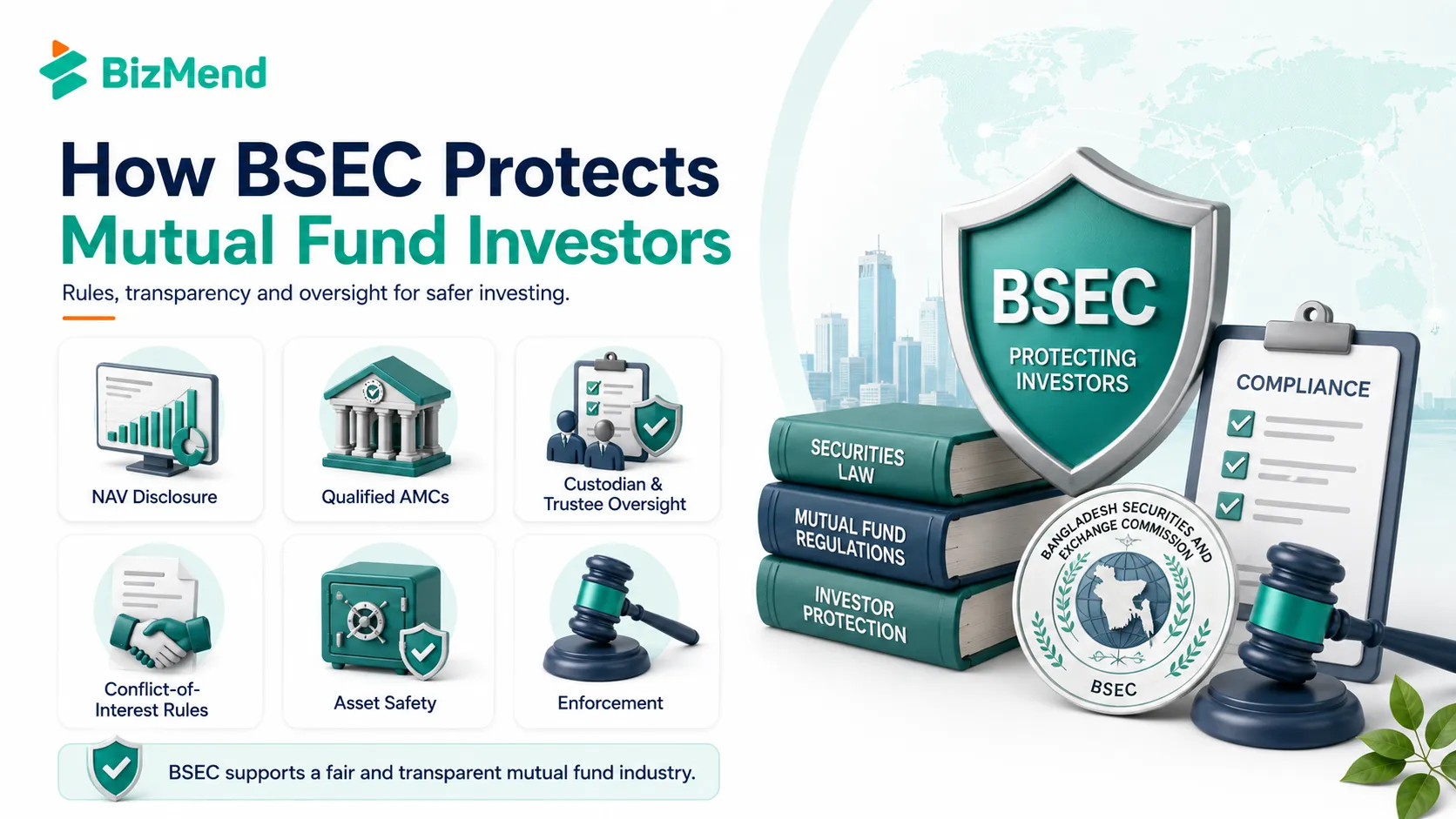
BSEC oversees all of them. Fund managers must disclose NAV and portfolio information according to BSEC’s current mutual fund rules and disclosure requirements.
What Is NAV and Why It Matters
NAV stands for Net Asset Value. It’s the price per unit of a mutual fund, calculated by dividing total fund assets minus liabilities by the total number of units outstanding.
For open-end funds, NAV is the basis for the sale and repurchase price, but the actual buying and redemption price may differ depending on permitted charges or pricing rules. It changes weekly based on how the underlying portfolio performs.
For closed-end funds, units trade on the DSE or CSE at market prices, which often differ from NAV. Many closed-end funds have historically traded at significant discounts to their NAV.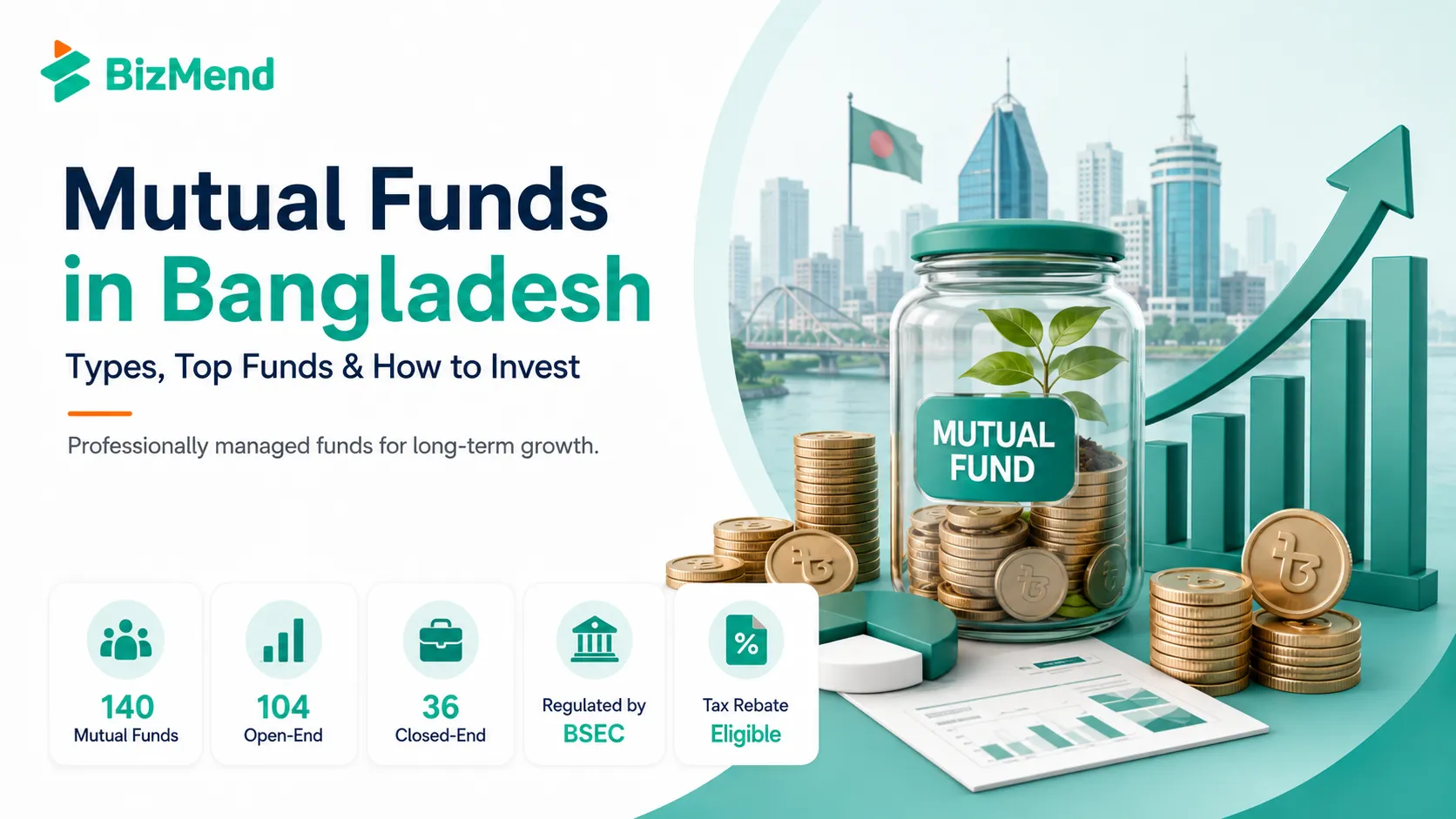
Types of Mutual Funds in Bangladesh
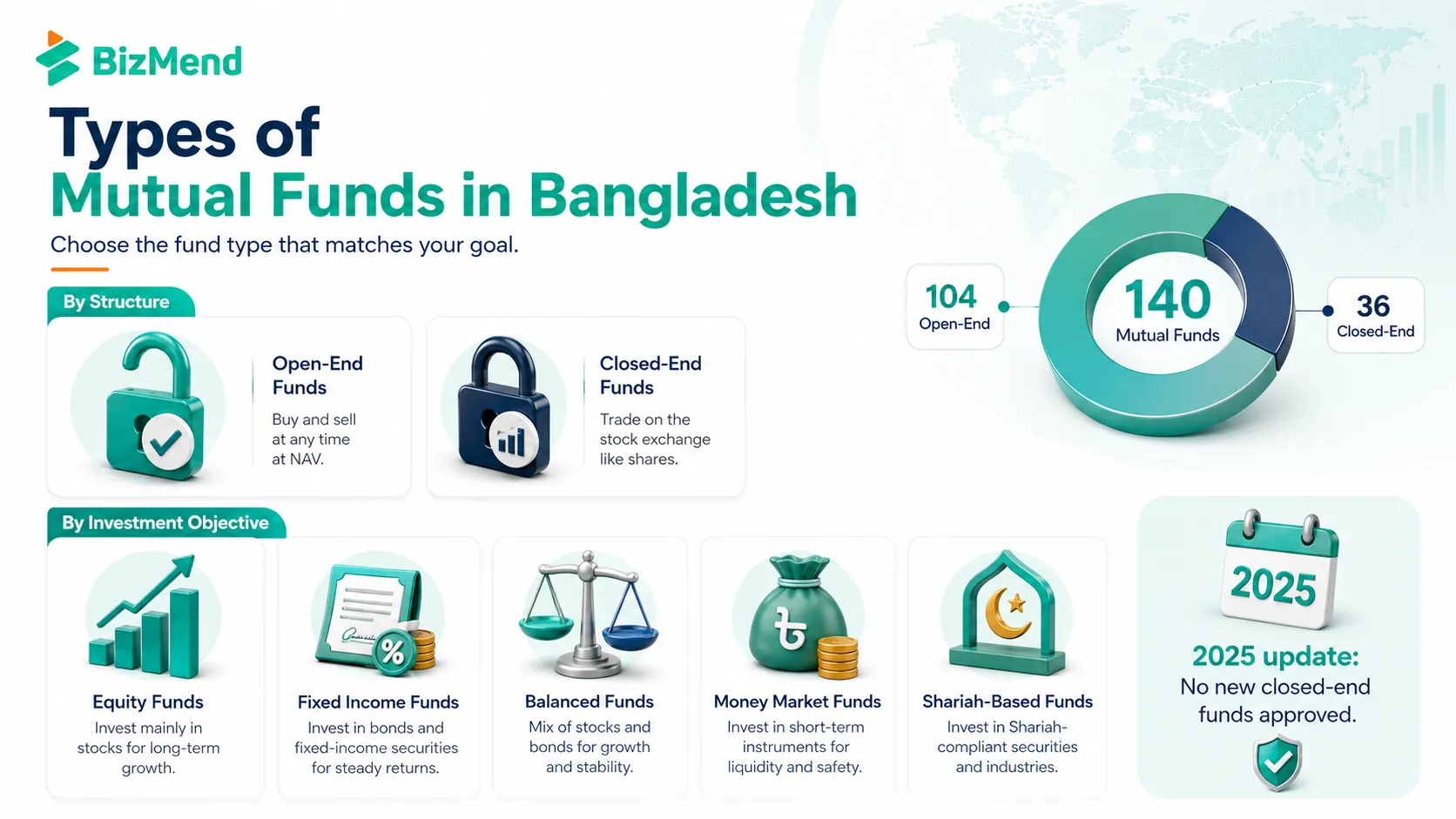
Open-End Mutual Funds
Open-end funds are not listed on the stock exchange. You buy and sell units directly through the AMC at the current NAV. There’s no fixed tenure. You can redeem your investment at any time, usually processed within a week.
As of 2026, BSEC has approved 104 open-end mutual funds in Bangladesh with a combined value of approximately Tk 8,593.5 crore. They’re generally more flexible and more transparent than closed-end funds because NAV is the actual transaction price.
These are the funds most beginner investors should start with, honestly.
Closed-End Mutual Funds
Closed-end funds raise a fixed pool of money, usually for 10 years, and are listed on DSE or CSE. You buy and sell units through your broker account like ordinary shares.
As of 2026, 36 closed-end mutual funds are listed on the DSE with a total market value of approximately Tk 4,481.26 crore.
Here’s the key development: under the Bangladesh Mutual Fund Regulations 2025, gazette published on 12 November 2025, no new closed-end mutual funds will be approved. Existing ones cannot extend their tenure. If the six-month average market price of a closed-end fund’s units remains at least 25% below its six-month average NAV, the fund manager must call a special general meeting under BSEC’s conversion rules. A three-fourths majority (75%) of unit holders must vote to either convert it to an open-end structure or liquidate it.
Short version: the era of closed-end funds in Bangladesh is winding down.
By Investment Objective
Mutual funds in Bangladesh also differ by what they invest in. The 2025 regulations define specific allocation rules:
- Equity funds: At least 51% invested in listed equities.
- Fixed income funds: At least 65% in fixed-income securities like bonds.
- Balanced funds: At least 50% in either fixed-income securities or listed equities.
- Money market funds: At least 60% in fixed-income instruments maturing in under one year.
You’ll also find Shariah-based mutual funds managed according to Islamic finance principles. ICB Asset Management Company (ICB AMCL), IDLC Asset Management, and LankaBangla Asset Management all offer Shariah-compliant options.
Who Manages Mutual Funds in Bangladesh?
Asset management companies (AMCs) are licensed by BSEC to manage mutual funds. Under the Bangladesh Mutual Fund Regulations 2025, each AMC must have a minimum paid-up capital of Tk 10 crore (up from Tk 5 crore). Existing companies have three years to comply.
Some of the active AMCs include ICB Asset Management Company Limited (ICB AMCL), IDLC Asset Management Limited, LankaBangla Asset Management Company Limited, EDGE AMC Limited, and VIPB Asset Management Company Limited.
BSEC prohibits AMCs from investing in businesses linked to their directors, affiliates, or associates. Fund directors, trustees, and asset managers are also barred from using mutual fund investments to secure directorships in any company.
To understand the broader regulatory framework behind Bangladesh’s capital market, including how BSEC oversees both mutual funds and direct equity investment, knowing who regulates what is a good foundation.
How Mutual Funds Actually Make You Money
Two ways. Dividends and capital gains.
Dividends: the fund distributes profits to unit holders. For equity funds (growth schemes), at least 50% of net profit earned in the year must be distributed as dividends, per BSEC rules.
Capital gains: if the NAV of your units rises above what you paid, you make a gain when you sell.
For dividend tax: if you have an E-TIN, you pay 10% advance income tax (AIT) on dividend income from mutual funds. Without an E-TIN, that rate rises to 15%. The tax rebate benefit on your investment amount under the Income Tax Act, 2023 makes mutual funds one of the more tax-efficient options available in Bangladesh.
For anyone comparing mutual funds to keeping money in an FDR, the flexibility of exit (no penalty for early redemption in open-end funds) and the tax advantage often tip the math toward mutual funds for medium-to-long-term goals.
How to Invest in Mutual Funds in Bangladesh: A Step-by-Step Guide
Step 1: Open a BO Account
To invest in any mutual fund in Bangladesh, you need a Beneficiary Owner (BO) account with CDBL. SIP units, for example from ICB AMCL, are credited directly to your BO account.
If you need guidance on opening a BO account and getting started in the Bangladesh capital market, that’s the very first move.
Step 2: Choose Your Fund Type
If you’re a beginner or someone who wants flexibility, an open-end fund is the safer starting point. You buy at NAV, you sell at NAV. No market-price discount games. No tenure lock-in.
Given the 2025 regulations and uncertainty around closed-end funds’ future, new investors are better served by open-end options.
Step 3: Pick an AMC and a Specific Fund
Different funds have different objectives. Here’s what to look at:
- What is the fund’s stated objective? Equity, balanced, income, money market, or Shariah-compliant?
- What are the historical NAV returns? As a reference point, IDLC Asset Management’s funds posted average annual compounded returns of 8.39% to 9.29% as of March 31, 2026, with their Shariah fund at 2.98%.
- How long has the fund been running?
- What sectors does it invest in?
You can check NAV on the BSEC website, the DSE website, or each AMC’s website. For tips on understanding mutual fund NAV and how to compare funds, a clear comparison will help you avoid choosing the wrong product.
Step 4: Submit Your Application and Invest
For open-end funds, visit the AMC’s office, a designated selling agent’s branch, or use their online platforms. You’ll need:
- NID or passport copy
- A/c payee cheque, pay order, or online bank transfer
- Your BO account number
Minimum investment: IDLC requires 500 units for individuals. EDGE AMC allows SIP from Tk 1,000 per month. VIPB Asset Management allows SIP from Tk 2,000 per month. ICB AMCL SIP investors get a 1% discount on the weekly sales price, with units credited directly to the BO account.
Step 5: Consider a SIP for Regular Investing
A Systematic Investment Plan (SIP) is a monthly commitment to invest a fixed amount. You set it up with the AMC, often through auto-debit from your bank account. You get units at the prevailing NAV. Over time, this averages out your purchase price across market cycles.
For anyone who keeps saying “I’ll invest when the market is lower,” SIP removes that decision entirely.
The 2026 Rule Changes: What They Mean for You as an Investor
The Bangladesh Mutual Fund Regulations 2025 represent the most significant overhaul of the mutual fund industry in years. Here’s what changed and why it matters.
No new closed-end funds. Going forward, all new mutual funds must be open-end. The regulation aligns Bangladesh closer to global practice, where open-end funds account for the vast majority of the industry.
Existing closed-end funds face accountability. Any fund trading 25% below NAV for six straight months must hold an EGM. Unit holders can vote to convert or liquidate.
Investment restrictions tightened. Mutual fund money can be invested in securities listed on the main board or SME platform of the stock exchange, IPOs or rights offers of such securities, and government securities. No unlisted equity, no option trading, no short-selling, no forward transactions. Debt and Shariah-based securities must carry a minimum credit rating of ‘A’.
Better oversight coming. The DSE is building a dedicated online platform for buying and selling open-end mutual fund units, expected by 30 June 2026. This would be the first such platform in Bangladesh’s history.
And look, if you’re a business owner thinking about setting up a company in Bangladesh and wondering where surplus business funds could be deployed, open-end mutual funds offer a relatively liquid, professionally managed option worth considering alongside FDRs.
Risks You Should Know Before Investing
Mutual funds are not fixed deposits. Returns are not guaranteed.
The stock market goes up and down. The LR Global Bangladesh case in 2024 showed exactly what bad governance looks like: the firm invested Tk 23 crore from six of its closed-end mutual funds into a delisted company, causing serious losses.
Some risks specific to Bangladesh mutual funds:
- Market risk: NAV falls when the stock market falls.
- Manager risk: A bad fund manager makes poor investment decisions.
- Liquidity risk: More relevant to closed-end funds, where market prices can differ significantly from NAV.
- Governance risk: As the LR Global case showed, not all fund managers act in unit holders’ best interests.
BSEC has strengthened governance in the 2025 regulations. But no regulation eliminates risk entirely.
For anyone comparing mutual funds to other investment options in Bangladesh like Sanchaypatra or FDR, mutual funds carry higher risk but also higher long-run return potential.
Mutual Funds vs. Directly Buying Stocks
A question I get a lot: why invest through a mutual fund when you can just buy shares yourself?
Direct stock investment gives you full control and potentially higher returns if you pick well. But it demands time, research, and the discipline not to panic-sell.
A mutual fund gives you professional management, diversification, and the structure of a regulated vehicle with custodians and trustees. For someone who doesn’t want to spend hours reading annual reports, that’s a real benefit.
For tips on how to buy shares directly on the Dhaka Stock Exchange, that’s a separate guide. Many experienced investors use both.
What NRBs (Non-Resident Bangladeshis) Need to Know
Non-Resident Bangladeshis (NRBs) are explicitly permitted to invest in Bangladesh mutual funds. Both open-end and closed-end funds accept NRB investors. ICB AMCL’s funds specifically list NRBs as eligible investors.
For NRBs interested in investment options in Bangladesh from abroad, mutual funds, particularly open-end ones, offer a simpler route than direct stock ownership, with clear entry and exit processes through the AMC.
Key Insights
- Bangladesh has 140 BSEC-approved mutual funds as of 2026: 104 open-end (Tk 8,593.5 crore) and 36 closed-end (Tk 4,481.26 crore) listed on the DSE.
- The Bangladesh Mutual Fund Regulations 2025 ended closed-end fund approvals. No new closed-end funds will be approved. Existing ones face conversion or liquidation if they trade 25% below NAV for six months.
- Open-end funds are the future. They offer NAV-based pricing, no tenure lock-in, and flexible exit. New investors should prioritize open-end options.
- Tax benefits are real. Investments in BSEC-registered mutual funds qualify for tax rebates under the Income Tax Act, 2023. Dividend income is taxed at 10% with an E-TIN and 15% without.
- You can start small. SIP options from EDGE AMC start from Tk 1,000 per month; VIPB from Tk 2,000. IDLC requires as few as 500 units for individuals.
- Governance has been tightened. The 2025 regulations prohibit AMCs from investing in businesses linked to their directors and bar fund managers from using fund assets to gain directorships.
- A DSE open-end mutual fund trading platform is expected by 30 June 2026, which will make buying and selling open-end fund units significantly easier for retail investors.
Frequently Asked Questions
What is a mutual fund in Bangladesh?
A mutual fund in Bangladesh is a regulated investment vehicle that pools money from many investors and invests it in BSEC-permitted assets including listed stocks, bonds, and government securities. Managed by a licensed AMC, investors earn returns through dividends and capital gains. As of 2026, BSEC has approved 140 mutual funds: 104 open-end and 36 closed-end.
What is the difference between open-end and closed-end mutual funds in Bangladesh?
Open-end funds are not listed on the stock exchange. You buy and sell units directly through the AMC at current NAV, with no fixed tenure. Closed-end funds are listed on DSE or CSE, have a fixed pool of capital, and a maximum tenure of 10 years. Under the Bangladesh Mutual Fund Regulations 2025, no new closed-end funds will be approved.
How do I invest in a mutual fund in Bangladesh?
You need a BO (Beneficiary Owner) account with CDBL, then choose an AMC and a specific fund. Visit the AMC’s office or a selling agent with your NID, a cheque or bank transfer, and your BO account details. Minimum investments vary: IDLC requires 500 units for individuals; EDGE AMC and VIPB offer SIP starting from Tk 1,000-2,000 per month.
What is NAV in mutual funds in Bangladesh?
NAV (Net Asset Value) is the per-unit price of a mutual fund, calculated by dividing total net assets by total units outstanding. BSEC requires open-end fund NAVs to be published weekly. For open-end funds, you buy and redeem units at a price based on NAV, subject to the fund’s applicable sale and repurchase pricing rules. For closed-end funds, units trade on the stock exchange at market prices, which may differ from NAV.
Are mutual fund returns guaranteed in Bangladesh?
No. Mutual fund returns in Bangladesh are not guaranteed. Returns depend on how the underlying investments perform. NAV can rise or fall. Historically, some well-managed open-end equity funds have delivered annual returns in the 8-15% range, but past performance does not guarantee future results. BSEC explicitly states that capital market investment carries risk.
Can NRBs invest in mutual funds in Bangladesh?
Yes. Non-Resident Bangladeshis (NRBs) are explicitly permitted to invest in both open-end and closed-end mutual funds in Bangladesh. ICB AMCL, IDLC, LankaBangla, and other AMCs accept NRB investors. NRBs can invest through AMC offices or selling agents, and units are credited to their BO accounts.
What tax benefits do mutual fund investors get in Bangladesh?
Investments in BSEC-registered mutual funds qualify for tax rebates under the Income Tax Act, 2023. For dividend income, investors with an E-TIN pay 10% advance income tax (AIT); those without an E-TIN pay 15%. The tax rebate on the invested amount itself makes mutual funds one of the more tax-efficient instruments available in Bangladesh.
What changed for mutual funds under the Bangladesh Mutual Fund Regulations 2025?
The regulations, gazette-published on 12 November 2025, prohibit new closed-end fund approvals, ban tenure extensions for existing ones, and trigger mandatory EGMs for funds trading 25% below NAV for six months. AMCs must meet a Tk 10 crore minimum paid-up capital; trustees must have Tk 200 crore. Investment in unlisted equities, option trading, and short-selling is prohibited.
What are Shariah-based mutual funds in Bangladesh?
Shariah-based mutual funds invest only in assets compliant with Islamic finance principles, avoiding interest-bearing instruments and prohibited sectors. AMCs including ICB AMCL, IDLC Asset Management, and LankaBangla offer Shariah fund options. IDLC’s Shariah fund posted a 2.98% average annual compounded return as of March 31, 2026.
Is it better to invest in a mutual fund or an FDR in Bangladesh?
It depends on your goals and risk tolerance. FDRs offer predictable returns and capital security. Mutual funds carry market risk but offer potentially higher long-run returns, professional management, liquidity for open-end funds, and tax rebate benefits that FDRs typically don’t. For medium-to-long-term goals of five or more years, a well-selected open-end equity fund has historically outperformed FDR rates in Bangladesh.
Final Thoughts
Mutual funds in Bangladesh are not the complicated, jargon-heavy products they’re made out to be. The 2025 reforms cleaned up some real structural problems, particularly the closed-end fund mess where investors were stuck for a decade with poor returns and no accountability. Things are more investor-friendly now than they’ve been in years.
If I were getting started today, I’d open a BO account, pick one open-end equity or balanced fund from a reputable AMC, and set up a monthly SIP. Something sustainable, even if it’s Tk 1,000 a month. What’s stopping you from making that first move?