
 by Sheikh Ornob
Most people in Bangladesh have heard “BSEC” thrown around in financial news. But ask most investors what it actually does, and you’ll get blank stares. Here’s the thing: BSEC Bangladesh is the referee of the entire capital market. Every stock you buy, every IPO you subscribe to, every broker you use, they’re all operating under BSEC’s rules.
This guide breaks it all down without the legal jargon.
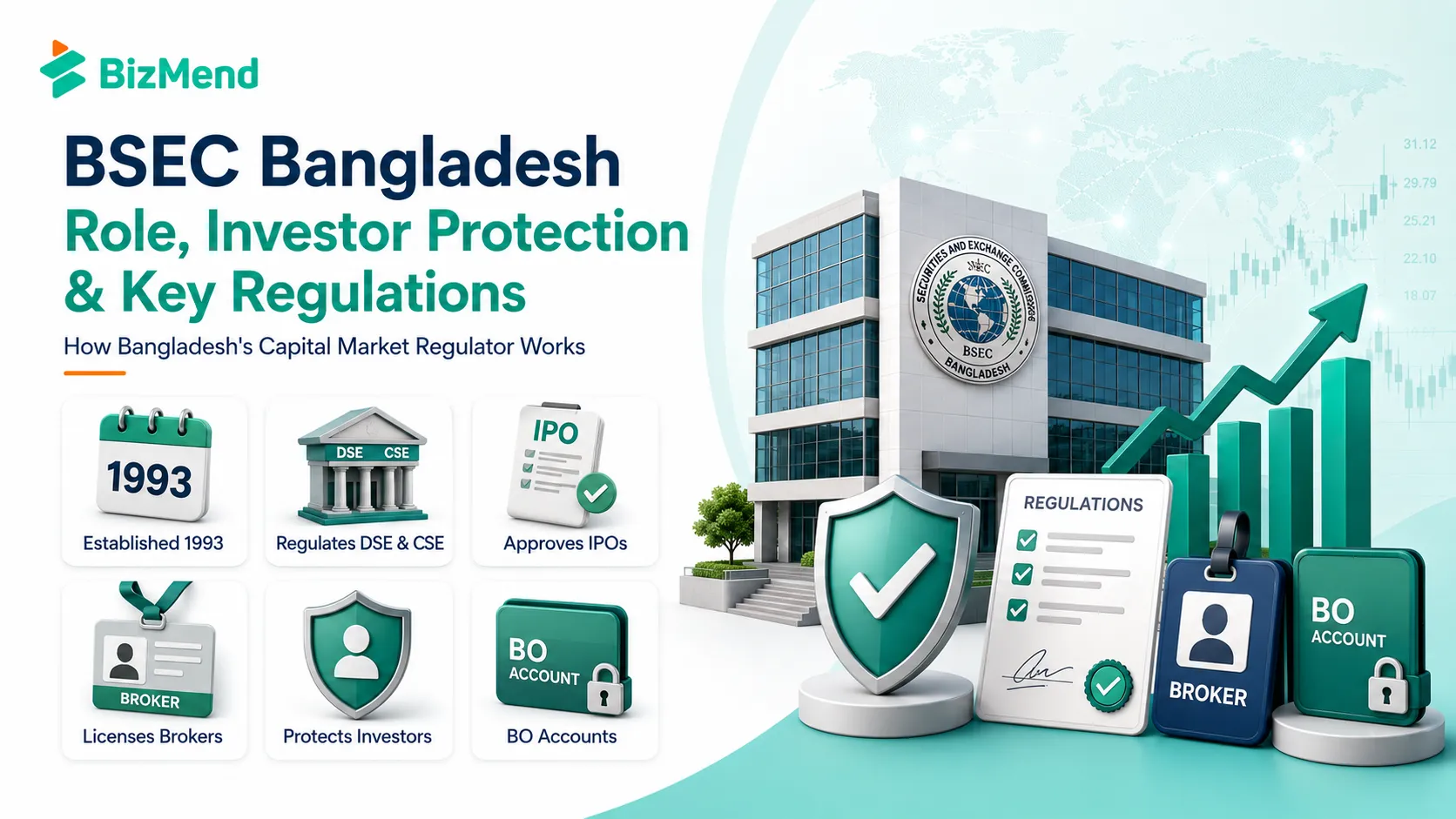
Quick answer: BSEC (Bangladesh Securities and Exchange Commission) is Bangladesh’s statutory capital market regulator, established on 8 June 1993 under the BSEC Act 1993. Attached to the Ministry of Finance, it oversees the Dhaka Stock Exchange (DSE) and Chittagong Stock Exchange (CSE), regulates IPOs, licenses brokers, and protects investor interests across Bangladesh’s capital market.
What Is BSEC Bangladesh?
BSEC stands for Bangladesh Securities and Exchange Commission. It was established on 8 June 1993 under the Bangladesh Securities and Exchange Commission Act, 1993. Before BSEC existed, Bangladesh’s capital market was regulated under the Capital Issues Act 1947 — a pretty outdated framework for a growing economy.
Today, BSEC is the primary regulator of Bangladesh’s entire capital market. That includes the Dhaka Stock Exchange (DSE) and the Chittagong Stock Exchange (CSE). Its legal mandate, straight from its founding act, is to protect investor interests, develop the securities market, and make rules connected to both.
BSEC is a statutory body attached to the Ministry of Finance. It’s also an ‘A’ category member of the International Organization of Securities Commissions (IOSCO) since 22 December 2013. That membership matters because it means BSEC follows internationally recognized disclosure standards and cooperates with securities regulators in other countries.
How BSEC Is Structured
The Commission has a Chairman who acts as its Chief Executive, plus four full-time Commissioners, all appointed by the government. The current Chairman is Khondoker Rashed Maqsood. In September 2024, Farzana Lalarukh, a former University of Dhaka faculty member, was appointed as a Commissioner for a four-year term.
BSEC also runs the Bangladesh Academy for Securities Market (BASM), set up in July 2019 as the official academic arm of the commission. BASM conducts training, research, and professional education programs for capital market participants.
BSEC’s Position in Bangladesh’s Financial System
BSEC doesn’t work alone. It coordinates with Bangladesh Bank (the central bank), the Registrar of Joint Stock Companies and Firms (RJSC), the National Board of Revenue (NBR), and others. Some investor complaints fall under Bangladesh Bank’s jurisdiction, not BSEC’s, so knowing who does what matters.
If you’re thinking about registering a company in Bangladesh before a potential public listing, understanding this regulatory landscape is useful even at the early stages of planning.
What Does BSEC Actually Do?
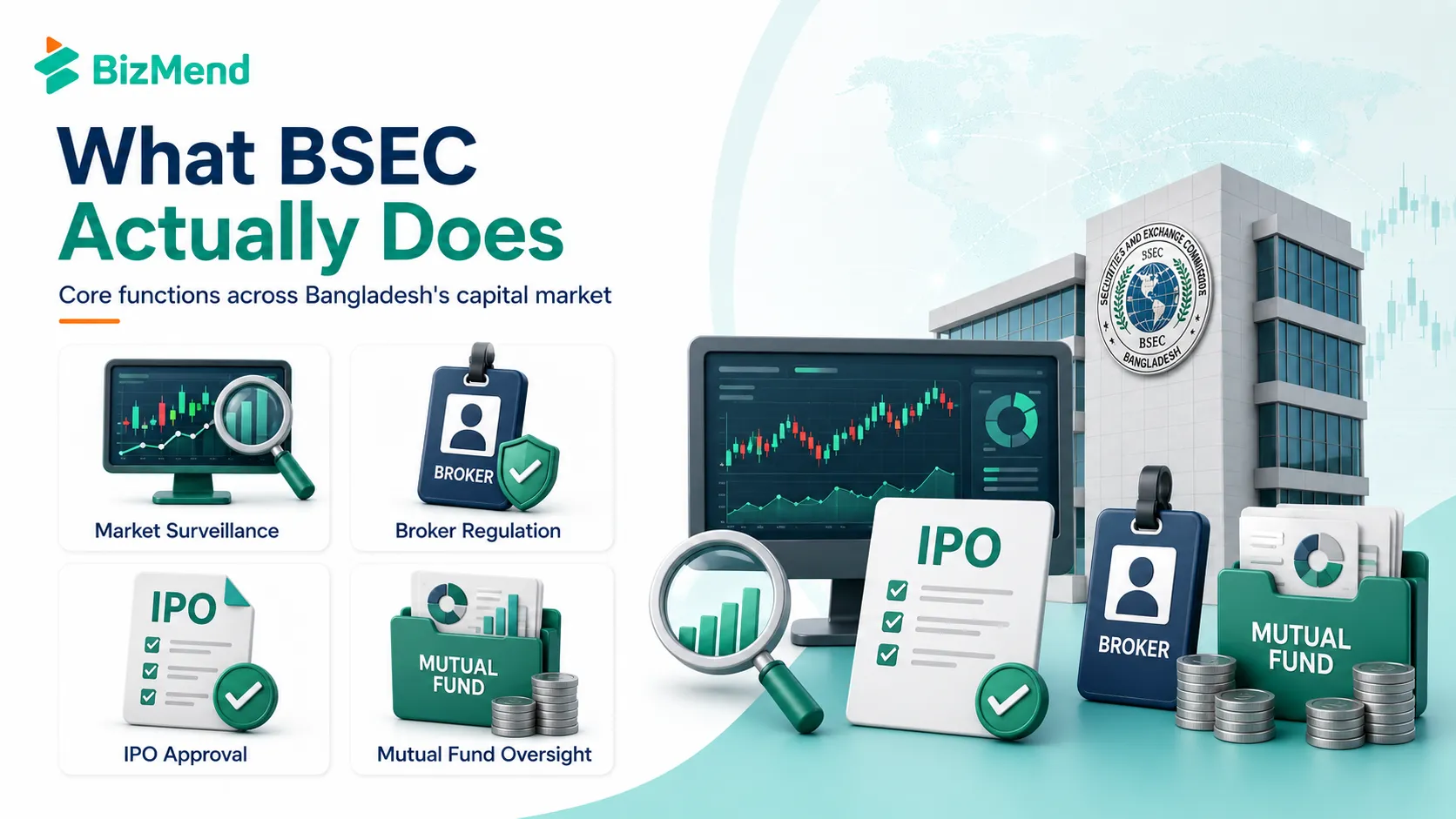
Honestly, the scope of BSEC’s work is broader than most investors realize. It’s not just watching stock prices. Here’s what the commission actually handles day to day.
Market Surveillance and Oversight
BSEC monitors trading activity across both DSE and CSE to detect manipulation, abnormal price movements, and suspicious patterns. In 2024, the commission said it was establishing a dedicated market intelligence unit following international standards.
In October 2024, BSEC instructed both exchanges to build a unified online platform where brokerage firms must update their Consolidated Customers’ Accounts (CCA) status daily at the end of trading hours. A CCA is the separate bank account brokers use to hold unused client funds. Any unauthorized use of those funds is a breach. And this isn’t a theoretical concern. Earlier, five brokerage firms were found to have embezzled approximately Tk 460 crore of investors’ money.
Regulating Brokers and Intermediaries
Every broker operating in Bangladesh’s capital market needs a Trading Right Entitlement Certificate (TREC). BSEC issues and regulates these licenses. Under the TREC Rules 2020, local brokerage companies need Tk 5 crore in paid-up capital plus Tk 3 crore in security deposit with the stock exchange.
If a brokerage firm has a CCA deficit, BSEC can suspend its access to IPO quotas, trading facilities, and even stop it from opening new branches. For anyone starting a brokerage or learning how brokerage regulation works in Bangladesh, the TREC framework is where it all begins.
Overseeing IPOs
IPO regulation is one of BSEC’s most visible jobs. Before any company can raise money from public investors, BSEC has to approve the listing. The commission reviews financials, assesses pricing, checks the auditors, and vets the issue manager.
In October 2025, BSEC approved the draft of the Bangladesh Securities and Exchange Commission (Public Offer of Equity Securities) Rules, 2025, and the final rules were later published on December 30, 2025. Key changes include:
- The Tk 50,000 minimum IPO investment requirement will be removed, opening IPO access to smaller investors.
- The 10% circuit breaker won’t apply for the first three trading days after a new listing, preventing artificial price swings.
- Direct listing is now permitted for multinational companies and large corporations with annual turnovers exceeding Tk 1,000 crore, with a 10% share offload requirement.
- The bidding limit for eligible investors under the book-building method drops from 2% to 1%, allowing wider participation.
BSEC Chairman Khondoker Rashed Maqsood said the “heart of the capital market is the IPO,” and the new rules are designed to make that pathway more accessible. For more on IPO investing and how to participate in Bangladesh, understanding BSEC’s approval process is the essential first step.
Mutual Funds and Asset Managers
BSEC regulates all mutual funds operating in Bangladesh. Every fund manager, every scheme, every unit trust must be registered and approved. In 2025, BSEC finalized new Mutual Fund Rules as part of its broader reform package.
A September 2024 inquiry revealed that LR Global Bangladesh Asset Management misallocated investor funds, causing losses of Tk 41.44 crore in a single fund. BSEC fined six directors Tk 1 crore each, ordered a Tk 90 crore refund to investors, and removed the firm from management. That’s the kind of enforcement that actually protects people.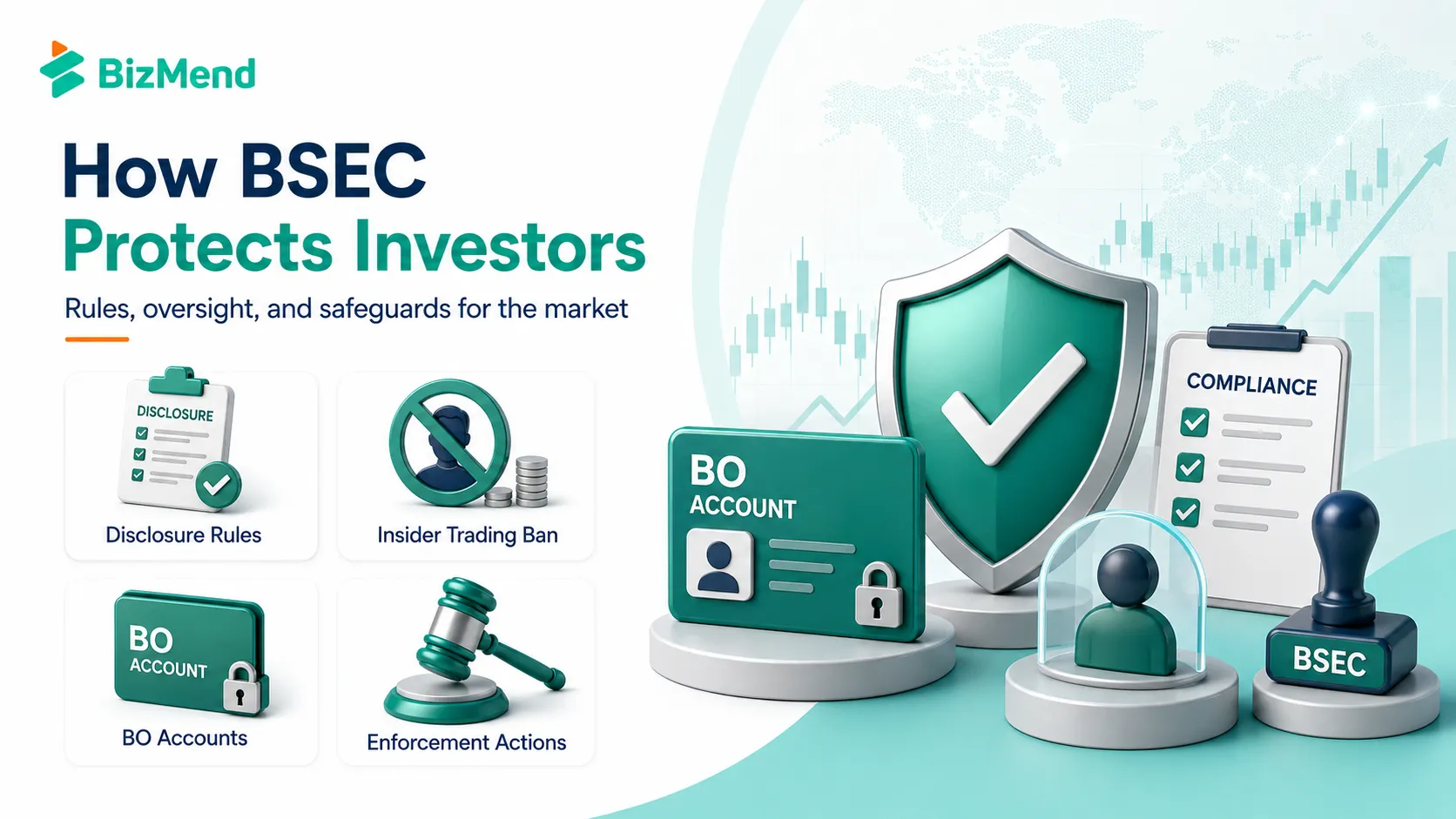
How BSEC Protects Investors
Investor protection is, officially, BSEC’s core mandate. But what does that look like in practice?
Disclosure Requirements for Listed Companies
Every company listed on DSE or CSE must publish timely, accurate financial reports. Quarterly and annual reports, price-sensitive disclosures, and corporate actions like dividends or rights issues all have to be made public through the exchange and BSEC.
BSEC’s Corporate Governance Code, 2018 requires listed companies to follow corporate governance conditions including independent directors, audit committee oversight, and enhanced compliance reporting. If you’re researching listed company compliance in Bangladesh, these guidelines are the right starting point.
Rules Against Insider Trading
Insider trading is prohibited under Bangladesh’s securities laws and the Bangladesh Securities and Exchange Commission (Prohibition of Insider Trading) Rules, 2022. Anyone possessing non-public, price-sensitive information about a listed company is barred from trading that company’s securities until the information is disclosed publicly.
The Securities and Exchange Commission (Amendment) Act, 2012, strengthened these rules, adding clearer definitions and tougher penalties for market manipulation and insider trading specifically.
BO Accounts and CDBL
Every investor needs a Beneficiary Owner (BO) account managed by the Central Depository Bangladesh Limited (CDBL) to trade on the DSE or CSE. BSEC works closely with CDBL to ensure these accounts are legitimate and properly maintained.
In 2025, BSEC cut the annual BO account maintenance fee from Tk 450 to Tk 150, a reduction of Tk 300. That’s a direct cost saving for every retail investor in the country. It’s a small but real step toward making stock market investing more accessible in Bangladesh.
Enforcement and Penalties
BSEC can impose fines, ban individuals from the market, suspend trading in securities, cancel broker registrations, and refer cases for criminal prosecution.
In 2025, BSEC took some of its boldest enforcement actions in years. Former BSEC Chairman Shibli Rubayat Ul Islam was banned from the capital market. Salman F Rahman, vice-chairman of Beximco Group and a former adviser to the previous government, was also banned. Heavy fines were imposed on large investors for alleged market manipulation.
To put this in context: between 1998 and 2010, only 2.6% of detected securities violations resulted in enforcement action by BSEC. The 2025 actions represented a significant shift from that pattern.
The 2024-2025 Capital Market Reform Push
After the change in political leadership in August 2024, the newly constituted BSEC moved quickly on reform.
What the Reform Taskforce Was Tasked With
On 7 October 2024, BSEC formed a five-member capital market reform taskforce. The members were: Dhaka University economics professor Mohammed Helal Uddin, former DSE Managing Director KAM Majedur Rahman, former Institute of Chartered Accountants of Bangladesh President AF Nesaruddin, BUET computer science professor Md Mostofa Akbar, and Dhaka University accounting and information systems associate professor Al-Amin.
The taskforce was assigned 17 initial terms of reference. These included:
- Adopting international governance standards for DSE, CSE, and the central depository
- Modernizing IPO rules for equity and private placements
- Improving financial disclosure and auditing standards for listed companies
- Holding issue managers, underwriters, auditors, and valuators accountable for false reporting
- Introducing FinTech, automation, and cybersecurity improvements to market infrastructure
- Coordinating more effectively with Bangladesh Bank, IDRA, NBR, and RJSC
For anyone thinking about Bangladesh’s capital market as a funding source for a business, these reforms are directly relevant to future IPO and bond issuance processes.
What Changed in 2025
By end of 2025, BSEC had completed three major regulatory overhauls:
- Equity Margin Rules 2025: BSEC repealed the Margin Rules, 1999 and introduced the Bangladesh Securities and Exchange Commission (Margin Repeal) Rules, 2025; separate margin-financing reforms were also proposed through the draft Margin Rules, 2025.
- Mutual Fund Rules 2025: Updated governance and accountability standards for fund managers, including stricter disclosure and oversight mechanisms.
- Public Offer of Equity Securities Rules 2025: The revised IPO framework was published as final rules on December 30, 2025, replacing the Public Issue Rules, 2015.
The benchmark DSEX index ended 2025 at 4,865 points, down 351 points (6.73%) from the previous year. Average daily turnover fell 18% year-on-year to Tk 521 crore. The reforms didn’t immediately boost prices. But market analysts widely see them as the structural groundwork for a more credible market going forward.
What This Means If You’re an Investor or Business Owner
For Beginner Investors
Understanding what BSEC does and how Bangladesh’s capital market works changes how you invest. Here are the practical takeaways:
- Your broker must hold your funds in a separate CCA account. If they misuse it, BSEC can act.
- Your BO account annual maintenance fee is now Tk 150. Know what you should be paying.
- For IPOs, the minimum Tk 50,000 investment barrier is being removed under the new 2025 rules.
- Check whether any company you’re investing in has filed its required quarterly reports. BSEC mandates this.
For Companies Considering Listing
If you’re a business owner exploring a public listing, BSEC’s IPO rules are the full rulebook. The reform taskforce noted that previous requirements, including a minimum paid-up capital of Tk 30 crore and mandatory profitability, deterred many legitimate businesses from listing. New rules aim to make listing more accessible for fundamentally strong companies, including multinationals.
If your business operates across borders or has international shareholders, understanding cross-border compliance and company formation will save you significant time before approaching BSEC for a listing.
Key Insights
- BSEC was established on 8 June 1993 under the Securities and Exchange Commission Act, 1993, making it Bangladesh’s sole capital market regulator for over 30 years, overseeing both DSE and CSE.
- The Commission has five members — a Chairman and four full-time Commissioners, all government-appointed — and operates as a statutory body attached to the Ministry of Finance.
- Investor protection is the top priority. Every major BSEC rule, from IPO approval to broker licensing to mutual fund oversight, is legally anchored in protecting the public investor.
- Three major regulations were completed in 2025: the Equity Margin Rules, updated Mutual Fund Rules, and the Public Offer of Equity Securities Rules 2025, the most significant regulatory overhaul in years.
- BO account fees were cut in 2025. The annual maintenance fee dropped from Tk 450 to Tk 150, a Tk 300 direct saving for every retail investor holding a BO account.
- Enforcement sharpened significantly. BSEC banned high-profile figures including former chairman Shibli Rubayat Ul Islam and Beximco’s Salman F Rahman from the capital market in 2025.
- BSEC holds IOSCO ‘A’ category membership since 22 December 2013, placing Bangladesh’s capital market regulator within the internationally recognized framework of securities oversight standards.
Frequently Asked Questions
What does BSEC stand for in Bangladesh?
BSEC stands for Bangladesh Securities and Exchange Commission. It’s the statutory body responsible for regulating Bangladesh’s capital market, including the Dhaka Stock Exchange and Chittagong Stock Exchange. BSEC was established on 8 June 1993 under the Bangladesh Securities and Exchange Commission Act, 1993, and operates as a body attached to the Ministry of Finance.
Is BSEC a government body?
Yes. BSEC is a statutory body attached to the Ministry of Finance. Its Chairman and four Commissioners are appointed by the government for fixed terms. While it functions independently in regulatory decisions, it reports to the Finance Ministry and operates under laws enacted by the Bangladesh government.
What is a BO account and why does BSEC require it?
A BO (Beneficiary Owner) account is a mandatory demat account every investor must open to trade on the DSE or CSE. It’s managed by the Central Depository Bangladesh Limited (CDBL) and records share ownership electronically. BSEC requires all investors to hold a BO account to prevent fraud and ensure accurate ownership records. The annual maintenance fee was reduced to Tk 150 in 2025, down from Tk 450.
How does BSEC regulate IPOs in Bangladesh?
BSEC reviews and approves all IPO applications before companies can raise public funds. It assesses the company’s financials, pricing, auditors, and issue managers. Under the Public Offer of Equity Securities Rules 2025, the process now gives stock exchanges a formal recommendation role, removes the minimum Tk 50,000 investment threshold, and introduces stricter pricing and valuation guidelines to attract stronger companies.
What are the rules for brokers registered with BSEC?
All brokers must hold a Trading Right Entitlement Certificate (TREC) under the TREC Rules 2020. Local companies need Tk 5 crore in paid-up capital plus a Tk 3 crore security deposit with the stock exchange. Brokers must maintain Consolidated Customers’ Accounts (CCA) to segregate client funds and update CCA status daily. BSEC can suspend, fine, or cancel a broker’s license for non-compliance.
How does BSEC handle insider trading?
Insider trading is prohibited under the Securities and Exchange Ordinance, 1969, and the BSEC Act. Anyone with non-public, price-sensitive information about a listed company is barred from trading that company’s securities until the information is publicly disclosed. The Securities and Exchange Commission (Amendment) Act, 2012, strengthened these rules with clearer definitions and tougher penalties for manipulation and insider trading.
What was the capital market reform taskforce and what did it deliver?
BSEC formed a five-member capital market reform taskforce on 7 October 2024 to recommend structural reforms across governance, transparency, and investor confidence. The taskforce was given 17 initial terms of reference. By end of 2025, its recommendations contributed to three completed regulatory overhauls: new Equity Margin Rules, updated Mutual Fund Rules, and the Public Offer of Equity Securities Rules 2025. It also recommended banning margin loan-based company directorships.
Is Bangladesh’s capital market open to foreign investors?
Yes. Foreign investors can invest in Bangladesh’s capital market subject to BSEC and Bangladesh Bank regulations. They must open BO accounts through CDBL. For SME board trading, both local and foreign investors are required to maintain a minimum portfolio value of Tk 10 lakh in the DSE secondary market to qualify, a reduction from the previous Tk 30 lakh requirement.
What is BASM and how does it relate to BSEC?
BASM stands for Bangladesh Academy for Securities Market. It was established in July 2019 as the official academic and training unit of BSEC. BASM runs professional development programs, investor education initiatives, and capital market research for brokers, analysts, fund managers, and listed company officers. It’s essentially BSEC’s education arm.
What happened to Bangladesh’s capital market in 2025?
The DSEX benchmark index ended 2025 at 4,865 points, down 6.73% from the previous year. Average daily turnover fell 18% to Tk 521 crore, and no new IPOs were approved during the year. However, BSEC completed three major regulatory reforms and took significant enforcement actions against high-profile market participants. Analysts broadly see 2025 as a difficult but structurally necessary year for the market.
Final Thoughts
BSEC’s job in Bangladesh is unglamorous but fundamental. Without a working securities regulator, public trust in the stock market collapses, and that has ripple effects across the whole economy. The 2025 reform cycle showed that accountability is possible, even in a market that has historically shielded powerful actors. That matters more than any single index number.
If you’re just getting started, open your BO account, understand the TREC-licensed brokers you can use, and check what BSEC requires from companies before you trust their IPO. The rules exist to protect you. Use them.