

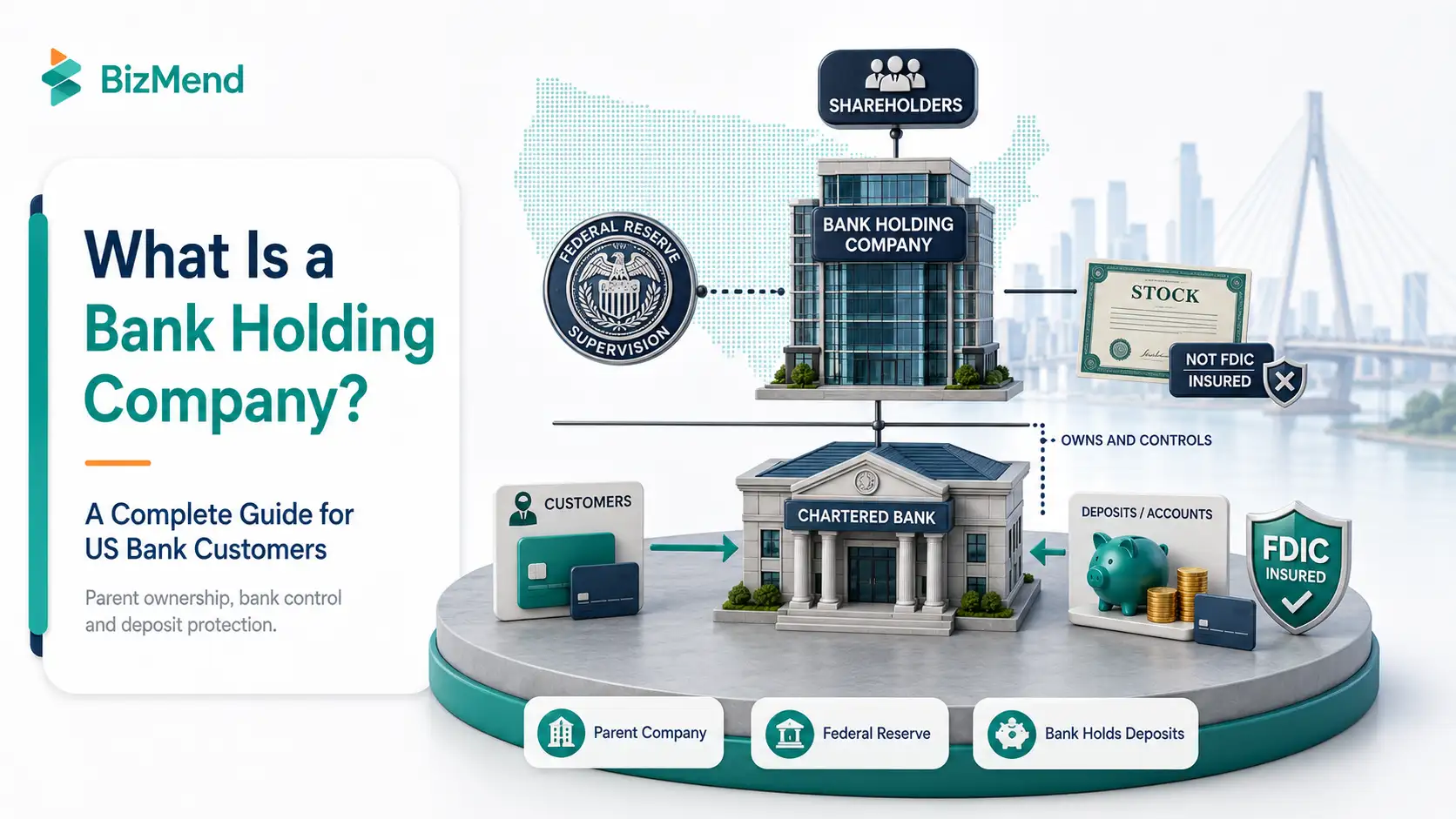
Understanding what a bank holding company is starts with one fact: the parent company that owns your bank is not the entity holding your deposit. The name on the branch door, the ticker on the stock exchange, and the charter behind your checking account are often three different things. That separation is deliberate, and it is written into federal law.
For most customers this stays invisible until something goes wrong. It surfaced sharply in 2023, when a failed bank and its parent ended up in two different legal processes with very different outcomes.
Quick Answer: A bank holding company is a corporation that controls one or more banks, usually by owning at least 25 percent of the bank’s voting shares. The Federal Reserve supervises it. It owns the bank but does not hold your deposit, and its stock carries no FDIC insurance.
What Is a Bank Holding Company?
A bank holding company is a corporation that controls at least one bank. The Bank Holding Company Act of 1956 defines that control as owning, controlling, or having the power to vote 25 percent or more of any class of a bank’s voting securities, controlling the election of a majority of its directors, or otherwise exercising a controlling influence over its management or policies.
The structure exists because of a 1950s problem. States restricted where banks could open offices, so companies started buying several banks and running them as one business, which sidestepped the branching limits entirely. Congress responded in 1956 by defining these parent companies, putting them under Federal Reserve supervision, and forcing them out of most non-financial businesses. The 1970 amendments closed the remaining gap by covering companies that control even a single bank.
Today the form is used by almost everything from a family-owned parent above one small bank to the largest financial groups in the country. The parent itself takes no deposits, issues no debit cards, and makes no loans to the public. It owns shares, raises capital, sets group strategy, and holds other subsidiaries. The logic matches any parent subsidiary structure outside banking, with one difference: entry, ownership, and permitted activities all require federal approval.
How a bank holding company differs from the bank itself
The bank is the licensed institution. It has a charter, a federal deposit insurance certificate, a primary supervisor, and a legal obligation to you as a depositor. The parent has none of that. It does not open a bank branch, take your money, or clear your payments. When people say a bank was acquired, the transaction usually happened at the holding company level while the charter underneath carried on unchanged.
How a Bank Holding Company Works
The layers inside the structure
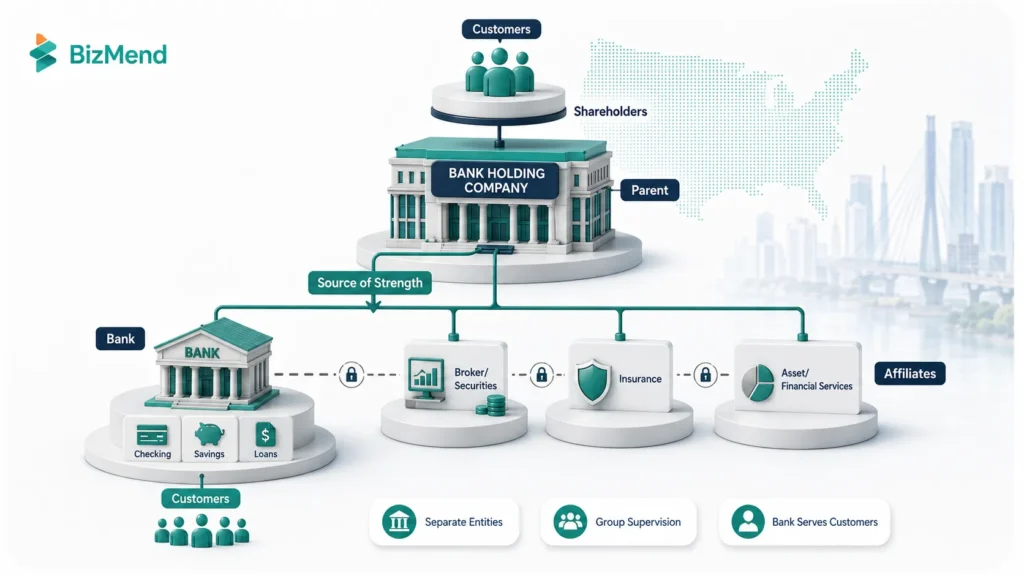
A simple group has two levels: shareholders own the holding company, and the holding company owns the bank. Larger groups add more. Below the parent you may find several chartered banks, a broker-dealer, an insurance agency, a leasing company, an asset manager, and offshore entities. Each is a separate legal person with its own balance sheet, and money does not flow freely between them.
Sections 23A and 23B of the Federal Reserve Act limit what a bank may do with its affiliates. Loans and asset purchases between the bank and the rest of the group face quantitative caps and collateral rules, and transactions must happen on market terms. The point is to stop a healthy bank from being drained to prop up a struggling sibling.
Who supervises a bank holding company
The Federal Reserve is the consolidated supervisor of every bank holding company, regardless of who supervises the bank underneath. The Fed describes its own position as umbrella supervision, meaning it looks at the group as a whole rather than duplicating the work of the bank, securities, and insurance regulators below.
So a single group can face several agencies at once. A subsidiary with a national bank charter answers to the Office of the Comptroller of the Currency. A sibling operating under a state bank charter answers to its state banking department alongside the Federal Deposit Insurance Corporation or the Federal Reserve. A broker-dealer subsidiary answers to the Securities and Exchange Commission. The parent answers to the Fed for all of it.
The source of strength obligation
Section 616 of the Dodd-Frank Act wrote a long-standing supervisory principle into statute: a company controlling an insured depository institution must serve as a source of financial and managerial strength to it. The Federal Deposit Insurance Act defines that as the ability to provide financial assistance to the insured institution if the institution comes under stress.
This runs one way only. The parent is expected to support the bank. The bank is not there to fund the parent, and the affiliate transaction rules exist to keep it that way.
| Important: Source of strength is an obligation on the parent, not a guarantee to you. It does not extend federal deposit insurance to holding company securities, and it does not promise that a parent will have the resources to rescue a bank when the moment arrives. |
What the parent may and may not own
The Bank Holding Company Act keeps banking separate from general commerce. A plain bank holding company may hold banks and activities the Federal Reserve has found to be closely related to banking, such as leasing, mortgage servicing, data processing, and trust services. It may not run a grocery chain or a manufacturing business. A company that elects financial holding company status under the Gramm-Leach-Bliley Act of 1999 gets a wider list that includes securities underwriting, insurance underwriting, and merchant banking.
Types of Bank Holding Company in the United States
Five parent structures sit under Federal Reserve supervision. They differ in what they can own and which rulebook applies.
| Structure | What it controls | Key condition or rulebook |
| Bank holding company | One or more commercial banks | Bank Holding Company Act and Regulation Y; limited to banking and closely related activities |
| Financial holding company | Banks plus securities, insurance, and merchant banking arms | Elected status under the Gramm-Leach-Bliley Act; every depository subsidiary must be well capitalized and well managed with a satisfactory Community Reinvestment Act rating |
| Savings and loan holding company | A savings association or thrift rather than a commercial bank | Home Owners’ Loan Act and Regulation LL; moved to Federal Reserve supervision by the Dodd-Frank Act |
| Mutual holding company | A mutual savings institution owned by its depositors, not by public shareholders | Regulation MM, which governs mutual reorganizations and subsidiary holding companies |
| Intermediate holding company | The US subsidiaries of a large foreign banking group | Regulation YY; required so the Federal Reserve can supervise the American operations as one unit |
Structure summary prepared 6 August 2026 from the Federal Reserve Bank Holding Company Supervision Manual and Regulation Y. Individual firms may hold more than one designation over time.
Why financial holding company status matters
Election is not permanent. If a depository subsidiary stops being well capitalized or well managed, the group must notify the Federal Reserve, agree a remediation plan, and fix the shortfall. Failure to cure within the period the Board allows can lead to an order to divest the banking subsidiaries or to abandon the expanded activities. Broad powers come attached to continuing conditions.
Bank Holding Company Requirements and Approvals
Forming one is a regulated transaction, not a filing formality. The sequence below applies to a typical domestic formation or acquisition.
1. Establish whether the control test is met. Crossing 25 percent of a class of voting securities is the clearest trigger, but director control and controlling influence also count, and the Board can make a controlling influence finding well below the ownership line.
2. File for prior approval. Section 3 of the Bank Holding Company Act requires Federal Reserve approval before a company acquires a bank or before an existing holding company acquires another one.
3. Register with the Federal Reserve. A company that becomes a bank holding company must register within 180 days.
4. Meet the financial and managerial standards. The Board weighs capital, earnings, management quality, competitive effects, convenience and needs of the community, and financial stability considerations.
5. Set up ongoing reporting. Holding companies file organizational and financial reports with the Federal Reserve, including the FR Y-6 annual report and, for larger firms, the FR Y-9C consolidated financial statements.
Scale then changes the burden. Under the Small Bank Holding Company and Savings and Loan Holding Company Policy Statement at Appendix C to Regulation Y, qualifying companies with pro forma consolidated assets below $3 billion get lighter capital and reporting treatment and more room to use acquisition debt. The threshold moved from $1 billion to $3 billion in August 2018 under the Economic Growth, Regulatory Relief, and Consumer Protection Act. To qualify, a company must avoid significant nonbanking activities, significant off-balance-sheet activities, and material outstanding debt or equity securities.
Benefits and Drawbacks of the Bank Holding Company Structure
Boards do not adopt this form for the paperwork. It solves specific problems and creates others.
What the structure makes possible
- Five practical gains explain most of the adoption.
- Capital raising at the parent, which can issue equity or debt and push proceeds down to the bank as capital.
- Acquisitions and reorganizations at the share level, which avoids merging charters every time the group grows.
- Activities the bank itself cannot conduct, held in separate nonbank subsidiaries with their own liability.
- Legal separation, so a problem in a leasing or insurance arm does not automatically become a claim against the bank.
- Flexibility over dividends and share repurchases at the group level, subject to Federal Reserve expectations.
What it costs
- The offsetting burdens are permanent rather than one-off.
- A second supervisor. The Federal Reserve examines the parent on top of whoever examines the bank.
- Federal approval for growth. Acquisitions need clearance, and clearance is not automatic.
- The source of strength obligation, which puts the parent’s resources on the hook for the bank.
- Consolidated capital requirements once the group passes the small company threshold.
- Extra legal, audit, and reporting cost that a standalone bank avoids entirely.
Most groups above a modest size conclude the trade is worth it, which is why the largest US banking organizations all sit beneath holding companies. Some smaller institutions go the other way and collapse the structure to save cost.

Why the Bank Holding Company Above Your Bank Matters to You
Federal deposit insurance attaches to the bank, not the parent. The FDIC insures deposits at an insured institution up to $250,000 per depositor, per insured bank, for each ownership category. It does not insure stocks, bonds, or other securities, and that includes shares or notes issued by the holding company whose name is on your branch.
March 2023 turned that into something concrete. Silicon Valley Bank was closed and placed into FDIC receivership. Its parent, SVB Financial Group, filed separately for Chapter 11 bankruptcy days later. In their joint statement, the Treasury, the Federal Reserve, and the FDIC confirmed that all depositors would be protected but that shareholders and certain unsecured debtholders would not be. The FDIC later summarized the outcome plainly: shareholders lost their investment and unsecured creditors took losses. Two entities, one name, two completely different results.
Three practical consequences follow. Deposit insurance limits are counted per insured bank, so if a holding company owns two banks that share a brand, coverage depends on whether they hold one charter or two. Investment products sold in a branch by an affiliate are not deposits and are not insured. And a bank’s real financial condition is reported in group filings under the parent’s name, which is where you look if you want to check it.
How to Identify the Bank Holding Company Behind Your Bank
None of this requires paid tools. Work through the following in order.
1. Read the fine print on your account agreement or statement. The legal name of the insured institution appears there, and it often differs from the marketing name.
2. Look up that legal name on the FDIC BankFind Suite. The record shows the charter class, the primary federal regulator, the FDIC certificate number, and the holding company at the top.
3. Check the Federal Financial Institutions Examination Council National Information Center for the full organizational hierarchy, including nonbank subsidiaries and any foreign parent.
4. If the parent is publicly traded, read its most recent annual report on Form 10-K. Item 1 sets out the group structure and the supervision that applies to it.
5. Confirm how many separate insured charters the group holds. This is the number that governs your coverage, not the number of brands.
The exercise is worth repeating whenever a merger is announced. Groups regularly consolidate two charters into one, and when that happens depositors who held separately insured accounts at both may find their balances combined under a single limit. If you are shopping rather than checking, the same records help you choose a national bank on evidence rather than advertising.
Risks, Limitations, and Common Misunderstandings
- Several widely held assumptions about holding companies turn out to be wrong in ways that cost people money.
- A holding company is a corporate structure, not a product. You cannot open one the way you open an account, and no bank holding company competes for your deposit directly.
- Federal supervision of the parent is not a guarantee of solvency. The Federal Reserve supervises every bank holding company, and companies still fail.
- Group size does not equal individual bank strength. A large parent can own a weak subsidiary, and the small company policy statement means many parents publish less financial detail than their bank does.
- Buying shares in a bank holding company is an equity investment carrying full loss risk, with no deposit protection at any level.
- Brand consolidation can quietly change your coverage. Two banks merging into one charter halves the number of separate $250,000 limits available to you.
- Some institutions have no holding company at all. A handful of sizeable US banks are owned directly by shareholders, which is legal and unremarkable.
- A foreign parent adds a layer. Where a US intermediate holding company sits beneath an overseas group, your deposit protection still comes from the US insured charter, not from the foreign parent.
Where Holding Companies Show Up Across Bank Types
The structure spans the whole market rather than clustering at the top. A small parent formed around a community bank in one or two counties works from the same statute as a group with a trillion dollars in assets, though the reporting and capital rules scale sharply with size.
The same applies in the middle of the market. A mid-sized regional bank commonly sits beneath a parent that also owns wealth management and insurance arms, which is often the reason the group elected financial holding company status in the first place. Digital institutions follow the pattern too, and an online bank with no offices at all usually has a registered parent above it, sometimes one whose main business began outside banking.
Key Insights
- Control means 25 percent of voting shares, board control, or controlling influence.
- The Federal Reserve supervises every bank holding company, whoever supervises the bank below.
- FDIC insurance covers deposits at the bank, never securities issued by the parent.
- Financial holding company status opens wider activities but carries continuing capital and CRA conditions.
- Parents below $3 billion in assets get lighter capital and reporting treatment.
- Coverage limits count per insured charter, not per brand or per holding company.
Final Thoughts on Bank Holding Companies
The parent above your bank rarely affects daily banking, and for most customers it never needs a second thought. It becomes relevant in three situations: when a merger changes how many insured charters a group holds, when someone offers you an investment product inside a branch, and when a bank comes under visible stress. In each case the useful question is the same one. Which legal entity is actually holding my money, and is that entity insured?
You can settle that question in a few minutes using the FDIC BankFind record for your bank. Supervision, ownership, and corporate structure all change over time, so check the current record rather than relying on a brand name you have known for years.
Frequently Asked Questions
What is a bank holding company in simple terms?
It is a company that owns a bank. Federal law treats any company controlling 25 percent or more of a bank’s voting shares, or controlling its board, as a bank holding company, which puts it under Federal Reserve supervision. The parent owns shares and sets strategy; the bank underneath holds the deposits and does the banking.
How does a bank holding company work day to day?
It raises capital, allocates it across subsidiaries, sets group policy, and files consolidated reports with the Federal Reserve. It does not serve customers. Transactions between the bank and its affiliates are capped and collateralized under Sections 23A and 23B of the Federal Reserve Act so that group activity cannot drain the bank.
Can I open an account with a bank holding company?
No. A holding company is a corporate parent, not a deposit product, and it holds no accounts. You open accounts with the chartered bank underneath it. The only way to hold a position in the parent is to buy its shares or bonds, which is an investment carrying loss risk rather than a banking relationship.
Is money at a bank owned by a holding company safe?
Deposits are insured on the same terms as anywhere else, up to $250,000 per depositor, per insured bank, for each ownership category, provided the bank is FDIC insured. Ownership by a parent changes nothing about that. What is never insured is stock or debt issued by the holding company itself.
What is the difference between a bank holding company and a financial holding company?
A financial holding company is a bank holding company that has elected wider powers under the Gramm-Leach-Bliley Act, allowing securities underwriting, insurance underwriting, and merchant banking. The election requires every depository subsidiary to be well capitalized, well managed, and rated at least satisfactory under the Community Reinvestment Act.
Who needs to register as a bank holding company?
Any company that acquires control of a US bank, including investor groups, foreign banking organizations operating here, and firms whose main business started outside banking. Registration with the Federal Reserve is due within 180 days, and Section 3 approval must be obtained before the acquisition rather than after it.
Does every US bank have a holding company?
No. Most do, and every very large banking organization does, but some banks are owned directly by their shareholders with no parent company in between. Whether a parent exists makes no difference to your deposit insurance, which follows the bank’s own charter and FDIC certificate.
