
How to Choose a Regional Bank in the US
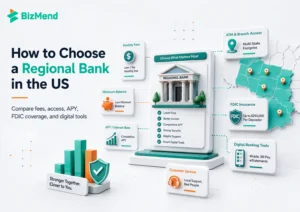
Learning how to choose a regional bank in the US comes down to matching seven factors against your own habits,…

What is a regional bank? Learn the definition, types, requirements, benefits and drawbacks, and how to choose the right one in the US.
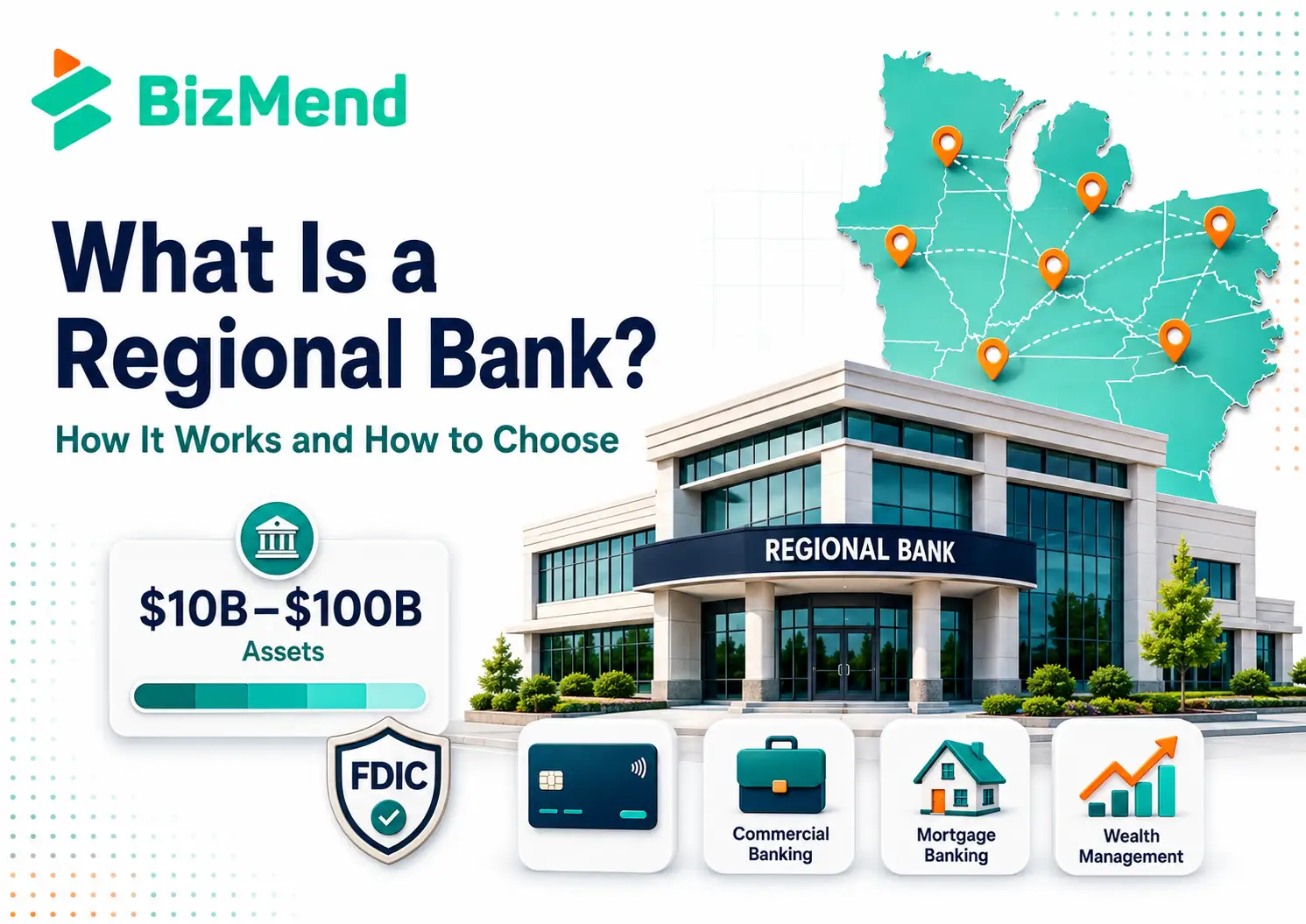
What is a regional bank? It sits in the middle of the US banking system, bigger than the local community bank down the street but far smaller than the handful of nationwide giants that dominate financial headlines. Newcomers comparing banks often lump every large-looking branch into one category, but regulators draw a specific line based on total assets.
That line matters because it decides how closely a bank gets examined, what products it can realistically offer, and how many states its branches cover. This guide explains what a regional bank is, the main types, requirements, and how to choose one.
Quick Answer: A regional bank is a US bank or bank holding company with total assets generally between $10 billion and several hundred billion dollars, though the exact range depends on which federal regulator supervises the bank. Regional banks typically operate across several states and offer a broader product range than a community bank.
The Federal Reserve defines a regional banking organization, or RBO, as a US firm with total assets between $10 billion and $100 billion. Below that range, a bank falls into the community banking organization tier; above it, a bank moves into the large and foreign banking organization tier alongside the largest institutions in the country.
As of June 30, 2025, the Federal Reserve supervised 100 regional banking organizations holding a combined $3.0 trillion in assets, according to the Fed’s own December 2025 Supervision and Regulation Report. That is roughly the same combined asset total as the more than 3,300 community banking organizations below the $10 billion line, which shows how much larger each individual regional bank tends to be.
Charter type plays no role in this classification, the same way it does not decide whether a bank counts as a community bank. A regional bank can hold a state charter or a national bank charter, and what actually places it in the regional tier is its total consolidated assets, not which regulator issued its charter.
The exact asset range depends on which regulator is doing the classifying, and the two federal bank regulators do not use the same numbers. The Federal Reserve’s regional banking organization range covers state member banks and bank holding companies between $10 billion and $100 billion. The Office of the Comptroller of the Currency draws a different line for the national banks it charters: its Regional and Midsize Financial Institutions group, created in a September 2025 reorganization, supervises national banks and federal savings associations with between $30 billion and $500 billion in assets. A $60 billion national bank and a $60 billion state member bank both count as regional in everyday usage, even though only one of them falls inside the Federal Reserve’s own regional range on paper.
Size drives everything about how a regional bank is supervised. The Federal Reserve’s Regional Banking Organization program examines these firms more frequently and with a more detailed supervisory plan than it uses for community banks, reflecting the added complexity that comes with a larger balance sheet and a wider footprint.
A bank does not choose to become regional the way it might choose a charter type; it grows into the tier as its total consolidated assets cross $10 billion, and it moves out of the tier again if assets pass $100 billion. That transition brings a new supervisory process, expanded governance expectations, and a shift toward the large and foreign banking organization program, along with more frequent examinations and a dedicated supervisory team assigned to the institution.
Geography reinforces the size-based definition in everyday use. Most regional banks concentrate their branches and lending relationships in one part of the country, such as the Southeast, Midwest, or Pacific Northwest, rather than spreading nationwide the way the largest banks do. This combination of a specific asset range and a defined geographic footprint is what separates a regional bank from both a smaller community bank and a nationwide brand, even though neither factor alone fully captures the distinction on its own.
Regional banks vary by charter, ownership structure, and how close they sit to either edge of the $10 billion to $100 billion range, and the label covers a wide spectrum of institutions in practice.
State-chartered regional banks hold a charter from a state banking department and add either the Federal Reserve or the FDIC as a federal regulator, similar to the charter structure covered in this state bank guide. Nationally chartered regional banks instead hold an OCC charter, reporting to the Comptroller of the Currency regardless of Federal Reserve membership, though the day-to-day banking experience often looks similar across both charter types at this size.
Bank holding company structures are common at this size, since a regional bank frequently operates as the lead subsidiary of a publicly traded holding company that may also own wealth management, insurance, or mortgage subsidiaries. Reviewing the national bank requirements checklist alongside a specific regional bank’s own account rules helps separate charter-level requirements from holding-company-level structure.
Super-regional banks sit near the top of the range, often approaching the $100 billion threshold with dozens or hundreds of branches spanning many states. These institutions frequently offer a product lineup that looks close to what a nationwide bank provides, including capital markets access and larger commercial lending limits, even though they remain inside the regional banking organization tier for now and could shift into the large and foreign banking organization program with continued growth.
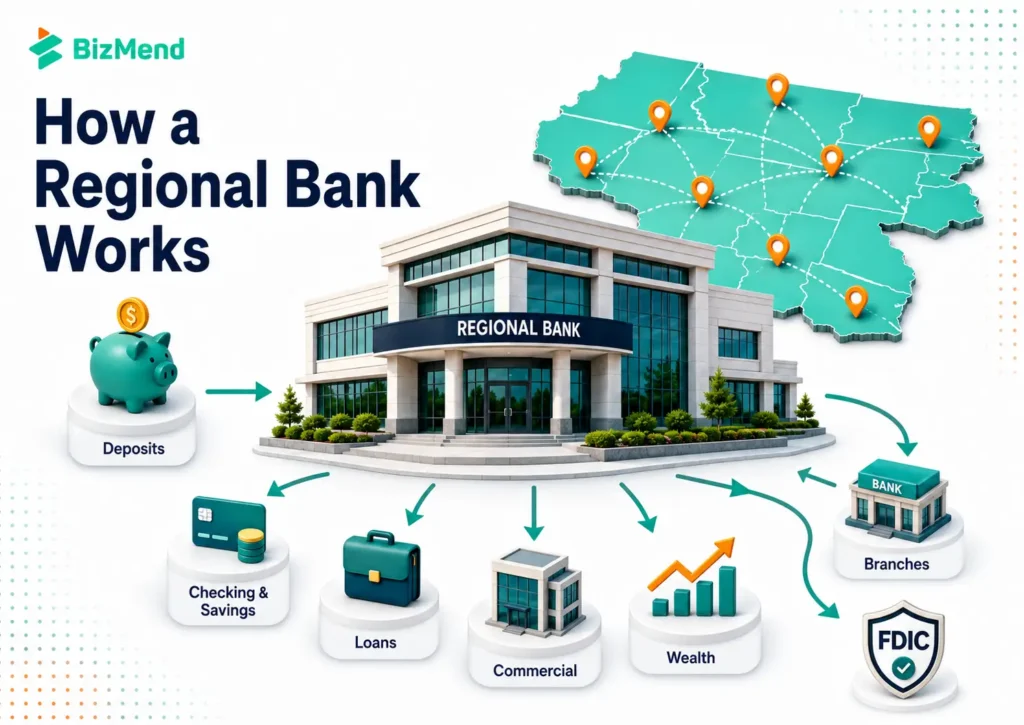
A regional bank funds itself the same way any bank does, gathering deposits through checking, savings, and CD accounts and lending that money out through mortgages, commercial loans, and consumer credit. What changes at this size is the breadth of what sits on both sides of that balance sheet and the sophistication of the systems used to manage it.
Regional banks typically support a fuller product lineup than a community bank, including dedicated commercial banking teams, treasury management services for businesses, wealth management and investment advice, and a branch and ATM network that spans an entire region rather than a single town. Decision-making sits somewhere between the local discretion common at a community bank and the centralized, algorithm-heavy underwriting used at the largest institutions, often varying by product line within the same bank.
Multi-state operations also mean a regional bank manages more regulatory complexity than a single-state community bank, coordinating compliance across several state banking departments in addition to its federal regulator. Many regional banks list on a public stock exchange, adding shareholder reporting and market scrutiny to the list of obligations a purely local bank does not usually carry, along with quarterly earnings calls and analyst coverage that a smaller institution rarely faces.
Two different sets of requirements apply, one for the bank itself and one for a customer opening an account.
For the bank, crossing $10 billion in total assets removes eligibility for the simplified community bank leverage ratio framework, so a regional bank must instead meet the standard risk-based capital and leverage requirements that apply to larger institutions. Federal Reserve supervisors also expect more developed liquidity risk management, governance, and internal controls once a bank enters the regional tier, reflecting the added complexity of its balance sheet and operations. The community bank requirements checklist covers the equivalent bank-level and customer-level rules for institutions still under the $10 billion line, useful for comparison if a specific bank’s size is unclear.
For a customer, opening a personal account at a regional bank generally requires the same basics as any US bank: a government-issued photo ID, a US mailing address, and a Social Security number or Individual Taxpayer Identification Number. Newcomers exploring a non-resident bank account typically face this same core document checklist regardless of whether the bank is a small community institution or a large regional one. Every dollar up to $250,000 per depositor, per bank, per ownership category carries identical FDIC protection at this size, so account safety is rarely the deciding factor once insurance is confirmed.
Business accounts add formation documents and an Employer Identification Number, and a regional bank’s dedicated commercial banking team often asks for additional financial statements once a business relationship grows beyond a basic checking account.
Weighing a regional bank against a smaller or larger alternative comes down to a short list of practical tradeoffs once FDIC insurance is confirmed on all sides of the comparison.
Benefits
Drawbacks
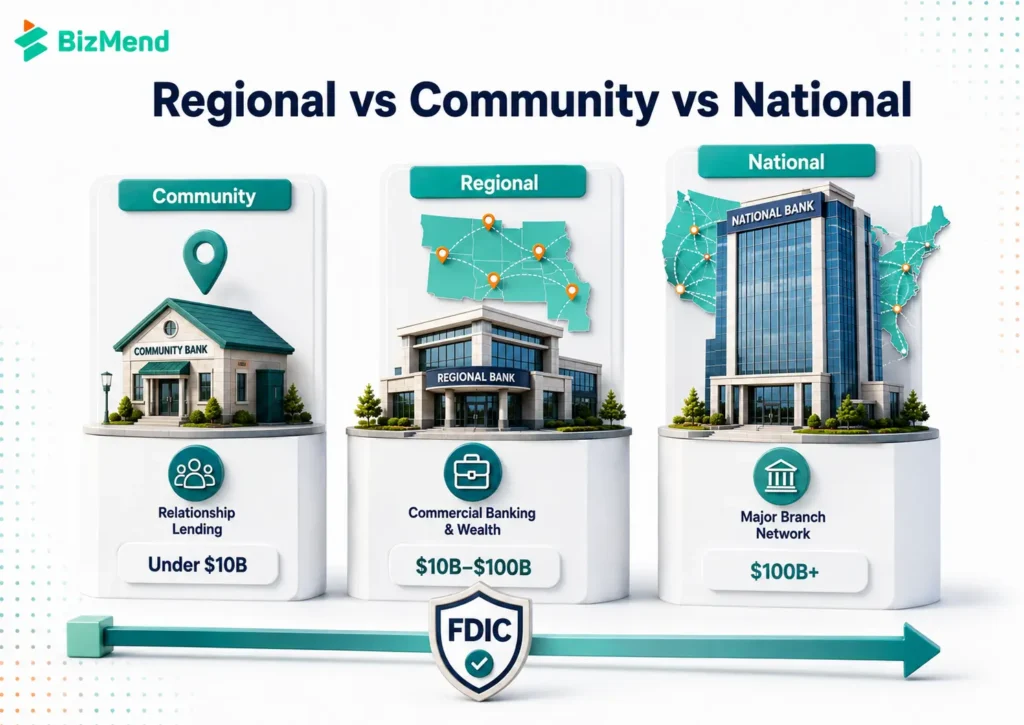
Asset size and geographic footprint together separate a regional bank from the alternatives a reader is most likely to compare it against when weighing where to move a paycheck or a business account.
A community bank sits below the $10 billion line and leans on local, relationship-based lending, while a regional bank operates at a larger scale with more centralized processes and a wider service area. A nationwide or global bank crosses the $100 billion mark and typically operates coast to coast or internationally, with the most standardized products and the least local flexibility of the three tiers.
| Feature | Community Bank | Regional Bank | Large or National Bank |
| Typical asset range | Under $10 billion | $10 billion to $100 billion | $100 billion or more |
| Geographic footprint | One town or county | Multiple states in one region | Nationwide or global |
| Lending decisions | Local loan officer discretion | Blend of local and centralized | Centralized underwriting |
| Product breadth | Basic deposit and loan products | Commercial banking and wealth management added | Full product suite, investment banking |
| FDIC or NCUA coverage | FDIC, up to $250,000 | FDIC, up to $250,000 | FDIC, up to $250,000 |
A credit union differs from all three bank tiers on ownership rather than size, since members technically own the institution regardless of how many assets it holds.
Matching the bank to an actual need works better than picking by brand recognition or branch count alone, especially once several regional banks look similar from the outside.
1. Confirm FDIC insurance and charter type. Search the FDIC’s BankFind tool to confirm current insured status and check whether the bank holds a state or national charter before applying, since a merger can change either detail without much notice.
2. Compare product breadth against what you actually need. A regional bank often makes sense specifically because it offers commercial banking or wealth management that a community bank does not, so confirm the specific products before switching from a smaller institution.
3. Check the branch and ATM footprint against where you live, work, and travel, since a regional bank’s coverage area can end abruptly at the edge of its home region, unlike a nationwide brand.
4. Ask about relationship-based flexibility for lending. Regional banks vary in how much local discretion loan officers retain, so ask directly if judgment-based small business or personal lending matters to you and your situation.
5. Compare fees and account terms directly with the specific branch or market you would use, since regional banks can price accounts differently across the states they serve, even within the same overall institution.
The process for choosing a national bank covers similar comparison factors from the largest-bank side, which is useful context if a regional bank in your comparison does not end up offering what you need.
A regional bank earns that label through total assets generally between $10 billion and $100 billion, not through a special charter or a fixed geographic rule. Both state and nationally chartered banks can fall into this tier, and FDIC insurance protects deposits the same way at a regional bank as it does at a small community institution or the largest national brand.
Before opening an account, confirm the specific bank’s current FDIC-insured status and charter type through the FDIC BankFind tool, then compare product breadth, branch coverage, and fees against what your daily banking and business needs actually require. Business owners weighing commercial lending should also ask directly about relationship depth and decision-making speed before committing to a new bank.
A regional bank is a US bank or bank holding company with total assets generally between $10 billion and $100 billion, a range the Federal Reserve classifies as a regional banking organization. It typically operates across several states within one part of the country.
A regional bank accepts deposits and makes loans like any bank, but it typically offers a broader product lineup than a community bank, including commercial banking and wealth management, while covering a multi-state region rather than a single town.
Yes, in most cases. Non-citizens can generally open an account with a valid passport and an Individual Taxpayer Identification Number in place of a Social Security number, since regional banks typically apply the same identity documentation rules as smaller or larger banks.
Yes, within FDIC limits. Nearly all regional banks carry FDIC deposit insurance covering up to $250,000 per depositor, per bank, per ownership category, identical to the protection at community banks and the largest national banks. Confirm any specific bank’s status through the FDIC’s BankFind tool.
The terms describe different things. A national bank refers to a federal OCC charter, while a regional bank refers to an asset size tier between $10 billion and $100 billion; a bank can be both a nationally chartered regional bank or a state-chartered one, since charter type and size classification are independent of each other.
The main difference is size and product breadth. A community bank generally holds less than $10 billion in assets and leans on local relationship lending, while a regional bank holds between $10 billion and $100 billion and typically adds commercial banking and wealth management services across a wider footprint.
Use the FDIC’s BankFind tool to search by location and confirm current FDIC-insured status and charter type, then compare a shortlist directly on product breadth, branch access, and fees before applying, since these details vary even among regional banks operating in the same state.

Learning how to choose a regional bank in the US comes down to matching seven factors against your own habits,…
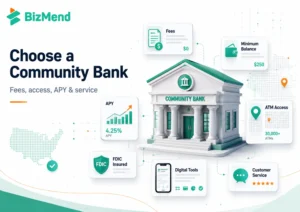
To choose a community bank, compare monthly fees, minimum balance rules, interest rates, ATM access, FDIC insurance, digital features, and…

Check the community bank requirements at a glance, follow the exact steps to apply, and see why applications get rejected…