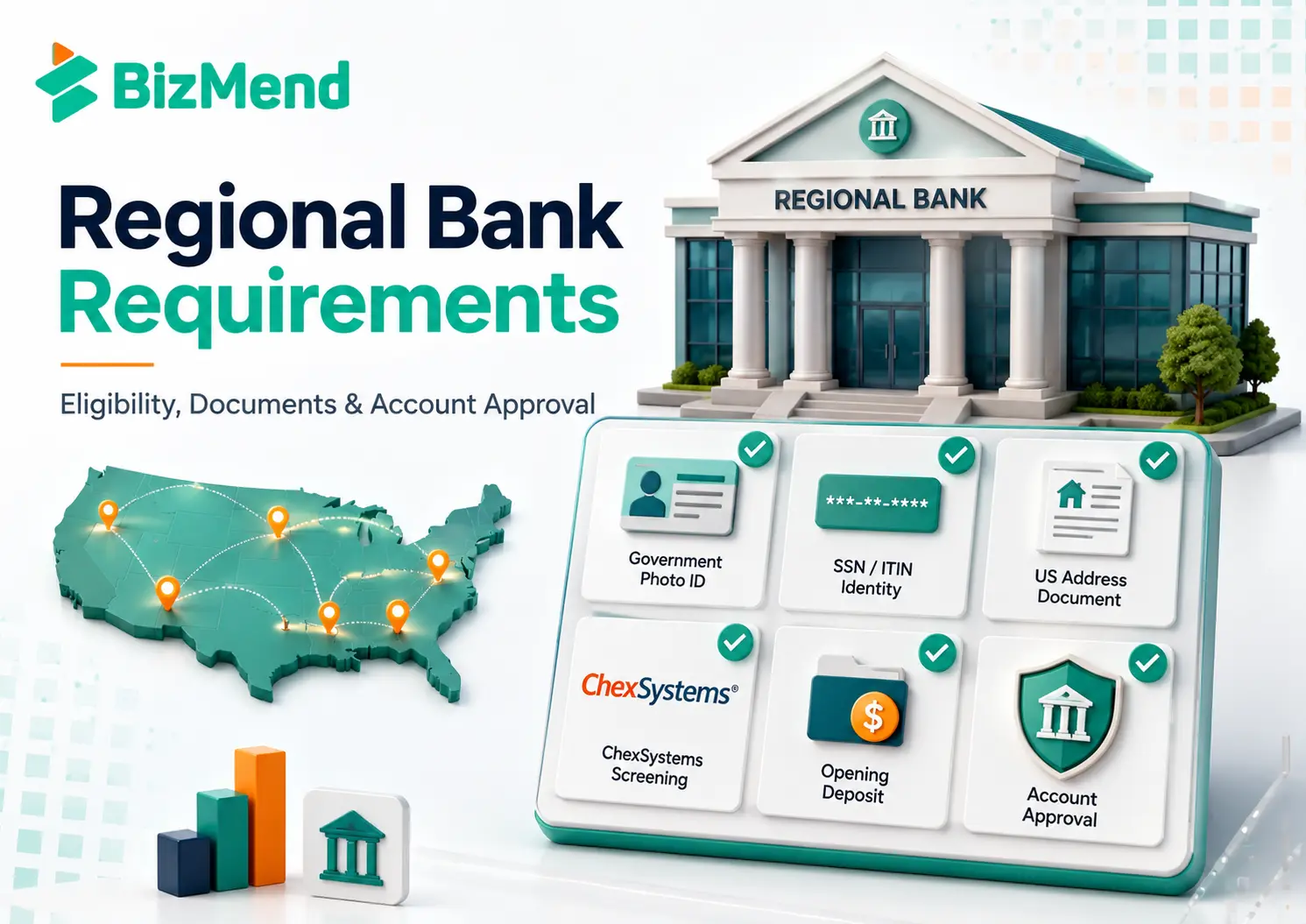
Regional bank requirements come down to the same four checks every US bank uses: proof of who you are, proof of where you live, a taxpayer number, and a banking history clean enough to pass a screening report. The larger footprint changes little about what you actually need to bring, though the application process itself often feels more digital than it does at a smaller branch.
This guide lists the exact eligibility rules, the documents to bring, the application steps in order, and the reasons applications get rejected, so nothing catches you off guard at the branch or online.
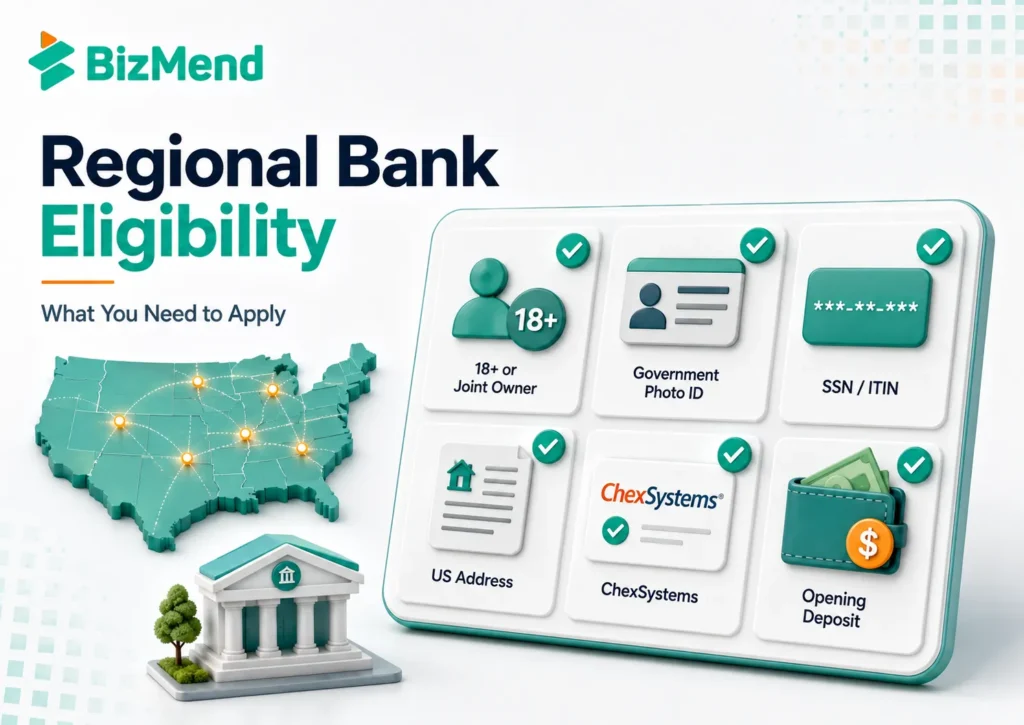
Quick Answer: To meet regional bank requirements, you generally need to be 18 or have a joint adult owner, a government-issued photo ID, a US address, and a Social Security number or ITIN, and pass a ChexSystems screening. Most regional banks also ask for a small opening deposit, often $25 to $100.
Regional Bank Requirements: Eligibility Checklist
Age. Opening an account alone generally requires being 18 or the age of majority in your state, since minors cannot enter a binding contract on their own. Interagency guidance from federal banking regulators confirms no federal law sets this age; state contract law does, which is why every regional bank asks for a parent or guardian to serve as a joint owner or custodian on a minor’s account, the same rule that applies at a smaller community bank. For background on what makes a bank a regional bank in the first place, this regional bank guide covers the classification this checklist assumes. Teen checking accounts, where a bank markets a product specifically for 13 to 17 year olds, still require an adult co-owner on the account even though the product carries a youth-focused name and app experience.
Identification. A regional bank needs a current government-issued photo ID, such as a driver’s license, a state ID card, a passport, or a military ID. A second document sometimes confirms your address if it does not match the ID, and some regional banks accept a college ID or a recent pay stub as a supplementary document when the primary ID alone leaves a gap in the file. Expired documents are rarely accepted even by a day, so checking the date before a branch visit saves a wasted trip.
Taxpayer number. Federal customer identification rules require every bank to collect a taxpayer identification number before opening an account. US citizens and most residents use a Social Security number; non-citizens without one can generally use an Individual Taxpayer Identification Number instead. The bank typically verifies this number electronically against government records within moments of submission, which is why a single mistyped digit can stall an otherwise straightforward application.
Screening check. Most regional banks review a ChexSystems report, a specialty consumer file tracking past account problems such as unpaid overdrafts or suspected fraud, kept separately from your credit score. Some regional banks also pull a secondary screening report from a different vendor for business or premium accounts, so a business owner should ask directly which reports the specific application will trigger.
Opening deposit. A regional bank typically asks for a small minimum deposit to activate the account, commonly $25 to $100, though some checking accounts open with $0 down and business or premium accounts can require more. Savings accounts sometimes carry a slightly higher minimum than checking, and a bank may waive the deposit entirely during a promotional signup period, so confirming the current figure directly with the branch or website avoids relying on an outdated number.
Documents Needed to Open a Regional Bank Account
Each document a regional bank asks for maps to a specific legal or risk requirement, not a random preference, and knowing the reason behind each one makes it easier to gather the right version the first time.
A government-issued photo ID confirms your identity and satisfies the bank’s federal customer identification obligations. A Social Security card or ITIN letter documents the taxpayer number the bank must collect, though many banks accept the number verbally once your ID or existing records confirm it, so carrying the physical card is a convenience rather than a strict requirement at most branches. Proof of a US address, such as a lease or a recent utility bill, matters most when your ID shows an old or out-of-state address, since the bank needs a current mailing address on file for statements, cards, and legally required notices. A second form of ID can help when your primary one does not fully match the bank’s verification system, particularly for applicants whose name changed through marriage or a legal process and whose older records have not fully caught up.
Business applicants add formation documents, such as articles of incorporation or an LLC certificate, and an Employer Identification Number, and a regional bank’s commercial banking team sometimes requests additional financial statements once the relationship grows beyond a basic account. Reviewing the national bank requirements checklist alongside this list is useful for founders comparing a regional bank against a large national alternative. The state bank requirements checklist covers the equivalent list for a smaller state-chartered institution, useful if a specific bank turns out not to be regional after all.
Trust and estate accounts add another layer entirely, typically requiring the trust document itself, an EIN for the trust if one has been issued, and identification for every trustee named as a signer, since a regional bank’s larger back office often has a dedicated team to review this paperwork that a small community branch may need to route to a specialist instead.
Joint accounts add one more identity check on top of everything above, since the bank must verify both account holders independently rather than accepting one person’s documents on behalf of the other. Bringing both applicants to the same appointment, when possible, tends to move faster than a two-step process where the second signer completes verification separately after the account is already partly set up.
Step-by-Step Process to Open a Regional Bank Account
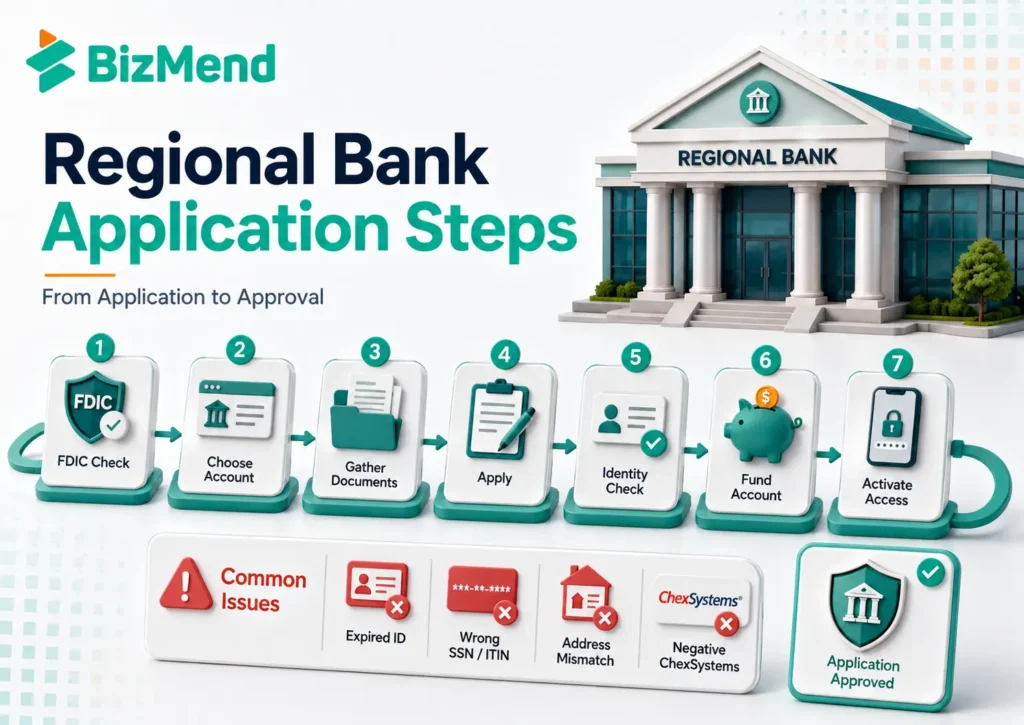
1. Confirm the bank is FDIC-insured and open to new accounts. Search the FDIC’s BankFind tool or call the branch before making a trip, since mergers happen more often at this scale than at a small local bank, and a recently acquired branch may operate under a different name or system than what a search engine still shows.
2. Choose the account type. Decide between checking, savings, or a business account, since document and minimum-deposit rules can differ slightly by product, and a regional bank’s tiered checking options sometimes waive fees differently depending on balance or direct deposit activity.
3. Gather your documents. Bring a government-issued photo ID, your Social Security number or ITIN, and proof of address if your ID does not already show it, along with a second ID if you happen to have one, since it rarely hurts to bring more than the minimum.
4. Complete the application. Apply in a branch, by phone, or online; regional banks often support a fuller digital application than a small community bank, though the identity information required stays the same regardless of the channel you choose to use.
5. Pass the identity and screening checks. The bank verifies your identity against its records and typically pulls a ChexSystems report before approving the account, a step that usually completes within the same session rather than requiring a separate visit.
6. Fund the account. Transfer from another bank, deposit cash, or mail a check to meet the minimum opening deposit, where one applies, before the account becomes fully usable for everyday transactions.
7. Set up account access. Activate online banking, order a debit card, and confirm how to reach support before you leave the branch or log off, since finishing this step immediately saves a follow-up call once you actually need the account.
Working through the same steps used when choosing a national bank applies here too, since the underlying document and funding requirements stay similar across most bank sizes once FDIC coverage is confirmed on the specific institution in question.
Common Reasons Regional Bank Applications Get Rejected
A negative ChexSystems record causes most denials. Unpaid overdrafts, a forced account closure, or suspected fraud on a past account can trigger a rejection even when your credit score is fine, since ChexSystems tracks banking history separately from credit history, using a scoring model built specifically around deposit account conduct rather than borrowing behavior.
Mismatched or expired identification is the second common cause. An ID that has expired, or a name and address that do not match your other documents, forces the bank to pause the application until something lines up, and a recent legal name change without updated records is a frequent trigger for this exact hold at a larger institution with more automated matching.
Insufficient proof of a US address trips up newcomers most often. Someone exploring a non-resident bank account may not yet have a utility bill in their own name, so a lease agreement usually solves this, and some regional banks accept a signed letter from an employer confirming a work address as an alternative when neither document is available yet.
An incomplete or mistyped taxpayer number also stalls approval. Double-checking your Social Security number or ITIN before you apply avoids a delay that a few minutes of review can prevent, since even a single transposed digit routes the application into manual review at most banks and can add a full extra business day to the process.
To avoid a denial, request your free ChexSystems report before applying if you have had banking trouble before, bring a current unexpired ID, and confirm your taxpayer number matches your records exactly. Reviewing the report yourself first also catches identity theft early, since an account you never opened can appear on your file and cause a confusing denial you would otherwise not understand.
What Happens After You Apply
Most regional bank applications are approved or denied the same day when submitted with a clean ChexSystems record and matching documents, whether in person or online. A paper application or one needing manual identity review, because a document did not scan clearly or a detail needed a second look, can take a few extra business days to clear.
If approved, the bank activates the account immediately or within a day or two, issues account and routing numbers, and mails a debit card that typically arrives within seven to ten business days, with temporary online access often available the same day the account opens. Many regional banks also activate mobile check deposit and bill pay within the first day or two, since their larger technology budgets tend to support faster feature rollout than a small community branch can manage. If denied, federal rules require the bank to send an adverse action notice naming the screening company involved, and you can request a free copy of that report to dispute anything inaccurate rather than assuming the decision is permanent.
Trying a state bank is worth considering if a specific regional bank cannot approve your application. The community bank requirements checklist is also worth a look, since document requirements stay largely the same across bank sizes once the underlying issue behind the denial is actually resolved. A second application at a different institution rarely causes further harm to your ChexSystems file once the original problem has been corrected.
Key Insights
- Four requirements cover most applicants: ID, taxpayer number, US address, and a passable ChexSystems record.
- No federal law sets a minimum age; banks require 18 or a joint adult owner for legal reasons.
- Non-citizens can generally use an ITIN instead of a Social Security number to open an account.
- Most rejections trace back to ChexSystems history, not an applicant’s credit score.
- Denied applicants have a federal right to a free copy of the report that caused the denial.
- Opening deposits commonly run $25 to $100, though some accounts require $0.
Final Thoughts
Meeting regional bank requirements comes down to four checks: a valid photo ID, a Social Security number or ITIN, a US address the bank can verify, and a ChexSystems history clean enough to pass review. Most applicants clear every step in one sitting once the right documents are in hand, since a larger bank rarely means a longer checklist.
Before applying, pull a free copy of your ChexSystems report if you have had banking trouble before, and confirm your ID and taxpayer number match your records exactly before you submit anything. If a bank denies the application, request the required notice, review the reason in writing, and correct the underlying issue before trying again at a different regional bank nearby.
Frequently Asked Questions
What do I need to open a regional bank account?
You generally need a government-issued photo ID, a Social Security number or ITIN, proof of a US address, and a passable ChexSystems record. Most banks also require a small opening deposit, and applicants under 18 need a joint adult owner on the account, while business accounts add formation paperwork and an EIN.
Can I open a regional bank account without an SSN?
Yes, in most cases. Non-citizens without a Social Security number can generally use an Individual Taxpayer Identification Number instead, since federal rules require a taxpayer number but not specifically an SSN for every single applicant who walks in, provided a valid photo ID is still presented.
What is the minimum deposit for a regional bank account?
It varies by bank and account type, but a common range is $25 to $100, and some checking accounts open with no minimum deposit at all. Savings and premium accounts sometimes carry a higher opening amount, so confirm the current figure directly with the specific bank before applying.
How long does it take to open a regional bank account?
Most in-person or online applications are approved the same day when the applicant has a clean ChexSystems record and matching documents. Applications needing manual identity review, or a mailed paper application, can take a few additional business days, particularly around a weekend or holiday.
What is ChexSystems and why does it matter?
ChexSystems is a specialty consumer reporting agency that tracks past banking problems, such as unpaid overdrafts or suspected fraud, separately from your credit score. Most regional banks review this report before approving a new account, and a negative record is the most common reason applications are denied, though older items eventually fall off the file.
Not for a basic personal account. The core eligibility list, ID, taxpayer number, address, and a passable ChexSystems record, stays the same regardless of the bank’s size. Larger regional banks sometimes offer more account tiers and a fuller digital application, but the underlying documents rarely change.
Can a business open a regional bank account the same day?
Often yes for a simple LLC or sole proprietorship with formation documents and an EIN ready, though a more complex business structure, a trust, or a large expected transaction volume can trigger additional review that takes a few extra business days to complete.


 by Sheikh Ornob