

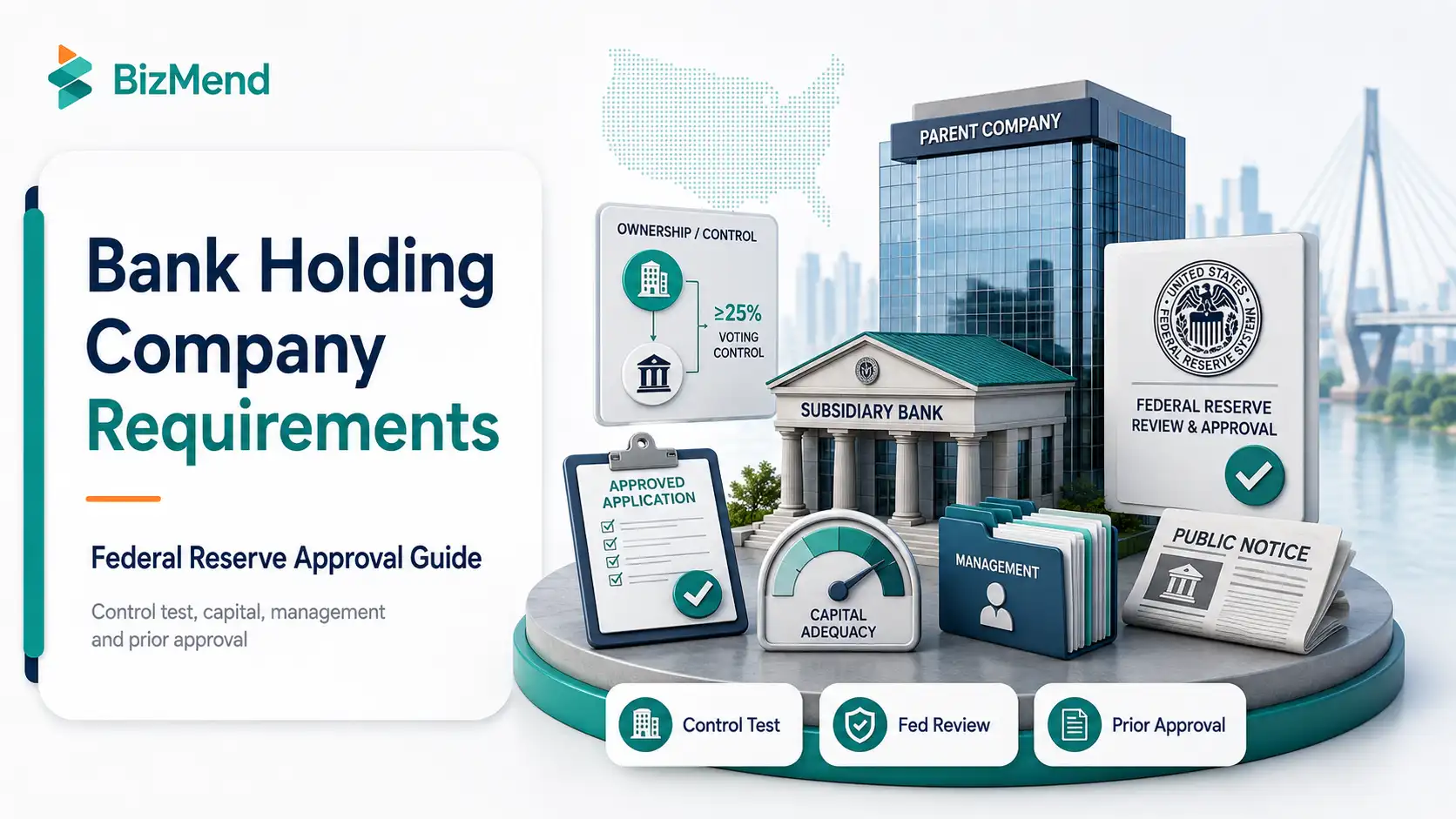
Bank holding company requirements start with a legal test, not a teller line. Under federal law, any company that gains control of a bank, meaning it owns 25 percent or more of the bank’s voting stock, controls the board, or exercises controlling influence, must first win approval from the Federal Reserve.
That approval process looks nothing like opening a checking account. Instead of an ID and a deposit slip, applicants submit financial statements, background information on their principals, and a case for why the deal serves the community. This guide walks through what the Federal Reserve actually asks for.
Quick Answer: Bank holding company requirements center on Federal Reserve approval rather than a walk-in application. A company must file under the Bank Holding Company Act, show adequate capital and experienced management, publish public notice, and pass Federal Reserve review before it can control a bank. No minimum deposit or age rule applies.
What Counts as a Bank Holding Company
Federal law does not care what a company calls itself. Under the Bank Holding Company Act of 1956, a company becomes a bank holding company the moment it controls a bank, and control has a precise legal meaning: owning 25 percent or more of any class of the bank’s voting stock, controlling the election of a majority of its directors, or being found by the Federal Reserve to hold a controlling influence over the bank’s management or policies. Any one of those three conditions triggers the law, regardless of the company’s size or intent, and the same test applies whether the company is buying an existing bank outright or simply increasing an existing minority stake past the 25 percent line.
This structure is essentially a parent company sitting above one or more banks, similar to a parent subsidiary structure used to separate liability and centralize ownership across other kinds of businesses. The parent itself is not a bank and cannot accept deposits directly; it exists to own, fund, and oversee the bank or banks underneath it.
Bank Holding Company Requirements at a Glance
- Before a transaction can close, the company must clear four broad requirement categories:
- Prior written approval from the Federal Reserve under Section 3 of the Bank Holding Company Act
- A pro forma financial condition, including capital position, that meets the Federal Reserve’s standards
- Directors and principal shareholders with the competence, experience, and integrity to run a bank safely
- A public notice period and a Federal Reserve review against the statutory factors in Regulation Y
None of these categories resembles opening a personal bank account. There is no fixed minimum deposit, no credit-bureau pull, and no consumer identification checklist. The closest equivalents are a capital adequacy review and a background check on the people who would run the company.
| Important: Legal caution: Regulation Y, filing thresholds, and processing timelines change periodically. Confirm current Federal Reserve procedures and consult banking counsel before relying on any figure in this guide to plan an actual filing. |
Who Can Form a Bank Holding Company
An individual, an existing company, or a group of investors acting together can become a bank holding company, as long as the resulting structure meets the control test above. There is no statutory age requirement beyond the general legal capacity to enter a binding contract; what regulators actually scrutinize is character and track record, not birth date.
Each proposed director and principal shareholder must supply identifying and biographical information as part of the application so the Federal Reserve can run the required background review. Foreign individuals and companies can also apply, though cross-border ownership typically draws closer scrutiny of funding sources and supervisory arrangements in the home country.
Many first-time applicants form a one-bank holding company built around a single community bank, since that path can qualify for the Federal Reserve’s expedited notice procedures described below. Larger or serial acquirers often build a multi-bank structure instead, sometimes anchored around a national bank charter. Other groups build the same kind of structure around a state bank charter, depending on which supervisor the founders prefer to work with. Organizations that keep adding locations across a wider footprint eventually start to resemble a regional bank holding company rather than a single-location lender.
Step-by-Step Process to Form a Bank Holding Company
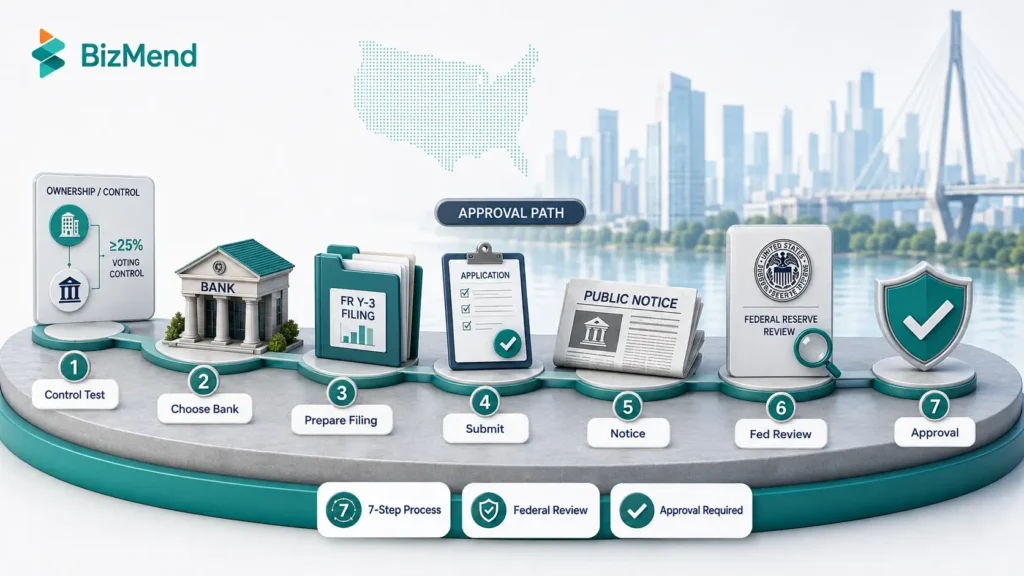
1. Confirm the Control Test Applies
Map the proposed ownership and board seats against the 25 percent voting-share threshold and the board-control test. If the structure falls short of both but still gives the company outsized influence, the Federal Reserve can still find a controlling influence after notice and a hearing.
2. Choose the Subsidiary Bank and Its Charter
Decide whether the company will acquire an existing bank or charter a brand-new one. A newly chartered bank still has to clear its own separate chartering and deposit insurance process with the Office of the Comptroller of the Currency, a state banking department, or the FDIC, independent of the Federal Reserve’s holding company review described below.
3. Prepare the Application Package
Assemble pro forma financial statements, biographical and financial reports on every proposed director and principal shareholder, a description of funding sources, and a Community Reinvestment Act plan where one applies.
4. File With the Appropriate Federal Reserve Bank
Most formations file Form FR Y-3. A one-bank formation that meets the criteria in Regulation Y section 225.17 can instead file the shorter Form FR Y-3N, which is not published for public comment and typically moves faster.
5. Publish Required Notices
Applications filed under sections 225.14 or 225.15 require a published notice in the relevant local newspaper, and the Federal Reserve separately publishes notice in the Federal Register. Section 225.17 notices skip this step entirely.
6. Clear Federal Reserve Review
The Federal Reserve evaluates the proposal against the statutory factors in Regulation Y section 225.13, covering financial condition, managerial resources, and the convenience and needs of the community, alongside the competitive effects the Bank Holding Company Act separately requires it to weigh.
7. Wait Out the Consummation Period
Once approved, most transactions cannot close for 30 calendar days, though the Department of Justice can shorten that to 15 days. Section 225.17 formations may close immediately after the notice period ends.
Comparing the Three Federal Reserve Filing Tracks
| Filing Track | Who Qualifies | Public Notice | Typical Timeline |
| Section 225.17 notice (Form FR Y-3N) | One-bank holding company formations meeting streamlined criteria | Not published | Acted on 30 calendar days after filing |
| Section 225.14 expedited notice | Well-run, well-capitalized bank holding companies making qualifying acquisitions | Newspaper and Federal Register | Roughly five business days after the comment period closes |
| Section 225.15 standard application (Form FR Y-3) | Formations and acquisitions that do not qualify for a streamlined path | Newspaper and Federal Register | About 30 to 60 calendar days after a complete filing |
Choosing the wrong track is a common source of delay. A company that assumes it qualifies for the fastest path, then gets redirected to the standard application midway through review, effectively restarts its own timeline.
Documents and Information Required for a Bank Holding Company Application
- Pro forma consolidated financial statements for the applicant and the resulting organization
- Biographical and financial reports for each proposed director, executive officer, and principal shareholder
- A description of the source and amount of funds used to acquire or capitalize the bank
- Organizational documents, such as articles of incorporation and bylaws for the holding company
- A Community Reinvestment Act plan when the transaction requires one
- Information on any nonbanking activities the company proposes to conduct alongside the bank
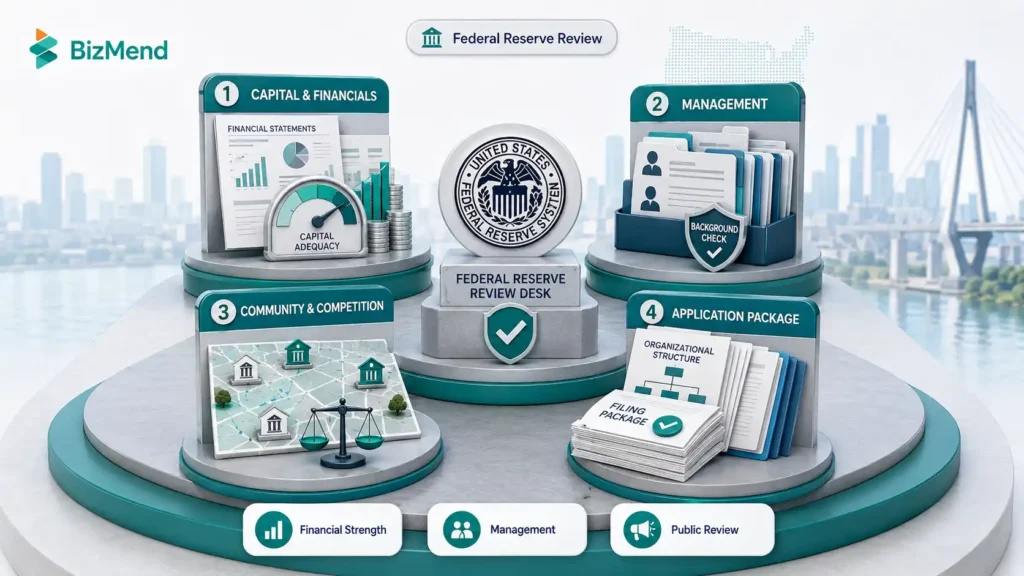
Every one of these items exists to answer a factor the Federal Reserve is legally required to weigh. The financial statements and funding-source description speak directly to capital adequacy. The biographical reports on directors and shareholders support the managerial-resources review, since the Federal Reserve is effectively vetting who will run the bank rather than checking a single applicant’s ID. The Community Reinvestment Act plan and organizational documents establish that the company is a real, accountable entity with a plan to serve its community, not a shell built only to hold shares. Skipping or rushing any one of these exhibits is one of the more common reasons a filing gets sent back for more information rather than moving toward approval, which is why applicants typically assemble the full package with banking counsel before the clock on Federal Reserve review even starts.
Common Reasons Bank Holding Company Applications Are Delayed or Denied
The Federal Reserve rarely denies a filing outright. More often, it stops the processing clock and asks for more information, which has the same practical effect on a closing timeline. The patterns below account for most of those delays.
- Pro forma capital that falls below what the Federal Reserve expects for the resulting size and risk profile
- Proposed directors or principal shareholders with a thin management track record or unresolved compliance history
- Gaps in the anti-money-laundering and Bank Secrecy Act program the subsidiary bank plans to run
- Competitive concerns in markets where the applicant already controls another bank
- A weak or missing Community Reinvestment Act plan for the communities the bank will serve
- An incomplete application package that forces the Reserve Bank to stop the processing clock
After Approval: Ongoing Obligations
Approval is not the finish line. Once formed, a bank holding company must serve as a source of financial and managerial strength to its subsidiary bank under Regulation Y section 225.4, and it takes on recurring reporting duties. Every bank holding company must file the Annual Report of Bank Holding Companies, Form FR Y-6, within 90 calendar days of its fiscal year end, covering its organizational structure, shareholders, and directors. Most also file quarterly financial reports sized to the company’s assets. Any future acquisition of an additional bank generally starts this entire filing process over again.
Small Bank Holding Company Policy Statement: Relief for Smaller Filers
Bank holding companies with pro forma consolidated assets under 3 billion dollars can qualify for the Federal Reserve’s Small Bank Holding Company and Savings and Loan Holding Company Policy Statement, provided they avoid significant nonbank activities, avoid significant off-balance-sheet exposure, and keep any outstanding public debt or equity securities below a material level. Qualifying companies are excluded from the standard consolidated capital rules that apply to larger holding companies and can generally use more acquisition debt than a larger organization would be permitted to carry, which is one reason so many community bank formations are structured as small, one-bank holding companies.
This relief applies to the holding company’s own capital structure. It does not lower the separate capital and chartering requirements the underlying bank must independently meet with its primary regulator.
Financial Holding Company Election: An Optional Extra Step
A bank holding company that wants to engage in a broader range of activities, such as insurance underwriting, securities dealing, or merchant banking, can elect to become a financial holding company under the Gramm-Leach-Bliley Act. That election is layered on top of, not a substitute for, the underlying bank holding company approval, and it requires the company and its subsidiary depository institutions to be well capitalized and well managed at the time of the election. Most newly formed bank holding companies never need this step; it becomes relevant only when the business plan calls for activities beyond traditional banking.
Key Insights
- Control, not intent, triggers Bank Holding Company Act coverage at 25 percent of voting stock or board control.
- There is no minimum deposit or age requirement; capital adequacy and management character are what get reviewed.
- One-bank formations can qualify for a faster, streamlined notice instead of a full application.
- The subsidiary bank’s own chartering and deposit insurance process runs separately from the holding company approval.
- Approval starts, rather than ends, the company’s source-of-strength and ongoing reporting obligations.
- Weak capital and unproven management are the most common reasons filings stall.
Final Thoughts
Forming a bank holding company is a regulatory filing, not a retail transaction. The Federal Reserve asks the same core questions every time: does the company have enough capital, do the proposed directors and principal shareholders have the character and experience to run a bank safely, and does the deal serve the community without harming competition. Meeting those tests, not gathering an ID and a deposit, determines approval.
Timelines and paperwork vary by transaction size, and a one-bank formation can qualify for faster review that a multi-bank acquisition will not. Because capital adequacy, source of strength duties, and Bank Secrecy Act expectations shift with each proposal, work with banking counsel and confirm current Federal Reserve procedures before filing an application.
Frequently Asked Questions
What is the difference between a bank and a bank holding company?
A bank holds deposits and makes loans directly under its own charter. A bank holding company is a separate parent organization that owns or controls one or more banks without itself accepting deposits, and it answers to the Federal Reserve rather than a bank chartering authority.
Is there a minimum deposit to form a bank holding company?
No. There is no fixed minimum deposit like a personal bank account requires. Instead, the Federal Reserve reviews the applicant’s pro forma capital position and financial condition case by case, based on the size and risk of the resulting organization.
Is there an age requirement to form a bank holding company?
No formal age threshold exists beyond the general legal capacity to enter a binding contract under state law. Federal Reserve review instead focuses on the competence, experience, and integrity of the proposed directors and principal shareholders, since character and track record matter far more than age.
What identifying information do individual principals need to provide?
Each proposed director and principal shareholder submits biographical and financial information as part of the application so the Federal Reserve can complete the required background review. This is closer to an executive vetting process than a retail identity check.
How long does it take to become a bank holding company?
Timelines vary by filing type. A streamlined one-bank notice can be acted on 30 calendar days after filing, while a standard application is normally decided within 30 to 60 days, plus a waiting period of about 15 to 30 days before the deal can close.
What is the Change in Bank Control Act, and how is it different from becoming a bank holding company?
The Change in Bank Control Act governs individuals or groups that acquire control of a bank or bank holding company without forming a new corporate structure. It follows its own 60-day notice process under Regulation Y, separate from the Bank Holding Company Act filings covered in this guide.
Can a bank holding company own more than one bank?
Yes. Multi-bank holding companies are common, and each additional acquisition generally requires its own Federal Reserve notice or application, evaluated against the same financial condition, managerial resources, and competitive-effects factors that applied to the original formation, plus a fresh look at the combined organization’s community record.
